Sandstone

A light, warm tan named after a stone that iron can turn red.

Overview

Sandstone is a light, warm tan with a soft golden cast. Its code here is #C8A97E: red a little stronger than green and well ahead of blue, which gives a muted yellowish brown. It is a little darker than tan and khaki, and almost the same color as desert.

The name is the rock. Sandstone is sand turned to stone: grains, usually quartz, held together by a natural cement such as silica, calcite or iron oxide. The word has been in English since 1609. The web color is the pale, yellowish kind of sandstone, and it matches what people picture: the average sandstone in the xkcd color survey is #C9AE74, a near twin. The 1930 A Dictionary of Color printed sandstone darker and redder, as a light brown.

Real sandstone can be white, gray, yellow, pink, red or brown. In red rock country, iron decides: grains coated with hematite, a red iron oxide, color the cliffs of Utah’s canyons, and Petra in Jordan is carved into a red sandstone landscape. It takes very little: in Utah’s Navajo Sandstone, red rock holds about 0.7% iron oxide and bleached white rock about 0.2%. The reddish-brown stone of New York’s brownstone houses owes its color to hematite too, along with pinkish feldspar grains.

On screen, sandstone is a soft, warm neutral for backgrounds, walls and outdoor or travel brands. It pairs well with terracotta, deep teal, sage and navy. Use dark text on it: black or dark brown reads well, white does not.
HEX#C8A97E
RGBrgb(200, 169, 126)
HSLhsl(35, 40%, 64%)
HSV35°, 37%, 78%
CMYK0, 16, 37, 22
OKLCHoklch(75.2% 0.068 75.5)
Every code converts from the HEX value #C8A97E. No color standard defines sandstone, and color lists disagree. #C8A97E sits very close to people’s average sandstone in the xkcd color survey, #C9AE74, while the 1955 ISCC-NBS dictionary files the sandstone of Maerz and Paul’s A Dictionary of Color (1930) as darker, redder light browns. CMYK is a screen-based estimate; print results vary.
Sandstone color card, hex #C8A97E: “Set in sandstone”

Sandstone on the color map

People’s average sandstone in the xkcd survey sits just right of the reference, inside the outline: a touch more golden. The Champa lion’s beige sandstone sits at the same lightness, on the outline’s left edge. The two dictionary groups sit below and to the left, darker and redder, and the Mathura Buddha’s red sandstone falls off the left of the view. The outline is an approximate range, not a measured one.

Shades and tints

Tints with white

Shades with black

Tones with gray

Sandstone sits in the middle. Tints add white, shades add black and tones add gray, in 10% steps out from it. Tap any swatch to copy its code.

Light and dark sandstone

#DECBB2
Light sandstoneMixed 40% with white. A pale, warm stone color for backgrounds.
#C9AE74
Survey sandstoneWhat people called sandstone, on average, in the xkcd survey. A little more golden.
#C8A97E
SandstoneThe reference color.
#A67B5B
Dictionary sandstoneISCC-NBS light brown, one of three groups where the 1955 dictionary files Maerz and Paul’s sandstone. Darker and redder.
#78654C
Dark sandstoneMixed 40% with black. A deep brown that holds white text.

Colors that go with sandstone

Pairings that work in rooms, outfits and interfaces.

Sandstone and terracotta

Pale rock and red rock together, like a canyon wall.

Sandstone and deep teal

Warm stone against cool water. Calm and outdoorsy.

Sandstone and sage

Soft and earthy. Good for homes and gardens.

Brownstone

Pale stone with deep reddish brown and near black, like a city rowhouse.

Sandstone and navy

Classic and confident. Navy makes the stone look warmer.

Sandstone and charcoal

Modern and grounded. The stone warms a dark layout.

Color-wheel palettes

Pick a palette to see where its colors sit on the color wheel. The caret marks sandstone. Tap a band to copy its code.

Similar colors

Desert91%Camel79%Tan83%SandstoneKhaki88%Putty77%Ecru88%

Lined up by hue around sandstone. Hover a color to see how similar it is.The bar under each name shows how similar it is. Similarity comes from the distance between the two colors in OKLab, a model of how we see color.

Sandstone vs desert

Sandstone#C8A97E · hue 35°
  • A hair lighter and more yellow
  • Named after a rock
  • Close to people’s average sandstone
Desert#C9A27E · hue 29°
  • A hair darker and pinker
  • Named after a landscape
  • Hard to tell apart on screen

Meaning

  • Red rock canyons
  • Brownstones
  • Stone carving
  • Rock-cut cities

Sandstone brings to mind red rock canyons, rows of brownstone houses and temples carved from stone. Its meanings come from the rock itself: common, easy to carve, and colored by small amounts of iron. Color research tests broad words such as brown, not sandstone, so the claims below are about the stone and how people have used it.

Iron sets the color

Government science

The Utah Geological Survey explains that the red, pink, yellow and brown of Utah’s red rock country for the most part come down to one element, iron. Hematite gives red, and hydrated iron oxides such as limonite and goethite give yellow and brown. In the Navajo and Wingate Sandstones, white quartz grains wear a thin coat of red hematite and are held together by a pale calcite or silica cement.1

A trace of iron makes the difference

Geological study

The amounts are tiny. In one detailed study of the Navajo Sandstone, red rock held about 0.7% iron oxide and bleached white rock about 0.2%. Groundwater carried iron out of the upper layers, leaving them pink or white, and dropped it elsewhere, darkening the rock to maroon or even black and forming iron balls called Moqui marbles.1

Sand glued by natural cement

Well established

Merriam-Webster defines sandstone as a rock of usually quartz sand united by a cement such as silica or calcium carbonate. At Zion, the National Park Service explains, iron oxide, calcium carbonate and silica, carried by water seeping through the sand of an ancient desert, cemented it into stone.2, 3

Brown enough to name a house

Historical record

Reddish-brown sandstone from Portland, Connecticut, was so popular from about 1850 to 1890 that city rowhouses came to be called brownstones, whatever they were built of. Pinkish feldspar grains stained by hematite give the stone its color. That warm color suited the taste of the time: the influential writer Andrew Jackson Downing told builders “to avoid all those colors nature avoids”.4

Sources (4)
  1. Weaver, L. (2020). “Glad You Asked: What Gives Utah’s ‘Red Rock Country’ its Color?” Survey Notes, Utah Geological Survey. It points to Nielson, Chan & Petersen (2009), on the Navajo Sandstone of Zion National Park, for more.
  2. Merriam-Webster, “sandstone”.
  3. National Park Service, “Geology”, Zion National Park.
  4. National Park Service, “Portland Brownstone Quarries”, National Historic Landmark nomination (designated 2000). It quotes Downing through Brown, “The Story of Brownstone” (1989).

History

Sandstone was a building and carving stone for thousands of years before it was a color name. Its story runs from a city carved into red rock to New York’s brownstone rows, and to a geologist who showed where red rock can form.

  1. 4th century BCE–1st century CE

    The Nabataean civilization flourishes. Its capital, Petra, in what is now Jordan, is half-built and half-carved into the rock of a red sandstone landscape.1

  2. 1609

    First known use of the word “sandstone” in English, for the rock.2

  3. Early 1840s

    Brownstone, used until then mostly for foundations and trim, comes into its own as the Romantic movement sweeps American architecture. Its warm, rich color and easy carving suit the new style.3

  4. About 1850–1890

    The “Brownstone Era”. Reddish-brown sandstone, mostly from Portland, Connecticut, fronts so many rowhouses in New York and other eastern cities that the houses themselves become “brownstones”.3

  5. 1880

    Brownstone makes up 78.6% of the stone buildings in New York City.3

  6. 1897

    A writer in the trade journal Stone complains of “long blocks of gloomy brownstone houses” and notes that the craze has turned to light-colored stone.3

  7. 1930

    Maerz and Paul’s A Dictionary of Color prints a sandstone that the 1955 ISCC-NBS dictionary files as light brown, light reddish brown or light grayish brown: darker and redder than today’s web code.4

  8. 1950

    Paul Krynine’s study of Connecticut’s sedimentary rocks, built partly on the Portland quarries, is published. It shows that red beds can form in warm, humid, tropical places, not only in deserts.3

  9. 2010

    In the xkcd color survey, the average color people call sandstone is #C9AE74, a near twin of this page’s code.5

Sources (5)
  1. UNESCO World Heritage Centre, “Petra”.
  2. Merriam-Webster, “sandstone”, first known use.
  3. National Park Service, “Portland Brownstone Quarries”, National Historic Landmark nomination (designated 2000), quoting Downing via Brown (1989), Hopkins, “General Features of Brownstone”, Stone (1897), and Krynine, Connecticut Geological and Natural History Survey Bulletin 73 (1950).
  4. Kelly, K. L. & Judd, D. B. (1955). The ISCC-NBS Method of Designating Colors and a Dictionary of Color Names. National Bureau of Standards Circular 553. Entry for Maerz and Paul’s sandstone as transcribed by Aubrey Jaffer, “Maerz and Paul color names”, with centroid colors from “Color-Name Dictionaries”, MIT CSAIL.
  5. Munroe, R. (2010). “Color survey results”. xkcd blog. The survey’s color averages are released as CC0 data.

Sandstone in use

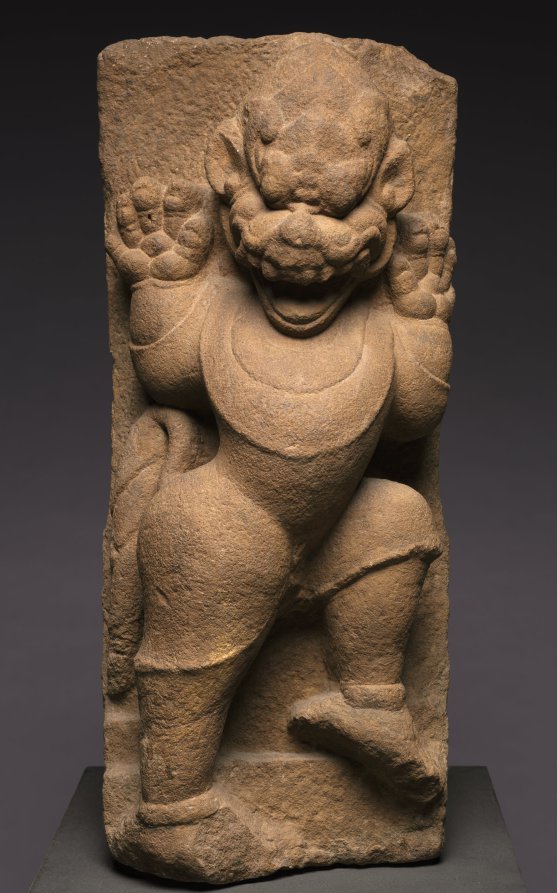
A carved stone lion rearing on its hind legs with clawed paws raised and mouth open in a roar, in warm tan sandstone, on a dark background
#D0A57E#B38A67#8D6B4E#5E4731
SculptureHeraldic Lion, Champa (900s)

A rearing, roaring lion carved as a guardian for a sacred site of the Cham kingdom, in what is now central and southern Vietnam. The museum lists the stone as beige sandstone. Where the light falls it reads about #D0A57E: the same lightness as this page’s code, a little pinker.

#D0A57E#B38A67#8D6B4E#5E4731
Source: Cleveland Museum of Art
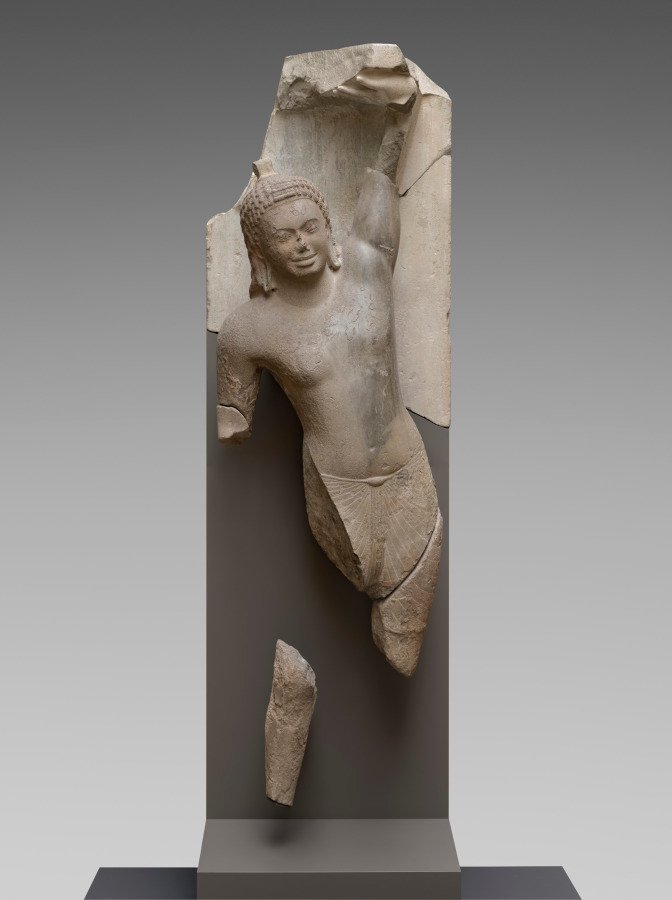
A tall, broken sandstone figure of a young god with one arm raised overhead against a stone slab, in pale gray-beige stone on a gray mount
#AFA499#988B7F#7F7061#604E3C
SculptureKrishna Lifting Mount Govardhan, Cambodia (about 600)

A masterwork of early Cambodian sculpture: the god Krishna holds up a mountain to shelter villagers and herds from a storm. It is one of eight huge figures found on a twin-peaked mountain near the ancient city of Angkor Borei. This sandstone is a cool gray-beige, about #988B7F, with little of the web color’s warmth.

#AFA499#988B7F#7F7061#604E3C
Source: Cleveland Museum of Art
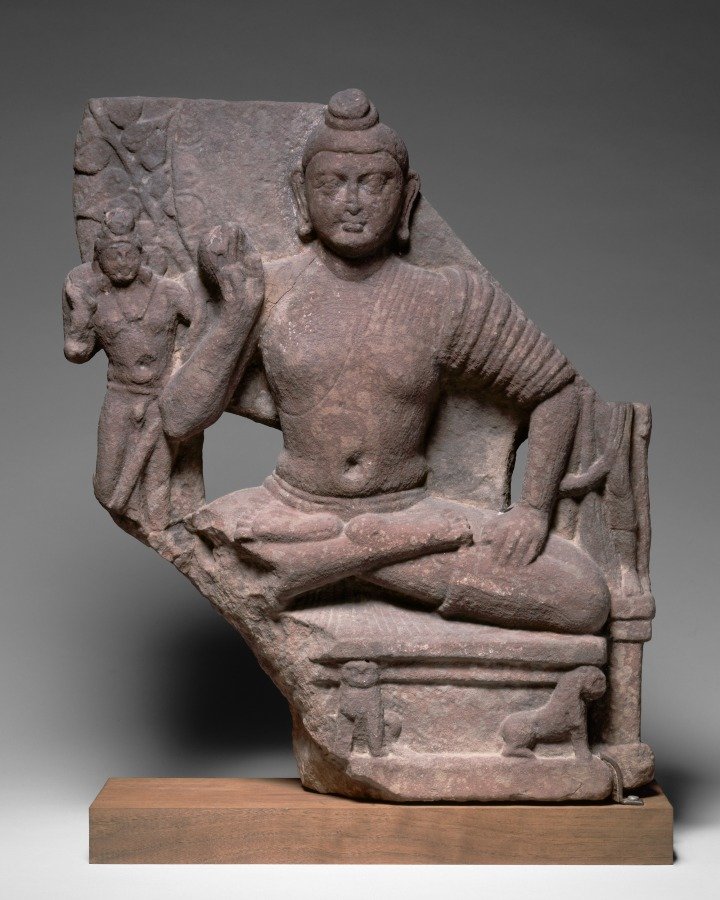
A seated Buddha carved in relief from mottled rose-brown sandstone, one hand raised, with a small standing attendant beside him and lions on the throne below
#B69C97#977E79#7B6660#5A4942
SculptureSeated Buddha, Mathura (about 120 CE)

An early form of the Buddha image, carved in Mathura in northern India: the Buddha sits under the Bodhi tree with lions on his throne. The museum calls the stone red mottled sandstone. In the photo it is a dusky rose-brown, about #977E79, flecked with paler spots.

#B69C97#977E79#7B6660#5A4942
Source: Cleveland Museum of Art

Palettes are sampled in-house.

Questions

What color is sandstone?

A light, warm tan with a soft golden cast. The code here is #C8A97E (RGB 200, 169, 126). Real sandstone can be white, yellow, pink, red or brown.

What is the hex code for sandstone?

#C8A97E. No color standard defines sandstone, but this code is very close to the average sandstone in the xkcd color survey, #C9AE74.

Why is some sandstone red?

Iron. In red sandstone the sand grains are coated with hematite, a red iron oxide. It takes very little: red Navajo Sandstone in Utah holds about 0.7% iron oxide, bleached white Navajo Sandstone about 0.2%.

What is the difference between sandstone and desert?

Almost none on screen. Desert (#C9A27E) is a hair pinker and sandstone (#C8A97E) a hair more yellow. Side by side, they are very hard to tell apart.

Is sandstone the same as tan?

Close, but not the same. Tan (#D2B48C) is a little lighter. Sandstone is a touch darker and a little richer.

Why are brownstones called brownstones?

After the reddish-brown sandstone that faced them, much of it quarried in Portland, Connecticut. It was so common in New York from about 1850 to 1890 that rowhouses were called brownstones even when they were built of something else.

What colors go with sandstone?

Terracotta and deep teal for an outdoor look, sage for a soft, earthy room, and navy or charcoal for contrast.