Mink

A soft grayish brown named after a fur that comes in dozens of colors.

Overview

Mink is a medium grayish brown, the soft, muted brown of coats, upholstery and knitwear, named after the fur of the mink. The code used here is #88796D: red at 53%, green at 47% and blue at 43%. The three are close together with red ahead, so it reads as a warm gray-brown, darker than mushroom and far lighter than taupe.

In English the word named the fur before it named the animal: Merriam-Webster dates mink, in the sense of the pelt, to the 1400s. The real fur is darker and warmer than the web color. A wild American mink is usually a dark tawny brown, with glossy guard hairs that turn almost black along the spine; only the dense underfur beneath is a grayish tawny with a bluish tint, close to the web’s mink. Fur farms bred their standard mink darker still, brown to black-brown.

Farms also turned one brown animal into a range of colors. Since the first color mutation, a blue-gray called platinum and later Silverblue, was described in 1931, breeders have found more than 35 mutations and combined them into over 100 colors, from white and pastel beige to sapphire blue-gray. Dictionaries define mink fur as “varying in color from white to dark brown”, and no color standard pins the name to one shade: the 1955 ISCC-NBS dictionary lists beaver, sable, chinchilla and muskrat as colors, but no mink.

As a color, mink is a quiet, warm neutral for walls, bedding, sofas and fashion, between gray and brown. It looks soft with cream and blush pink, tailored with navy or charcoal and rich with brass. Black text reads well on it; white text passes only at large sizes, so use a darker mink, such as #5F554C, behind white type.
HEX#88796D
RGBrgb(136, 121, 109)
HSLhsl(27, 11%, 48%)
HSV27°, 20%, 53%
CMYK0, 11, 20, 47
OKLCHoklch(58.6% 0.026 60.9)
Every code converts from the HEX value #88796D. No color standard defines mink. The ISCC-NBS dictionaries of color names and the xkcd color survey have no entry for it, and Merriam-Webster defines mink only as the animal and its fur, “varying in color from white to dark brown”. #88796D is the code used here; the crowd-sourced open color-name list gives a close #8A7561, and the nearest ISCC-NBS color group is light brownish gray, about #8E8279. CMYK is a screen-based estimate; print results vary.
Mink color card, hex #88796D: “Mink outside the box”

Mink on the color map

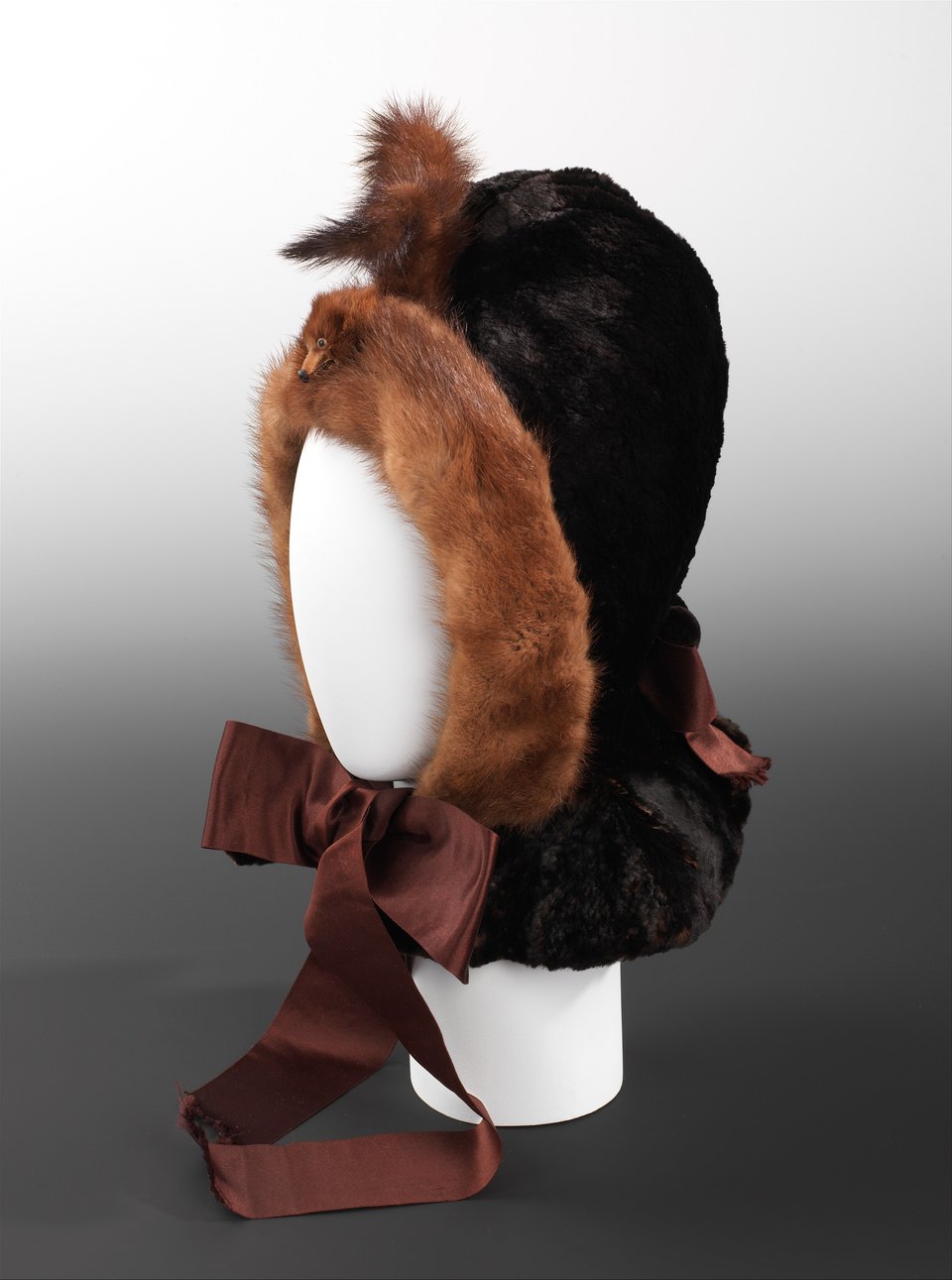
The open color-name list’s mink sits almost on the reference value, a touch darker and yellower. The nearest ISCC-NBS group, light brownish gray, sits just above it, a little lighter and grayer. The mink trim on the 1870 bonnet lies just outside the outline at the lower left: darker and redder, and far more saturated than this map can show. The outline is an approximate range, not a measured one.

Shades and tints

Tints with white

Shades with black

Tones with gray

Mink sits in the middle. Tints add white, shades add black and tones add gray, in 10% steps out from it. Tap any swatch to copy its code.

Light and dark mink

#CFC9C5
Pale minkMixed 60% with white. A warm, near-white gray for backgrounds.
#B8AFA7
Light minkMixed 40% with white. A soft gray-beige.
#8E8279
Light brownish grayThe ISCC-NBS group nearest to mink, a shade lighter and grayer.
#88796D
MinkThe reference color.
#5F554C
Dark minkMixed 30% with black. Dark enough for white text, for buttons and headings.
#8C4F33
Mink fur, about 1870Sampled from the mink trim of a bonnet at the Met. Real wild mink is far warmer and redder than the web color.
#483C32
TaupeNamed after the mole. The same hue, much darker. See taupe

Colors that go with mink

Pairings that work in rooms, outfits and interfaces.

Mink and cream

Soft and classic. A calm base for living rooms and linens.

Mink and blush

Dusty pink warms the gray-brown. Gentle for bedrooms, invitations and packaging.

Mink and navy

A tailored pairing, as in a navy coat with a gray-brown scarf.

Mink and brass

Warm metal accents lift the muted brown. Rich but quiet.

Victorian winter

From the 1870 bonnet below: black fur, reddish mink trim and brown silk ribbon.

Mink and charcoal

A dark theme in warm grays. Modern and calm, good for interfaces.

Color-wheel palettes

Pick a palette to see where its colors sit on the color wheel. The caret marks mink. Tap a band to copy its code.

Similar colors

Slate gray72%Light slate gray67%Mocha75%MinkDove gray70%Stone80%Eucalyptus69%

Lined up by hue around mink. Hover a color to see how similar it is.The bar under each name shows how similar it is. Similarity comes from the distance between the two colors in OKLab, a model of how we see color.

Mink vs taupe

Mink#88796D · hue 27°
  • A medium grayish brown
  • Named after a prized fur
  • Light enough for dark text
Taupe#483C32 · hue 27°
  • A dark grayish brown
  • Named after the mole, taupe in French
  • Takes white text easily

Meaning

  • Named for a fur
  • Luxury
  • Bred colors
  • No standard shade

Mink’s meanings come from the fur. The mink coat became a byword for luxury in the mid-1900s, and farms bred the brown animal into dozens of colors, so the name never settled on one shade. Research on color and emotion tests broad words such as brown and gray, not mink, so the claims here are about the fur and the name.

The fur came first

Word history

Merriam-Webster’s oldest sense of mink, dated to the 15th century, is the “soft fur or pelt of the mink varying in color from white to dark brown”, not the animal. The word comes from late Middle English mynk, a fur. Its earlier origin is uncertain; it is often linked to Swedish mänk or menk.1, 2, 3

A byword for luxury

Historical record

During the 1952 US election campaign, protesters greeted Richard Nixon with signs promising “No Mink Coats for Nixon”. In his televised Checkers speech that September he answered that his wife “doesn’t have a mink coat. But she does have a respectable Republican cloth coat.”4

One animal, dozens of farmed colors

Genetics

Wild American mink are tawny brown. Since the first color mutation was described in 1931, breeders have found more than 35 and combined them into over 100 colors. Geneticists have traced Silverblue to a change in the MLPH gene and the gunmetal gray Aleutian to one in LYST; bred together, the two give sapphire mink.5, 6

No color standard names it

Dictionary

Maerz and Paul’s A Dictionary of Color (1930) printed many fur names as colors, including beaver, sable, chinchilla, muskrat, nutria and squirrel, but no mink, and the 1955 ISCC-NBS dictionary of color names has none either. The xkcd color survey has no mink entry.7, 8

“Mink-dyed” had to be spelled out

Law

Cheaper furs were dyed to pass for mink. The US Fur Products Labeling Act of 1951 made sellers name the animal a fur came from and say when it was dyed, and a Life guide that year warned shoppers about “mink-dyed Baltic coneys”: rabbit.9, 10, 11

Sources (11)
  1. Merriam-Webster, “mink”, definitions and first known use.
  2. Dictionary.com, “mink”, based on the Random House Unabridged Dictionary: origin 1425–75, late Middle English, of uncertain origin.
  3. Wiktionary, “mink”, etymology, citing the Middle English Dictionary (Middle English mynk, fur of the European mink).
  4. Wikipedia, “Checkers speech”, citing Morris, R. (1990), Richard Milhous Nixon: The Rise of an American Politician, pp. 776–778 and 831.
  5. Manakhov, A. D. et al. (2019). Genome analysis identifies the mutant genes for common industrial Silverblue and Hedlund white coat colours in American mink. Scientific Reports, 9, 4581. doi:10.1038/s41598-019-40918-7
  6. Anistoroaei, R., Krogh, A. K. & Christensen, K. (2013). A frameshift mutation in the LYST gene is responsible for the Aleutian color and the associated Chédiak-Higashi syndrome in American mink. Animal Genetics, 44(2), 178–183. doi:10.1111/j.1365-2052.2012.02391.x
  7. Jaffer, A. “Maerz and Paul color names”, the ISCC-NBS placements of the color names in Maerz and Paul’s A Dictionary of Color (1930), from Kelly, K. L. & Judd, D. B. (1955), The ISCC-NBS Method of Designating Colors and a Dictionary of Color Names, NBS Circular 553. MIT CSAIL.
  8. Munroe, R. (2010). “Color survey results”. xkcd blog. The survey’s color list has no entry for mink.
  9. 15 U.S.C. § 69, Fur Products Labeling Act, Aug. 8, 1951, ch. 298, 65 Stat. 175. Legal Information Institute, Cornell Law School.
  10. Federal Trade Commission, “Fur Products Labeling Act: synopsis”: labels must give the animal’s name and say when fur is “bleached, dyed or otherwise artificially colored”.
  11. Wallace, R. (3 December 1951). “It’s Usually Rabbit”. Life, 31(23), pp. 90 and 95. Google Books, as quoted in Wiktionary, “mink”.

History

Mink was a fur name for five centuries before it was a color. Mink coats took over fashion in the 20th century, farms bred the brown animal into a range of colors, and the color name never settled.

  1. 1425–75

    First known use of mink in English, for the fur or pelt, from late Middle English. Merriam-Webster dates it to the 15th century.1, 2

  2. About 1870

    A fashionable American winter bonnet is trimmed with a whole mink, head and upright tails included. It was worn by the wife of Joseph Wechsler, a partner in the Brooklyn store that became Abraham & Straus.3

  3. Late 1800s

    Breeding American mink for fur begins in North America, as trapping wild mink no longer meets the demand for pelts.4

  4. Late 1920s

    Mink becomes the principal fur in American fashion shows.5

  5. 1930

    Maerz and Paul’s A Dictionary of Color prints beaver, sable, chinchilla, muskrat, nutria and squirrel as color names, but no mink.6

  6. 1931

    The first mink color mutation is described: a blue-gray first called platinum, later Silverblue.7

  7. 1943

    A mutation with yellowish-brown fur and a slight bluish sheen appears on a Canadian farm and is sold as Pastel mink.5

  8. 1951

    The US Fur Products Labeling Act requires fur labels to name the animal and to say when a fur is dyed.8

  9. 1957

    At a London fur auction in May, more mutation pelts than standard brown pelts are offered for the first time.5

  10. 2013–19

    Geneticists trace Aleutian gray to the LYST gene and Silverblue to MLPH. Bred together, the two mutations give sapphire mink.9, 7

Sources (9)
  1. Merriam-Webster, “mink”, definitions and first known use.
  2. Dictionary.com, “mink”, based on the Random House Unabridged Dictionary: origin 1425–75, late Middle English, of uncertain origin.
  3. The Metropolitan Museum of Art, “Bonnet”, American, about 1870, fur and silk (2009.300.1451), Brooklyn Museum Costume Collection at the Met.
  4. Wikipedia, “American mink”, sections on description and farming, citing Heptner, V. G. & Sludskii, A. A. (2002), Mammals of the Soviet Union, vol. II, part 1b, and Seton, E. T. (1909), Life-Histories of Northern Animals, pp. 896–897.
  5. Wikipedia, “Mink fur”, sections on fashion history and mutation colors, citing Wilcox, R. T. (1951), The Mode in Furs, p. 158, and Zimmermann, H. (1959), “Grundlagen der Mutationsnerzzucht”, Das Pelzgewerbe, pp. 147–153.
  6. Jaffer, A. “Maerz and Paul color names”, the ISCC-NBS placements of the color names in Maerz and Paul’s A Dictionary of Color (1930), from Kelly, K. L. & Judd, D. B. (1955), The ISCC-NBS Method of Designating Colors and a Dictionary of Color Names, NBS Circular 553. MIT CSAIL.
  7. Manakhov, A. D. et al. (2019). Genome analysis identifies the mutant genes for common industrial Silverblue and Hedlund white coat colours in American mink. Scientific Reports, 9, 4581. doi:10.1038/s41598-019-40918-7
  8. 15 U.S.C. § 69, Fur Products Labeling Act, Aug. 8, 1951, ch. 298, 65 Stat. 175. Legal Information Institute, Cornell Law School.
  9. Anistoroaei, R., Krogh, A. K. & Christensen, K. (2013). A frameshift mutation in the LYST gene is responsible for the Aleutian color and the associated Chédiak-Higashi syndrome in American mink. Animal Genetics, 44(2), 178–183. doi:10.1111/j.1365-2052.2012.02391.x

Mink in use

A tall black fur bonnet on a white mannequin head, framed around the face by a reddish-brown mink whose small head and bushy tails sit on top, tied with wide brown silk ribbons
#A56947#8C4F33#733D25#161213
HatWinter bonnet with mink trim, American (about 1870)

A tall black fur bonnet framed by a whole mink, its head and upright tails worn as an ornament, tied with wide brown silk ribbons. The mink reads as a warm reddish brown, from about #733D25 in shadow to #8C4F33 in the light, with highlights near #A56947: far warmer and more saturated than the web’s mink, #88796D.

#A56947#8C4F33#733D25#161213
Source: The Met

Palettes are sampled in-house.

Questions

What color is mink?

A medium grayish brown, named after the fur of the mink. The code used here is #88796D (RGB 136, 121, 109). No color standard defines mink, so other sources give slightly different values.

Is mink brown or gray?

In between. Its red, green and blue values are close together, with red a little ahead, so it reads as a warm gray or a muted brown. Its saturation is only about 11%.

Is the color mink the same color as mink fur?

Not quite. Wild mink is a dark tawny brown, and the standard farmed mink was bred darker still, brown to nearly black. The web’s mink is closer to the soft grayish underfur, or to the paler farmed colors.

What colors do farmed mink come in?

Many. Breeders have found more than 35 color mutations since 1931 and combined them into over 100 colors, including white, pastel beige, Silverblue, the gunmetal gray Aleutian, sapphire blue-gray and near-black.

What is the difference between mink and taupe?

They share a hue. Taupe in its dictionary form (#483C32), named after the mole, is much darker; mink (#88796D) is a medium grayish brown. Paint and fashion often use taupe for lighter shades, which can overlap with mink.

What is the difference between mink and mocha?

Mocha (#A38068) is lighter, warmer and rosier, like coffee with milk. Mink (#88796D) is grayer and a little darker.

Does white text work on mink?

Only at large sizes. White text on #88796D has a contrast of about 4.2 to 1, below the 4.5 to 1 needed for body text. Black text reaches 5.0 to 1. For white text, use a darker mink such as #5F554C.

What colors go with mink?

Cream and ivory for a soft room, blush pink for warmth, navy or charcoal for contrast, and brass or gold accents for a richer look.