Dark brown

A deep, warm brown with a code that counts down from six to one.

Overview

Dark brown is a deep, warm brown, the color of strong coffee, dark wood and many people’s eyes. The code most color lists use, #654321, has a clear orange warmth. It sits between sepia, which is a little lighter and more orange, and taupe, which is darker and grayer.

Read the code’s digits and they count down from 6 to 1. No color standard defines it: the earliest place we found it is a one-sentence Wikipedia article from June 2005 that gave no source, and CSS has no darkbrown keyword. By chance or not, the code lands almost exactly on the ISCC-NBS dictionary’s deep yellowish brown, #654522.

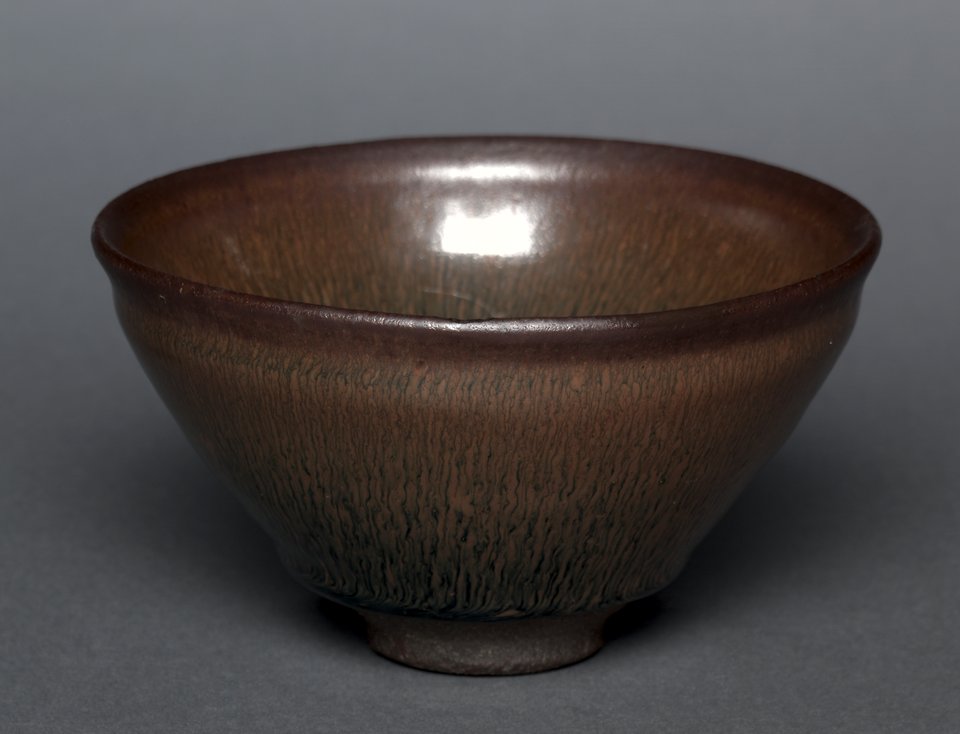
Where a source does define dark brown, it is darker or grayer. The printing industry’s list of paper colors uses #5C4033, the ISCC-NBS dictionary centers dark brown on #422518, and people’s average dark brown in the xkcd survey was #341C02, close to black. The glaze of the Song dynasty tea bowl below falls in that darker band too.

Dark brown carries white text easily and makes a warm, softer stand-in for black. It looks classic with cream, fresh with sky blue, earthy with sage green and cozy with burnt orange.
HEX#654321
RGBrgb(101, 67, 33)
HSLhsl(30, 51%, 26%)
HSV30°, 67%, 40%
CMYK0, 34, 67, 60
OKLCHoklch(41.4% 0.068 64.0)
Every code converts from the HEX value #654321. No color standard defines dark brown as #654321. It is the code most color lists use, and it traces back to an unsourced Wikipedia article from 2005. The Printer Working Group’s media color names give dark brown as #5C4033, and the ISCC-NBS dictionary centers it on #422518. CMYK is a screen-based estimate; print results vary.
Dark brown color card, hex #654321: “#654321: the countdown to brown”

Dark brown on the color map

People’s average dark brown sits straight below the outline: the same hue, but much darker. The dictionary’s dark brown sits just outside the lower left, darker and a little redder. The printer standard’s dark brown sits inside the outline near its left edge, at about the same lightness but redder and grayer, and the tea bowl’s glaze falls inside the outline toward the lower left. The outline is an approximate range, not a measured one.

Shades and tints

Tints with white

Shades with black

Tones with gray

Dark brown sits in the middle. Tints add white, shades add black and tones add gray, in 10% steps out from it. Tap any swatch to copy its code.

Light and dark dark brown

#D1C7BC
Pale dark brownMixed 70% with white. A warm greige for walls and backgrounds.
#937B64
Light dark brownMixed 30% with white. A soft, grayish mid-brown.
#654321
Dark brownThe reference color.
#5C4033
Printer dark brownThe dark-brown paper color in the printing industry’s media names standard. Grayer and a little redder.
#422518
Dictionary dark brownThe center of the ISCC-NBS dark brown. Darker and redder.
#341C02
Everyday dark brownPeople’s average dark brown in the xkcd survey. Close to black.

Colors that go with dark brown

Pairings that work in rooms, outfits and interfaces.

Dark brown and cream

Warm and classic. Think leather, paper and old wood.

Dark brown and sky blue

Blue cools the warm brown. Fresh, outdoorsy and easy on the eye.

Dark brown and white

Crisp and grounded. White text reads easily on dark brown.

Dark brown and sage

Earthy and calm. Good for natural products and interiors.

Dark brown and burnt orange

Autumn warmth. Rich, cozy and a little retro.

Hare’s fur

The browns of the Jian tea bowl. Deep, glossy and quiet.

Color-wheel palettes

Pick a palette to see where its colors sit on the color wheel. The caret marks dark brown. Tap a band to copy its code.

Similar colors

Umber73%Walnut83%Russet73%Coffee79%Chocolate78%Sepia89%Dark brown

Lined up by hue around dark brown. Hover a color to see how similar it is.The bar under each name shows how similar it is. Similarity comes from the distance between the two colors in OKLab, a model of how we see color.

Dark brown vs coffee

Dark brown#654321 · hue 30°
  • Deeper and warmer
  • A clear orange-brown
  • No standard; the code most lists use
Coffee#6F4E37 · hue 25°
  • A little lighter
  • Grayer and slightly redder
  • Named after the drink

Meaning

  • Brown eyes
  • Newborns
  • Melanin
  • Song tea bowls

Dark brown is the color of many human eyes and of the tea bowls that Song dynasty China prized. It reads as warm, solid and dependable, a softer stand-in for black. Eye research uses the broad word brown, not dark brown, so the eye claims below cover every brown iris, from amber to almost black.

The most common eye color

Rough estimate

Brown is the most common eye color in the world. One eye-care guide puts it at 70 to 80% of people, and says that eyes which look black are really a very dark brown, hard to tell from the pupil. Global figures like this are rough estimates, and they count every shade of brown, not dark brown alone.1

Most babies start out brown

One study

Many people think babies are born with blue eyes. In a Stanford study of 192 healthy newborns, 63% had brown eyes and 21% blue. The babies all came from one hospital, so the exact shares won’t hold everywhere.2

Dark eyes hold more melanin

Well established

Melanin, the pigment that also colors skin and hair, gives the iris its color. In a 2005 study of donor eyes, brown irises held about 40% more melanin than lighter ones, and almost all of it was eumelanin; the other type, pheomelanin, made up only a few percent.1, 3

Dark bowls for white tea

Museum record

In Song dynasty China, powdered tea was whisked into a white foam, and connoisseurs prized the contrast of that foam against the dark brown and black glazes of Jian bowls from Fujian. Emperor Huizong (reigned 1100–1126) called their streaked glaze “hare’s fur.” When steeped tea leaves came into use, the bowls fell out of favor in China but stayed treasured in Japan, where powdered tea remained popular.4, 5

Sources (5)
  1. Debrowski, A. & Rivera, M. (2026). “What is the rarest eye color?”, All About Vision, reviewed by S. Maiti, OD (updated 9 September 2026).
  2. Ludwig, C. A., Callaway, N. F., Fredrick, D. R., Blumenkranz, M. S. & Moshfeghi, D. M. (2016). “What colour are newborns’ eyes? Prevalence of iris colour in the Newborn Eye Screening Test (NEST) study”. Acta Ophthalmologica, 94(5), 485–488.
  3. Wielgus, A. R. & Sarna, T. (2005). “Melanin in human irides of different color and age of donors”. Pigment Cell Research, 18(6), 454–464.
  4. Cleveland Museum of Art, Black Glazed Teabowl, Jian ware, China, Southern Song dynasty, 1100s–1200s, 2020.176, collection notes.
  5. Cleveland Museum of Art, Black-Glazed Teabowl with Incised Characters for “Imperial Tribute”, Jian ware, China, Southern Song dynasty, 1100s–1200s, 2020.175, collection notes.

History

Dark brown has three codes from three kinds of source: a color dictionary, a printing standard and an unsourced web page. The web page’s code is the one most sites use.

  1. 1100s

    Emperor Huizong of the Song dynasty calls the streaked glaze of dark Jian tea bowls “hare’s fur,” and says the bowls should be deep and wide so that tea powder can be whisked well.1

  2. 1955

    The ISCC-NBS dictionary of color names centers its dark brown on #422518. Its deep yellowish brown, #654522, is almost the same as today’s common code.2

  3. 2005

    On 23 June, a one-sentence Wikipedia article on dark brown gives #654321 as its color, with no source. It is the earliest use of the code we could find. In September the article is turned into a redirect to brown.3

  4. 2010

    In the xkcd color survey, people’s average dark brown comes out as #341C02, far darker than #654321.4

  5. 2013

    The Printer Working Group’s standard names for paper and other print media list dark brown at #5C4033.5

Sources (5)
  1. Cleveland Museum of Art, Black Glazed Teabowl, Jian ware, 2020.176, collection notes.
  2. Jaffer, A. “Color-Name Dictionaries”, with the ISCC-NBS centroids, MIT CSAIL; after Kelly, K. L. & Judd, D. B. (1955), The ISCC-NBS Method of Designating Colors and a Dictionary of Color Names, NBS Circular 553.
  3. Wikipedia, “Dark brown”, first revision, 23 June 2005, and the page’s history.
  4. Munroe, R. (2010). “The 954 most common RGB monitor colors”, xkcd color survey (CC0).
  5. Printer Working Group (2013). PWG Media Standardized Names 2.0 (MSN2), PWG 5101.1-2013, Table 2, Color Names.

Dark brown in use

A small, deep stoneware tea bowl on a narrow foot, covered in a glossy dark brown glaze streaked with fine darker lines, on a gray background
#4C3225#3C2A20#2D221A#5C4639
CeramicJian ware tea bowl, China (960–1279)

A small Song dynasty stoneware tea bowl under a glossy “hare’s fur” glaze, with fine darker streaks running down through the brown. In the photo the glaze reads about #4C3225, darker and grayer than #654321 and close to the dictionary’s dark brown.

#4C3225#3C2A20#2D221A#5C4639
Source: Cleveland Museum of Art

Palettes are sampled in-house.

Questions

What color is dark brown?

A deep, warm brown, like strong coffee or dark wood. The code most color lists use is #654321 (RGB 101, 67, 33).

What is the hex code for dark brown?

Most color lists give #654321. A printing industry standard for paper colors uses #5C4033, and the ISCC-NBS color dictionary centers dark brown on #422518. CSS has no darkbrown keyword.

Why is the dark brown code 654321?

Nobody recorded why. The digits simply count down from 6 to 1, and the earliest use we found, a Wikipedia article from 2005, gave no source. By chance or not, it lands almost exactly on the ISCC-NBS center for deep yellowish brown, #654522.

Is there a dark brown in CSS?

No. CSS has brown (#A52A2A), which looks brick red, and saddlebrown (#8B4513), a lighter, redder brown. For dark brown, use a hex code such as #654321.

What is the difference between dark brown and coffee?

Coffee (#6F4E37) is a little lighter, grayer and redder. Dark brown (#654321) is deeper, with a clearer orange warmth.

What colors go with dark brown?

Cream and warm white for a classic look, sky blue for contrast, sage green for an earthy feel, and burnt orange for autumn warmth.

Are dark brown eyes the most common?

Brown is by far the most common eye color, with estimates of 70 to 80% of people worldwide. Eyes that look black are really a very dark brown.