Mushroom

A soft grayish beige, named after a food that comes in both white and brown.

Overview

Mushroom is a light grayish brown with a beige cast, the kind of soft, in-between neutral that is hard to call either gray or brown. The code used here, #A89F91, has red at about 66%, green at 62% and blue at 57%. The three are close together, with red a little ahead, so it reads as a warm gray.

The name is slippery because mushrooms come in two colors. The common cultivated mushroom is sold white, as button mushrooms, and brown, as cremini and portobello, and all of them are one species. Farmed mushrooms used to be brown or cream; the white ones in most stores today descend from a single white mushroom found on a Pennsylvania farm in 1925.

Color dictionaries split the same way. Maerz and Paul’s A Dictionary of Color (1930) printed mushroom as a dark brownish gray, on the same sample as camel and beaver, while the Plochere color system of 1948 gave it as a pale yellow to yellowish white. The code used here sits in between: a muted gray-beige a step darker than greige, close to the pale gray-brown cap of the wild mushroom.

Mushroom is a quiet, natural neutral for walls, upholstery, knitwear and packaging. It pairs well with cream, sage, dusty rose and charcoal. Dark text reads well on it; white text is too faint, even at large sizes.

HEX#A89F91
RGBrgb(168, 159, 145)
HSLhsl(37, 12%, 61%)
HSV37°, 14%, 66%
CMYK0, 5, 14, 34
OKLCHoklch(70.6% 0.023 79.0)
Every code converts from the HEX value #A89F91. No color standard defines mushroom, and color sites disagree: #A89F91 is one common code, while others use the xkcd survey’s #BA9E88 or lighter, pinker values. The nearest ISCC-NBS group to #A89F91 is light grayish yellowish brown, about #AE9B82. The 1955 ISCC-NBS dictionary files the mushroom of Maerz and Paul’s A Dictionary of Color (1930) as a brownish gray, about #5B504F, and the mushroom of the 1948 Plochere color system as pale yellow and yellowish white. CMYK is a screen-based estimate; print results vary.
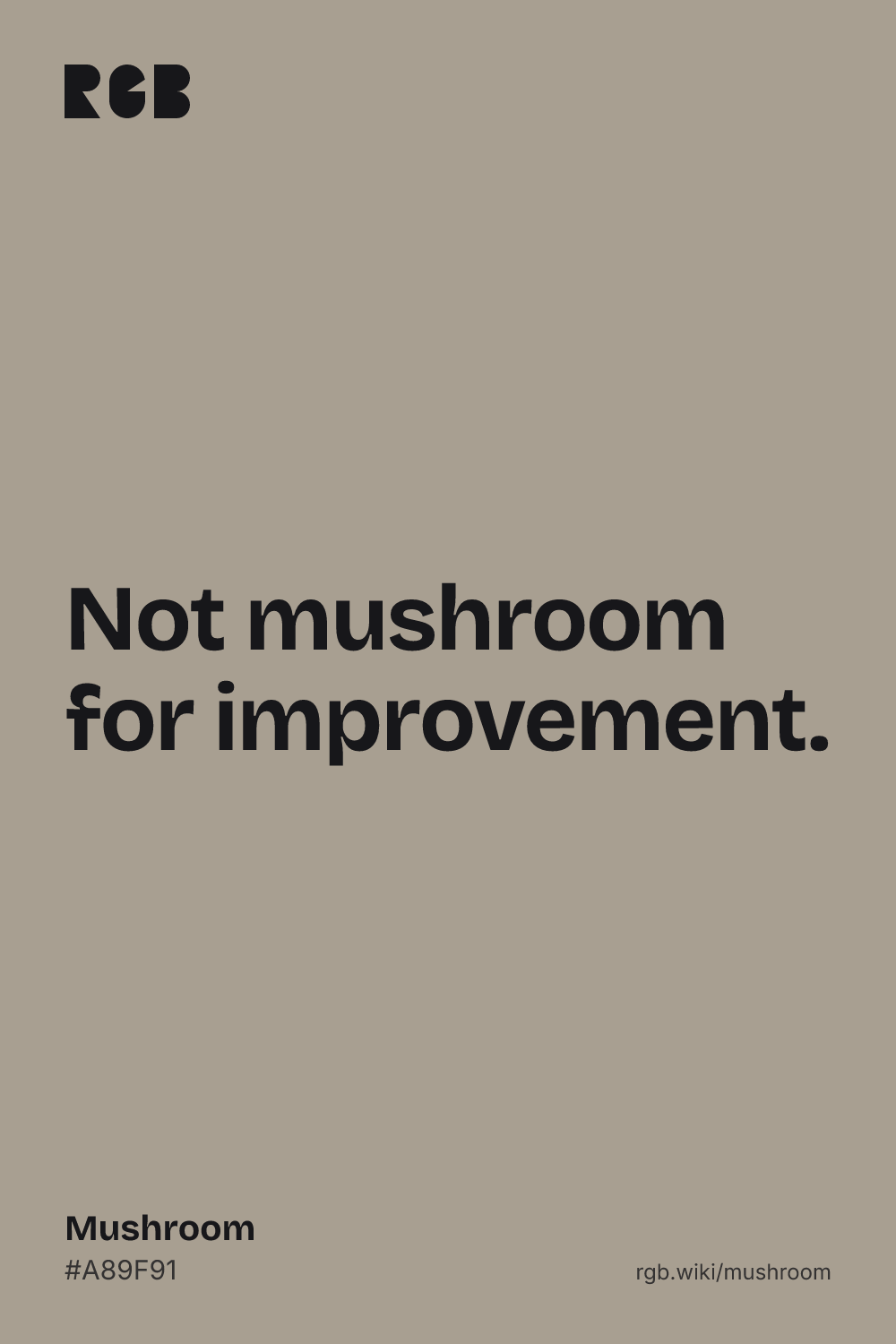
Mushroom color card, hex #A89F91: “Not mushroom for improvement”

Mushroom on the color map

The xkcd survey average and the open color-name list’s mushroom are pinker, to the left; people’s average sits inside the outline. The nearest ISCC-NBS group sits just below and to the left of the reference value. Plochere’s two mushrooms, from a system the dictionary files under interior decorating, are far lighter, near the top right. Maerz and Paul’s mushroom, a dark brownish gray (#5B504F), falls outside this view. The outline is an approximate range, not a measured one.

Shades and tints

Tints with white

Shades with black

Tones with gray

Mushroom sits in the middle. Tints add white, shades add black and tones add gray, in 10% steps out from it. Tap any swatch to copy its code.

Light and dark mushroom

#E5E2DE
Pale mushroomMixed 70% with white. A warm, near-white gray.
#CBC5BD
Light mushroomMixed 40% with white. A soft, pale gray-beige.
#BAB1A4
GreigeA step lighter and about as muted. See greige
#A89F91
MushroomThe reference color.
#766F66
Dark mushroomMixed 30% with black. A deep brown-gray for text and borders.
#5B504F
Dictionary mushroomThe ISCC-NBS brownish gray, where the 1955 dictionary files Maerz and Paul’s mushroom of 1930. Their book used the same sample for camel and beaver.

Colors that go with mushroom

Pairings that work in rooms, outfits and interfaces.

Mushroom and cream

Soft and quiet. A calm base for walls and linens.

Mushroom and sage

Two muted naturals that sit easily together.

Mushroom and dusty rose

Gentle warmth. The pink lifts mushroom’s gray.

Mushroom and charcoal

Light and dark grays with a brown undertone. Modern and calm.

Woodland

From the drawing below: brown caps, pale flesh and moss.

Mushroom and terracotta

A warm clay accent wakes up the soft neutral.

Color-wheel palettes

Pick a palette to see where its colors sit on the color wheel. The caret marks mushroom. Tap a band to copy its code.

Similar colors

Rosy brown75%Camel72%MushroomHeather gray87%Dark gray82%Cement90%Sage green74%

Lined up by hue around mushroom. Hover a color to see how similar it is.The bar under each name shows how similar it is. Similarity comes from the distance between the two colors in OKLab, a model of how we see color.

Mushroom vs greige

Mushroom#A89F91 · hue 37°
  • A light grayish brown
  • Named after a food that comes white or brown
  • A step darker
Greige#BAB1A4 · hue 35°
  • A pale gray-beige
  • Named after raw, unfinished cloth
  • A step lighter

Meaning

  • Mushrooms
  • White in stores
  • Split dictionaries
  • Interior decorating

Mushroom suggests the forest floor, earthy cooking and calm, natural rooms. But the word has no fixed color: the food comes white and brown, and color dictionaries have used the name for both a near white and a dark brownish gray. Color research tests broad words like gray and brown, not mushroom, so the claims here are about the mushroom and the name.

One mushroom, two colors

Botany

The common cultivated mushroom, Agaricus bisporus, is grown in more than 70 countries. Young, it comes in two colors: white, sold as white or button mushrooms, and brown, sold as cremini or baby bella. Grown larger, the brown form is sold as portobello. All of them are one species. The wild form has a pale gray-brown cap, gills that turn from pink to dark brown, and a dark brown spore print.1, 2
How store mushrooms turned white

Historical record

Farmed mushrooms were once brown or cream. In 1925 Louis Ferdinand Lambert found a single white mushroom among the brown ones at his Keystone Mushroom Farm in Coatesville, Pennsylvania, and grew a pure white strain from it. His Snow White was the leading commercial mushroom by 1933, and almost all button mushrooms sold today descend from it. A 1963 market study found that shoppers preferred mushrooms white, with color a highly important consideration.3, 1

Two dictionaries, opposite colors

Dictionary

The 1955 ISCC-NBS dictionary of color names records two very different mushrooms. Maerz and Paul’s A Dictionary of Color (1930) printed mushroom on the same dark brownish-gray sample as camel, beaver and starling. The Plochere color system (1948), which the dictionary files under interior decorating, gave mushroom as a pale yellow and a yellowish white.4, 5

A word with no color sense

Dictionary

Merriam-Webster defines mushroom as the fleshy fruiting body of a fungus, especially an edible one, and as an upstart, but gives it no color sense. The word has been in English since the 1400s, from Middle English musheron and Anglo-French musherum.6

Sources (6)
  1. Wikipedia, “Agaricus bisporus”, description, names and history, citing Zeitlmayr, L., Wild Mushrooms (1976), Carluccio, A., The Complete Mushroom Book (2003), the Mushroom Council and Genders, R. (1969).
  2. Adams, P. (16 March 2022). “Ask Paul: What’s the Difference Between Cremini and Button Mushrooms?” America’s Test Kitchen.
  3. Stevenson, J. (26 September 2011). “Unearthing the Keystone Mushroom Farm Collection”. Hagley Museum and Library.
  4. Kelly, K. L. & Judd, D. B. (1955). The ISCC-NBS Method of Designating Colors and a Dictionary of Color Names. NBS Circular 553. Entries “Mushroom”, “Mushroom (same as Beaver)”, “Camel (same as Beaver)” and “Starling (same as Beaver)”, and the list of sources.
  5. Jaffer, A. “Maerz and Paul color names”, with ISCC-NBS centroids from “Color-Name Dictionaries”, MIT CSAIL.
  6. Merriam-Webster, “mushroom”, definitions, etymology and first known use.

History

Mushroom has been an English word since the 1400s, but its color has never settled. Farmers turned the mushroom itself from brown to white, and two color dictionaries gave the name to colors at opposite ends of the scale.

  1. 15th century

    First known use of mushroom in English, from Middle English musheron, from Anglo-French.1

  2. 1751

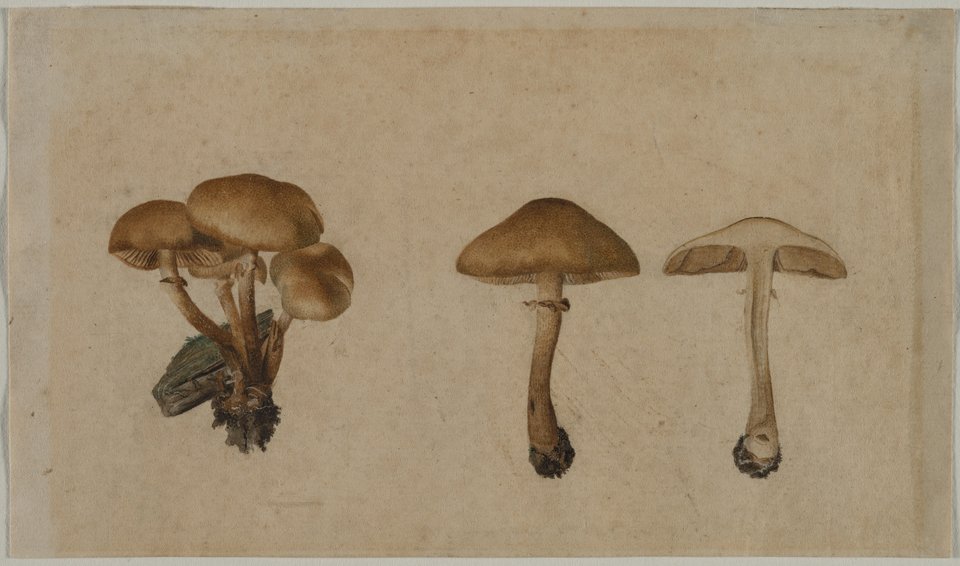
    The German artist Georg Wilhelm Baurenfeind paints brown, gilled mushrooms in brown wash and gouache, one of them cut in half to show its gills.2

  3. 1925

    Louis Ferdinand Lambert finds a white mushroom growing among brown ones at the Keystone Mushroom Farm in Coatesville, Pennsylvania, and grows a pure white strain from it.3

  4. 1930

    Maerz and Paul’s A Dictionary of Color prints mushroom as plate 15, sample A6, the same sample it calls beaver, camel and starling.4, 5

  5. 1933

    Lambert’s Snow White strain is the leading commercial mushroom.3

  6. 1948

    Gladys and Gustave Plochere publish the Plochere Color System in Los Angeles, with 1,248 color cards; its mushroom is a pale yellow to yellowish white.4

  7. 1955

    The ISCC-NBS dictionary files Maerz and Paul’s mushroom as a brownish gray and Plochere’s as pale yellow and yellowish white.4

  8. 1963

    A market study finds that shoppers prefer mushrooms white and uniform in size, with color a highly important consideration.3

Sources (5)
  1. Merriam-Webster, “mushroom”, etymology and first known use.
  2. Cleveland Museum of Art, “Mushrooms”, Georg Wilhelm Baurenfeind (German, about 1710–1763), 1751, brush and brown wash and gouache (1975.257).
  3. Stevenson, J. (26 September 2011). “Unearthing the Keystone Mushroom Farm Collection”. Hagley Museum and Library.
  4. Kelly, K. L. & Judd, D. B. (1955). The ISCC-NBS Method of Designating Colors and a Dictionary of Color Names. NBS Circular 553. Mushroom entries and section 9.7, “Plochere Color System”.
  5. Jaffer, A. “Maerz and Paul color names”, MIT CSAIL.

Mushroom in use

A drawing of brown mushrooms on tan paper: a cluster growing from a mossy twig on the left, a single mushroom with a ring on its stem in the middle, and a pale mushroom cut in half on the right, showing its brown gills
#846139#6F4E2A#7F6342#9E8869
DrawingMushrooms, by Georg Wilhelm Baurenfeind (1751)

Brown, gilled mushrooms in brush, brown wash and gouache: a cluster growing from a mossy twig, one standing mushroom and one cut in half. The caps read about #6F4E2A, far warmer and darker than the web’s mushroom. The pale flesh of the cut cap, about #9E8869, comes nearer, though it is still more golden.

#846139#6F4E2A#7F6342#9E8869
Source: Cleveland Museum of Art

Palettes are sampled in-house.

Questions

What color is mushroom?

A light grayish brown with a beige cast, close to the pale gray-brown cap of the wild form of the common mushroom. The code used here is #A89F91 (RGB 168, 159, 145).

Is mushroom gray or brown?

In between. Its red, green and blue values are close together, with red a little ahead, so it reads as a warm gray or a very soft brown. Its saturation is only about 12%.

Why does the name cover such different colors?

Mushrooms themselves come white and brown, and the word has no fixed color sense. A 1930 color dictionary used mushroom for a dark brownish gray, while a 1948 color system for interior decorating used it for a near white.

What is the difference between mushroom and greige?

Greige (#BAB1A4) is a step lighter. The two are about equally muted, so mushroom is, in effect, a deeper greige.

What is the difference between mushroom and taupe?

Taupe in its dictionary form (#483C32) is a dark brown-gray, far darker than mushroom (#A89F91). Paint and fashion often use taupe for lighter grayish browns, which can come close to mushroom.

What is the difference between mushroom and camel?

Camel (#C19A6B) is a light golden brown, much more saturated. Mushroom (#A89F91) is grayer. Oddly, the 1930 Dictionary of Color printed both names on the same brownish-gray sample.

What is the difference between mushroom and mocha?

Mocha (#A38068) is a warmer, rosier brown, like coffee with milk. Mushroom (#A89F91) is a little lighter and much grayer.

What colors go with mushroom?

Cream and soft white for a calm room, sage or moss green for an earthy one, dusty rose for warmth, and charcoal or deep brown for contrast.

Is mushroom warm or cool?

Slightly warm. Red leads green and blue, but only a little, so it sits close to neutral and works with both warm and cool colors.