Titanium white

The white of the 20th century: a pigment from 1916 that now whitens almost everything, and catches the occasional forger.

Overview

Titanium white is a clean, almost neutral white. Its web code, #F3F4F0, sets red, green and blue within four steps of each other, with green a touch highest and blue lowest, so it reads as white with the faintest cool, chalky cast. It is a little softer than pure white and lighter than white smoke.

The name comes from the pigment, titanium dioxide (TiO₂), sold as Pigment White 6. The element was found in Cornish sand in 1791 and named after the Titans of Greek myth, but the white only became practical in 1916, when companies in Norway and the United States began making it at scale. It hides what lies beneath it better than any other white, it is far less toxic than lead white, and today it is the white in almost every paint, plastic, paper coating and toothpaste.

It comes in two crystal forms. Anatase came first but tended to chalk and could discolor. Rutile, made commercially from 1937, covers up to a quarter better and weathers well, and it now dominates the market. Because both have known start dates, conservators use them as a clock: a painting that contains titanium white cannot be older than the pigment.

On screens, titanium white works as a quiet page or card background that is less glaring than pure white. Black text on it reaches 19.0:1 and white text is unreadable. It pairs well with charcoal, with strong primaries, and with the warmer whites it replaced.
HEX#F3F4F0
RGBrgb(243, 244, 240)
HSLhsl(75, 15%, 95%)
HSV75°, 2%, 96%
CMYK0, 0, 2, 4
OKLCHoklch(96.5% 0.005 117.9)
Every code converts from the HEX value #F3F4F0. No color standard defines titanium white, and we could not trace #F3F4F0 to a published source: the CSS and X11 color lists, the xkcd color survey and the ISCC-NBS dictionaries have no entry for it. The nearest dictionary value is the ISCC-NBS category white, #F2F3F4, used for Ridgway’s “white” (1912), which is almost the same color. CMYK is a screen-based estimate; print results vary.
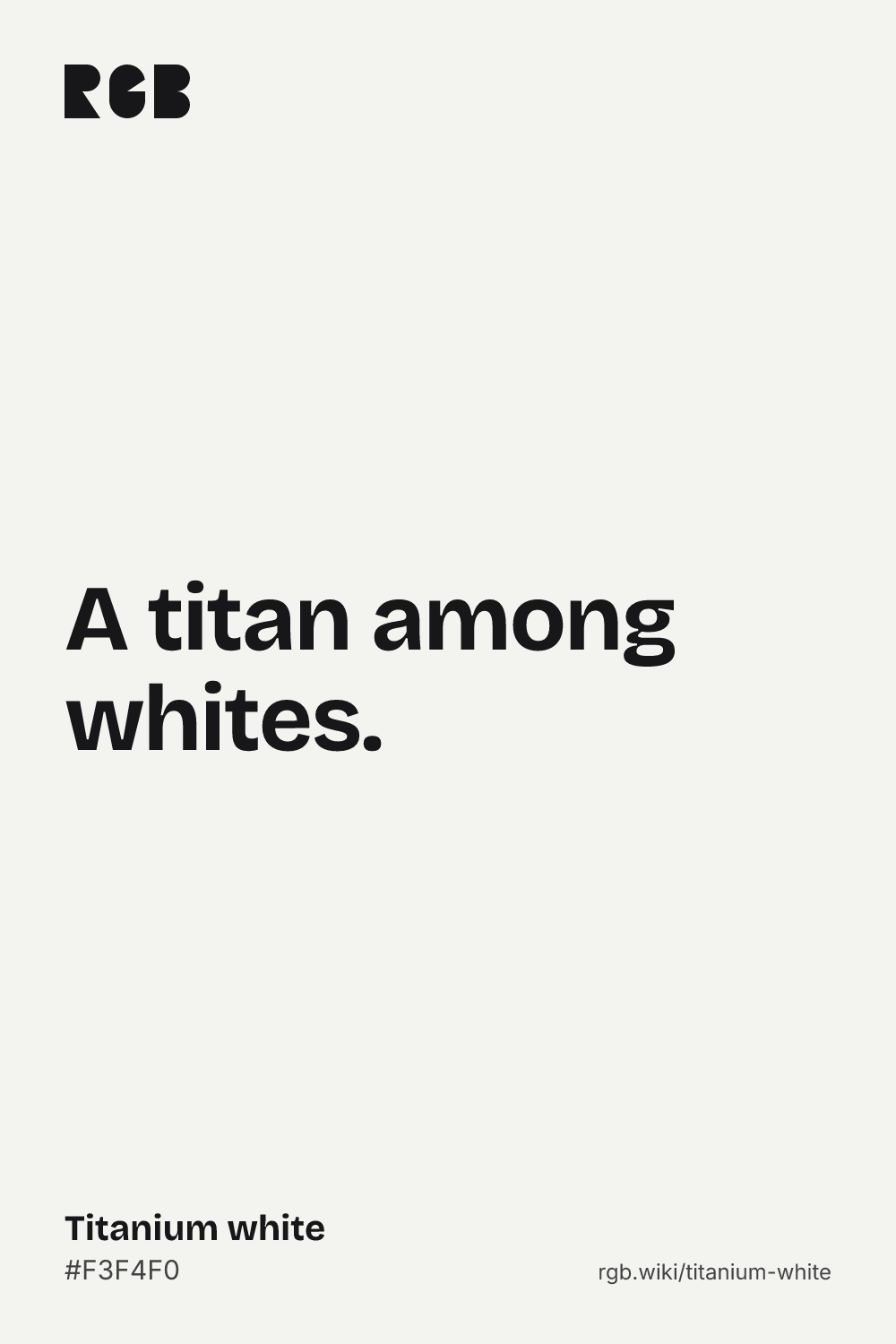
Titanium white color card, hex #F3F4F0: “A titan among whites”

Titanium white on the color map

Titanium white has almost no hue, so every value here sits close to the center line. Pure white and white smoke sit inside the outline just above it, a little lighter. The dictionary white sits at the same lightness but just to the right, its trace of tint leaning cool. Lead white sits below and outside the outline to the left: a darker, warmer, creamier white. The outline is an approximate range, not a measured one.

Shades and tints

Tints with white

Shades with black

Tones with gray

Titanium white sits in the middle. Tints add white, shades add black and tones add gray, in 10% steps out from it. Tap any swatch to copy its code.

Light and dark titanium white

#FFFFFF
WhitePure white, one step up. Titanium white is only 11 to 15 steps out of 255 below it.
#F3F4F0
Titanium whiteThe reference color.
#F2F3F4
ISCC-NBS whiteThe white category of the 1955 color dictionary: the same lightness, with a hint of blue instead of green.
#F3EEE2
Lead whiteThe older, warmer pigment white that titanium white pushed off the palette. See lead white
#C2C3C0
Light titanium grayMixed 20% with black.
#929290
Mid titanium grayMixed 40% with black.
#616260
Dark titanium grayMixed 60% with black. Dark enough for body text on titanium white, at about 5.6:1.

Colors that go with titanium white

Pairings that work in rooms, outfits and interfaces.

Titanium and charcoal

Clean and modern. A soft white page with near-black text, good for long reading.

Primary studio

The white straight from the tube beside strong primaries, as in a painter’s first mixing lesson.

Old and new whites

Titanium white with the warmer whites it replaced. Layered and gentle, good for interiors.

Titanium grays

The white with its own shades, mixed with black. Calm and tonal, for dashboards and forms.

Rocket white

Crisp white, black and a signal orange, in the spirit of painted launch hardware.

Night and titanium

Dark mode. Titanium white text reads bright but not harsh on a deep gray.

Color-wheel palettes

Pick a palette to see where its colors sit on the color wheel. The caret marks titanium white. Tap a band to copy its code.

A gray has no hue, so turning it around the wheel only gives the same gray back. Monochrome is the one wheel palette that works for it.

Similar colors

Seashell92%Linen92%Isabelline95%Alabaster93%Titanium whiteWhite smoke96%Off white92%

Lined up by hue around titanium white. Hover a color to see how similar it is.The bar under each name shows how similar it is. Similarity comes from the distance between the two colors in OKLab, a model of how we see color.

Titanium white vs lead white

Titanium white#F3F4F0 · hue 75°
  • Almost neutral, a faintly cool white
  • Titanium dioxide, made at scale from 1916
  • Low toxicity, the best hiding power
Lead white#F3EEE2 · hue 42°
  • Warmer and a little darker, creamy
  • Basic lead carbonate, used since antiquity
  • Poisonous, now rarely sold

Meaning

  • Named for the Titans
  • The most used white
  • Dates forgeries
  • Safer than lead

Titanium white’s meaning is practical rather than symbolic. Its name reaches back to Greek myth, but its story is industrial: a white that covers better and costs less than the old ones, and that now turns up in paint, food, pills and sunscreen. That ubiquity gives it a second role, as a date stamp in paintings. No study has tested how the color titanium white makes people feel, so the claims below rest on chemistry, museum science and regulation.

Named for the Titans

Word history

William Gregor found the metal in black sand in Cornwall in 1791. In 1795 the German chemist Martin Heinrich Klaproth found it again in rutile and, following the pattern of uranium, borrowed a name from mythology: the Titans, the sons of the Earth.1

The white with the most hiding power

Materials science

Titanium dioxide bends light more strongly than almost any other common substance, so a thin layer hides what is under it. It has more hiding power and tinting strength than any other white pigment. It began more expensive than lead white, but less of it was needed, and today about 4.6 million tons a year are used worldwide.2

A forger’s giveaway

Historical record

Since titanium white did not exist as a paint before the late 1910s, its presence in a supposedly older work is a red flag. The German forger Wolfgang Beltracchi was caught after selling a painting presented as a work by Heinrich Campendonk: analysis by Nicholas Eastaugh found titanium white, a pigment not in use in Campendonk’s day, in a paint whose tube label did not list it. He was sentenced to six years in 2011.3, 4

Rutile narrows the date

Museum reference

The two crystal forms tell different times. Pure anatase pigment was on sale from 1923, while rutile pigment was patented in 1931 and only made commercially from 1937. Rutile in a paint layer therefore points to the late 1930s or later.4

Safer than lead, with open questions

Regulation

Titanium dioxide is far less toxic than lead white, which is why art suppliers now recommend it instead. But inhaled titanium dioxide dust is classed by the IARC as possibly carcinogenic to humans (Group 2B), and the European Union removed it from its list of food additives in 2022. The United States, the United Kingdom and Canada still allow it in food.2, 5

Sources (5)
  1. Wikipedia, “Titanium”, section on history, citing Emsley, J. (2001), Nature’s Building Blocks, Oxford University Press, p. 452, and Klaproth, M. H. (1795), “Chemische Untersuchung des sogenannten hungarischen rothen Schörls”, Beiträge zur chemischen Kenntniss der Mineralkörper, vol. 1, pp. 233–244.
  2. Laver, M. (1997). “Titanium Dioxide Whites”. In Fitzhugh, E. W. (ed.), Artists’ Pigments: A Handbook of Their History and Characteristics, vol. 3, pp. 295–355. National Gallery of Art, Washington. As summarized in Wikipedia, “Titanium white”, and Wikipedia, “Titanium dioxide”, section “Pigment”, citing Winkler, J. (2003), Titanium Dioxide, Vincentz, p. 5.
  3. Wikipedia, “Wolfgang Beltracchi”, citing “The surprising secrets of busting art forgeries”, BBC Culture, 19 October 2015, and Der Spiegel, 27 October 2011.
  4. Museum of Fine Arts, Boston, CAMEO materials database: “Titanium white” and “Anatase”, citing Laver (1997).
  5. Wikipedia, “Titanium dioxide”, sections on health and food use, citing International Agency for Research on Cancer (2006), IARC Monographs, vol. 93, Commission Regulation (EU) 2022/63, and the US FDA’s page on titanium dioxide as a color additive in foods.

History

Titanium white is a modern color with an old element behind it. Its history runs from a Cornish stream in 1791 to the paint factories of 1916, and from there into nearly every white thing people make.

  1. 1791

    William Gregor, a clergyman and amateur geologist, finds an unknown metal oxide in magnetic black sand from a stream in Cornwall.1

  2. 1795

    Martin Heinrich Klaproth identifies the same element in rutile and names it titanium, after the Titans of Greek myth.1

  3. 1916

    The Titanium Pigment Company of Niagara Falls, New York, and the Titan Company of Norway, working independently, begin commercial production of titanium dioxide pigment.2, 3

  4. 1920

    The American and Norwegian makers cross-license their patents.3

  5. 1921

    A titanium white oil color made for artists is introduced by an American manufacturer.2

  6. 1923

    Pure anatase pigment goes on sale in France; earlier products had been mixtures with other white or filler pigments.4

  7. Late 1920s

    Titanium and zinc whites overtake lead white as the main white pigments on the market.3

  8. 1937

    Rutile pigment, with better hiding power and less chalking, enters commercial production in Europe and the United States.4

  9. 1966

    The US Food and Drug Administration approves titanium dioxide as a food color, up to 1% of a food’s weight.5

  10. 2003

    Astronomers report that the light from J002E3, an object spotted near Earth in 2002, matches titanium dioxide paint, the white on the Saturn V rocket, and conclude it is most likely the third stage left over from Apollo 12.6

  11. 2011

    Wolfgang Beltracchi is sentenced to six years in prison; titanium white in a fake Campendonk had helped expose him.7

  12. 2022

    The European Union removes titanium dioxide (E 171) from its authorized food additives, effective 7 February, with a six-month grace period.8

Sources (8)
  1. Wikipedia, “Titanium”, section on history, citing Emsley, J. (2001), Nature’s Building Blocks, Oxford University Press, p. 452, and Klaproth, M. H. (1795), “Chemische Untersuchung des sogenannten hungarischen rothen Schörls”, Beiträge zur chemischen Kenntniss der Mineralkörper, vol. 1, pp. 233–244.
  2. Pigments through the Ages, “Titanium white: history”, WebExhibits, citing Laver, M. (1997). “Titanium Dioxide Whites”. In Fitzhugh, E. W. (ed.), Artists’ Pigments: A Handbook of Their History and Characteristics, vol. 3, pp. 295–355. National Gallery of Art, Washington.
  3. Wikipedia, “Titanium white”, citing Laver, M. (1997). “Titanium Dioxide Whites”. In Fitzhugh, E. W. (ed.), Artists’ Pigments: A Handbook of Their History and Characteristics, vol. 3, pp. 295–355. National Gallery of Art, Washington. p. 297, and Markowitz, G. & Rosner, D. (1987), Deceit and Denial: The Deadly Politics of Industrial Pollution, University of California Press, p. 54.
  4. Museum of Fine Arts, Boston, CAMEO materials database: “Titanium white” and “Anatase”, citing Laver (1997).
  5. Wikipedia, “Titanium dioxide”, section “Food additive” and safety, citing the US FDA, “Titanium Dioxide as a Color Additive in Foods”.
  6. Jorgensen, K. et al. (2003). Observations of J002E3: Possible Discovery of an Apollo Rocket Body. Bulletin of the American Astronomical Society, 35, 981. ADS 2003DPS....35.3602J. Cited in Wikipedia, “Titanium dioxide”.
  7. Wikipedia, “Wolfgang Beltracchi”, citing “The surprising secrets of busting art forgeries”, BBC Culture, 19 October 2015, and Der Spiegel, 27 October 2011.
  8. European Commission (2022). Commission Regulation (EU) 2022/63 of 14 January 2022, removing titanium dioxide (E 171) from the list of authorized food additives.

Questions

What color is titanium white?

A clean, nearly neutral white with a faint cool, chalky cast. Its usual web code is #F3F4F0 (RGB 243, 244, 240). It is slightly softer than pure white.

What is titanium white made of?

Titanium dioxide (TiO2), listed in the Colour Index as Pigment White 6. Artists’ paints often blend it with zinc oxide to improve how the paint film dries.

Is titanium white pure white?

No pigment is perfectly white, and the web code is not pure white either: it sits 11 to 15 steps out of 255 below #FFFFFF. On its own it reads as white; beside pure white on a screen it looks very slightly gray.

What is the difference between titanium white and lead white?

Titanium white is a modern, nearly neutral white with the strongest hiding power of any white pigment and low toxicity. Lead white is a far older, warmer and more flexible white, but it is poisonous. On this site lead white’s code is #F3EEE2, a creamier tone.

When was titanium white invented?

The element was discovered in 1791, but titanium dioxide pigment was first made commercially in 1916, in Norway and the United States. An artists’ oil color followed in 1921, pure anatase pigment in 1923, and the rutile form in 1937.

How does titanium white help detect forgeries?

Because the pigment did not exist as paint before the late 1910s, finding it in a work said to be older shows the work, or that part of it, was painted later. It helped expose the forger Wolfgang Beltracchi, who was sentenced in 2011.

What is the difference between rutile and anatase?

They are two crystal forms of titanium dioxide. Anatase came first and is softer, but early grades chalked and could discolor. Rutile covers up to 25 percent better and weathers well, and it now dominates the market.

What colors go with titanium white?

Charcoal or near-black for text, strong red, yellow and blue for a bold look, warm whites such as lead white or bone for a layered one, and its own grays for a calm interface.