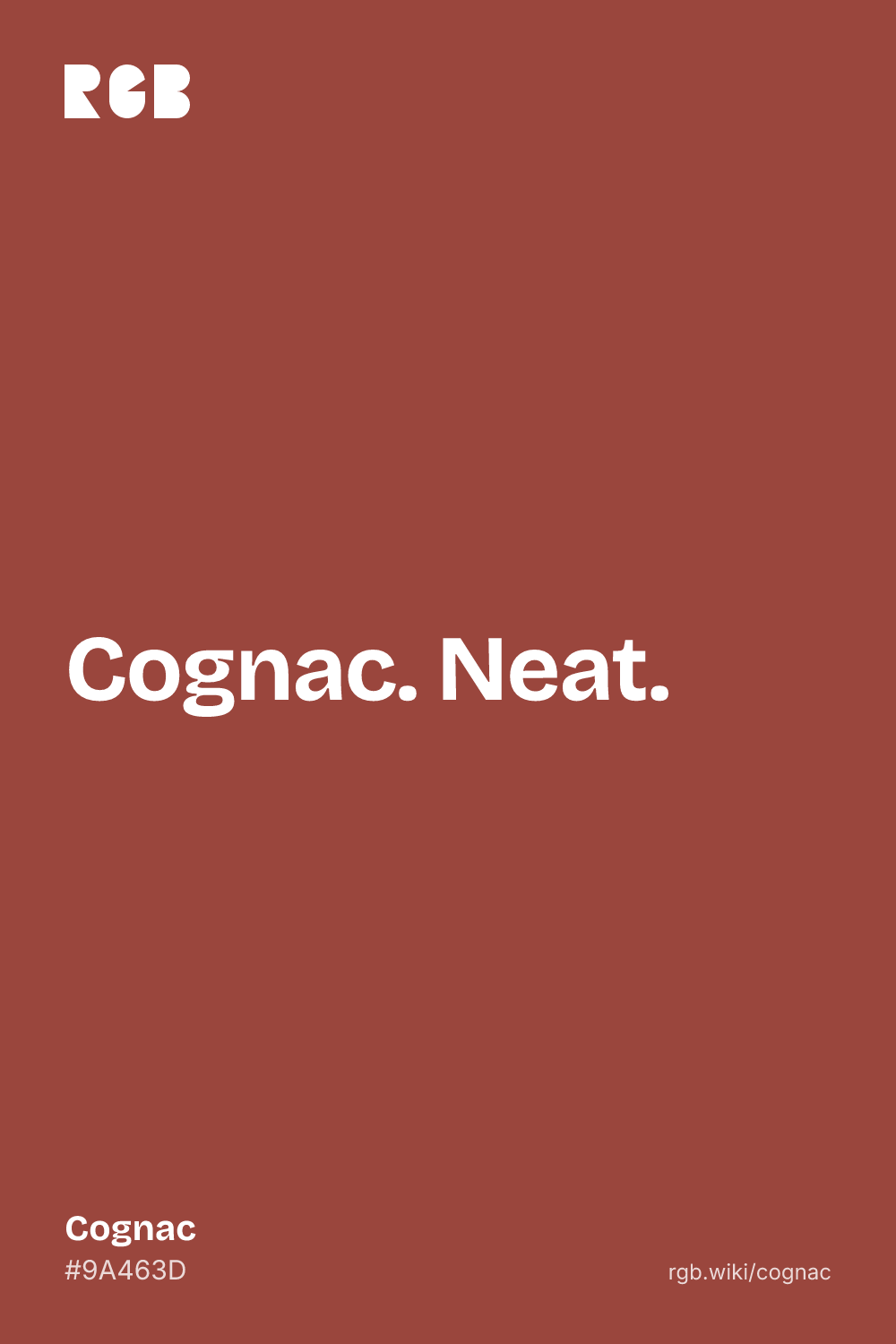
A deep reddish brown named after the French brandy, which takes its color from oak.
Overview
Cognac is a deep, reddish brown. The code most color lists use, #9A463D, has red at about 60% strength and much less green and blue, which gives a warm brown with a clear red lean. It is almost the same color as chestnut.
The name comes from the brandy, and the brandy from the town of Cognac in western France. Cognac comes off the still as a colorless spirit. All its color comes from the oak casks it ages in, for at least two years and often for decades, and the only coloring the rules allow besides oak is plain caramel.
In a glass, cognac is a clear golden to amber brown, lighter than any solid swatch. The code is closer to the leather goods sold as cognac: a medium brown with an auburn cast. The 1930 A Dictionary of Color had another idea again. Its cognac is a moderate brown, filed in the same color group as its coffee.
Cognac is dark enough for white text and rich enough to carry a design on its own. It pairs well with cream, navy, olive and black.
HEX
#9A463D
RGB
rgb(154, 70, 61)
HSL
hsl(6, 43%, 42%)
HSV
6°, 60%, 60%
CMYK
0, 55, 60, 40
OKLCH
oklch(50.1% 0.114 28.1)
Every code converts from the HEX value #9A463D. No color standard defines cognac. #9A463D is the code most color lists use. The 1955 ISCC-NBS dictionary files the cognac of Maerz and Paul’s A Dictionary of Color (1930) as a moderate brown, about #6F4E37, which is darker and much less red. CMYK is a screen-based estimate; print results vary.
Cognac on the color map
LighterDarker
Chestnut sits almost on top of the reference value, a hair to the right. The dictionary’s cognac is a duller, more yellowish brown and sits just outside the outline on the right, a little lower. Cognac in a glass is a transparent amber that a flat code can’t capture, so it isn’t plotted. The outline is an approximate range, not a measured one.
Shades and tints
Tintswith white
Shadeswith black
Toneswith gray
Cognac sits in the middle. Tints add white, shades add black and tones add gray, in 10% steps out from it. Tap any swatch to copy its code.
Light and dark cognac
#E1C8C5
Pale cognacMixed 70% with white. A dusty rose for backgrounds.
#C2908B
Light cognacMixed 40% with white. A muted, rosy tan.
#9A463D
CognacThe reference color.
#954535
ChestnutAlmost the same, a touch browner. See chestnut
#6F4E37
Dictionary cognacThe ISCC-NBS moderate brown, where the 1955 dictionary files Maerz and Paul’s cognac. The same group as their coffee. See coffee
#5C2A25
Dark cognacMixed 40% with black. A deep red-brown for text and borders.
Colors that go with cognac
Pairings that work in rooms, outfits and interfaces.
Cognac and cream
Warm and inviting, like a leather armchair in a library.
Cognac and navy
Brown shoes with a navy suit. Classic and confident.
Cognac and olive
Earthy and outdoorsy. Good for menswear and travel gear.
Cognac and amber
The leather and the drink: red-brown with a golden glow.
Cognac and slate
A cool blue-gray calms the warm brown. Modern and quiet.
Cognac night
A dark theme with a lighter cognac as the accent.
Color-wheel palettes
Pick a palette to see where its colors sit on the color wheel. The caret marks cognac. Tap a band to copy its code.
Lined up by hue around cognac. Hover a color to see how similar it is.The bar under each name shows how similar it is. Similarity comes from the distance between the two colors in OKLab, a model of how we see color.
Cognac vs chestnut
Cognac#9A463D · hue 6°
A touch redder
Named after a French brandy
Also a common leather color
Chestnut#954535 · hue 10°
A touch browner and darker
Named after the nut
Also a horse and hair color
Meaning
Brandy
Oak casks
Western France
Leather
Cognac suggests old leather, oak casks and an after-dinner glass. Its meanings come from the brandy, a protected French spirit whose color is a record of time spent in wood. Color research tests broad words like brown and red, not cognac, so the claims here are about the drink, its rules and the trade names it lent to leather.
Colorless until it meets oak
Well established
Cognac is distilled twice in copper stills and comes off the still as a colorless spirit of about 70% alcohol. It must then age at least two years in oak casks, where it develops its color, aromas and flavors. Aged brandies in general take their golden or brown color from the wood.1, 2, 3
Caramel is the only added color
Legal rule
Under the rules of the Cognac appellation, the only ways to adjust the color are plain caramel, the additive E150a, and an infusion of oak chips.4
Named after a town
Word history
Cognac is named after the French town in and around which the brandy is made, and Merriam-Webster dates the word in English to 1751. The word brandy itself comes from the Dutch brandwijn, “burnt wine”: Dutch traders distilled the region’s wines to keep them from spoiling at sea.5, 6
A leather color too
One trade guide
In the leather trade, cognac names a medium brown with a reddish cast. One saddlery’s color guide calls it “aptly named for its resemblance to cognac liquor” and describes it as a medium brown with subtle auburn undertones. Makers set their own shades, so cognac leather varies.7
Sources (7)
Bureau National Interprofessionnel du Cognac, “Production”, section Aging.
Wikipedia, “Cognac”, sections Distillation and Aging.
Cognac was a trade before it was a color. Dutch merchants, oak casks and French law shaped the brandy, and the color name followed it into fashion and the color dictionaries.
1500s
Dutch traders begin distilling the wines of the Charente to preserve them on long voyages. They call the spirit brandwijn, burnt wine, the root of the word brandy.1
1600s
Double distillation arrives in the region. Delays in loading ships reveal that the spirit improves with age in casks of oak from the nearby Limousin forest.1
Wikipedia, “Cognac”, section Grades, citing the Bureau National Interprofessionnel du Cognac.
Questions
What color is cognac?
A deep, reddish brown. The code most color lists use is #9A463D (RGB 154, 70, 61).
Is cognac the same as chestnut?
Almost. Chestnut (#954535) is a touch browner and cognac (#9A463D) a touch redder. Side by side, they are hard to tell apart.
Why is cognac brandy brown?
It isn’t at first. Cognac comes off the still colorless and takes its color from the oak casks it ages in, for at least two years. Producers may also adjust the color with plain caramel.
Is cognac leather the same color?
Close, but it varies. Leather sold as cognac is usually a medium brown with a red or auburn cast, and each maker sets its own shade.
What is the difference between cognac and caramel?
Caramel (#C68E17) is lighter and golden. Cognac (#9A463D) is darker and redder, closer to chestnut.
What colors go with cognac?
Cream and ivory for warmth, navy or slate blue for contrast, olive for an earthy look, and black for something formal.
Is there an official cognac color code?
No. #9A463D is the code most color lists use, but no standard defines it. The 1930 Dictionary of Color put cognac in a moderate brown, closer to coffee.