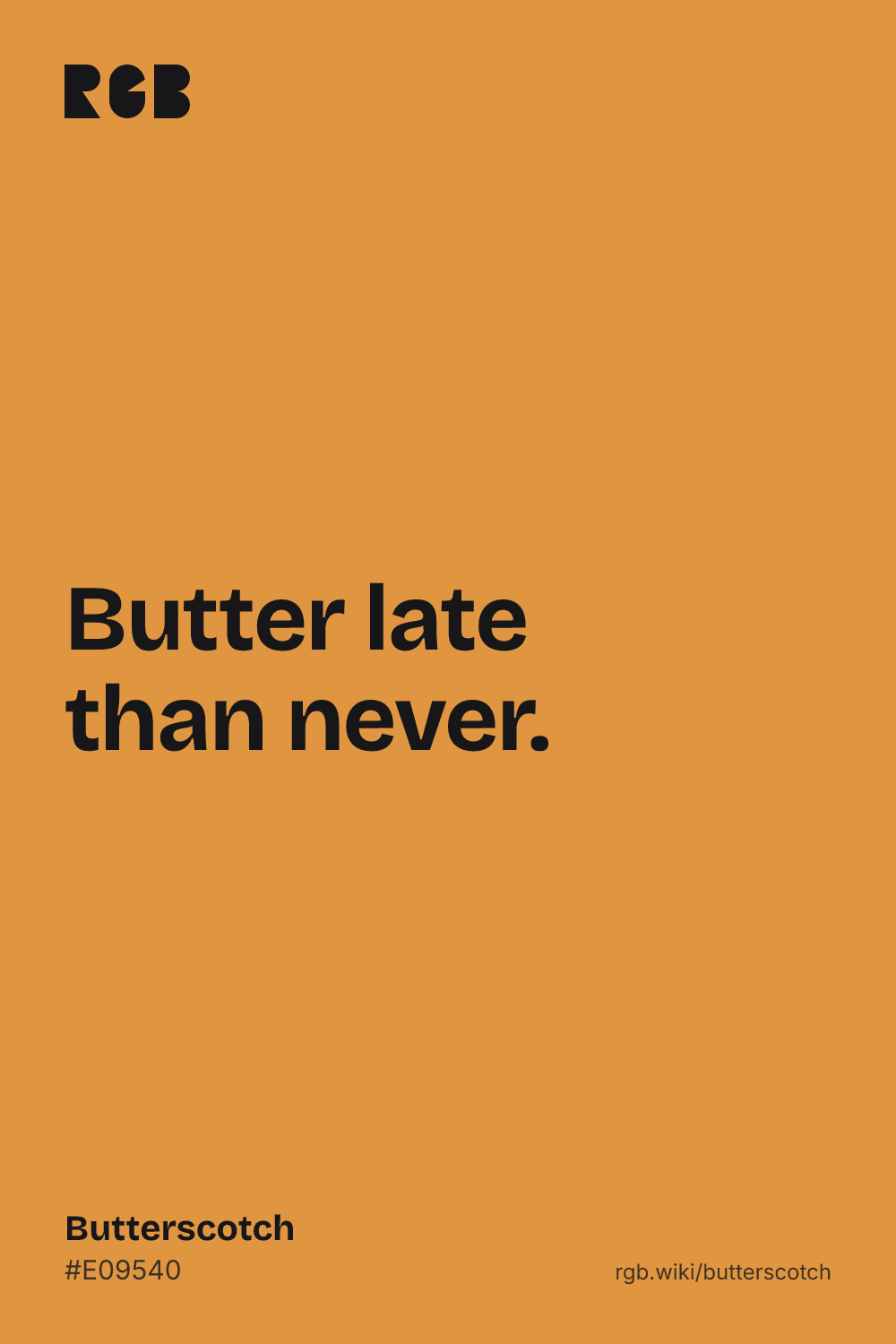
Butterscotch is a warm, light orange brown. Its usual code, #E09540, has red at 88%, green at 58% and blue at 25%, a glowing amber that sits between orange and brown. Next to caramel it looks lighter and more orange; next to fawn, stronger and less pink.
The name comes from a Yorkshire sweet of butter, sugar and treacle, tied to Doncaster from its first records. A newspaper printed a recipe for “Doncaster butterscotch” in 1848, and by 1851 several rival Doncaster confectioners were selling it. Where the “scotch” comes from is still argued over. It probably has nothing to do with Scotland: the main theories are an old verb meaning to score or cut, and the word scorch.
As a color, butterscotch has drifted. Maerz and Paul’s A Dictionary of Color (1930) had a butterscotch sample that the 1955 ISCC-NBS dictionary files as moderate brown and moderate yellowish brown, a mid brown close to toffee, and Merriam-Webster still defines the color as a moderate yellowish brown. Later sources went lighter: a 1950 dictionary put butterscotch among orange yellows, and people in the xkcd color survey picked a bright golden orange, #FDB147. The code sits between the two, much nearer the modern view.
Butterscotch is a light, warm mid-tone. Black or very dark brown text reads well on it, at 8.5 to 1; white text doesn’t, at under 2.5 to 1. It looks old-fashioned and sweet with cream, rich with chocolate and deep red, and bright against navy or plum.