A warm golden orange, like a jar of honey held up to the light.
Overview
Honey is a warm golden orange. Its code, #EBA937, has red near full strength, green at about two-thirds and little blue. It is softer and more orange than amber, lighter than caramel, and almost the same as the code for marigold.
No standard defines the code. Real honey is graded, not named: the U.S. Department of Agriculture sorts it into seven color classes, from Water White to Dark Amber, each a range on a scale of ambers. Darker classes are redder. The palest honeys are a very pale yellow and the darkest are nearly black.
The color follows the flower. Orange blossom and alfalfa honey are white to extra light amber, while buckwheat and avocado honey are dark. Darker honey tastes stronger and holds more minerals, and any honey darkens slowly with age and heat. In a 1962 USDA survey of 490 American honeys, the average color fell in White, the third-palest class.
Honey is a light color, so dark text reads well on it and white text does not. It pairs well with navy, sage, cream, charcoal and soft lavender.
HEX
#EBA937
RGB
rgb(235, 169, 55)
HSL
hsl(38, 82%, 57%)
HSV
38°, 77%, 92%
CMYK
0, 28, 77, 8
OKLCH
oklch(77.9% 0.145 76.5)
Every code converts from the HEX value #EBA937. No color standard defines honey. #EBA937 is the code most color lists use. The 1955 ISCC-NBS dictionary files the honey yellow of Maerz and Paul’s A Dictionary of Color (1930) under dark grayish yellow, #A18F60, a much duller color. Real honey is classed by the USDA’s color standards, which give each class a range on the Pfund scale rather than a screen color. CMYK is a screen-based estimate; print results vary.
Honey on the color map
LighterDarker
Marigold sits almost on the code. Amber lies inside the outline, lighter and yellower, and caramel just inside it at the bottom, darker. The cauldron in the 1224 manuscript lies below the outline: the same hue as the code, but much darker. The dictionary’s dark grayish yellow lies below and to the right, yellower and far duller. The outline is an approximate range, not a measured one.
Shades and tints
Tintswith white
Shadeswith black
Toneswith gray
Honey sits in the middle. Tints add white, shades add black and tones add gray, in 10% steps out from it. Tap any swatch to copy its code.
Light and dark honey
#F9E5C3
Pale honeyMixed 70% with white. A creamy pale gold for backgrounds.
#F3CB87
Light honeyMixed 40% with white. A soft, buttery gold.
#EBA937
HoneyThe reference color.
#AF7D28
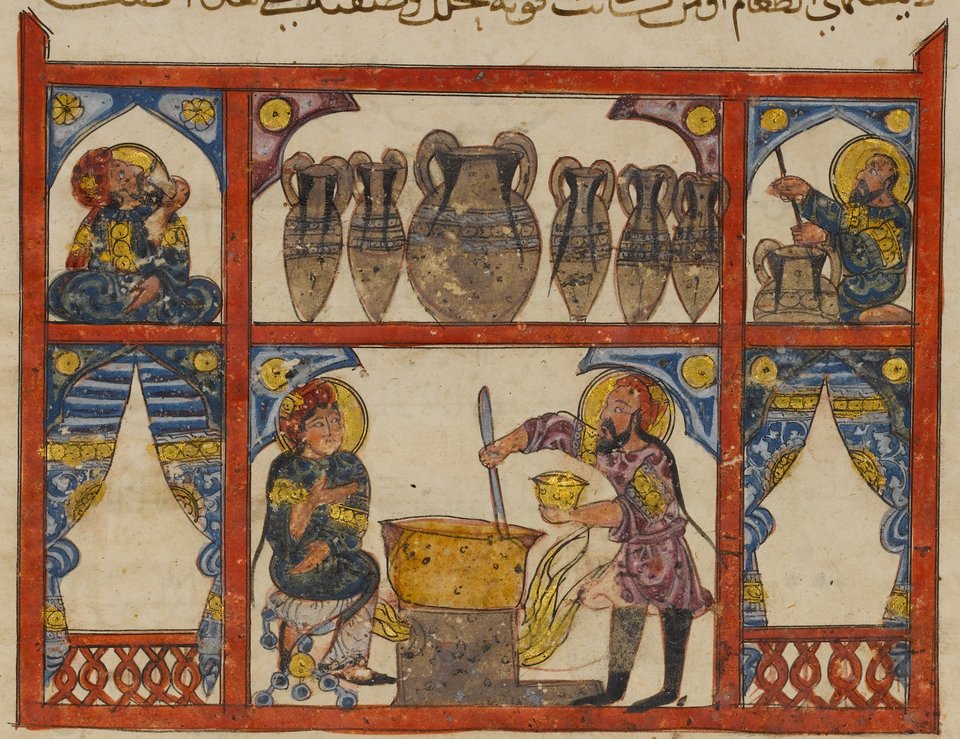
Honey cauldronSampled from the golden cauldron in a 1224 manuscript painting of medicine made from honey. The same hue, darker.
#76541C
Dark honeyMixed 50% with black. A deep golden brown, dark enough for white text.
Colors that go with honey
Pairings that work in rooms, outfits and interfaces.
Honey and cream
Warm and soft, with a dark brown for text.
Honey and navy
Gold against deep blue. Classic and confident.
Honey and sage
Garden colors. Calm and natural.
Pale to dark honey
Honey runs from pale yellow to nearly black. Illustrative tones, not the USDA standards.
Honey and charcoal
A bright accent on near black. Modern and bold.
Honey and lavender
Gold and soft purple, like a bee garden in summer.
Color-wheel palettes
Pick a palette to see where its colors sit on the color wheel. The caret marks honey. Tap a band to copy its code.
Lined up by hue around honey. Hover a color to see how similar it is.The bar under each name shows how similar it is. Similarity comes from the distance between the two colors in OKLab, a model of how we see color.
Honey vs amber
Honey#EBA937 · hue 38°
Softer and more orange
Named after the food
Real honey runs from pale yellow to nearly black
Amber#FFBF00 · hue 45°
Brighter and yellower
Named after fossil resin
Halfway between yellow and orange on the color wheel
Meaning
Floral sources
Color grades
Darkens with age
Sweetheart
Honey suggests sweetness and warmth, and English uses the word for a loved one too. The color varies as much as the food: honey runs from nearly colorless to nearly black, depending mostly on the flowers the bees visited. Color research tests broad words like yellow and orange, not honey, so the claims here are about real honey and how it is graded.
The flower sets the color
Well established
There are more than 300 kinds of honey in the United States, in shades from nearly colorless to dark brown. Orange blossom honey is white to extra light amber, alfalfa honey white or extra light amber, wildflower honey amber to dark amber, and avocado honey dark amber. Climate plays a smaller part, through the darkening effect of heat.1, 2
Darker honey, stronger taste
Well established
As a general rule, light honey tastes milder and dark honey stronger, though some light honeys have strong flavors of their own. Dark honey also holds more minerals and nitrogen than light honey.1, 2
Honey darkens with time
Well established
Heating darkens honey quickly, and storage does the same slowly, at a rate that depends on the temperature. Part of the darkening comes from amino acids reacting with the sugars to form yellow and brown compounds.2
Graded by redness
Official standard
The USDA’s glass color standards of 1951 ask graders to judge a honey’s hue, “amber quality or redness”: honey redder than the Amber standard is Dark Amber. Color is only a label. The U.S. grades state that it is not a factor of quality.3, 4
White, J. W., Jr. & Doner, L. W. (1980). “Honey Composition and Properties”. In Beekeeping in the United States, USDA Agriculture Handbook 335, pp. 82–91.
Honey was labeled and painted long before anyone gave it a color code. In the United States its colors became official classes in 1927.
About 1386–1347 BCE
At the palace of Amenhotep III at Malqata, in Thebes, a jar is labeled in ink as holding honey. A fragment of it was excavated in 1916–17.1
1224
A painter in Baghdad, ʿAbdullah ibn al-Fadl, illustrates an Arabic translation of Dioscorides’ De Materia Medica, a book of medicines, with a scene of preparing medicine from honey.2
1927
The U.S. Department of Agriculture sets up color classes for extracted honey: Water White, Extra White, White, Extra Light Amber, Light Amber and Amber. Honey is matched on the Pfund comparator, against a wedge of amber glass with a millimeter scale.3
1951
Permanent glass color standards replace the Pfund comparator for official grading. To choose the glass, USDA chemists match it to caramel dissolved in glycerin, which matches typical filtered honey. Graders judge hue, “amber quality or redness”.3
1955
The ISCC-NBS dictionary files the honey yellow of Maerz and Paul’s 1930 A Dictionary of Color under dark grayish yellow, a dull, grayish gold.4
1962
A USDA survey analyzes 490 American floral honeys. Their average color is the dark half of White; eastern and southern honeys run darker than average, north-central and intermountain honeys lighter.5
1985
The current U.S. standards list seven color classes, from Water White (8 mm or less on the Pfund scale) to Dark Amber (over 114 mm), and state that color is not a factor of quality.6
The Metropolitan Museum of Art, “Preparing Medicine from Honey”, from a dispersed manuscript of an Arabic translation of De Materia Medica of Dioscorides, dated 621 AH/1224 CE (57.51.21).
Jaffer, A. “(M) Dictionary of Color”, the ISCC-NBS placements of Maerz and Paul’s color names (1955 dictionary).
White, J. W., Jr. & Doner, L. W. (1980). “Honey Composition and Properties”, USDA Agriculture Handbook 335, summarizing Composition of American Honeys, USDA Technical Bulletin 1261 (1962).
A page from an Arabic translation of Dioscorides’ book of medicines, painted in Baghdad by ʿAbdullah ibn al-Fadl. One man stirs a great golden cauldron while another fills a cup. The cauldron reads about #AF7D28: the same hue as the honey code, but darker.
#AF7D28#BA8C41#9B3F1F#C4B295
Source: The Met
Source
Sampled from the cauldron, the red frame and the paper in the Metropolitan Museum of Art’s photograph (57.51.21), a public-domain image released under the museum’s Open Access program (CC0). The image is cropped to the painting. Colors in a photo shift with the lighting, so read the codes as close, not exact.
Palettes are sampled in-house.
Questions
What color is honey?
A warm golden orange. The code most color lists use is #EBA937 (RGB 235, 169, 55). Real honey ranges much wider, from nearly colorless to nearly black.
What are the colors of honey?
In the United States, honey is classed into seven colors: Water White, Extra White, White, Extra Light Amber, Light Amber, Amber and Dark Amber. Each class is a range on the Pfund scale, from 8 millimeters or less for Water White to over 114 for Dark Amber.
Why is some honey darker than others?
Mostly because of the flowers the bees visited. Orange blossom and alfalfa honey are light, while buckwheat and avocado honey are dark. Heat and long storage also darken honey.
Is darker honey better?
Not by the U.S. grades, which do not count color as a factor of quality. Darker honey generally tastes stronger and holds more minerals, and lighter honey tastes milder.
Is honey the same color as amber?
Close, but amber (#FFBF00) is brighter and yellower, and honey (#EBA937) is softer and a little more orange. The U.S. honey classes use the word amber for their darker grades.
What colors go with honey?
Navy, sage green, cream, charcoal and soft lavender. Honey is a light color, so use dark text on it.