Goldenrod

A deep golden yellow named for the late-summer wildflower that gets blamed for hay fever.

Overview

Goldenrod is a deep golden yellow with a lean toward orange. Its code, #DAA520, is the CSS keyword goldenrod: strong red, about two-thirds green and little blue. It is darker and more orange than gold, and a little duller and yellower than marigold.

The name comes from the plant, Solidago, whose small yellow flowers bloom in long plumes from July through October. The plant has been called goldenrod in English since 1568, and the color since 1915. It is the state flower of Nebraska and Kentucky, and it is often blamed for hay fever, though the pollen behind most fall sneezing comes from ragweed.

The web code is darker than the flower most people picture. In the xkcd color survey, the average goldenrod was a lighter, brighter yellow, #FAC205, and the first X Window System color list, in 1985, made goldenrod a pale, pure yellow, #DBDB70. Today’s value arrived in 1989, when the list took in new colors from two contributors, one working from paint samples and the other from a box of crayons.

Goldenrod is a mid-tone, so white text on it reaches only about 2.2:1; use black or a deep brown instead. It pairs well with purple, as goldenrod and asters do in a late-summer field, and with navy, maroon, sage and charcoal.
HEX#DAA520
RGBrgb(218, 165, 32)
HSLhsl(43, 74%, 49%)
HSV43°, 85%, 85%
CMYK0, 24, 85, 15
OKLCHoklch(75.2% 0.147 84.0)
Every code converts from the HEX value #DAA520. #DAA520 is the CSS keyword goldenrod (red 218, green 165, blue 32) in the CSS Color Module Level 4, which took it from the X11 color list by way of SVG 1.0; the X list set this value in 1989, and the 1955 ISCC-NBS dictionary files the goldenrod of Maerz and Paul’s A Dictionary of Color (1930) as a strong yellow, #D4AF37. CMYK is a screen-based estimate; print results vary.
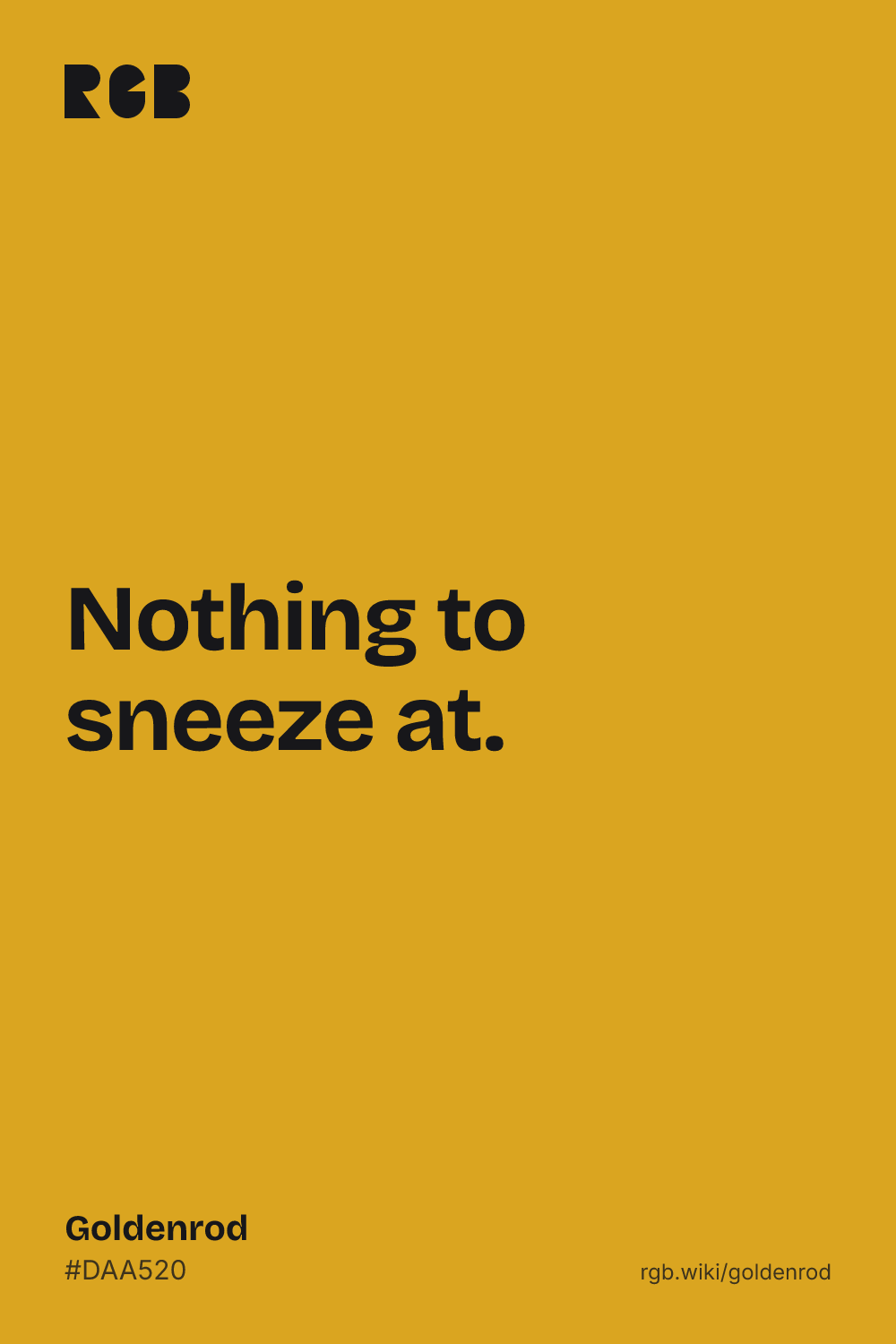
Goldenrod color card, hex #DAA520: “Nothing to sneeze at”

Goldenrod on the color map

People’s average goldenrod in the xkcd survey is lighter and a touch yellower than the code, near the top of the outline. The dictionary’s strong yellow sits just to the right, yellower at about the same lightness, and the printed flowers of 1890 fall between the two. The first X goldenrod of 1985 lies far outside, up and to the right: a pale, pure yellow. The outline is an approximate range, not a measured one.

Shades and tints

Tints with white

Shades with black

Tones with gray

Goldenrod sits in the middle. Tints add white, shades add black and tones add gray, in 10% steps out from it. Tap any swatch to copy its code.

Light and dark goldenrod

#FAFAD2
Light goldenrod yellowThe CSS keyword lightgoldenrodyellow. Almost white, with a faint yellow tint. See light goldenrod yellow
#EEE8AA
Pale goldenrodThe CSS keyword palegoldenrod. A soft, creamy yellow for backgrounds. See pale goldenrod
#DBDB70
First goldenrod (1985)The goldenrod of the earliest X Window System color list: a pale, pure yellow, replaced in 1989.
#DAA520
GoldenrodThe reference color, the CSS keyword goldenrod.
#D4AF37
Dictionary goldenrodISCC-NBS strong yellow, where the 1955 dictionary files Maerz and Paul’s 1930 goldenrod. A little yellower and duller; the gold page shows the same code as metallic gold.
#B8860B
Dark goldenrodThe CSS keyword darkgoldenrod. A deep mustard brown, called medium goldenrod in the X list until December 1989. See dark goldenrod

Colors that go with goldenrod

Pairings that work in rooms, outfits and interfaces.

Goldenrod and aster purple

The pairing of a late-summer field, where goldenrod and purple asters often bloom together. Opposites on the color wheel.

Goldenrod and navy

Warm gold on deep blue. Classic and confident, like a set of school colors.

Goldenrod and maroon

The University of Chicago’s first color, and the maroon that replaced it in 1894. Rich and collegiate.

Goldenrod and sage

Gold flowers over gray-green leaves. Earthy and calm, good for gardens and homes.

Goldenrod and charcoal

Bold and modern. Let goldenrod carry the accents and keep the text light.

Goldenrod and teal

Warm gold against cool blue-green. Lively without being loud.

Color-wheel palettes

Pick a palette to see where its colors sit on the color wheel. The caret marks goldenrod. Tap a band to copy its code.

Similar colors

Butterscotch75%Indian yellow79%Gamboge87%Marigold87%Honey83%Orpiment72%Goldenrod

Lined up by hue around goldenrod. Hover a color to see how similar it is.The bar under each name shows how similar it is. Similarity comes from the distance between the two colors in OKLab, a model of how we see color.

Goldenrod vs marigold

Goldenrod#DAA520 · hue 43°
  • A little darker and duller
  • Leans less toward orange
  • The CSS keyword goldenrod
Marigold#EAA221 · hue 39°
  • Brighter and more orange
  • The ISCC-NBS strong orange yellow
  • Named for the flower of Day of the Dead altars

Meaning

  • Wildflower
  • Hay fever myth
  • State flower
  • Paper color

Goldenrod is the wildflower of late summer, loved by bees and blamed for sneezing. Two states chose it as their flower and a third as their wildflower, and printers list it as a standard paper color. Studies of color and mood test basic words like yellow, not goldenrod, so the claims here are about the plant and how people use the name.

Not the cause of hay fever

Well established

Goldenrod blooms at the same time as fall allergies, so it takes the blame. But it is pollinated by insects, and its pollen grains are too heavy to be carried by the wind. The culprit is ragweed, a plain green plant whose fine pollen fills the air from August into November.1, 2

Florists can still react

One small study

Handling the flowers day after day is another matter. A Dutch hospital described 14 patients, most of them flower-industry workers, who had become allergic to flowers they handled; their tests showed cross-reactions with goldenrod pollen among others, and most changed jobs. It is a small case series, not a measure of how common this is.3

A state flower twice over

Official record

Nebraska declared the goldenrod its state flower in 1895, and Kentucky adopted it in 1926. South Carolina made tall goldenrod, Solidago altissima, its official state wildflower in 2003.4, 5, 6

A standard paper color

Technical standard

The 1995 Printer MIB, a standard that lets printers report the paper in each tray, lists seven paper colors taken from international printing standards: white, pink, yellow, buff, goldenrod, blue and green. The Printer Working Group’s 2013 list gives goldenrod the same reference code as CSS, #DAA520.7, 8

Sources (8)
  1. Swihart, E. (2022). “Autumn allergies: don’t blame goldenrod”. Good Growing, University of Illinois Extension.
  2. American College of Allergy, Asthma & Immunology, “Ragweed Allergy”.
  3. de Jong, N. W., Vermeulen, A. M., Gerth van Wijk, R. & de Groot, H. (1998). “Occupational allergy caused by flowers”. Allergy, 53(2), 204–209.
  4. Nebraska Secretary of State, “State Symbols”, State Flower.
  5. Kentucky General Assembly, KRS 2.090, “State flower”; Kentucky Department of Tourism, “Symbols & Traditions” (adopted 1926).
  6. South Carolina Code of Laws, Section 1-1-704, “Official State wildflower” (2003 Act No. 31).
  7. Smith, R., Wright, F., Hastings, T., Zilles, S. & Gyllenskog, J. (1995). RFC 1759: Printer MIB, prtInputMediaColor (values from ISO 10175 and ISO 10180).
  8. The Printer Working Group (2013). PWG 5101.1-2013, Media Standardized Names 2.0, Table 2, Color Names.

History

Goldenrod was the name of a plant for more than three centuries before it named a color. Along the way it was a university’s first color, two states’ flower and the subject of Edison’s last big research project, and its screen code changed before it reached the web.

  1. 1568

    First recorded use of goldenrod in English, as the name of the plant.1

  2. By 1892

    By October 1, when the University of Chicago holds its first classes, its board of trustees has chosen goldenrod as the school’s color.2

  3. 1894

    On May 5, students and faculty switch the University of Chicago to maroon. Football coach Amos Alonzo Stagg later wrote that the yellow “ran, soiled easily, and had a regrettable symbolism”.2

  4. 1895

    Nebraska’s legislature declares the goldenrod, Solidago serotina, the state flower.3

  5. 1915

    First recorded use of goldenrod as a color name in English.4

  6. 1926

    Kentucky adopts the goldenrod as its state flower. The law today reads simply: “The goldenrod is the official state flower of Kentucky.”5

  7. 1927

    Thomas Edison, Henry Ford and Harvey Firestone found the Edison Botanic Research Corporation in Fort Myers, Florida, to find a homegrown source of rubber. Edison tests more than 17,000 plants and settles on goldenrod as the most promising.6, 7

  8. 1930

    Maerz and Paul print a goldenrod sample on plate 10 of A Dictionary of Color.4

  9. 1955

    The ISCC-NBS dictionary files Maerz and Paul’s goldenrod under strong yellow, #D4AF37, a little yellower than today’s web code.8

  10. 1985

    The X Window System’s color list is first checked into revision control, on August 19. Its goldenrod is 219, 219, 112 (#DBDB70), a pale, pure yellow.9

  11. 1989

    On October 31, the day John C. Thomas shares a list of colors he matched to his box of 72 crayons, the X list’s goldenrod changes to 218, 165, 32, today’s #DAA520. By mid-December the list also has dark goldenrod, pale goldenrod and light goldenrod yellow.9, 10

  12. 2001

    SVG 1.0 lists goldenrod as red 218, green 165, blue 32, the code CSS still uses.11

Sources (11)
  1. Merriam-Webster, “goldenrod”, definition and first known use.
  2. University of Chicago Athletics, “Maroon, Maroons, and the Phoenix”, quoting Stagg’s autobiography, Touchdown!
  3. Nebraska Secretary of State, “State Symbols”, State Flower.
  4. Wikipedia, “Goldenrod (color)”, citing Maerz and Paul, A Dictionary of Color (1930), p. 196 and plate 10, sample L5.
  5. Kentucky Department of Tourism, “Symbols & Traditions”; Kentucky General Assembly, KRS 2.090, “State flower”.
  6. Vargues, L. (2013). “In Search of Thomas Edison’s Botanical Treasures”. Plant Talk, New York Botanical Garden.
  7. National Park Service, Thomas Edison National Historical Park, “Year of Innovation: September”.
  8. Jaffer, A. “Maerz and Paul color names”, with ISCC-NBS centroids from “Color-Name Dictionaries”, MIT CSAIL.
  9. X Consortium, revision history of rgb.txt, imported from the consortium’s historical archive; see the 1985 file and the change of October 31, 1989.
  10. Sexton, A. (2014). “Re: Last call comments on CSS3 module: color”, www-style mailing list, W3C.
  11. W3C (2001). Scalable Vector Graphics (SVG) 1.0 Specification, recognized color keyword names.

Goldenrod in use

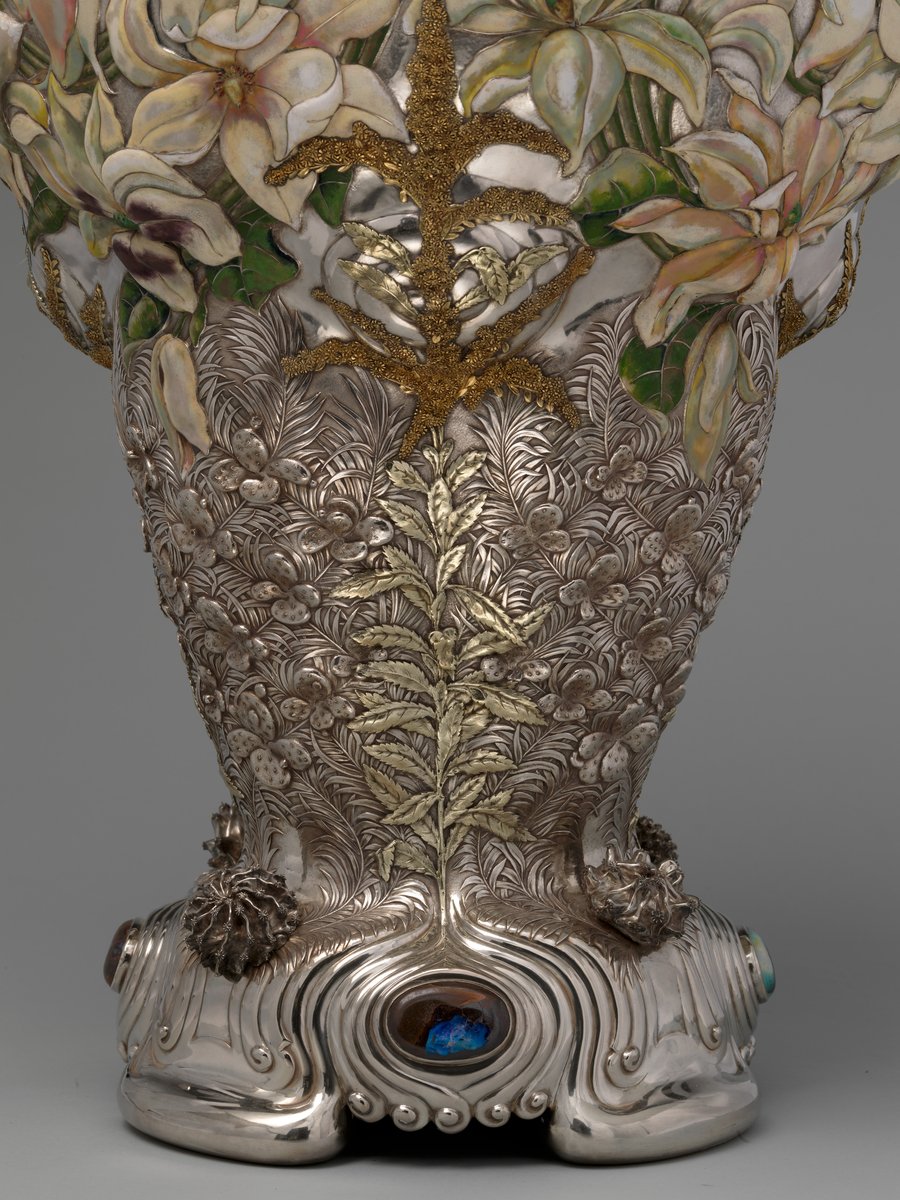
The lower half of a silver vase: enameled white and pink magnolias at the top, a spray of goldenrod in textured gold running down the center, and a silver base set with an opal
#A28E70#7E6646#634A29#492F10
MetalworkThe Magnolia Vase by Tiffany & Co. (1893)

The centerpiece of the firm’s display at the 1893 World’s Columbian Exposition in Chicago. Pinecones, magnolias and cacti stand for parts of the United States; goldenrod, made of American gold, stands for the whole country. In the photo the gold sprays read as a deep bronze, about #7E6646, with bright glints where they catch the light.

#A28E70#7E6646#634A29#492F10
Source: The Met
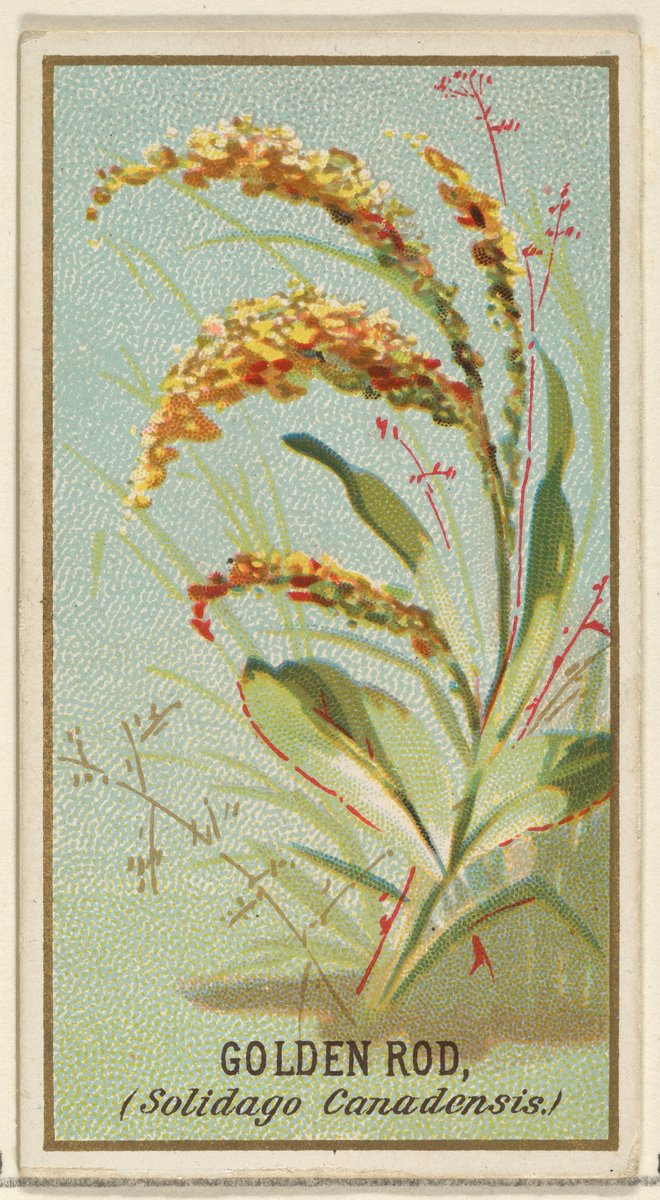
A small printed card showing a goldenrod plant with arching plumes of yellow and orange flowers against a pale blue-green background, captioned Golden Rod (Solidago Canadensis)
#DDBE65#BD9955#A87737#8B4E24
Trade cardGolden Rod, from a Flowers series (1890)

A small lithographed card from Goodwin & Company’s Flowers series, now at the Metropolitan Museum of Art, showing Canada goldenrod, Solidago canadensis. The printer shaded the plumes from a soft yellow, about #DDBE65, through gold to rust. The middle gold, #BD9955, has almost the same hue as the web code but is darker and duller.

#DDBE65#BD9955#A87737#8B4E24
Source: The Met

Palettes are sampled in-house.

Questions

What color is goldenrod?

A deep golden yellow that leans toward orange. The web code is #DAA520 (RGB 218, 165, 32), the CSS keyword goldenrod.

Does goldenrod cause hay fever?

Rarely, if ever. Goldenrod is pollinated by insects, and its heavy pollen doesn’t travel far on the wind. It blooms at the same time as ragweed, whose fine, windblown pollen is the main cause of late-summer and fall hay fever. People who handle the flowers every day, such as florists, can still become allergic.

Which states have goldenrod as their state flower?

Nebraska, since 1895, and Kentucky, since 1926. South Carolina named tall goldenrod its state wildflower in 2003.

What is the difference between goldenrod and gold?

Goldenrod (#DAA520) is darker and more orange. Gold (#FFD700) is lighter and closer to pure yellow. Both are CSS keywords.

What are dark goldenrod, pale goldenrod and light goldenrod yellow?

Three more CSS keywords. Dark goldenrod (#B8860B) is a deep mustard brown. Pale goldenrod (#EEE8AA) is a soft cream yellow, and light goldenrod yellow (#FAFAD2) is almost white.

What colors go with goldenrod?

Purple, as in a late-summer field of goldenrod and asters. Navy, maroon and charcoal for contrast, and sage for an earthy look. Put dark text on goldenrod; white text is hard to read on it.

What is goldenrod paper?

A deep yellow paper, one of seven standard paper colors in printer standards, along with white, pink, yellow, buff, blue and green. The Printer Working Group gives it the same reference code as CSS, #DAA520.