Tangerine

A vivid orange named after Tangier, and redder on the fruit than on screen.

Overview

Tangerine is a vivid orange, deeper than the CSS keyword orange and yellower than pumpkin. Its code is #F28500: red near full strength, green a little over half and no blue at all. That puts it almost exactly on the center of the ISCC-NBS color group vivid orange.

The name comes from a port. Merriam-Webster traces tangerine to French Tanger, the city of Tangier in Morocco, and dates it to 1842 for the fruit. In Florida, a mandarin believed to have come from Tangier was growing by 1843, and a seedling of it, the Dancy, spread the name. As a color word, tangerine goes back to at least 1899.

Real tangerines are redder than the code. Merriam-Webster defines the color as “a moderate to strong reddish orange”, the Dancy’s rind turns reddish orange when ripe, and the 1955 ISCC-NBS dictionary filed Maerz and Paul’s tangerine as a moderate reddish orange, #CB6D51. The red comes from a peel pigment, β-citraurin. Botanically, a tangerine is a kind of mandarin, and a clementine is a mandarin crossed with a sweet orange.

On screens, tangerine needs dark text: white text on it reaches only about 2.6:1. It suits food, sport and bright buttons, and pairs well with navy, teal and leaf green. Two football clubs call their color tangerine, and their crests, shown below, use two different oranges.
HEX#F28500
RGBrgb(242, 133, 0)
HSLhsl(33, 100%, 47%)
HSV33°, 100%, 95%
CMYK0, 45, 100, 5
OKLCHoklch(72.2% 0.172 58.5)
Every code converts from the HEX value #F28500. No color standard defines tangerine. #F28500 is the code most color lists use, and Wikipedia credits it to color websites, not to a dictionary. It falls almost exactly on the center of ISCC-NBS vivid orange, #F38400, one of the two groups where the 1955 ISCC-NBS dictionary files the tangerine of Taylor, Knoche & Granville’s Descriptive Color Names Dictionary. Maerz and Paul’s tangerine (1930), the source of the 1899 date, is filed far redder and softer, as a moderate reddish orange (Jaffer’s tables). CMYK is a screen-based estimate; print results vary.
Tangerine color card, hex #F28500: “Going off on a tangerine”

Tangerine on the color map

The x-axis is hue, from red on the left to yellow on the right. The ISCC-NBS vivid orange sits right on the reference. The survey’s tangerine and Blackpool’s crest lie just above and to the right, a touch lighter and yellower, and Dundee United’s crest falls to the left, redder. The two dictionary tangerines, Maerz and Paul’s and the textile card’s, sit together at the lower left, outside the outline: darker, redder and softer. The printed fruit lies far up and to the right, a pale apricot. The outline is an approximate range, not a measured one.

Shades and tints

Tints with white

Shades with black

Tones with gray

Tangerine sits in the middle. Tints add white, shades add black and tones add gray, in 10% steps out from it. Tap any swatch to copy its code.

Light and dark tangerine

#F7B666
Light tangerineMixed 40% with white. A warm apricot for backgrounds.
#FF9408
Survey tangerineThe xkcd color survey’s tangerine: a touch lighter and yellower.
#F28500
TangerineThe reference color.
#FF7518
PumpkinRedder and a little lighter, with a page of its own. See pumpkin
#CB6D51
Dictionary tangerineThe ISCC-NBS moderate reddish orange, where the 1955 dictionary files Maerz and Paul’s tangerine. Redder and softer, closer to Merriam-Webster’s definition.
#915000
Dark tangerineMixed 40% with black. A deep amber brown that holds white text.

Colors that go with tangerine

Pairings that work in rooms, outfits and interfaces.

Tangier

Tangerine with harbor blue, whitewash and clay.

Citrus grove

The fruit with glossy leaves and blossom white.

Tangerine and navy

A bright accent on a deep, calm base.

Tangerine and teal

Orange against deep teal, its near opposite.

Tangerine and black

Bold and sporty, the colors of a football kit.

Surimono

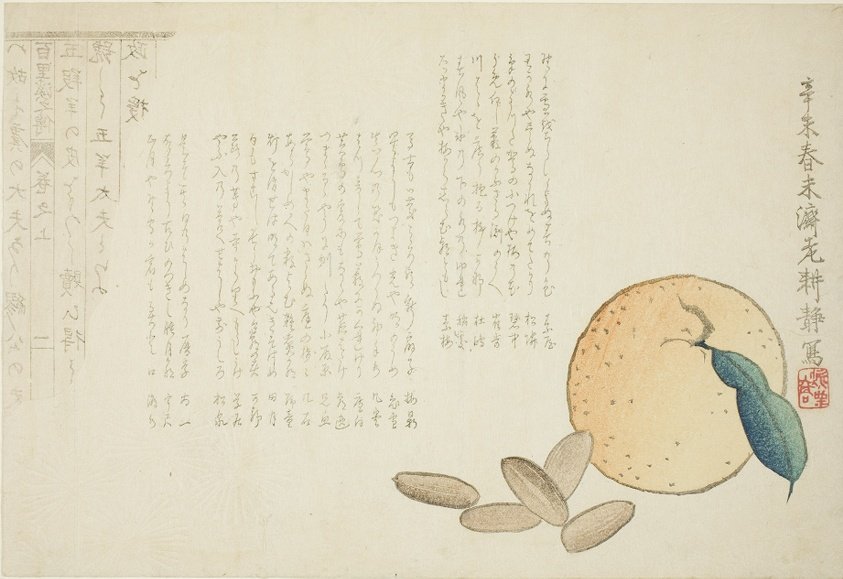
From Kosei’s 1871 print: a pale tangerine, a blue-green leaf and nuts on cream paper.

Color-wheel palettes

Pick a palette to see where its colors sit on the color wheel. The caret marks tangerine. Tap a band to copy its code.

Similar colors

Coral72%Papaya72%Pumpkin80%Safety orange84%TangerineButterscotch78%Gamboge73%

Lined up by hue around tangerine. Hover a color to see how similar it is.The bar under each name shows how similar it is. Similarity comes from the distance between the two colors in OKLab, a model of how we see color.

Tangerine vs pumpkin

Tangerine#F28500 · hue 33°
  • Yellower and a little deeper
  • Named after a citrus fruit, and the fruit after a port
  • Almost exactly the ISCC-NBS vivid orange
Pumpkin#FF7518 · hue 24°
  • Redder and a little lighter
  • Named after a squash
  • No standard code

Meaning

  • Named for Tangier
  • A kind of mandarin
  • The red in the rind
  • Cold nights

Tangerine’s meanings come from the fruit and its name, not from studies of the color: research on color and feeling tests broad words like orange, not tangerine. What the fruit does explain is why the dictionaries’ tangerine is redder than the web’s.

Named after a port

Dictionary record

Merriam-Webster traces tangerine to French Tanger, the Moroccan port of Tangier, plus the English ending -ine, and dates its first use for the fruit to 1842. The word is older as an adjective meaning “of Tangier”: the Oxford English Dictionary, as cited by Wikipedia, finds it in The Tatler in 1710.1, 2

A tangerine is a mandarin

Well documented

Merriam-Webster defines a tangerine as any of various mandarin oranges with usually deep orange skin and pulp. UC Riverside’s citrus collection traces the name to the Dancy, a Florida mandarin descended from a tree believed to have come from Tangier, and notes that the word now seems to cover any mandarin. Mandarin itself may come from the color of a Chinese official’s robes, Merriam-Webster suggests, though it marks that origin as uncertain.1, 3, 4

A clementine is half orange

Genetic evidence

A 2018 genome study in Nature confirmed that the clementine is a cross between the Willowleaf mandarin and the sweet orange, selected from a chance seedling found in Algeria. Merriam-Webster traces its name to Clément Rodier, the French priest who found it around 1902. The same study showed that the Ponkan mandarin is a parent of the Dancy tangerine.5, 6

The red in the rind

Measured

The peel of oranges and mandarins gets an orange-reddish tint from β-citraurin, a pigment that an enzyme cuts from larger carotenoids, zeaxanthin and β-cryptoxanthin. In 2013, researchers in Spain identified that enzyme, and a 2015 study found its gene most active in the peels with the deepest orange-red color. UC Riverside describes the ripe Dancy’s rind as reddish orange.7, 8, 3

The orange needs cold nights

Extension guidance

University of Florida researchers write that citrus peel turns from green to orange when night temperatures drop below 55 °F (about 13 °C), whatever the ripeness inside, and that in the tropics, where nights stay warmer, ripe fruit stays green. Packinghouses often finish the color with a trace of ethylene gas, about 3 to 5 parts per million, a step called degreening.9

Sources (9)
  1. Merriam-Webster, “tangerine”.
  2. Wikipedia, “Tangerine”, section Etymology, citing the Oxford English Dictionary.
  3. Givaudan Citrus Variety Collection at UC Riverside, “Dancy mandarin”.
  4. Merriam-Webster, “mandarin”.
  5. Wu, G. A., Terol, J., Ibanez, V., et al. (2018). Genomics of the origin and evolution of Citrus. Nature, 554(7692), 311–316. doi:10.1038/nature25447.
  6. Merriam-Webster, “clementine”.
  7. Rodrigo, M. J., Alquézar, B., Alós, E., et al. (2013). A novel carotenoid cleavage activity involved in the biosynthesis of Citrus fruit-specific apocarotenoid pigments. Journal of Experimental Botany, 64(14), 4461–4478. doi:10.1093/jxb/ert260.
  8. Zheng, X., Xie, Z., Zhu, K., Xu, Q., Deng, X. & Pan, Z. (2015). Isolation and characterization of carotenoid cleavage dioxygenase 4 genes from different citrus species. Molecular Genetics and Genomics, 290(4), 1589–1603. doi:10.1007/s00438-015-1016-8.
  9. Ritenour, M. A. & Alferez, F. (2020). “Obtaining Optimal Peel Color of Fresh Florida Citrus”. Citrus Industry, 21 September 2020.

History

Tangerine is a place name that became a fruit, then a color. Its story runs from a Moroccan port to Florida orchards and two football grounds.

  1. 1710

    Tangerine appears in English as an adjective meaning “of Tangier”, the Moroccan port on the Strait of Gibraltar, in The Tatler.1

  2. 1842

    The first known use of tangerine for the fruit, from French Tanger, Tangier.2

  3. 1843

    A mandarin known as the Moragne “tangierine” grows in N. H. Moragne’s orchard in Florida. It is believed to have come from Tangier with Major Atway, the property’s previous owner.3

  4. 1867

    A seedling of that tree in Colonel G. L. Dancy’s orchard at Orange Mills, Florida, becomes the Dancy. Its reputed origin in Tangier gives the name tangerine, now used for almost any mandarin.3

  5. 1899

    The first recorded use of tangerine as a color name in English, according to Maerz and Paul’s A Dictionary of Color (1930), which prints a tangerine sample on its plate 2.4

  6. 1902

    The clementine, a chance seedling from the orphanage garden of Brother Clément Rodier at Misserghin, Algeria, is named after him. The article that names it calls it “une nouvelle tangérine”, a new tangerine.5, 6

  7. 1923

    Blackpool F.C. takes up tangerine shirts. A club director and referee, Albert Hargreaves, had been taken with the orange of the Netherlands team, and supporters date the new shirts to a home game against Crystal Palace on 29 September.7

  8. 1955

    The ISCC-NBS dictionary of color names files Maerz and Paul’s tangerine as a moderate reddish orange and the textile industry’s Standard Color Card tangerine as a strong reddish orange, while Taylor, Knoche & Granville’s tangerine falls in vivid or strong orange.8

  9. 1969

    Dundee United first wears tangerine, on 4 August against Everton, after Barbara Kerr, the manager’s wife, took to the burnt orange shirts the team had worn in America as the Dallas Tornado.9

  10. 1999

    Apple sells its iMac in five fruit colors: grape, strawberry, lime, blueberry and tangerine.10

Sources (10)
  1. Wikipedia, “Tangerine”, section Etymology, citing the Oxford English Dictionary.
  2. Merriam-Webster, “tangerine”.
  3. Givaudan Citrus Variety Collection at UC Riverside, “Dancy mandarin”.
  4. Wikipedia, “Shades of orange: Tangerine”, citing Maerz and Paul, A Dictionary of Color (1930), p. 205 and plate 2.
  5. Merriam-Webster, “clementine”.
  6. Wikipedia, “Clementine”, section History, citing Trabut, L. (1902). L’hybridation des Citrus: une nouvelle tangérine, “la Clémentine”. Revue Horticole, 74, 232–234.
  7. Blackpool Supporters’ Trust, “Did you know?”.
  8. Jaffer, A. “A Dictionary of Color” (Maerz and Paul), “Standard Color Card of America” and “Descriptive Color Names Dictionary” tables, with their ISCC-NBS groups.
  9. Dundee United F.C., “50 Years of Tangerine”, 8 July 2019.
  10. TidBITS, “Jobs Introduces New iMacs and G3 Systems”, 5 January 1999.

Tangerine in use

Japanese woodblock print of a round, pale orange tangerine with one blue-green leaf and four long nuts at lower right, below columns of black calligraphy on cream paper, with a sheet of printed text showing from the back at upper left and a small red seal at right
#DCBD8C#E4CB9E#516869#9B8B6D
PrintTangerine and Chinese Legend by Kosei (1871)

A Japanese surimono print made for the spring of 1871. A tangerine with one leaf and four nuts lies on paper embossed with chrysanthemums. At upper left a sheet seen from the back, its characters reversed, tells the life of Baili Xi, a prime minister of the ancient Chinese state of Qin. In the photo the fruit reads about #DCBD8C on its shaded side: a pale apricot, much softer than the web code.

#DCBD8C#E4CB9E#516869#9B8B6D
Source: Art Institute of Chicago

Logos belong to their owners and are shown unaltered, only to show where each palette comes from. Palettes are sampled in-house.

Questions

What color is tangerine?

A vivid orange: #F28500 (RGB 242, 133, 0). Merriam-Webster defines the color as a moderate to strong reddish orange, so real tangerines and older color dictionaries lean redder than the web code.

Where does the name tangerine come from?

From Tangier, the Moroccan port: French Tanger plus the English ending -ine. Merriam-Webster dates the fruit sense to 1842, and tangerine has been used as a color name since at least 1899.

What is the difference between a tangerine, a mandarin and a clementine?

A tangerine is a kind of mandarin, usually with deep, reddish orange skin, and today the word is used for almost any mandarin. A clementine is a cross between a mandarin and a sweet orange, found in Algeria around 1902.

Is tangerine the same as orange?

No. The CSS keyword orange, #FFA500, is lighter and yellower. Tangerine is deeper and a little redder, and pumpkin (#FF7518) is redder still.

Why are tangerines orange?

Carotenoid pigments, with β-citraurin adding a reddish tint to the peel. The peel turns orange when nights get cool, below about 55 °F; in the tropics ripe fruit can stay green.

Which football clubs play in tangerine?

Blackpool in England, since 1923, and Dundee United in Scotland, since 1969. Their crests use different oranges: #F39200 for Blackpool and a redder #FF6600 for Dundee United.

What colors go with tangerine?

Navy and teal for contrast, leaf green and cream for a fresh citrus look, and black for a bold, sporty one. Use dark text on it: white text on tangerine reaches only about 2.6:1.