Most sand is tan from iron
Government scienceNOAA explains that the tan color of most beach sand comes from iron oxide, which tints quartz a light brown, and from feldspar, which is brown to tan in its original form.1
A warm, light yellow, like a sunlit beach.
Sand is a light, warm yellow with a golden tone. Its code here is #E2CA76: high red and green, much less blue. It is the average color that people named “sand” in the xkcd color survey, in which web users named over five million colors on their own screens.
The name needs no explaining: sand is the loose grain of beaches and deserts, a word that goes back to Old English. As a color word it was in use by 1627, according to Maerz and Paul’s A Dictionary of Color (1930), and Merriam-Webster defines it as “a yellowish-gray color”.
Real sand is rarely this golden, and rarely one color. Most beach sand is tan because iron oxide tints its quartz grains and feldspar adds brown. Volcanic beaches are black, Bermuda’s beaches are pink from the shells of tiny single-celled creatures, and White Sands in New Mexico is bright white gypsum. Older color dictionaries made sand grayer: their sand is closer to #C2B280, the code this site uses for ecru.
Use sand where you want warmth without strong color: beach and travel brands, summer menus, outdoor gear. It pairs naturally with sea teal, navy and terracotta, and with olive for an earthy look.
| HEX | #E2CA76 | |
|---|---|---|
| RGB | rgb(226, 202, 118) | |
| HSL | hsl(47, 65%, 67%) | |
| HSV | 47°, 48%, 89% | |
| CMYK | 0, 11, 48, 11 | |
| OKLCH | oklch(84.1% 0.108 93.9) |
Sandy sits just above the reference, inside the outline. The two dictionary sands sit inside the outline but lower down. This view shows hue and lightness, not how gray a color is, and both are much grayer than the survey’s sand. The dunes in Chase’s painting sit just outside, to the lower left. The outline is an approximate range, not a measured one.
Tints with white
Shades with black
Tones with gray
Pairings that work in rooms, outfits and interfaces.
Beach colors: warm sand and teal water.
Nautical and confident, like a sailing club.
Warm and Mediterranean. Good for food and travel.
Earthy and outdoorsy. Suits gardens and gear.
Light and summery. Keep text a dark brown for contrast.
Modern and grounded. Sand brightens a dark layout.
Pick a palette to see where its colors sit on the color wheel. The caret marks sand. Tap a band to copy its code.
Lined up by hue around sand. Hover a color to see how similar it is.The bar under each name shows how similar it is. Similarity comes from the distance between the two colors in OKLab, a model of how we see color.
Sand suggests beaches, deserts and summer, and in English it also measures time: Merriam-Webster lists “the sand in an hourglass”, and so the moments of a lifetime, among the meanings of the word. Research on color and emotion tests broad hues such as yellow, not sand, so the claims below are about the real material and the name.
NOAA explains that the tan color of most beach sand comes from iron oxide, which tints quartz a light brown, and from feldspar, which is brown to tan in its original form.1
Black sand comes from volcanic rock and is common in Hawaii, the Canary Islands and the Aleutians. Bermuda’s pink beaches come from tiny single-celled, shelled creatures called foraminifera, and some white Hawaiian beaches come from parrotfish, which grind up coral reef as they feed. White Sands in New Mexico is the world’s largest gypsum dunefield, covering 275 square miles.1, 2
Maerz and Paul’s A Dictionary of Color (1930) noted that one textile color card made sand darker than “beach”, while the Standard Color Card of America made it lighter. In 1955, the ISCC-NBS dictionary filed the sand of four references under six color names, including grayish yellow, yellowish gray and light olive gray.3, 4
Sand has been a color word for four centuries, but references have never agreed on it. The bright, golden sand of the web comes from what people call sand today.
First recorded use of sand as a color name in English, according to Maerz and Paul.1
Maerz and Paul’s A Dictionary of Color prints a sample of sand and notes that two color standards disagree on whether sand is darker or lighter than “beach”.1
The Standard Color Card of America, the textile trade’s color card, shows a sand that is later classed as a yellowish gray.2
The Descriptive Color Names Dictionary shows sand as a grayish yellow, about #C2B280 in screen terms.2
The US National Bureau of Standards publishes the ISCC-NBS dictionary, which sorts the sands of four references into six color names.2
In the xkcd color survey, the average color people call sand is a light golden yellow, #E2CA76, this page’s code.3
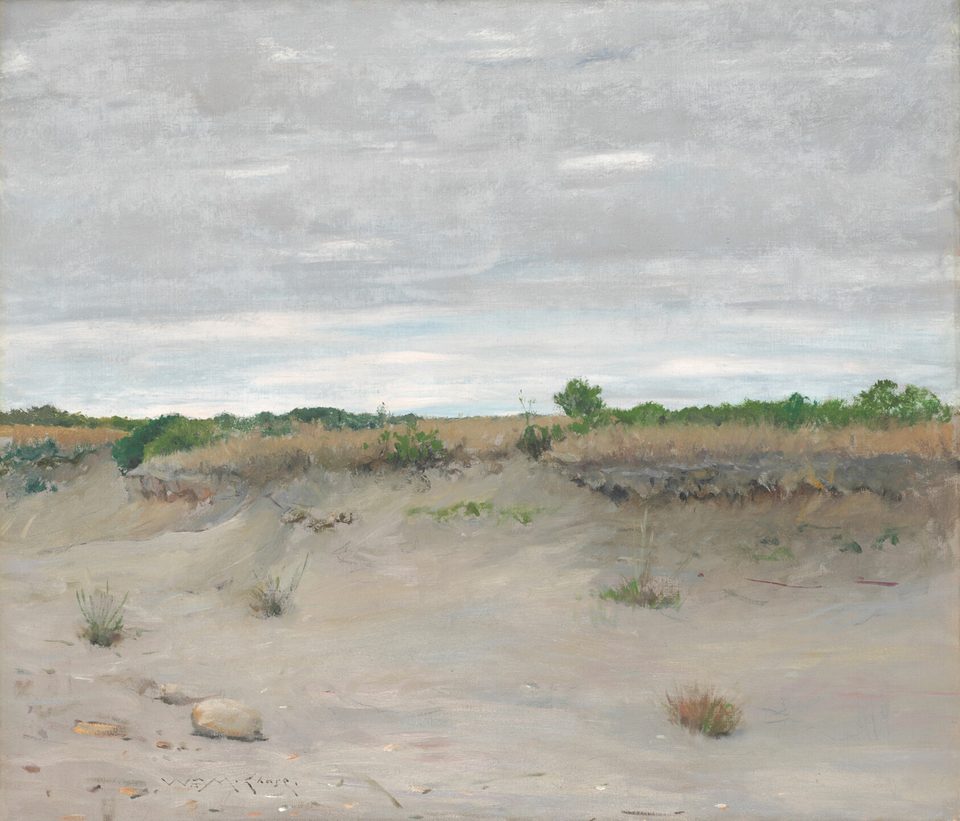
Chase painted the dunes near his summer art school at Shinnecock, Long Island, with quick strokes and, as the Art Institute of Chicago notes, an overall gray tone for an overcast day. Under a gray sky the sand is a pale gray-beige, about #B7AFA3, far from a sunny golden sand.
Sampled from the sand in the Art Institute of Chicago’s image (1991.249), released as CC0 (public domain). The description of the painting comes from the museum’s record. Colors in a photo shift with the lighting, so read the codes as close, not exact.
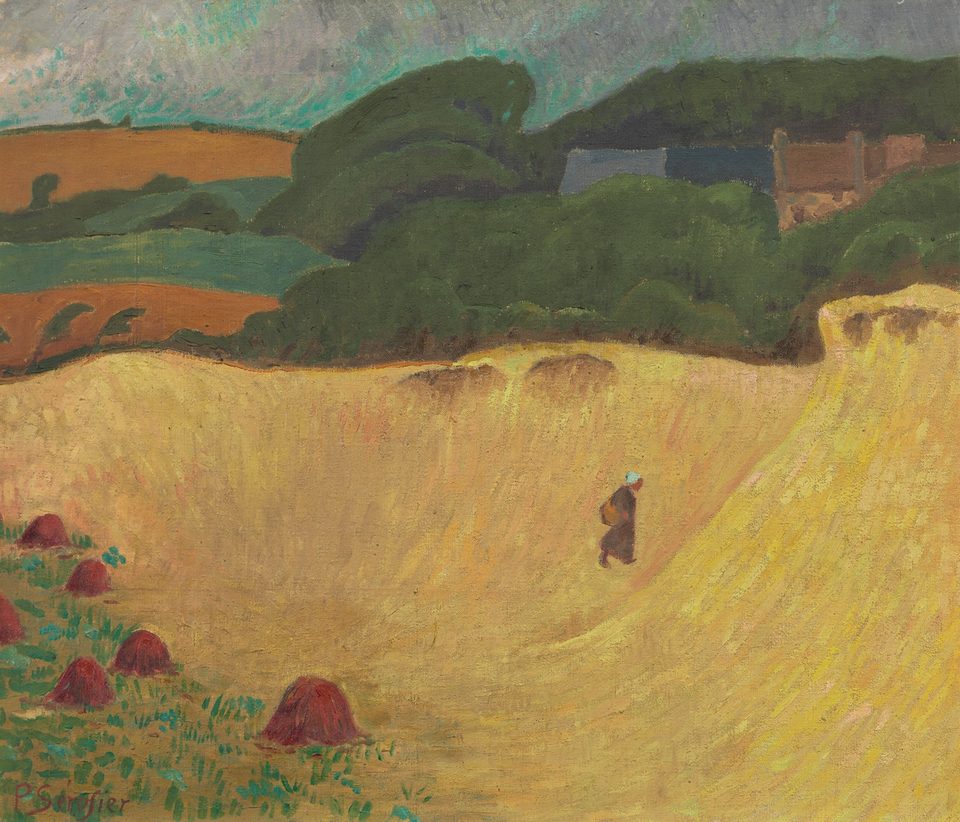
Sérusier painted the dunes of a Breton beach in broad fields of bold color, a style called synthetism, with one tiny figure walking across them. His sand is a warm golden ocher, about #C5A65C: a deeper version of this page’s golden sand.
Sampled from the dunes in the Art Institute of Chicago’s image (2011.307), released as CC0 (public domain). The description of the painting comes from the museum’s record. Colors in a photo shift with the lighting, so read the codes as close, not exact.
Palettes are sampled in-house.
A light, warm yellow with a golden tone. The code here is #E2CA76 (RGB 226, 202, 118), the average sand from the xkcd color survey. Real sand ranges from white to black.
#E2CA76 is the most common web value. No standard defines sand, and older color dictionaries give grayer codes such as #C2B280.
No. The CSS keyword sandybrown (#F4A460) is a light orange, much warmer and pinker than sand.
Beige on the web (#F5F5DC) is a pale off-white. Sand is darker and more golden.
Tan (#D2B48C) is browner and grayer. Sand is lighter and more yellow.
Teal and navy for a beach look, terracotta and olive for an earthy one, and charcoal or white for contrast.