Gamboge

A deep orange yellow named after a poisonous tree resin from Cambodia.

Overview

Gamboge is a deep orange yellow. Its usual code, #E49B0F, has red near full strength, green at about 60% and almost no blue. It sits between goldenrod and marigold: more orange than goldenrod and a shade deeper and purer than marigold.

The name comes from Cambodia. Gamboge is a gum resin tapped from Garcinia trees in Cambodia and Thailand. Workers cut the bark and let the yellow latex run into bamboo canes, where it hardens into rods sold as pipe gamboge. Merriam-Webster traces the word to Camboja, the Portuguese name for Cambodia, and dates it to 1653.

The rods are a dirty orange outside but grind to a brilliant yellow powder that turns into paint with plain water. Painters in Japan used it by the 700s, and from the 1600s it reached Europe in quantity by sea. Mixed with Prussian blue, it made a leaf green. But it fades in light, and it is a violent purgative. In 1836 a London medicine seller was convicted of manslaughter after a man died from pills made with gamboge.

As a color, gamboge is warm and saturated. Black text on it reads very well (contrast about 9:1); white text does not (about 2.3:1). It pairs well with deep blues, brick red and leaf green.

HEX#E49B0F
RGBrgb(228, 155, 15)
HSLhsl(39, 88%, 48%)
HSV39°, 93%, 89%
CMYK0, 32, 93, 11
OKLCHoklch(74.3% 0.154 74.7)
Every code converts from the HEX value #E49B0F. #E49B0F is the color Wikipedia gives for the gamboge sample in Maerz and Paul’s A Dictionary of Color (1930), plate 10, sample K6. The 1955 ISCC-NBS dictionary files that sample as strong yellow, a little yellower and duller (Jaffer’s table). Gamboge is not a CSS keyword, and Merriam-Webster defines the color simply as “a strong yellow.” CMYK is a screen-based estimate; print results vary.
Gamboge color card, hex #E49B0F: “Absolutely gamboge-ous”

Gamboge on the color map

The two dictionary groups disagree. Strong orange yellow, the group Wikipedia names, sits almost on top of the reference. Strong yellow, where the 1955 dictionary files Maerz and Paul’s sample, sits just outside the outline to the right: yellower, a little lighter and duller. The yellow in the 1720 painting sits beside it, a little higher: lighter and softer than the code. The outline is an approximate range, not a measured one.

Shades and tints

Tints with white

Shades with black

Tones with gray

Gamboge sits in the middle. Tints add white, shades add black and tones add gray, in 10% steps out from it. Tap any swatch to copy its code.

Light and dark gamboge

#F7E1B7
Pale gambogeGamboge with a lot of white. A soft cream.
#EFC36F
Light gambogeGamboge mixed with white. A light golden yellow.
#E49B0F
GambogeThe reference color.
#B8860B
Dark goldenrodThe CSS keyword. Darker and a little less orange. See dark goldenrod
#A06C0A
Dark gambogeGamboge with black mixed in. A deep mustard brown.

Colors that go with gamboge

Pairings that work in rooms, outfits and interfaces.

Gamboge and Prussian blue

The watercolorist’s pair. Mixed, they make a leaf green.

Gamboge and brick red

Warm and rich, from the reds and yellows of South Indian painting.

Gamboge and leaf green

Sunny and botanical. Good for gardens and food.

Gamboge and indigo

Near-opposites. Bold and confident on a dark ground.

Gamboge on paper

A wash of yellow on cream. Soft and handmade.

Gamboge and charcoal

High contrast and graphic. Good for signs and posters.

Color-wheel palettes

Pick a palette to see where its colors sit on the color wheel. The caret marks gamboge. Tap a band to copy its code.

Similar colors

Tangerine73%Butterscotch84%Indian yellow78%GambogeMarigold90%Honey81%Goldenrod87%

Lined up by hue around gamboge. Hover a color to see how similar it is.The bar under each name shows how similar it is. Similarity comes from the distance between the two colors in OKLab, a model of how we see color.

Gamboge vs marigold

Gamboge#E49B0F · hue 39°
  • Deeper and purer, with almost no blue
  • Named after a tree resin from Cambodia
  • Code from Maerz and Paul’s 1930 sample
Marigold#EAA221 · hue 39°
  • A touch lighter and softer
  • Named after a flower
  • Code is the ISCC-NBS strong orange yellow

Meaning

  • Tree resin
  • Watercolor
  • Fades in light
  • Purgative

Gamboge is a painter’s yellow that comes out of a tree. It was easy to carry and easy to turn into watercolor, and it gave a bright, clear yellow. But it fades in light, and it is a strong purgative that can kill in large doses. Color research tests basic words such as yellow, not gamboge, so there is no evidence about a mood of its own.

Tapped from Garcinia trees

Reference works

Gamboge is the hardened latex of Garcinia trees, chiefly Garcinia hanburyi of Cambodia and Thailand. The 1911 Encyclopaedia Britannica describes cutting the bark and catching the juice in bamboo joints, so it reached market as cylinders called pipe or roll gamboge. It is roughly three parts resin to one part gum, so it makes paint with water alone.1, 2
A watercolor yellow

Technical studies

Gamboge was used most in watercolor. Painters mixed it with Prussian blue for green, and the botanical artist William Hooker’s leaf green began as that mix. Laboratory studies have found it in 19th-century natural-history watercolors from Mexico and treat it as one of the organic yellows to look for in Japanese prints.2, 3, 4, 5

It fades and reacts

Conservation handbooks

Gamboge is very sensitive to light, so it fades. It reacts with lime, which rules it out for fresco, and with lead white. Conservation handbooks give these as reasons it dropped out of artists’ paints.2

A drastic purgative

Historical record

The 1911 Britannica calls gamboge “a drastic hydragogue cathartic,” second in strength only to croton oil and elaterium. It went into a popular cure-all pill, and in 1836 a London seller was convicted of manslaughter after a customer died from large doses.1, 6

Gambogic acid in the lab

Lab studies only

Gambogic acid, the main yellow compound in the resin, kills cancer cells in laboratory dishes, for example cervical cancer cells in a 2015 study. These are cell and animal studies only. There is no proven effect in people.7, 8

Sources (8)
  1. Encyclopædia Britannica, 11th ed. (1911), vol. 11, “Gamboge”, via Wikisource.
  2. Wikipedia, “Gamboge”, citing Winter, “Gamboge,” in Artists’ Pigments, vol. 4 (2007), Eastaugh et al., The Pigment Compendium (2004), Harley, Artists’ Pigments c. 1600–1835 (1970), and Finlay, Color: A Natural History of the Palette (2002).
  3. Frausto-Reyes, C., et al. (2009). “Raman spectroscopy for the identification of pigments and color measurement in Dugès watercolors.” Spectrochimica Acta Part A 74(5): 1275–1279. doi:10.1016/j.saa.2009.09.060.
  4. Biron, C., et al. (2018). “Probing some organic ukiyo-e Japanese pigments and mixtures using non-invasive and mobile infrared spectroscopies.” Analytical and Bioanalytical Chemistry 410(27): 7043–7054. doi:10.1007/s00216-018-1305-2.
  5. Wikipedia, “Shades of green: Hooker’s green”, citing St. Clair, The Secret Lives of Colour (2016), p. 81.
  6. The Newgate Calendar, “Robert Salmon: convicted of manslaughter, in administering ‘Morison’s Pills’” (April 1836).
  7. Krajarng, A., et al. (2015). “Apoptosis induction associated with the ER stress response through up-regulation of JNK in HeLa cells by gambogic acid.” BMC Complementary and Alternative Medicine 15: 26. doi:10.1186/s12906-015-0544-4.
  8. Wikipedia, “Gambogic acid”.

History

Gamboge traveled from the forests of Cambodia to painters’ boxes in Japan, India and Europe. Its story runs through trade routes, a deadly pill and a war.

  1. 700s

    The earliest recorded use of gamboge, in Japanese art.1

  2. Late 1500s

    Merchants from the East first bring gamboge to Europe, according to the 1911 Britannica.2

  3. 1600s

    Sea trade makes gamboge easier to get in Europe. English color manuals of the time call it gama gitta.1

  4. 1653

    First known use of the word gamboge in English, from Camboja, the Portuguese name for Cambodia.3

  5. About 1720

    South Indian painters color silver with gamboge to imitate gold, in sets of paintings made for French Jesuit missionaries.4

  6. Early 1800s

    The botanical artist William Hooker (1779–1832) mixes gamboge with Prussian blue for leaves. The mix becomes known as Hooker’s green.5

  7. 1836

    A London medicine seller is convicted of manslaughter and fined £200 after a sea captain dies from large doses of pills “composed of gamboge, cream of tartar and other noxious and deleterious ingredients.”6

  8. 1875

    The botanist Joseph Dalton Hooker formally describes Garcinia hanburyi, the main gamboge tree.7

  9. 1970s–1980s

    Supplies run short under the Khmer Rouge. Shipments that do arrive are found to contain bullet casings.1

Sources (7)
  1. Wikipedia, “Gamboge”, citing Winter, “Gamboge,” in Artists’ Pigments, vol. 4 (2007), Eastaugh et al., The Pigment Compendium (2004), Harley, Artists’ Pigments c. 1600–1835 (1970), and Finlay, Color: A Natural History of the Palette (2002).
  2. Encyclopædia Britannica, 11th ed. (1911), vol. 11, “Gamboge”, via Wikisource.
  3. Merriam-Webster, “gamboge”, definitions, etymology and first known use.
  4. Cleveland Museum of Art, “Khadgaroma, Son of Ravana” (2001.163) and “Sugriva” (1975.73), collection records.
  5. Wikipedia, “Shades of green: Hooker’s green”, citing St. Clair, The Secret Lives of Colour (2016), p. 81.
  6. The Newgate Calendar, “Robert Salmon: convicted of manslaughter, in administering ‘Morison’s Pills’” (April 1836).
  7. Wikipedia, “Garcinia hanburyi”, citing Hooker, Journal of the Linnean Society, Botany 14: 485 (1875).

Gamboge in use

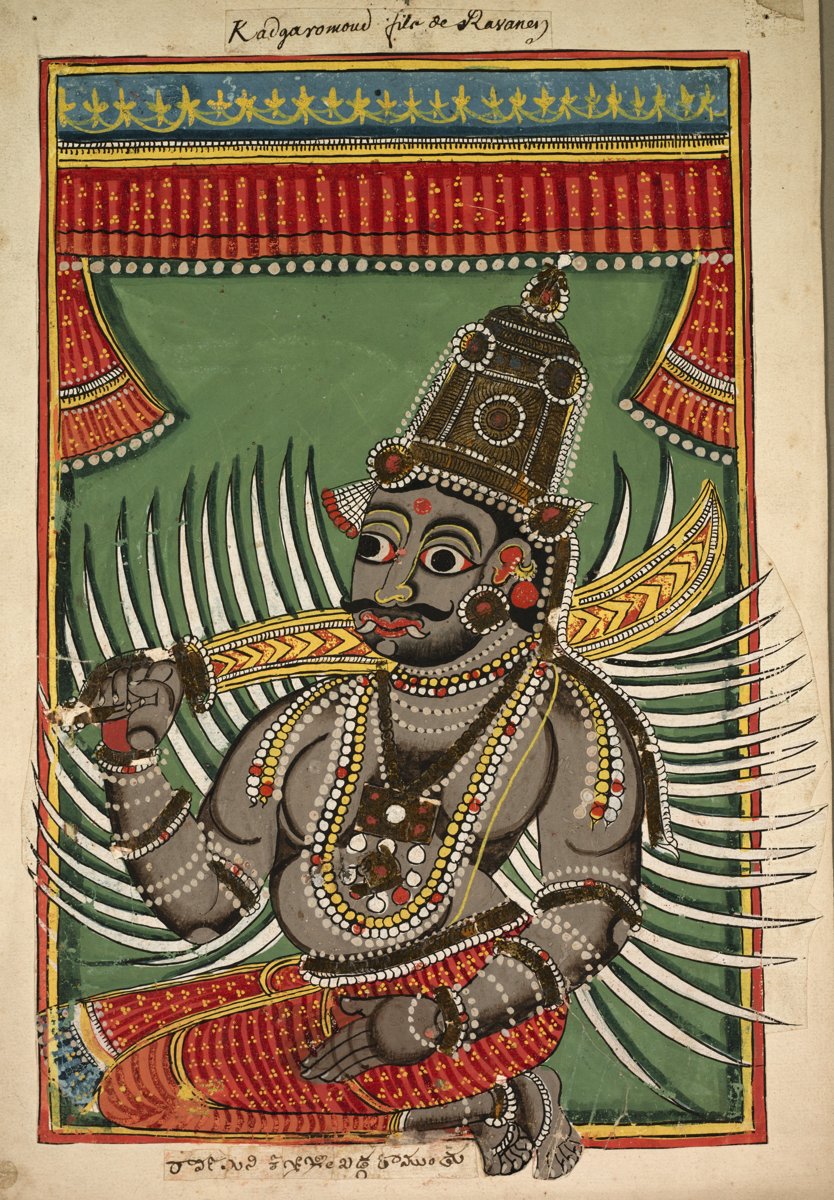
Indian painting of a gray-skinned demon seated cross-legged under a red canopy on a green ground, wearing a tall crown and holding a yellow curved sword, with white blades fanning out behind him
#D9B857#943526#6C7052#3D3828
PaintingKhadgaroma, Son of Ravana (about 1720)

A demon from the Ramayana, painted in southern India for French Jesuit missionaries, now at the Cleveland Museum of Art. Instead of gold, the painters used silver tinted with yellow, which the museum says was likely gamboge. In the photo the yellows read about #D9B857, lighter and softer than the web code.

#D9B857#943526#6C7052#3D3828
Source: Cleveland Museum of Art

Palettes are sampled in-house.

Questions

What color is gamboge?

A deep orange yellow. The usual code is #E49B0F (RGB 228, 155, 15): red near full strength, green at about 60% and almost no blue.

How do you pronounce gamboge?

Merriam-Webster gives gam-BOHJ, with gam-BOOZH as a second pronunciation.

Why is it called gamboge?

After Cambodia. The resin came from trees there, and the word comes from Camboja, the Portuguese name for the country. Its first known use in English is from 1653.

Is gamboge toxic?

The resin is. It is a strong purgative, and large doses have killed people. The color on a screen is just a code.

What is the difference between gamboge and marigold?

They share a hue. Gamboge (#E49B0F) is a little deeper and purer, with almost no blue; marigold (#EAA221) is a touch lighter and softer.

Is gamboge the same as Garcinia cambogia?

No. Both come from Garcinia trees, and the fruit of Garcinia gummi-gutta, once called Garcinia cambogia, is sometimes also called gamboge. But the pigment comes from the resin of other species, chiefly Garcinia hanburyi.

What colors go with gamboge?

Prussian blue and indigo for contrast, brick red for warmth, leaf green for a botanical look, and cream or charcoal as neutrals.