Indian yellow is a warm, moderate orange yellow. Its code, #E3A857, has strong red, about two-thirds green and a little blue, which softens it. It sits right beside honey and is a shade calmer than gamboge, the other old Asian yellow it is most often mixed up with.
The name comes from a pigment, known in India as piuri and in English as purree. It reached European color sellers as hard balls, dark brown outside and deep orange inside, with a strong smell. Chemically it is mostly the calcium and magnesium salts of euxanthic acid. Painters in Rajput and Mughal India used it on paper and even on palace walls, and European watercolorists took it up in the 1800s.
Where it came from was argued over for more than a century. In 1883 T. N. Mukharji wrote that milkmen near Monghyr, in Bihar, made it from the urine of cows fed only on mango leaves. Later writers, among them the author Victoria Finlay, found little else to back the story up. Then in 2016 researchers recovered the samples Mukharji had sent to Kew Gardens and found a chemical marker of cattle urine in some of them.
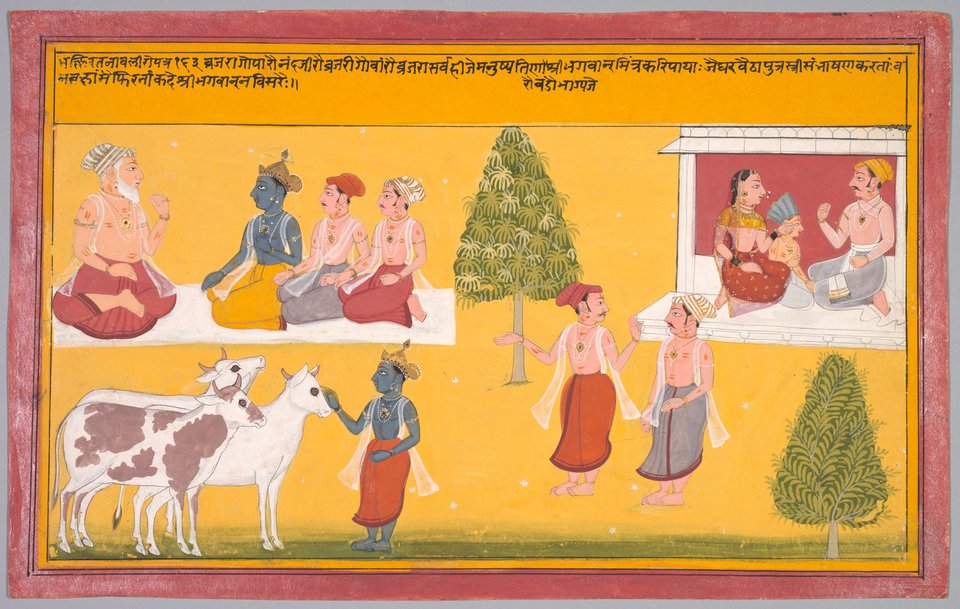
The web code is the color dictionary’s sample, not the pigment at its brightest. The real thing is transparent and glows: on an 18th-century Mewar painting where the museum identified Indian yellow, the ground samples near #F9BC48. On screens #E3A857 is a light color, so use black or dark brown text (10:1); white text reaches only 2.1:1. It pairs well with deep red, indigo and leaf green.