Coffee

A warm, muted brown named after roasted coffee beans.

Overview

Coffee is a warm, muted brown, the color of roasted coffee beans. Its code, #6F4E37, has red at about 44%, green at 31% and blue at 22%, so it reads as a soft, slightly reddish brown rather than an orange one.

The code comes from a color dictionary. English has used coffee as a color name since 1695. When the 1955 ISCC-NBS dictionary sorted the samples of Maerz and Paul’s A Dictionary of Color (1930), it filed their coffee under moderate brown, whose center is #6F4E37. About ninety other Maerz and Paul names share that group, among them auburn, cognac, cocoa, burnt umber and mocha bisque.

Real roasted coffee is darker. In the roaster, beans go from a grayish yellow through yellow and brown to almost black. In a 2025 study, ground coffee was lighter than the web code only before first crack, the moment the beans first pop. The code is also a little grayer than real coffee of the same lightness. People picture coffee the other way: in the xkcd color survey, the average coffee was #A6814C, a light golden brown closer to coffee with milk.

Coffee is a dependable dark neutral. White text reads well on it, at a contrast of 7.4 to 1, and it pairs well with cream, sage, dusty blue and terracotta. For a milkier brown, see mocha; for a deeper one, dark brown.
HEX#6F4E37
RGBrgb(111, 78, 55)
HSLhsl(25, 34%, 33%)
HSV25°, 50%, 44%
CMYK0, 30, 50, 56
OKLCHoklch(45.4% 0.057 55.6)
Every code converts from the HEX value #6F4E37. #6F4E37 is the center of ISCC-NBS color group 58, moderate brown, in John Foster’s sRGB version. The 1955 ISCC-NBS dictionary puts the coffee of Maerz and Paul’s A Dictionary of Color (1930) in that group, and Wikipedia uses the same code. CMYK is a screen-based estimate; print results vary.
Coffee color card, hex #6F4E37: “Grounds for celebration”

Coffee on the color map

The roast stages trace the path beans take in the roaster. Unroasted beans and the color-change stage sit high on the right, lighter and yellower. First crack falls just below the reference, inside the outline, and second crack sits lower and to the left, darker and grayer. People’s average coffee in the xkcd survey sits high on the right too, next to the unroasted beans: lighter and more golden, like coffee with milk. The outline is an approximate range, not a measured one.

Shades and tints

Tints with white

Shades with black

Tones with gray

Coffee sits in the middle. Tints add white, shades add black and tones add gray, in 10% steps out from it. Tap any swatch to copy its code.

Light and dark coffee

#D4CAC3
Pale coffeeMixed 70% with white. A warm greige for backgrounds.
#A67B5B
LatteCafé au lait, coffee with milk. The ISCC-NBS light brown, one of three groups where the 1955 dictionary files Maerz and Paul’s café au lait. Wikipedia gives this code for latte.
#6F4E37
CoffeeThe reference color.
#613E29
First crackGround coffee when the beans first pop in the roaster, from the average reading in a 2025 study. A little darker and redder than the code.
#3D2B1E
EspressoMixed 45% with black. No standard defines espresso; this near-black brown is about as dark as ground coffee at second crack.

Colors that go with coffee

Pairings that work in rooms, outfits and interfaces.

Coffee and cream

Coffee with milk. Warm, soft and easy on the eyes.

Coffee and sage

Earthy and calm. Good for homes, gardens and food packaging.

Coffee and dusty blue

Warm brown against a cool, soft blue. Relaxed and grown-up.

Coffee and terracotta

Two warm earth tones. Cozy for autumn, menus and ceramics.

Coffee and charcoal

Dark and modern. Good for interfaces that need a warm accent.

Roaster’s path

The colors beans pass through in the roaster, from measured samples: unroasted, color change, first crack and second crack.

Color-wheel palettes

Pick a palette to see where its colors sit on the color wheel. The caret marks coffee. Tap a band to copy its code.

Similar colors

Wenge80%Umber86%Russet80%Toffee93%CoffeeSepia79%Dark brown79%

Lined up by hue around coffee. Hover a color to see how similar it is.The bar under each name shows how similar it is. Similarity comes from the distance between the two colors in OKLab, a model of how we see color.

Coffee vs mocha

Coffee#6F4E37 · hue 25°
  • Darker and richer
  • Named after the roasted bean
  • Takes white text well
Mocha#A38068 · hue 24°
  • Lighter and milkier
  • Named after a Yemeni coffee port
  • Needs dark text

Meaning

  • Roast level
  • Judged by eye
  • Brewing
  • Milk

Coffee’s color is less a symbol than a signal. Roasters, buyers and drinkers read it to judge how dark a coffee was roasted, often just by eye, and so how it will taste. Brewing and milk change it again in the cup. Studies of color and mood test broad words like brown, not coffee, so the claims here are about the color of coffee itself: how it is measured and what it tells people.

No agreed light, medium or dark

Industry record

The coffee trade has no agreed standard for what light, medium or dark roast means, and some roasters sell light roasts darker than other roasters’ dark roasts. For years the trade’s de facto measure has been analyzers that give a number from about 100 for very light roasts to 20 for very dark ones, but not every roaster can afford one. In a 2023 survey at a roasters’ retreat, half said they judged roast level simply by looking.1, 2

Roasting follows one color path

Measured

In a 2025 study, coffees from three origins, roasted in seven very different ways, all followed the same curve through color space: from a lightness (L*) of about 60 for unroasted beans to about 20 for very dark ones. Beans first turn a little lighter, redder and yellower, then darken and turn grayer. At first crack, ground coffee measured about L* 30, and at second crack about L* 20, whatever the roast.2

Cold brew looks redder

Measured

Brewing changes the color too. In 243 brews diluted to the same strength, roast level had the strongest effect on color, but brew temperature mattered for light and medium roasts: coffee brewed cold came out redder, and coffee brewed hot came out browner and blacker.3

A milkier look tastes creamier

One small study

In a small virtual-reality study, 32 people sipped the same black cold brew while seeing it as either a dark brown or a light brown drink. They rated the light brown coffee creamier, but its color did not change how sweet they found it or how much they liked it.4

Sources (4)
  1. Anokye-Bempah, L., Donis-González, I. R. & Ristenpart, W. D. (2024). “What Color is Your Coffee?” 25, Issue 21. Specialty Coffee Association.
  2. Anokye-Bempah, L., Styczynski, T., Ristenpart, W. D. & Donis-González, I. R. (2025). A universal color curve for roasted arabica coffee. Scientific Reports, 15, 24192. doi:10.1038/s41598-025-06601-w
  3. Yeager, S. E. et al. (2022). Roast level and brew temperature significantly affect the color of brewed coffee. Journal of Food Science, 87(4), 1837–1850. doi:10.1111/1750-3841.16089. Summary by the lead author: “The Color in Your Cup”, 25, Issue 17.
  4. Wang, Q. J., Meyer, R., Waters, S. & Zendle, D. (2020). A dash of virtual milk: Altering product color in virtual reality influences flavor perception of cold-brew coffee. Frontiers in Psychology, 11, 595788. doi:10.3389/fpsyg.2020.595788

History

Coffee was a color word long before anyone could measure coffee’s color. For most of that time, roasters judged roasts by eye, and the trade is still settling how to name its browns.

  1. 1695

    First recorded use of “coffee” as a color name in English.1

  2. 1893

    First known use of “cappuccino” in English. The drink is named after a color: the word is Italian for Capuchin, from the likeness of its color to a Capuchin friar’s habit.2

  3. 1922

    In All About Coffee, William Ukers writes that “there is no universal standard” for how dark coffee should be roasted. The North American trade names eight roasts, from light and cinnamon to French and Italian, and a roaster judges his batch by pulling out samples and comparing them with a type sample.3

  4. 1930

    Maerz and Paul’s A Dictionary of Color prints a coffee sample, plate 15, A11. The same year, “espresso” enters English.1, 2

  5. 1955

    The ISCC-NBS dictionary files Maerz and Paul’s coffee as a moderate brown, centered on #6F4E37. It files the coffee of a 1950 dictionary of merchandise colors much darker, from dark yellowish brown to dark olive brown.4, 5

  6. 1990s

    The Specialty Coffee Association of America adopts a roast scale read by near-infrared analyzers, the Agtron Gourmet scale, as its standard. Reference disks from the Roast Color Classification System, described in 1995, let roasters compare beans by eye.6, 8

  7. 2023

    At the Specialty Coffee Association’s Roasters Guild Retreat, 125 people name the colors of ground coffee samples under controlled light, the first step toward a dictionary of roast colors.7

  8. 2025

    UC Davis researchers publish a universal color curve for roasted arabica coffee: whatever the origin or roast profile, roasting beans follow one path through color space.8

  9. 2025–26

    The Specialty Coffee Association proposes a non-proprietary roast color standard, measured with visible light in CIELAB and freely available. A test method for roast level, SCA-131, is in development, and a project to name roast colors is planned for 2026.6, 9

Sources (9)
  1. Maerz, A. & Paul, M. R. (1930). A Dictionary of Color. McGraw-Hill. Page 193; plate 15, sample A11, as cited in Wikipedia, “Coffee (color)”.
  2. Merriam-Webster, “cappuccino” and “espresso”, etymology and first known use.
  3. Ukers, W. H. (1922). All About Coffee. The Tea and Coffee Trade Journal Company, New York. Project Gutenberg text, chapter on roasting.
  4. Kelly, K. L. & Judd, D. B. (1955). The ISCC-NBS Method of Designating Colors and a Dictionary of Color Names. NBS Circular 553. Entries “Coffee” (Maerz and Paul; Taylor, Knoche and Granville, Descriptive Color Names Dictionary, 1950).
  5. Jaffer, A. “Maerz and Paul color names”, with ISCC-NBS centroids from “Color-Name Dictionaries”, MIT CSAIL.
  6. Specialty Coffee Association (2025). Developing Roast Color Standards for the Specialty Coffee Industry: A New Roast Color Measurement Approach. White paper.
  7. Anokye-Bempah, L., Donis-González, I. R. & Ristenpart, W. D. (2024). “What Color is Your Coffee?” 25, Issue 21. Specialty Coffee Association.
  8. Anokye-Bempah, L., Styczynski, T., Ristenpart, W. D. & Donis-González, I. R. (2025). A universal color curve for roasted arabica coffee. Scientific Reports, 15, 24192. doi:10.1038/s41598-025-06601-w. Cites Pugash, M. (1995), “The Roast Color Classification System”, Tea & Coffee Trade Journal, 167.
  9. Specialty Coffee Association, “SCA Standards”, standards in development; and “Developing Roast Color Standards for the Specialty Coffee Industry”.

Coffee in use

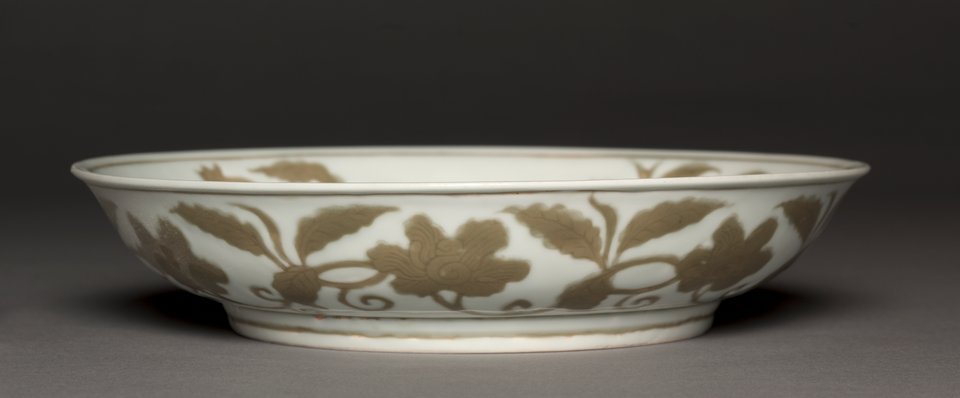
A shallow white porcelain dish seen from the side, painted around the outside with olive brown flowers, leaves and curling vines
#837354#6C5C42#998E72#D1D1C5
CeramicDish with coffee-brown decoration, China (1488–1505)

A porcelain dish from the Jingdezhen kilns, with the reign mark of the Hongzhi emperor, painted under the glaze in an iron-oxide brown that the museum calls coffee brown. In the photo the flowers and leaves read about #837354, with darker strokes near #6C5C42: a soft olive brown, lighter and less red than this page’s code.

#837354#6C5C42#998E72#D1D1C5
Source: Cleveland Museum of Art

Palettes are sampled in-house.

Questions

What color is coffee?

A warm, muted brown, the color of roasted coffee beans. Its usual code is #6F4E37 (RGB 111, 78, 55), the center of the ISCC-NBS moderate brown.

What is the espresso color code?

No color standard defines espresso, so there is no official code. This page shows espresso as #3D2B1E, coffee mixed 45% with black, which is about as dark as ground coffee at second crack.

What color is a latte?

Coffee with milk is usually given as café au lait, #A67B5B, the ISCC-NBS light brown. It is very close to mocha, #A38068.

Why is a cappuccino called a cappuccino?

Cappuccino is Italian for Capuchin. According to Merriam-Webster, the drink got its name because its color looks like the habit of a Capuchin friar. The word has been used in English since 1893.

How does roasting change the color of coffee?

Unroasted beans are a grayish yellow. In the roaster they first turn a little lighter and yellower, then brown, dark brown and finally almost black. Ground coffee measures a lightness of about 60 before roasting, about 30 at first crack and about 20 at second crack.

What is the difference between coffee and mocha?

Coffee (#6F4E37) is a darker, richer brown. Mocha (#A38068) is lighter and milkier, like coffee with milk. Both names come from coffee: mocha from the Yemeni port that once shipped it.

What colors go with coffee?

Cream, sage, dusty blue and terracotta are the most reliable. Cream keeps it soft, blue cools it down and charcoal makes it modern. White text reads well on coffee.