Almond

The pale color of an almond with its brown skin taken off.

Overview

Almond is a pale, warm beige with a soft pink cast. The code most color lists use is #EFDECD: red 239, green 222 and blue 205, each a step below the one before, which tints white toward a light, creamy tan.

The name points to the inside of the nut, not the outside. A raw almond wears a thin brown skin. Soak it briefly in hot water and the skin slips off, leaving the pale seed. That is blanching, and it is the almond this code describes. The CSS color blanched almond is lighter and more golden still.

In 1930, almond meant a brown, not a cream. Maerz and Paul’s A Dictionary of Color prints almond, almond brown and toasted almond, and the 1955 ISCC-NBS dictionary files all three among the light browns, one of them the light yellowish brown of camel. Their burnt almond is a moderate brown, the same code this site uses for coffee. By the late 1970s, almond was also a popular color for kitchen appliances.

No standard defines the screen almond. The common code sits within a point of X11’s AntiqueWhite2, a darker step of antique white. Almond needs dark text: brown, navy or charcoal read well on it, and white does not. It pairs with toasted browns, dusty pink, olive and deep blue.

HEX#EFDECD
RGBrgb(239, 222, 205)
HSLhsl(30, 52%, 87%)
HSV30°, 14%, 94%
CMYK0, 7, 14, 6
OKLCHoklch(91.0% 0.030 67.4)
Every code converts from the HEX value #EFDECD. No color standard defines almond. #EFDECD is the code most color lists use, and it traces to a crayon color from 1998, not a color dictionary. The crayon’s current published value, #EED9C4, is a shade darker. The 1955 ISCC-NBS dictionary files the almond of Maerz and Paul’s A Dictionary of Color (1930) as a light brown. CMYK is a screen-based estimate; print results vary.
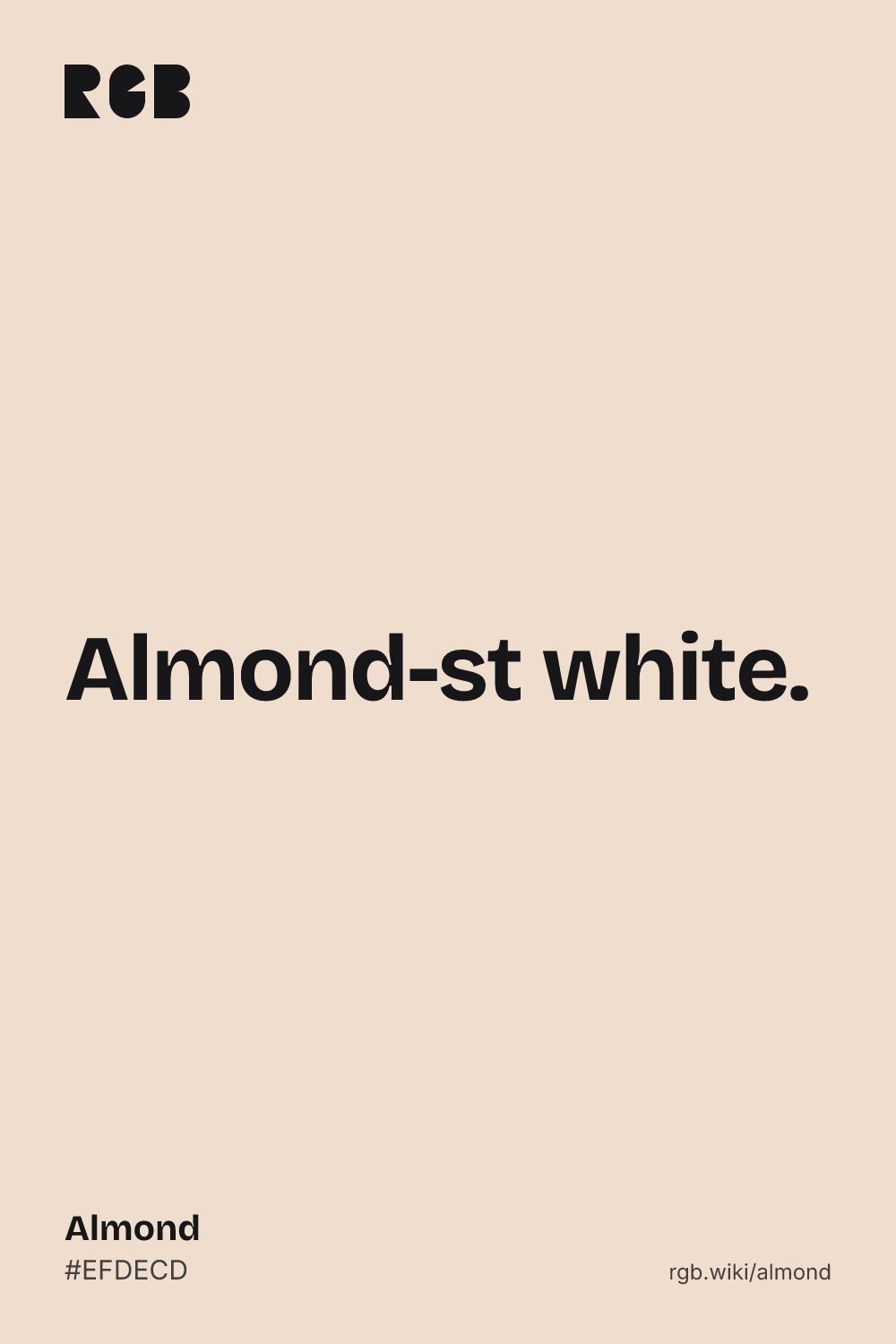
Almond color card, hex #EFDECD: “Almond-st white”

Almond on the color map

The xkcd survey has no average for almond. The crayon value and X11’s AntiqueWhite2 sit inside the outline, next to the reference. Blanched almond sits at the top edge, lighter and a little more golden. The two dictionary browns from 1930 sit far below the outline: that almond was the color of the skin, not the kernel. The outline is an approximate range, not a measured one.

Shades and tints

Tints with white

Shades with black

Tones with gray

Almond sits in the middle. Tints add white, shades add black and tones add gray, in 10% steps out from it. Tap any swatch to copy its code.

Light and dark almond

#FFEBCD
Blanched almondThe CSS keyword blanchedalmond: lighter, brighter and a touch more golden than almond. See blanched almond
#EFDECD
AlmondThe reference color.
#BFB2A4
Shaded almondAlmond mixed with 20% black, a warm light gray-beige for borders and quiet backgrounds.
#A67B5B
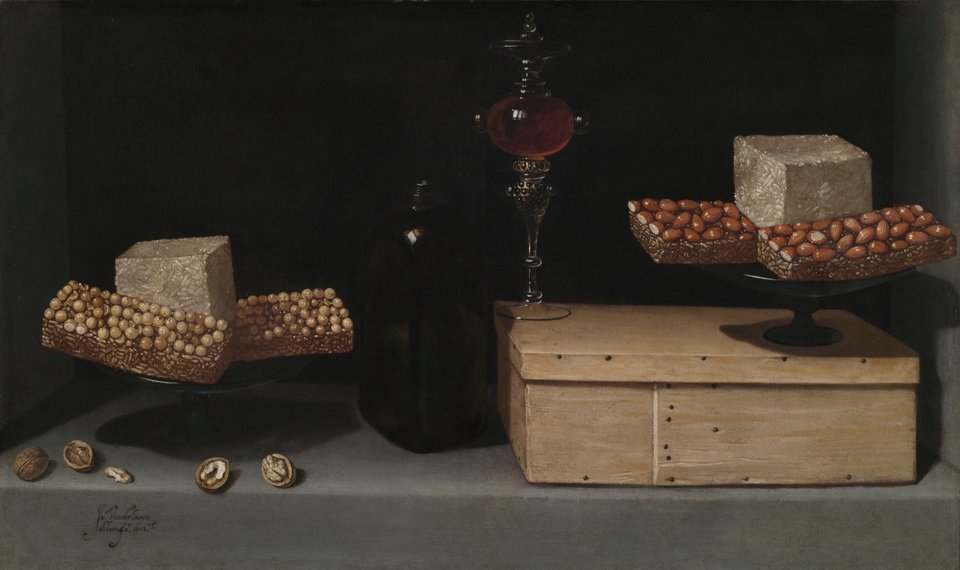
Toasted almondThe ISCC-NBS light brown where the 1955 dictionary files Maerz and Paul’s toasted almond, and one of the four groups for their almond. Close to the brown of the almond skins in the 1622 still life below.
#6F4E37
Burnt almondThe ISCC-NBS moderate brown where Maerz and Paul’s burnt almond falls. The same code as coffee. See coffee

Colors that go with almond

Pairings that work in rooms, outfits and interfaces.

Turrón

From a 1622 still life of almond sweets: pale kernel, brown skins and a dark shelf.

Blanched and toasted

The nut from skin to kernel. A tone-on-tone brown palette for food and packaging.

Almond blossom

Pale pink flowers on dark branches against a spring sky.

Late 1970s kitchen

Almond with the gold and olive greens of appliance colors from the same years.

Almond and navy

Calm and crisp. Navy text reads well on the warm background.

Almond on espresso

A dark theme: almond text on deep brown, with toasted almond for accents.

Color-wheel palettes

Pick a palette to see where its colors sit on the color wheel. The caret marks almond. Tap a band to copy its code.

Similar colors

Champagne pink97%AlmondPlatinum86%Champagne87%Bone90%Pearl94%Parchment86%

Lined up by hue around almond. Hover a color to see how similar it is.The bar under each name shows how similar it is. Similarity comes from the distance between the two colors in OKLab, a model of how we see color.

Almond vs blanched almond

Almond#EFDECD · hue 30°
  • A little darker, softer and pinker
  • No standard defines it
  • No CSS keyword
Blanched almond#FFEBCD · hue 36°
  • Lighter and a touch more golden
  • Came to screens from a paint maker’s samples in 1989
  • A CSS keyword, blanchedalmond

Meaning

  • The kernel
  • Early blossom
  • Almond shape
  • 1970s kitchens

Almond takes its meanings from the tree and its nut: a pale kernel under a brown skin, blossom that opens early in spring, and a shape that artists borrowed for holy figures. In the late 1970s it also became a kitchen color. Studies of color and emotion test basic words such as brown, pink and white, never almond, so the claims here are about the nut, the tree and how the name was used.

Pale only once the skin comes off

Well established

An almond is not a true nut but the seed of a drupe, a fruit related to the peach. The seed has a thin brown skin. Blanching softens it in hot water so it can be slipped off, leaving the pale seed inside. The pale almond on screens is the blanched one.1, 2
The first tree to flower

Museum record

Almond trees flower early in spring, which made them a symbol of new life. Van Gogh painted a branch of almond blossom against a blue sky in 1890 as a gift for his newborn nephew.3

Almonds in the Hebrew Bible

Text record

In the Book of Numbers, Aaron’s staff buds, blossoms and bears almonds overnight, a sign that he was chosen. Exodus describes the bowls on the branches of the tabernacle’s gold lampstand as “made like unto almonds”.4

An almond-shaped frame for holy figures

Art history

In Christian art, a mandorla is an almond-shaped frame around the whole figure of Christ or the Virgin Mary. Unlike a halo, it surrounds the entire body. Mandorla is the Italian word for almond, named for the shape.5

A kitchen color of the late 1970s

Newspaper feature

After the avocado and gold appliances of the 1960s and 70s, a set of “new naturals”, almond among them, took over kitchens at the end of the 1970s. Whites came back in the 1980s and 90s. This comes from a designer’s newspaper column, not a sales record.6

Sources (6)
  1. Wikipedia, “Almond”, on the fruit (a drupe, not a true nut) and on blanched almonds.
  2. Wikipedia, “Blanching (cooking)”, on softening and removing the seed coat of almonds.
  3. Van Gogh Museum, “Almond Blossom”, Vincent van Gogh, Saint-Rémy-de-Provence, February 1890.
  4. The Bible, Numbers 17:8 and Exodus 25:33, King James Version, via Bible Gateway.
  5. Wikipedia, “Mandorla”.
  6. Friedmann, R. S. “Appliance colors tell kitchen history”. Scripps Howard News Service, in the Star Tribune, December 15, 2012.

History

Almond has named two very different colors. In 1930 it was a light brown, the color of the nut in its skin. Today it is a pale cream, the color of the kernel, and that is the almond screens use.

  1. 1890

    In February, Vincent van Gogh paints Almond Blossom in Saint-Rémy-de-Provence, pale blossom on a blue sky, for his brother Theo’s newborn son.1

  2. 1930

    Maerz and Paul’s A Dictionary of Color prints a whole family of almond names: almond, almond brown and toasted almond, burnt almond, almond green and almond blossom, a pink.2

  3. 1955

    The ISCC-NBS dictionary files Maerz and Paul’s almond across four light brown groups, burnt almond as a moderate brown and almond green as a grayish green. None of them is a cream.2

  4. Late 1970s

    Almond joins harvest wheat, coffee and onyx black in a set of “new naturals” that take over from avocado and harvest gold on kitchen appliances.3

  5. 1989

    The X Window System’s color list adds blanched almond, 255, 235, 205, in a set of light colors copied from a paint maker’s samples. The same release adds AntiqueWhite2, 238, 223, 204, within a point of today’s almond.4

  6. 1998

    A crayon color named almond goes on sale. It is still made, and the code most lists give for almond traces to it.5

  7. 2001

    SVG 1.0 makes blanchedalmond, rgb(255, 235, 205), a web color keyword. Plain almond never becomes one.6

Sources (6)
  1. Van Gogh Museum, “Almond Blossom”, with its history and provenance.
  2. Jaffer, A. “Maerz and Paul color names”, with ISCC-NBS centroids from “Color-Name Dictionaries”, MIT CSAIL.
  3. Friedmann, R. S. “Appliance colors tell kitchen history”. Scripps Howard News Service, in the Star Tribune, December 15, 2012.
  4. Paul Raveling’s list, raveling.txt, and his notes from the X11 README, quoted in Jaffer, “Color-Name Dictionaries”, MIT CSAIL.
  5. Wikipedia, list of crayon colors, standard colors, giving almond as made from 1998 to the present.
  6. W3C (2001). Scalable Vector Graphics (SVG) 1.0, recognized color keyword names.

Almond in use

A dark still life on a gray stone ledge: bars of nut sweets on glass stands, the right-hand bars studded with whole brown almonds, a tall ornate wine glass, a dark bottle, a pale wooden box and a few walnuts
#A2856E#80553D#653F2C#44281C
PaintingStill Life with Sweets, Juan van der Hamen y León (1622)

Bars of turrón, a Spanish sweet of honey and nuts, sit on glass stands beside a wooden box, a bottle and a few walnuts. On the right-hand bars, whole almonds still in their skins are pressed into the top. They read as warm browns in the photo, about #80553D, with highlights near #A2856E: the almond of the 1930 dictionary, not the pale kernel the web code shows.

#A2856E#80553D#653F2C#44281C
Source: Cleveland Museum of Art

Palettes are sampled in-house.

Questions

What color is almond?

A pale, warm beige with a soft pink cast, like the inside of an almond once its brown skin is taken off. Its usual code is #EFDECD (RGB 239, 222, 205).

What is the hex code for almond?

#EFDECD is the code most color lists use. In HSL it is about 30°, 52%, 87%. No standard defines it, and there is no CSS keyword for almond.

What is the difference between almond and blanched almond?

Blanched almond (#FFEBCD) is a CSS keyword and is lighter, brighter and a little more golden. Almond (#EFDECD) is a step darker and softer, with a faint pink cast.

Is almond the same as beige?

They are close neighbors. Both are pale, warm neutrals, but the CSS beige (#F5F5DC) is yellower and closer to cream, while almond is pinker and a little darker.

Was almond always a pale color?

No. In Maerz and Paul’s 1930 dictionary, almond, almond brown and toasted almond were light browns, like the nut in its skin, and burnt almond was darker still. By the late 1970s almond was also a popular kitchen appliance color, and the screen almond is a pale cream.

What colors go with almond?

Deep brown, navy and charcoal for text, toasted browns for a tone-on-tone look, dusty pink and soft blue for a spring palette, and gold and olive for a retro kitchen feel.