Named after Pergamon
Word history“Parchment” comes through Middle English parchemin and Latin pergamena from Greek pergamēnē, “of Pergamon”, the city that was famous for making it. Merriam-Webster dates the English word to the 14th century.1
A pale, warm off-white named after the scraped animal skin that carried books for over a thousand years.
Parchment is a very pale, warm off-white with a faint yellow cast. Its usual code is #F1E9D2: red 241, green 233, blue 210, so blue sits lowest and tips the white toward cream. It is almost the same as eggshell, a shade warmer, and a little more yellow and less peach than antique white.
The name comes from a writing material, not a pigment. Parchment is animal skin, usually sheep, goat or calf, that is soaked in lime to loosen the hair, stretched on a wooden frame, scraped thin with a curved knife and dried under tension. It is never tanned, which is what makes it parchment and not leather. Fine calfskin is called vellum, from the French for calf. The word itself goes back through Latin pergamena to Pergamon, the Greek city in what is now Turkey that was famous for making it.
Real parchment has no single color. The flesh side of a skin is smoother and lighter than the hair side, and parchment makers rubbed in chalk and lime pastes to whiten it. Age, handling and damp then push it toward tan: the museum manuscripts below sample around #CFC2A9 and #C6B59B, well darker than the web code. Color dictionaries agree that parchment is darker and yellower too. The ISCC-NBS dictionary files Maerz and Paul’s 1930 parchment sample as a grayish yellow, the same code as ecru, while people in the xkcd survey picked a light, clear yellow.
On screens, #F1E9D2 is a soft page color. Black text on it has a contrast of 17.3:1, so body text reads comfortably, but against pure white it nearly vanishes (1.21:1), and a parchment panel on a white page needs a border. It suits brown and black “ink”, deep red, forest green and gold, the colors of a manuscript page.
| HEX | #F1E9D2 | |
|---|---|---|
| RGB | rgb(241, 233, 210) | |
| HSL | hsl(45, 53%, 88%) | |
| HSV | 45°, 13%, 95% | |
| CMYK | 0, 3, 13, 5 | |
| OKLCH | oklch(93.4% 0.032 91.0) |
The xkcd survey’s parchment sits above the code and to the right: lighter and a clear yellow. The 1950 dictionary value lies just below and right, a little darker and yellower. The sampled museum parchment and Maerz and Paul’s 1930 sample are much darker, off the bottom of this view, so they are pinned to the edge; the museum parchment leans slightly left, toward tan. The outline is an approximate range, not a measured one.
Tints with white
Shades with black
Tones with gray
Pairings that work in rooms, outfits and interfaces.
Brown-black ink, vermilion and gold on parchment, the working colors of a medieval scribe.
Gold on indigo, after the dyed parchment of the Blue Qur’an, with parchment as the light text.
A legal document look: dark ink, a red wax seal and a brown cord.
Calm and bookish, like a library reading room.
Tan paper, faded sea blue and brown linework.
Tonal and soft for interiors or a reading app, built from parchment’s own shades.
Pick a palette to see where its colors sit on the color wheel. The caret marks parchment. Tap a band to copy its code.
Lined up by hue around parchment. Hover a color to see how similar it is.The bar under each name shows how similar it is. Similarity comes from the distance between the two colors in OKLab, a model of how we see color.
Parchment’s meanings come from the material. The name points to Pergamon, the old story of its invention there is a legend, and the material’s two sides gave scribes two shades to manage. Because it lasts, parchment became the material of laws, scriptures and diplomas. No study has tested the color parchment itself; research on color and emotion uses basic words such as white and yellow.
“Parchment” comes through Middle English parchemin and Latin pergamena from Greek pergamēnē, “of Pergamon”, the city that was famous for making it. Merriam-Webster dates the English word to the 14th century.1
Pliny, citing Varro, says parchment was invented at Pergamon when Ptolemy of Egypt banned the export of papyrus to a rival library. Herodotus already wrote about books on skins centuries earlier, and the 1911 Britannica says the story need not be taken literally; Pergamon more likely improved the craft.2, 3
The flesh side of a skin is smoother and lighter than the hair side. Scribes laid hair side to hair side and flesh side to flesh side when they folded sheets into a book, so that any two open pages had the same tint.3, 4
Parchment was chosen for religious texts, laws, deeds and land records because it is strong and stable. The U.S. Constitution, the Declaration of Independence and the Bill of Rights are all written on it, and “parchment” still means an academic diploma.5, 1
Parchment could be dyed. The Blue Qur’an, made in North Africa in the 900s or earlier, is written in gold on parchment dyed deep blue with indigo; one of its leaves is shown below.6
Parchment was a writing material for more than two thousand years before it was a color name. The web code is recent; the dictionaries’ older samples are darker and yellower.
Herodotus notes that the Ionian Greeks call books “skins”, a sign that writing on animal hide was already common long before Pergamon.1
Eumenes II rules Pergamon. Tradition credits his reign with a new way of preparing skins for writing, the material later named after the city.2
Pliny the Elder, citing Varro, tells the story that parchment was invented at Pergamon after Ptolemy banned the export of papyrus from Egypt.1
Most works meant to last in West Asia and Europe have been copied from papyrus onto parchment, now the standard material for important books.3
“Parchment” enters English, from Anglo-French parchemin.4
Jean Pucelle paints the Hours of Jeanne d’Evreux, a prayer book for the queen of France, on vellum pages about 9 by 6 cm.5
Gutenberg prints his Bible. Most copies are on paper, but some are printed on parchment, the luxury option; 12 of the 48 surviving copies are on it.3
The U.S. Constitution is written on parchment, as were the Declaration of Independence in 1776 and, two years later, the Bill of Rights.6
The ISCC-NBS dictionary of color names files Maerz and Paul’s 1930 parchment as a grayish yellow and Taylor, Knoche and Granville’s 1950 parchment as a pale yellow, both darker and yellower than today’s code.7
Parchment, 241, 233, 210 (#F1E9D2), appears in the Xona.com color list, taken from a paint maker’s RGB values. Wikipedia later cites the list for the color.8
In the xkcd color survey, the average color people call parchment is #FEFCAF, a light clear yellow.9
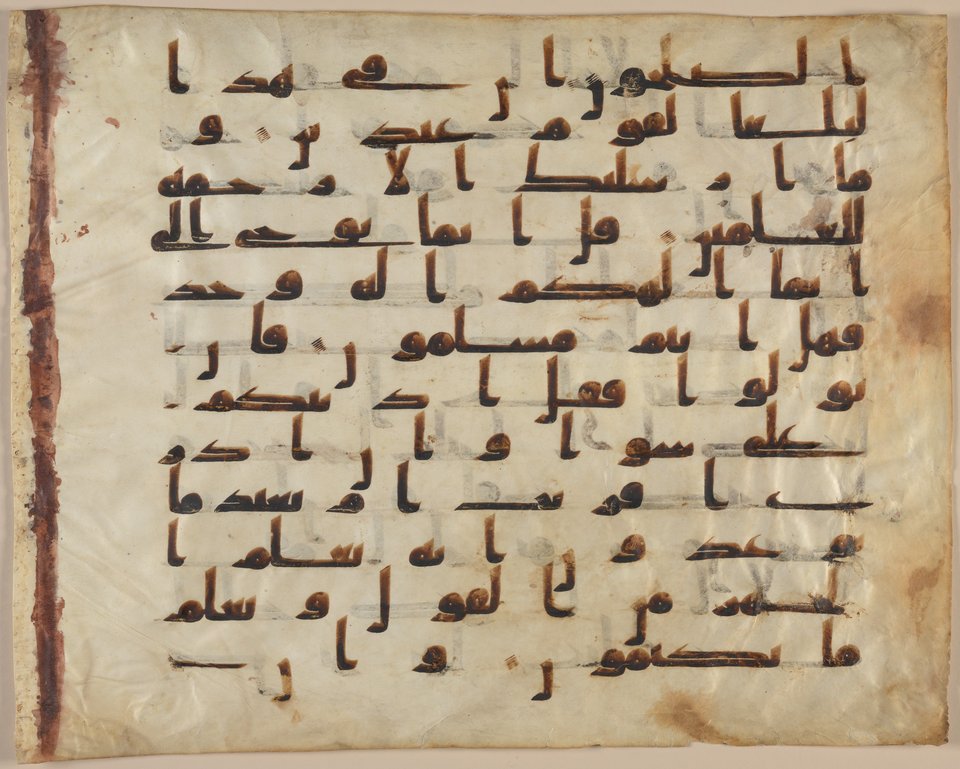
A huge leaf, about 55 by 70 cm, from an early Qur’an made in Syria or North Africa. The blank parchment samples around #CFC2A9 to #C1B091, a tan well darker than the web code, and the brown ink near #4D3B32.
Sampled from the Metropolitan Museum of Art’s photograph (2004.87), released as CC0 (public domain). The parchment was measured on its own, apart from the ink. Colors in a photo shift with the lighting, so read the codes as close, not exact.
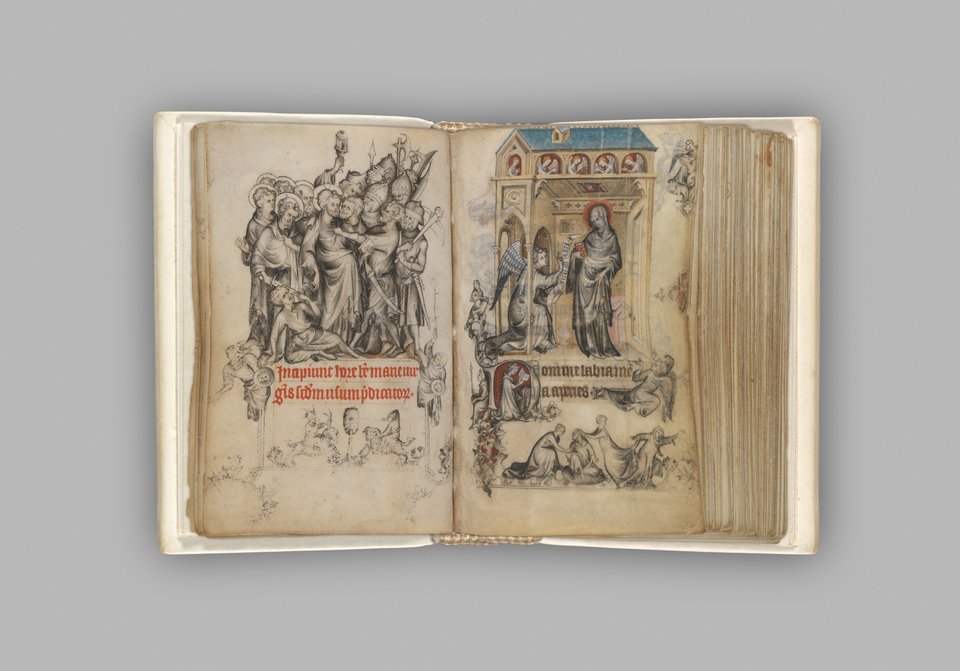
A prayer book small enough to hold in one hand, painted in grisaille, shades of gray, for the queen of France. Seven centuries on, its vellum pages read as a warm tan, about #C6B59B, with darker shading near #9D8A72.
Sampled from the Metropolitan Museum of Art’s photograph (54.1.2), released as CC0 (public domain). The codes come from the two open pages only. Colors in a photo shift with the lighting, so read the codes as close, not exact.
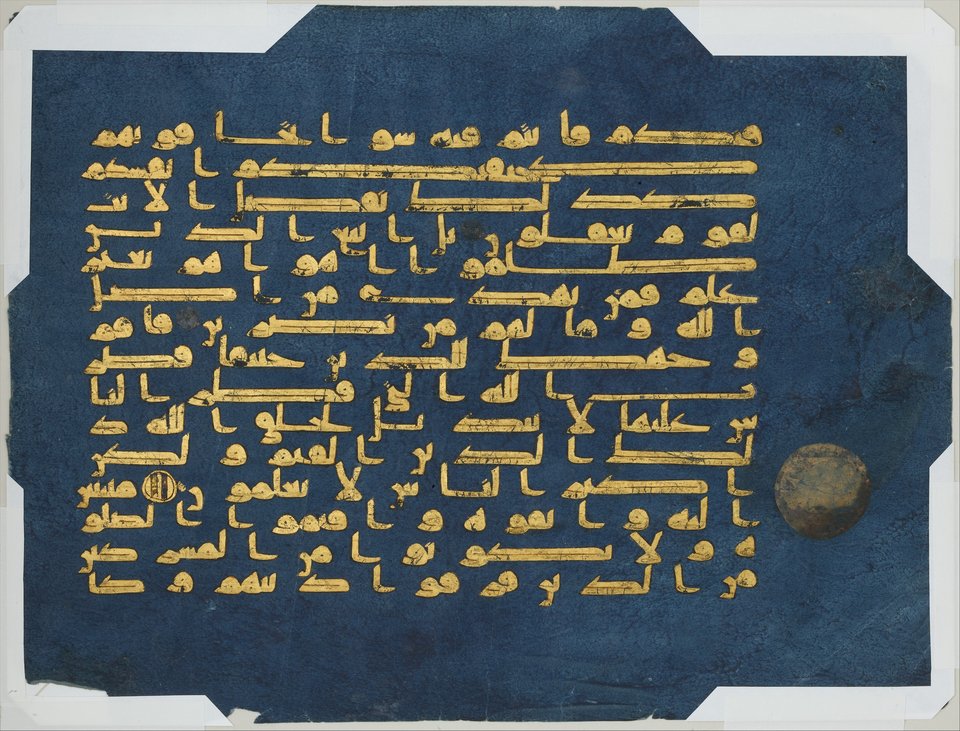
Parchment was not always left pale. This leaf was dyed with indigo, about #2F455A, and written in gold, near #CCAF64. A silver verse marker has tarnished dark.
Sampled from the Metropolitan Museum of Art’s photograph (2004.88), released as CC0 (public domain). Colors in a photo shift with the lighting, so read the codes as close, not exact.
Palettes are sampled in-house.
A very pale, warm off-white with a faint yellow cast. The usual code is #F1E9D2 (RGB 241, 233, 210). Real parchment and older color dictionaries are darker and more tan.
Animal skin, usually sheep, goat or calf. The skin is soaked in lime, stretched on a frame, scraped thin and dried under tension. It is not tanned, so it is not leather.
Vellum is fine parchment made from calfskin; the name comes from the French for calf. In practice the two words are often used loosely, and many libraries say parchment for both.
The word comes through Latin pergamena from Pergamon, an ancient Greek city in what is now Turkey that was famous for making it. The story that it was invented there is a legend.
Almost. Parchment (#F1E9D2) is a shade warmer and more golden; eggshell (#F0EAD6) is a hair grayer. Side by side most people cannot tell them apart.
Yes. The U.S. National Archives says the Declaration of Independence, the Constitution, the Bill of Rights and the Articles of Confederation are written on parchment.
No. Baking parchment and parchment paper are plant-based paper treated to look or act like parchment. Real parchment is animal skin.
Brown or black ink colors, deep red, forest green and gold give it a manuscript look. Indigo and gold echo the Blue Qur’an, and soft grays keep it calm.