Defined as a light beige
DictionaryMerriam-Webster lists “a light beige” among the meanings of bone. The word itself goes back to Old English bān and has meant the hard tissue of the skeleton since before the 12th century.1
A light grayish beige, the color of clean, dry bone.
Bone is a light beige with a touch of gray. The code most color lists use is #E3DAC9: red a little higher than green, and blue lower again, so it reads as a warm off-white that has been dulled. It is darker and grayer than ivory or eggshell.
The name is plain English, from Old English bān. Merriam-Webster defines the color simply as “a light beige”. Maerz and Paul’s 1930 Dictionary of Color dates bone as a color name to the first decade of the 1800s.
Real bone has no single color, and heat shows it best. Forensic scientists know a set sequence: as bone burns it turns from ivory to brown, then black, then gray, and finally white once all the organic matter has burned away. Charred bone gives a black pigment; bone burned white becomes the ash in bone china. The carved bone objects further down sit between: tan, worn and warmer than the code.
Bone is a quiet neutral for walls, linen, paper and screens when white feels too bright. It pairs well with black, olive, terracotta, navy and dark wood.
| HEX | #E3DAC9 | |
|---|---|---|
| RGB | rgb(227, 218, 201) | |
| HSL | hsl(39, 32%, 84%) | |
| HSV | 39°, 11%, 89% | |
| CMYK | 0, 4, 11, 11 | |
| OKLCH | oklch(89.1% 0.025 83.4) |
Yellowish white and the bone china sample sit inside the outline, up and to the right: lighter and a little more yellow-green. Yellowish gray sits just below its bottom edge. The two carved bone samples sit outside it, down and to the left: darker, warmer and tanner than the code. The outline is an approximate range, not a measured one.
Tints with white
Shades with black
Tones with gray
Pairings that work in rooms, outfits and interfaces.
Stark and graphic. Softer than black on pure white.
Earthy and calm. Good for linen, pottery and outdoor brands.
Warm and sunbaked. Suits tiles, ceramics and Mediterranean rooms.
Classic and tailored. Bone softens navy without losing contrast.
Rich and natural. The pale wall and dark wood of a library or study.
Crisp and traditional, like blue-and-white china on a pale cloth.
Pick a palette to see where its colors sit on the color wheel. The caret marks bone. Tap a band to copy its code.
Lined up by hue around bone. Hover a color to see how similar it is.The bar under each name shows how similar it is. Similarity comes from the distance between the two colors in OKLab, a model of how we see color.
Bone reads as plain, natural and quiet: an undyed, unbleached kind of white. The name points to the material itself, and the material has a story of its own. Heat moves bone through a whole run of colors, which forensic scientists use to read burned remains, and bone burned white is the ash that makes bone china. No study has tested moods for bone as a color; research on color and feeling uses broad words such as white or brown.
Merriam-Webster lists “a light beige” among the meanings of bone. The word itself goes back to Old English bān and has meant the hard tissue of the skeleton since before the 12th century.1
A 2023 review of fifty years of research gives the expected colors of heated bone as ivory, brown, black, various grays and white, with exceptions in yellow, orange, blue, green, pink and red. In one lab study, pig bone was gray or black below 650 °C and white from 650 °C up, once all the organic matter and carbonate had gone.2, 3
Investigators use burned-bone color to estimate how hot a fire was, but the same review notes that methods and names for the colors vary between studies. A 2024 experiment found that metals touching the bone, such as iron, copper, manganese and zinc, change the colors it turns.2, 4
Bone china is made with calcined animal bone, defined as at least 30 percent phosphate from bone, and it is known for its whiteness and translucency. Bone heated in a sealed vessel with little air gives bone char instead, a black material used as an artists’ pigment, bone black, and to filter water and refine sugar.5, 6
Bone is an old word but a fairly young color name. Its rise runs alongside that of bone china, the English porcelain made from burned bone.
“Bone” is already an English word, from Old English bān, for the hard parts of the skeleton.1
Thomas Frye, at his porcelain works in Bow, East London, close to the cattle markets, uses up to 45 percent bone ash in what he calls “fine porcelain”.2
Josiah Spode refines the recipe in Stoke-on-Trent and launches “Stoke China” in 1796. After his death the next year, his son renames it “bone china”.2
First recorded use of “bone” as a color name in English, in the first decade of the century; the exact year is uncertain.3
Versions of Spode’s bone china are made by all the major English factories.2
Maerz and Paul’s A Dictionary of Color records bone among its color names, with the early 1800s date.3
A review of fifty years of forensic research sets out the usual colors of heated bone, from ivory through brown, black and gray to white.4
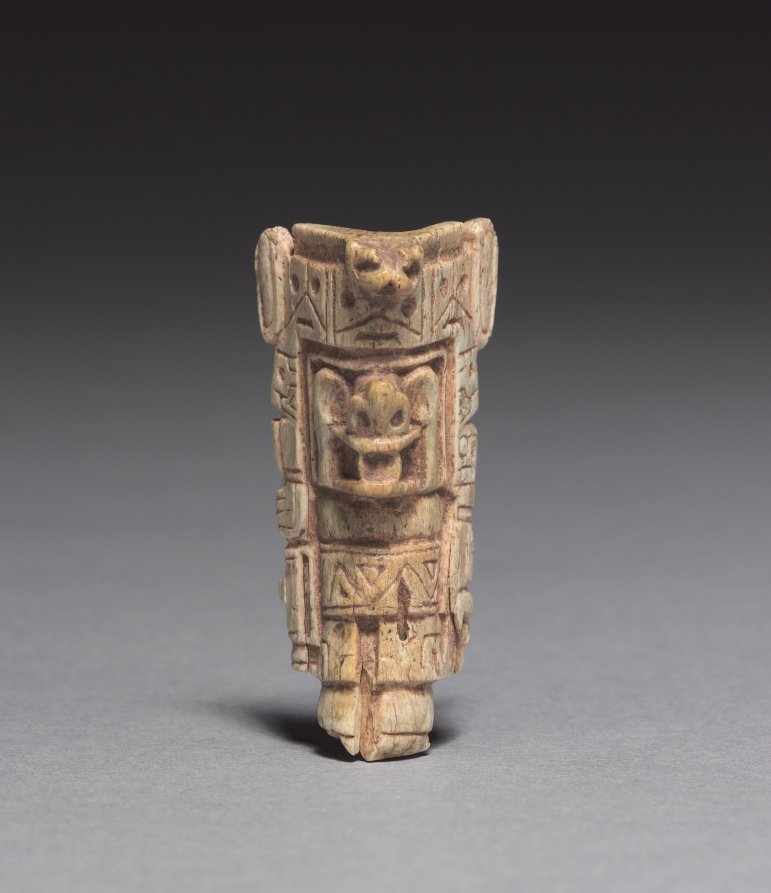
A carved bone figure only 5 cm tall, from the Southern Highlands of the Andes, holding an axe and a human head. The bone has aged to a warm tan, with brown in the cuts: darker and more golden than the web’s bone.
Sampled from the Cleveland Museum of Art’s photograph (1996.293), released as CC0 (public domain). Colors in a photo shift with the lighting, so read the codes as close, not exact.
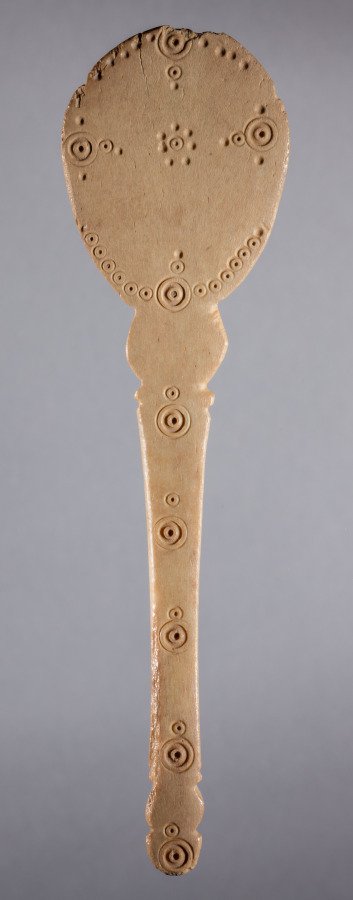
A flat strip of bone about 14 cm long from early Islamic Iran, decorated with incised ring-and-dot circles. It reads as a light tan, with honey-brown where the surface has worn.
Sampled from the Cleveland Museum of Art’s photograph (1962.147), released as CC0 (public domain). Colors in a photo shift with the lighting, so read the codes as close, not exact.
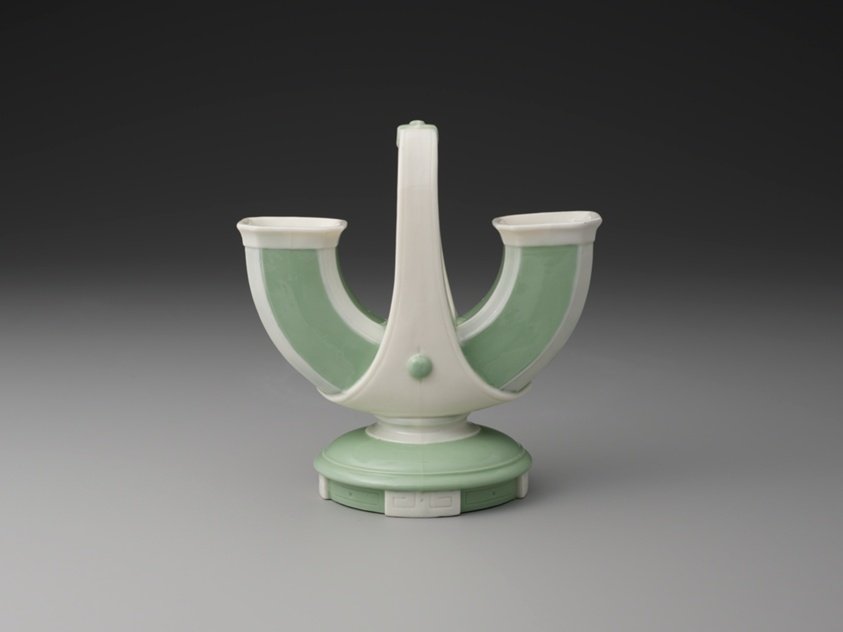
A Minton vase from Stoke-on-Trent, probably designed by Christopher Dresser, at the Art Institute of Chicago. Bone china is made from burned bone, yet its body is a cool, clean white, nothing like the beige of the color named after bone. It looks grayer here because of the museum lighting.
Sampled from the Art Institute of Chicago’s photograph (2020.307), released as CC0 (public domain). Colors in a photo shift with the lighting, so read the codes as close, not exact.
Palettes are sampled in-house.
A light beige with a touch of gray. The code most color lists use is #E3DAC9 (RGB 227, 218, 201). Merriam-Webster defines bone simply as a light beige.
Bone (#E3DAC9) is darker and grayer, a muted beige. The web’s ivory (#FFFFF0) is almost white with a faint yellow tint. Real carved ivory and real carved bone both look tan in old museum pieces, much darker than either code.
It sits between the two. Bone is too dark and gray to read as white next to pure white, but lighter and grayer than most beiges. Most people would call it an off-white or a pale beige.
Eggshell (#F0EAD6) is lighter and a little more yellow. Bone (#E3DAC9) is a step darker and grayer, with a slightly warmer cast.
Black and navy for contrast, olive and terracotta for an earthy look, walnut brown for warmth, and cobalt blue for a crisp, traditional pairing.
No. Bone china is made with burned animal bone, but burning removes the organic matter, and the ash is white. The finished china is prized for being white and translucent, much lighter and cooler than the beige called bone.