Antique white

A warm, peachy off-white that came to screens from a paint chart.

Overview

Antique white is a pale, warm white with a peachy beige tint. Its code, #FAEBD7, is the CSS keyword antiquewhite: red almost full, green a little lower and blue lower again, which warms white toward peach.

The name reached screens from a paint chart. In 1989 Paul Raveling added a set of light and off-white colors to the X Window System’s color list, copied from a paint maker’s samples, to give a better choice of light window backgrounds. Antique white was one of them, along with linen, old lace and navajo white. Web browsers took over the list, and CSS still uses it.

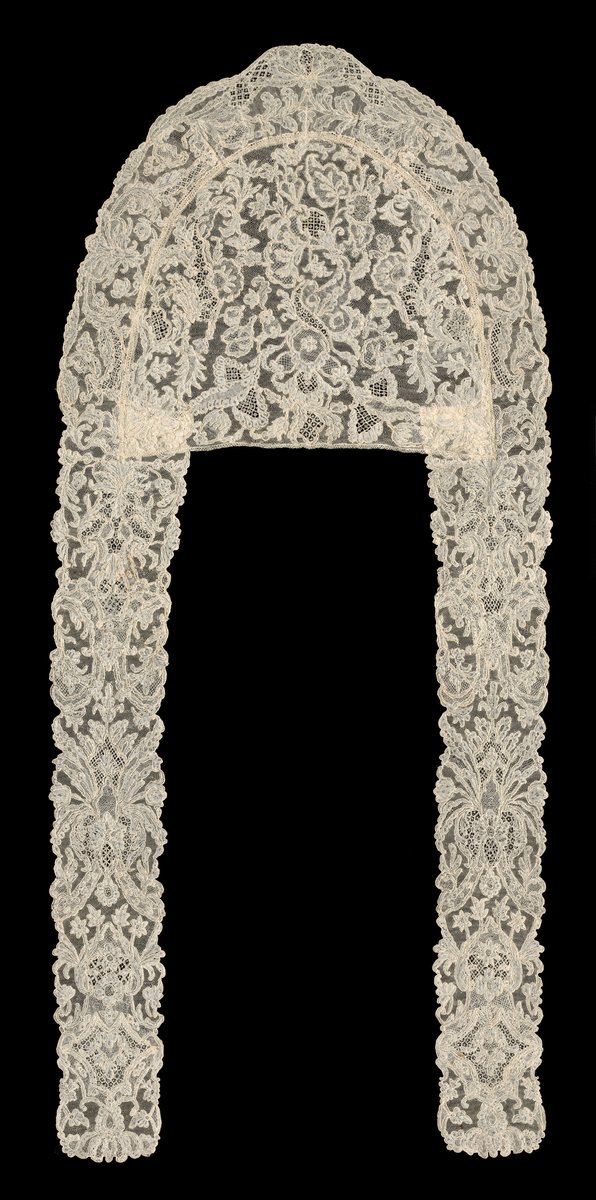
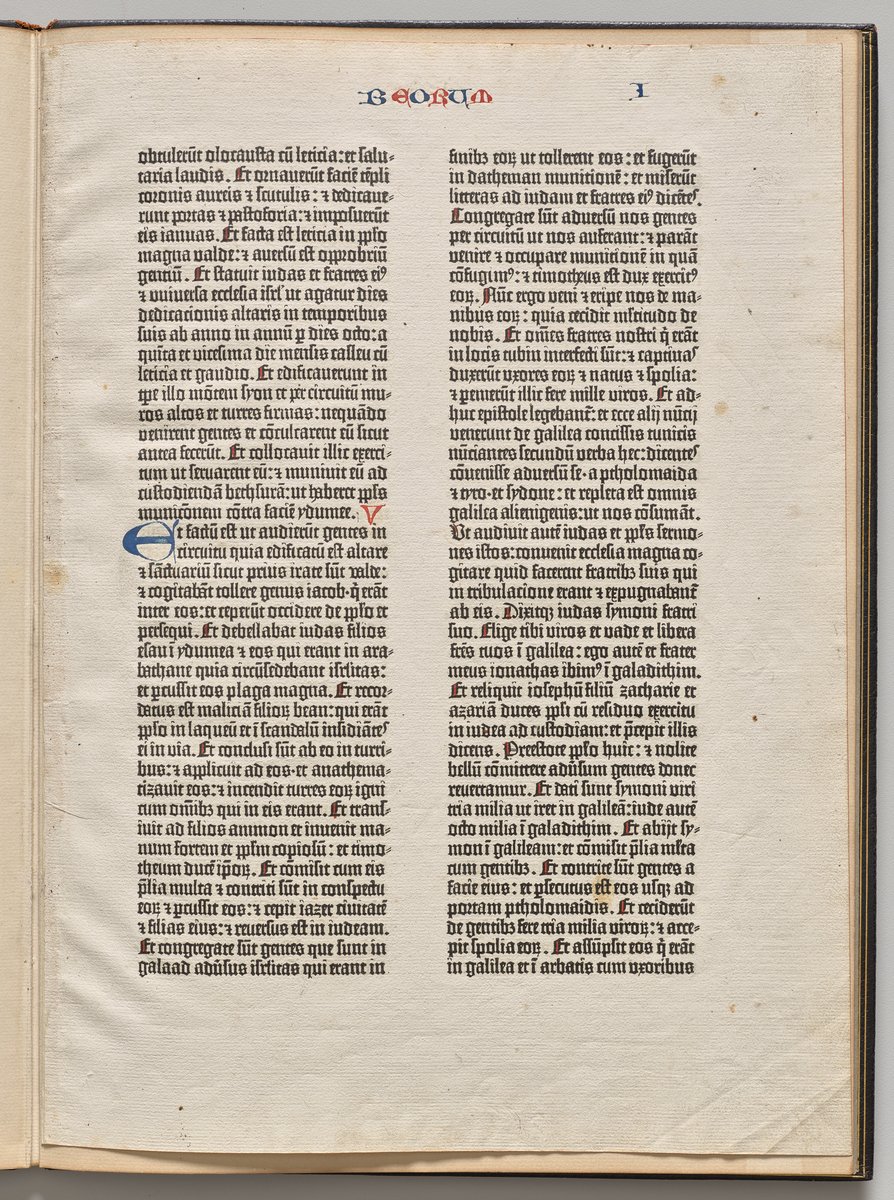
“Antique” points to how whites age. Paper browns as acids break down its fibers, light yellows linen and cotton, and ivory takes on a yellow patina. Real old whites are darker and more varied than the code: in the museum photos below, a lace headdress from the 1730s and a Gutenberg Bible page from the 1450s both read as a soft gray-beige, close to antique white in hue but well below it in lightness.

On screens, antique white makes a warm page background for dark brown, navy or charcoal text. Next to champagne it is a touch lighter and softer. Next to linen it is a little deeper and more peach.

HEX#FAEBD7
RGBrgb(250, 235, 215)
HSLhsl(34, 78%, 91%)
HSV34°, 14%, 98%
CMYK0, 6, 14, 2
OKLCHoklch(94.7% 0.031 75.2)
Every code converts from the HEX value #FAEBD7. #FAEBD7 is the CSS keyword antiquewhite, defined in the CSS Color Module Level 4 and first listed among the web’s color names in SVG 1.0 (2001). It comes from the X Window System’s 1989 color list, whose light and off-white colors were copied from a paint maker’s samples. CMYK is a screen-based estimate; print results vary.
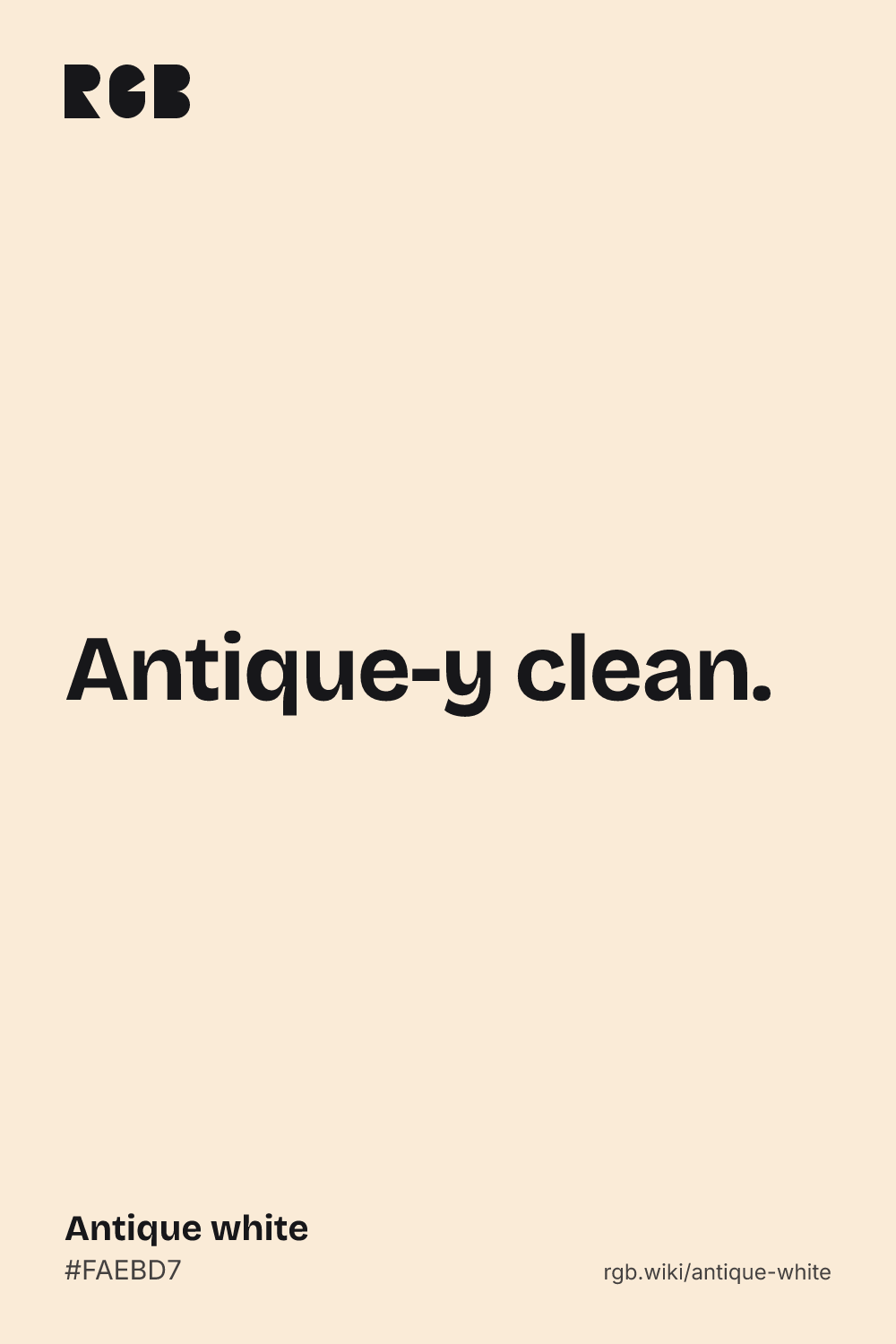
Antique white color card, hex #FAEBD7: “Antique-y clean”

Antique white on the color map

The xkcd survey has no average for antique white. The Gutenberg page’s paper sits at the bottom edge of the outline, a little yellower than the code. The 1730s lace sits just below the outline, darker and a touch yellower still. Colors in photos shift with the lighting, so read both as close, not exact. The outline is an approximate range, not a measured one.

Shades and tints

Tints with white

Shades with black

Tones with gray

Antique white sits in the middle. Tints add white, shades add black and tones add gray, in 10% steps out from it. Tap any swatch to copy its code.

Light and dark antique white

#FFEFDB
Bright antique whiteThe same tint at full brightness, almost papaya whip. The X11 color list calls it AntiqueWhite1, the top of its numbered antique white scale. See papaya whip
#FAEBD7
Antique whiteThe reference color.
#EEDFCC
Deep antique whiteA step darker, almost the same as almond. X11 calls it AntiqueWhite2. See almond
#CDC0B0
Gray antique whiteA warm light gray-beige, X11’s AntiqueWhite3.
#8B8378
Dark antique whiteA warm mid gray close to stone, X11’s AntiqueWhite4. Dark enough for large text on antique white, not for body text. See stone

Colors that go with antique white

Pairings that work in rooms, outfits and interfaces.

Gutenberg page

From a 1450s Bible page: warm paper, brown-black ink, and red and blue added by hand.

Antique white and navy

Crisp and classic. Navy text reads well on the warm page.

Antique white and sage

Soft and natural. Suits kitchens, gardens and wellness brands.

Antique white and dusty rose

Vintage and romantic, like old lace with faded roses.

Antique white and charcoal

Modern and calm. A softer take on black on white.

Lace on black

From the museum photo of 1730s lace: pale linen laid on black. A dark theme with antique white text.

Color-wheel palettes

Pick a palette to see where its colors sit on the color wheel. The caret marks antique white. Tap a band to copy its code.

Similar colors

Antique whiteBlanched almond93%Champagne93%Papaya whip93%Lead white92%Parchment92%Eggshell93%

Lined up by hue around antique white. Hover a color to see how similar it is.The bar under each name shows how similar it is. Similarity comes from the distance between the two colors in OKLab, a model of how we see color.

Antique white vs champagne

Antique white#FAEBD7 · hue 34°
  • A touch lighter and softer
  • A paint name brought to screens in 1989
  • A CSS keyword, antiquewhite
Champagne#F7E7CE · hue 37°
  • A touch darker and more golden
  • Named after the sparkling wine
  • No CSS keyword

Meaning

  • Old paper
  • Lace and linen
  • Antiques
  • Age

Antique white suggests the mellowed whites of antiques and old things: paper, lace, linen and ivory that have aged. It reads as warm, gentle and a little nostalgic. Those meanings come from the materials, not from research. Studies of color and emotion test basic words such as white, not antique white, so the claims here are about how real whites age and about the word itself.

Old paper browns from acid

Conservation science

Acids slowly cut the cellulose fibers in paper, and book leaves often turn browner and more brittle at the edges, where they soak up pollution from the air. Mechanically pulped wood paper, such as newsprint, came in from the mid-1800s and keeps the wood’s lignin, which speeds the damage. Rag paper made from cotton and linen before then tends to stay strong.1
Light yellows linen and cotton

Conservation guidance

Conservators read yellowing in old textiles as a sign of light damage. Light, especially ultraviolet, oxidizes the fibers, and cotton, linen, silk and wool all yellow with exposure. The yellowing often shows first along folds.2

Ivory gains a yellow patina

Conservation guidance

Ivory and bone can develop a brownish yellow patina over the years, as part of natural aging. The Canadian Conservation Institute advises leaving it alone: bleaching or sanding will almost certainly do serious damage.3

“Antique” colors used to be dark

Dictionary record

Older color names that start with “antique” are mostly browns and dusky reds. Merriam-Webster defines antique bronze and antique brown as browns and antique rose as a grayish red, and Maerz and Paul’s 1930 dictionary lists plain “antique” as an olive brown. Neither has an antique white.4, 5

Sources (5)
  1. Library of Congress, “The Deterioration and Preservation of Paper: Some Essential Facts”, Preservation Directorate.
  2. Dancause, R., Wagner, J. & Vuori, J. “Caring for textiles and costumes”. Canadian Conservation Institute, 2018, revised 2024.
  3. Stone, T. “Care of Ivory, Bone, Horn and Antler”. Canadian Conservation Institute Notes 6/1, 1983, revised 2010.
  4. Merriam-Webster, “antique bronze”, “antique brown” and “antique rose”.
  5. Jaffer, A. “Maerz and Paul color names”, MIT CSAIL, giving the ISCC-NBS groups (light and moderate olive brown) for the “antique” sample in Maerz and Paul’s A Dictionary of Color (1930).

History

Antique white is a paint color that became a computer color. It reached screens in 1989 and became a web standard in 2001, with the same code all the way: 250, 235, 215.

  1. 1930

    Maerz and Paul’s A Dictionary of Color lists “antique” as a color of its own, an olive brown, beside antique gold, antique bronze and antique red. It has no antique white.1

  2. 1987

    X11 ships with a short color list of basic colors and gray steps, first tuned for DEC terminals. Its only white is plain white.2

  3. 1989

    Release 4 of the X Window System adds antique white, 250, 235, 215, in a new set of light and off-white colors copied from a paint maker’s samples “to provide a better choice for light-colored window backgrounds”. Paul Raveling, who added them, said he tuned many of the list’s colors on his own HP monitor.3, 4

  4. 1989

    The same list gives antique white four numbered shades, AntiqueWhite1 to AntiqueWhite4, stepping from the brightest version of the tint toward black.3

  5. 2001

    SVG 1.0 lists “antiquewhite”, rgb(250, 235, 215), among the web’s color keywords.5

  6. 2011

    CSS Color Module Level 3 becomes a W3C Recommendation on June 7 and makes the same list official in CSS, antiquewhite #faebd7 included. The numbered shades are left out.6

Sources (6)
  1. Jaffer, A. “Maerz and Paul color names”, with ISCC-NBS centroids from “Color-Name Dictionaries”, MIT CSAIL.
  2. The original X list, old-rgb.txt, and the X11 README’s note that it was “tuned” for Digital VT240 terminals, quoted in Jaffer, “Color-Name Dictionaries”; release date (X11R1, September 1987) from Wikipedia, “X11 color names”.
  3. Paul Raveling’s list, raveling.txt, and his notes from the X11 README, quoted in Jaffer, “Color-Name Dictionaries”, MIT CSAIL.
  4. Wikipedia, “X11 color names”, history of the list, and “X Window System”, release history (X11R4, 1989).
  5. W3C (2001). Scalable Vector Graphics (SVG) 1.0, recognized color keyword names.
  6. W3C (2011). CSS Color Module Level 3, extended color keywords, W3C Recommendation, June 7, 2011.

Antique white in use

A pale cream lace headdress laid flat on black: a rounded cap at the top and two long lace streamers hanging down, patterned with flowers and scrolls
#D3C9B6#B9B09D#968D7D#6D6658
Lace“Lace head” from Alençon, France (1730s)

A cap, its narrow edging and a pair of lappets, the streamers that framed the face, all in linen needle lace. Few complete lace headdresses survive, and in their day they showed off the wearer’s wealth and taste. Nearly three hundred years on, the lace reads as a soft gray-cream in the photo, about #D3C9B6.

#D3C9B6#B9B09D#968D7D#6D6658
Source: Cleveland Museum of Art
A pale cream printed page with two columns of dense black Gothic type, a blue initial letter and small red letters at the top
#D7CDBE#A05950#4B5769#392F24
BookPage from a Gutenberg Bible (about 1450–55)

A page from the earliest major book printed in Europe with metal movable type, with red and blue letters added by hand. It is printed on laid paper, which in Gutenberg’s day was made from cotton and linen rags, the kind that tends to stay strong. After more than 570 years the paper reads about #D7CDBE in the photo: darker than antique white, but close in hue.

#D7CDBE#A05950#4B5769#392F24
Source: Cleveland Museum of Art

Palettes are sampled in-house.

Questions

What color is antique white?

A pale, warm white with a peachy beige tint. Its code is #FAEBD7 (RGB 250, 235, 215), the CSS keyword antiquewhite.

What is the hex code for antique white?

#FAEBD7. In CSS you can also write the keyword antiquewhite, which every modern browser understands. In HSL it is about 34°, 78%, 91%.

What is the difference between antique white and linen?

Both are CSS off-whites from the same 1989 color list. Linen (#FAF0E6) is lighter and paler, with less tint. Antique white (#FAEBD7) is a little deeper and more peach.

Is antique white the same as off-white?

Antique white is one kind of off-white: a white with a warm, peachy beige tint. Off-white is the broader name for any white that is not pure. The common off-white code, #FAF9F6, is much closer to pure white.

Why is it called antique white?

The name suggests the mellowed whites of old lace, linen, paper and ivory. On screens it comes from a paint color: in 1989 it was copied from a paint maker’s samples into the X Window System’s color list, which web browsers later took over.

When was antique white created?

As a screen color, in 1989, when it joined the X Window System’s color list. Some references say 1987, but the first X color list from that year has no off-whites at all. Antique white has been a web color keyword since SVG 1.0 in 2001.

What colors go with antique white?

Navy, charcoal and dark brown for readable text, sage and dusty rose for a soft vintage look, and deep red for an old-book feel.