Mango

The orange of ripe mango flesh, not of the skin around it.

Overview

Mango is a bright, warm orange named after the ripe fruit. Its code, #FFA62B, has full red, about two-thirds green and a little blue. It is the average color that people in the xkcd color survey called mango; no color standard defines it. On screens it sits almost on top of the web color orange, #FFA500, and of chrome yellow and yellow-orange.

A mango has two colors, and the name means the inside. The flesh runs from pale yellow to deep orange, depending on the variety, and gets its color from carotenoids, mostly beta-carotene. The skin can be green, yellow, red or purple-red, often several at once. In the CIELAB numbers that fruit scientists use, the code’s hue, about 71°, sits at the orange end of ripe mango flesh, roughly 70° to 95°, and it is more intense than any of the 25 varieties measured in a 2025 study. It is a mango at its most orange.

The name was not always this bright. Mango first appears as a color name in 1926, in the textile trade, and the sample that Maerz and Paul printed in 1930 sat among tans and brownish oranges. The 1955 ISCC-NBS dictionary filed it as brownish orange, #AE6938, or light brown. Some color lists give a yellower mango, #FFC800, taken from a colored pencil.

#FFA62B is a light color: white text on it reaches only about 2:1, while black text reaches 10.7:1. Use dark text on it, or deep mango, #99641A, for text on white. It pairs well with teal, indigo, leaf green and cream. Its near twin is yellow-orange: mango is a touch deeper and more saturated, yellow-orange a touch lighter and softer.
HEX#FFA62B
RGBrgb(255, 166, 43)
HSLhsl(35, 100%, 58%)
HSV35°, 83%, 100%
CMYK0, 35, 83, 0
OKLCHoklch(79.6% 0.162 68.5)
Every code converts from the HEX value #FFA62B. #FFA62B is the average color that people in the xkcd color survey (2010, CC0) named mango. No color standard defines it. Wikipedia’s list of yellows gives a yellower mango, #FFC800, taken from a colored pencil, and the one dictionary mango, Maerz and Paul’s 1930 sample, is filed by the 1955 ISCC-NBS dictionary as brownish orange or light brown (Jaffer’s tables). CMYK is a screen-based estimate; print results vary.
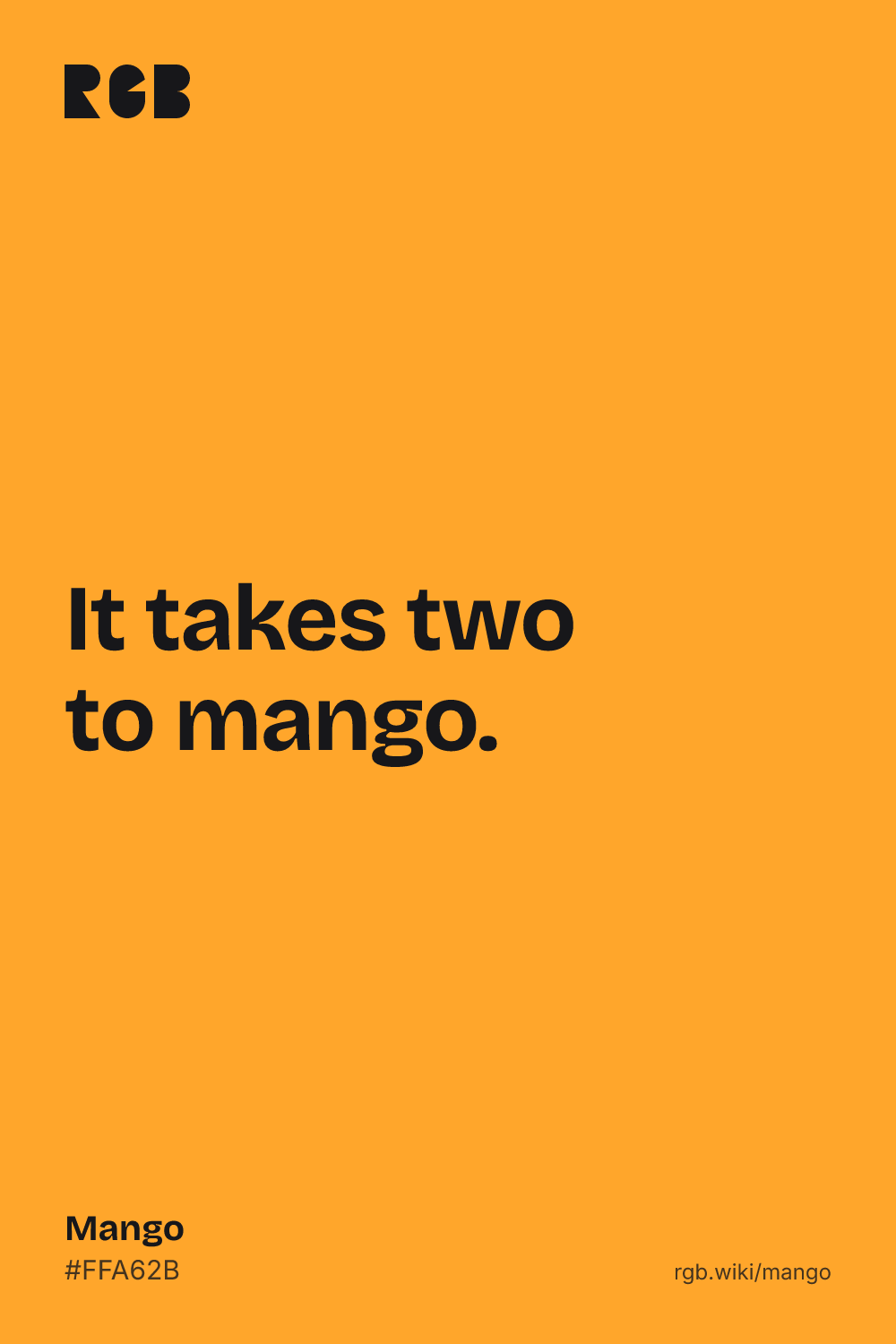
Mango color card, hex #FFA62B: “It takes two to mango”

Mango on the color map

Yellow-orange sits just above the reference and CSS orange almost on top of it, both inside the outline. The colored-pencil mango sits on the upper right edge: lighter and yellower. The two ISCC-NBS groups for Maerz and Paul’s 1930 mango sit far below and a little to the left: much darker, duller and a little redder. The outline is an approximate range, not a measured one.

Shades and tints

Tints with white

Shades with black

Tones with gray

Mango sits in the middle. Tints add white, shades add black and tones add gray, in 10% steps out from it. Tap any swatch to copy its code.

Light and dark mango

#FFDBAA
Pale mangoMixed 60% with white. A soft cream for backgrounds.
#FFCA80
Light mangoMixed 40% with white. A warm apricot tint.
#FFA62B
MangoThe reference color.
#FFC800
Yellow mangoThe yellower mango some color lists use, from a colored pencil. No standard defines it.
#99641A
Deep mangoMixed 40% with black. Reaches 5:1 against white, so it works for text and buttons.
#AE6938
Dictionary mangoISCC-NBS brownish orange, one of the two groups where the 1955 dictionary files Maerz and Paul’s 1930 mango.

Colors that go with mango

Pairings that work in rooms, outfits and interfaces.

Mango and lagoon

Ripe fruit against blue-green water. Fresh and tropical.

Gauguin’s mangoes

From the 1896 still life: golden, blushing and green skins on a dark ground.

Mango lassi

Mango, yogurt cream and a little cardamom green. Soft and warm.

Mango and indigo

Near opposites on the screen color wheel. Bold, with mango as the light.

Leaf and fruit

Mango with the deep green of its leaves. Natural and lively.

Mango sunset

Mango and coral on a plum-black night. Made for dark themes.

Color-wheel palettes

Pick a palette to see where its colors sit on the color wheel. The caret marks mango. Tap a band to copy its code.

Similar colors

Sandy brown78%MangoYellow-orange90%Chrome yellow94%Marigold81%Honey84%Orpiment83%

Lined up by hue around mango. Hover a color to see how similar it is.The bar under each name shows how similar it is. Similarity comes from the distance between the two colors in OKLab, a model of how we see color.

Mango vs yellow-orange

Mango#FFA62B · hue 35°
  • A touch deeper and more saturated
  • Named after ripe mango flesh
  • The xkcd survey’s average mango
Yellow-orange#FFAE42 · hue 34°
  • A touch lighter and softer
  • A tertiary color on the painter’s wheel
  • Code traced to a crayon color

Meaning

  • Fruit name
  • 1926 textile color
  • Beta-carotene
  • Judge by feel

Mango’s meanings come from the fruit. The name traveled into English through Portuguese, the textile trade made it a color name in the 1920s, and fruit scientists can say what colors the flesh and why the skin is a poor guide. Studies of color and emotion test words like “orange”, not mango, so there is no measured mood for this color.

Named after the fruit

Word history

Merriam-Webster traces mango to Portuguese manga, probably from Malayalam māṅṅa, and dates it in English to 1582. Julia Morton notes how widely the name spread: mango in English and Spanish, manga in Portuguese, mangue in French and manja in Dutch.1, 2

A textile color by 1926

Historical record

Maerz and Paul’s A Dictionary of Color (1930) marks mango as a name used only in the textile industry and dates it to 1926. Their sample sits on a plate of tans and brownish oranges, beside tawny, sorrel and titian gold, and the 1955 ISCC-NBS dictionary files it as brownish orange or light brown, far deeper than today’s code.3, 4

Carotenoids color the flesh

Study

A 2025 study measured the ripe flesh of 25 mango varieties, from deep orange to pale yellow. The more orange the flesh, the more orange carotenoids it held, above all all-trans beta-carotene. Pale yellow varieties often had few carotenoids and high acidity, a sign that incomplete ripening adds to their pale color.5

Skin color is a poor guide to ripeness

Industry guidance

The US National Mango Board tells shoppers not to focus on color, because it is not the best sign of ripeness, and to judge by feel: a ripe mango gives slightly when squeezed. Morton notes that red skin was treated as a necessity for mangoes shipped to northern markets, even when their quality was lower than that of plainer varieties.6, 2

A national fruit

Official symbol, secondhand

The mango is the national fruit of India, Pakistan and the Philippines, and the mango tree is the national tree of Bangladesh. We found this in Wikipedia’s summary, which cites the Government of India for India’s choice.7

Sources (7)
  1. Merriam-Webster, “mango”: etymology and first known use (1582).
  2. Morton, J. F. (1987). “Mango”. In Fruits of Warm Climates, pp. 221–239. Miami: J. F. Morton. Online at Purdue University’s NewCROP.
  3. Maerz, A. & Paul, M. R. (1930). A Dictionary of Color. New York: McGraw-Hill. Plate 13, sample D11 (p. 49); index entry “MangoT … 1926” (p. 198); key to the letter T, “a color name used only in the textile industry” (p. 145). Internet Archive.
  4. Kelly, K. L. & Judd, D. B. (1955). The ISCC-NBS Method of Designating Colors and a Dictionary of Color Names. NBS Circular 553. Maerz and Paul’s mango under 54 brownish orange and 57 light brown, as listed in Jaffer’s (M) table.
  5. Takagi, T., Hong, H., Dillon, N., Crisp, P., Cozzolino, D. & O’Hare, T. (2025). The association between the flesh colour and carotenoid profile of 25 cultivars of mangoes. Molecules 30(8): 1661. doi:10.3390/molecules30081661.
  6. National Mango Board, “How to choose a mango”.
  7. Wikipedia, “Mango”, Culture, citing the Government of India’s Know India page “National Fruit”.

History

Mango took a long road from a South Indian word to a screen color, and its color changed on the way: a brownish textile shade in the 1920s, a bright survey orange today.

  1. 1582

    The first known use of mango in English. The word comes through Portuguese manga, probably from Malayalam māṅṅa.1

  2. 1896

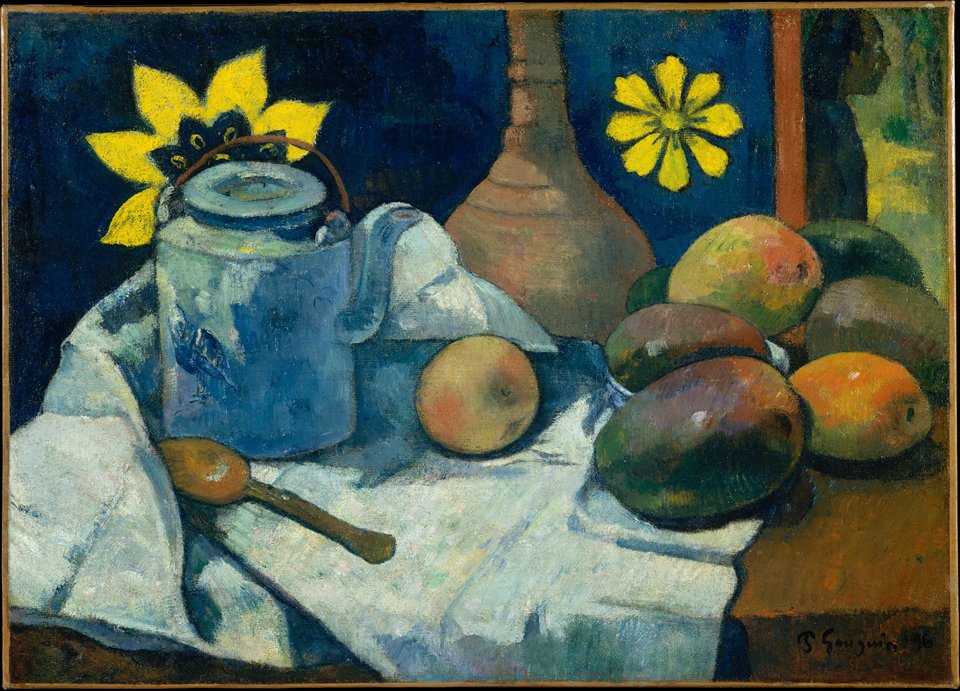
    Paul Gauguin paints Still Life with Teapot and Fruit, modeled on a Cézanne still life he owned, with mangoes in place of Cézanne’s apples. His mangoes show their skins: green, golden and blushing red.2

  3. 1926

    The first recorded use of mango as a color name in English, in the textile trade.3

  4. 1930

    Maerz and Paul print mango in A Dictionary of Color as sample D11 on plate 13, a plate of tans and brownish oranges, between tawny above it and the titian gold and sorrel of the same row.3

  5. 1955

    The ISCC-NBS dictionary of color names files Maerz and Paul’s mango under brownish orange, #AE6938, and light brown, #A67B5B.4

  6. 1987

    Julia Morton’s Fruits of Warm Climates describes mango flesh as pale yellow to deep orange, and skins from light or dark green to yellow, yellow-orange and reddish pink, often blushed red or purple-red.5

  7. 2010

    In the xkcd color survey, people’s average mango is #FFA62B, a bright light orange and the code most color lists now use.6

  8. 2025

    A study of 25 varieties measures ripe mango flesh from a CIELAB hue of 78.9°, the deep orange Creeper, to 100.1°, the pale Xoai Than Ca, and links the orange to beta-carotene.7

Sources (7)
  1. Merriam-Webster, “mango”.
  2. The Metropolitan Museum of Art, “Still Life with Teapot and Fruit”, Heilbrunn Timeline of Art History, and the collection record (1997.391.2).
  3. Maerz, A. & Paul, M. R. (1930). A Dictionary of Color. New York: McGraw-Hill. Plate 13 (pp. 48–49) and index, p. 198. Internet Archive.
  4. Kelly, K. L. & Judd, D. B. (1955). The ISCC-NBS Method of Designating Colors and a Dictionary of Color Names. NBS Circular 553, via Jaffer’s (M) table.
  5. Morton, J. F. (1987). “Mango”. In Fruits of Warm Climates, pp. 221–239. Miami: J. F. Morton.
  6. Munroe, R. (2010). xkcd color survey: the 954 most common RGB monitor colors (CC0).
  7. Takagi, T. et al. (2025). The association between the flesh colour and carotenoid profile of 25 cultivars of mangoes. Molecules 30(8): 1661. doi:10.3390/molecules30081661.

Mango in use

Gauguin’s still life of a blue and white teapot, a wooden spoon and a round fruit on a rumpled white cloth, with a heap of green, purple-red and golden mangoes at the right, against a deep blue wall with two yellow flowers and a figure glimpsed through a doorway
#BF7F24#AA663C#AC9748#1F2B27
PaintingStill Life with Teapot and Fruit, Paul Gauguin (1896)

Gauguin based this still life on a Cézanne he owned and put mangoes where Cézanne had apples. They show the fruit’s skin, not its flesh: in the photo they sample as golden ochre #BF7F24, a reddish blush, yellow-green and a dark green, all far deeper than the web code.

#BF7F24#AA663C#AC9748#1F2B27
Source: The Met

Palettes are sampled in-house.

Questions

What color is mango?

A bright, warm orange like ripe mango flesh. Its code is #FFA62B (RGB 255, 166, 43), the average color people named mango in the xkcd color survey. No color standard defines it.

Is mango the same as yellow-orange?

Almost. The two have nearly the same hue. Mango (#FFA62B) is a touch deeper and more saturated, with less blue; yellow-orange (#FFAE42) is a touch lighter and softer. Side by side you can see the difference, but apart few people could tell them apart.

Is mango color orange or yellow?

Orange, leaning a little toward yellow. Its hue is close to the web color orange (#FFA500). Some color lists give a yellower mango, #FFC800, taken from a colored pencil.

What color is the inside of a mango?

Pale yellow to deep orange, depending on the variety. Carotenoids, above all beta-carotene, color the flesh, and the more of them it holds, the more orange it looks. The code #FFA62B matches flesh at its most orange.

Does the color of a mango’s skin show if it is ripe?

Not reliably. Skins can be green, yellow, red or purple-red depending on the variety, and the US National Mango Board advises judging by feel instead: a ripe mango gives slightly when squeezed.

Why do old color dictionaries show mango as brown?

Mango began as a textile color name in 1926, and the sample in Maerz and Paul’s 1930 dictionary was a muted brownish orange. The 1955 ISCC-NBS dictionary filed it as brownish orange or light brown. Today’s bright code comes from a 2010 survey instead.

What colors go with mango?

Teal and indigo give strong contrast, leaf green keeps it natural, and cream or chocolate brown keep it warm. On a dark plum or navy ground it glows.

Can I use mango for text?

Not on white: mango text reaches only about 2:1. Use deep mango, #99641A, which reaches 5:1 on white, and keep #FFA62B for backgrounds, accents and buttons with dark text.