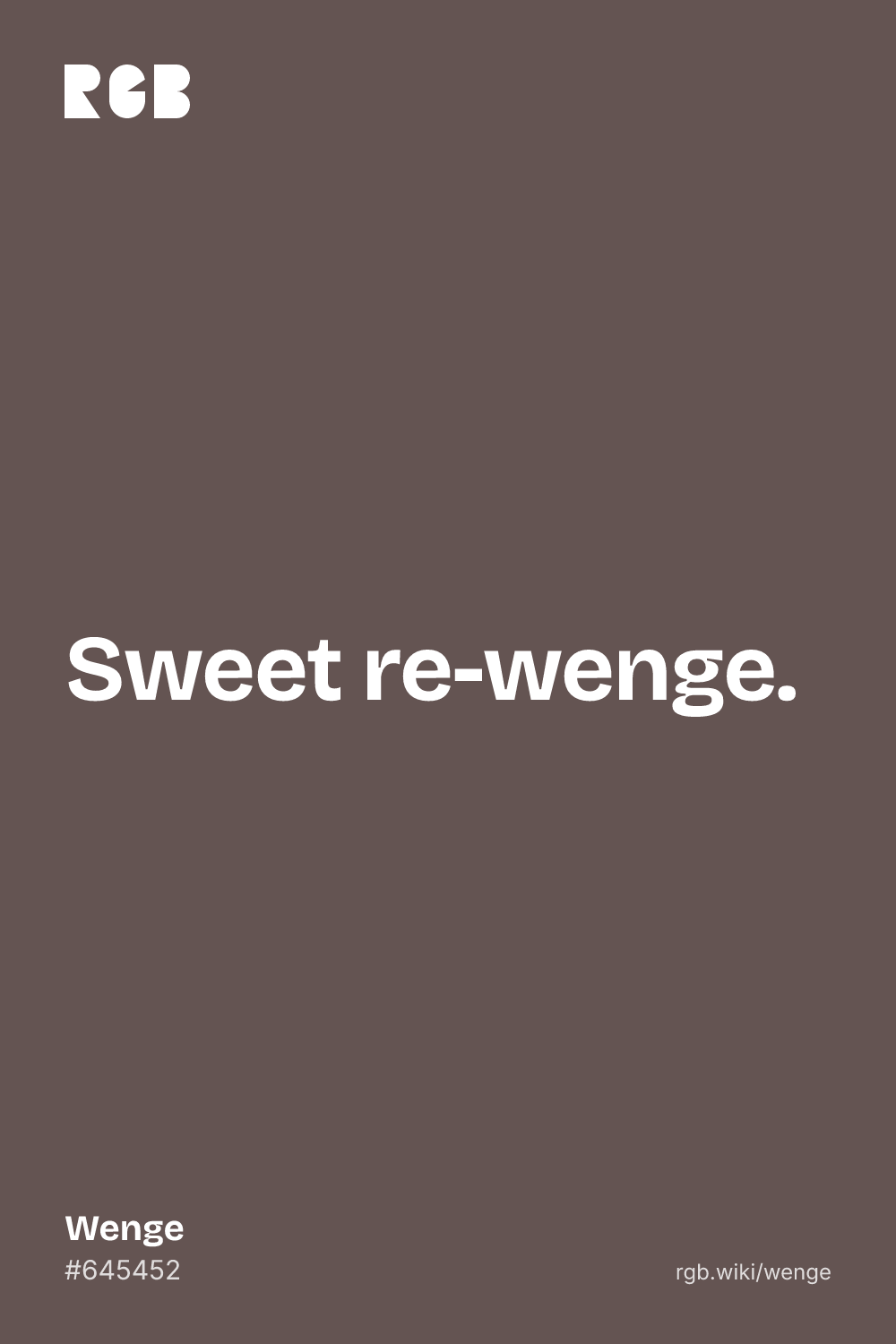
Wenge is a dark grayish brown with a faint rosy cast, named after the wood of a Central African tree. The code used here is #645452: red at 39%, green at 33% and blue at 32%. The three values sit close together with red ahead, so it reads as a quiet brown-gray, almost identical to umber but a touch pinker.
The wood comes from Millettia laurentii, a tree of the rainforests of Cameroon, Gabon, Equatorial Guinea and both Congos, first described by the Belgian botanist Émile De Wildeman in 1904. It is not one color. Freshly sawn heartwood is yellow and darkens in the air to dark brown or black-brown, with near-black streaks; an oil finish can make it look almost black, and long sunlight can fade it again. The web code is a soft average of those stripes, far lighter than a finished wenge table.
Wenge is a hard, heavy timber used for floors, stairs, paneling, veneer, furniture and instruments, and the trade has marketed it as a kind of ebony: its names include “grey ebony” and, in French, faux ébénier. That demand has a cost. The IUCN has listed the tree as endangered since 1998, because of habitat loss and logging. No color standard defines wenge; #645452 is simply the code most color references repeat.
As a design color, wenge is a calm, grown-up neutral. It carries white text easily and pairs well with linen, pale maple, brass, sage and dusty rose. For the deep look of oiled wenge furniture, use a near-black brown such as #28201C instead.