Chocolate

A deep, warm brown named after chocolate, which itself runs from ivory to almost black.

Overview

Chocolate is a deep, warm brown with an orange glow. The code most color lists use, #7B3F00, has red at just under half strength, green at a quarter and no blue at all. On screen it is almost the same color as walnut and russet, a touch more orange than both.

The word reached English in 1604 as the name of a drink, by way of Spanish from Nahuatl, the language of the Aztecs. Merriam-Webster traces it to chikolātl, probably from chikolli, a hook, likely the beater used to mix the drink, and ātl, water. It has named a color since at least 1737.

Real chocolate is duller than the code. The code is closest to the milk chocolate people picture: in the xkcd color survey, the average milk chocolate was #7F4E1E, while plain chocolate came out #3D1C02, close to black. Measured with a colorimeter, 70% dark chocolates run from about #785145 to #593F3E, much grayer, in line with Merriam-Webster’s definition of chocolate as “a brownish gray”.

Cocoa powder is lighter. Natural cocoa measures about #976F50, and treating it with alkali, the Dutch process, makes it darker and redder. White chocolate holds cocoa butter but none of the brown cocoa solids, so it stays pale. Chocolate carries white text easily, at a contrast of 8.2 to 1, and pairs well with cream, pink, mint and sky blue.

Names differ between color lists. In CSS and HTML, the keyword chocolate is #D2691E, the same code as cinnamon. This page covers chocolate as #7B3F00.
HEX#7B3F00
RGBrgb(123, 63, 0)
HSLhsl(31, 100%, 24%)
HSV31°, 100%, 48%
CMYK0, 49, 100, 52
OKLCHoklch(43.5% 0.105 57.0)
Every code converts from the HEX value #7B3F00. #7B3F00 is the chocolate most color lists use. Wikipedia gives it as a match for the chocolate sample in Maerz and Paul’s A Dictionary of Color (1930), plate 8, sample H10, but the 1955 ISCC-NBS dictionary files Maerz and Paul’s chocolate as a dark grayish brown, about #3E322C, so treat the code as typical, not official. The CSS keyword chocolate is a different color, #D2691E. CMYK is a screen-based estimate; print results vary.
Chocolate color card, hex #7B3F00: “Choc-full of brown”

Chocolate on the color map

People’s average milk chocolate in the xkcd survey sits inside the outline, a little above and to the right. The browner 70% dark chocolates sit inside near the left edge, and the dictionary’s chocolate just below the outline. Both are far grayer than the code, which this map of hue and lightness doesn’t show. People’s plain chocolate falls well below, near black. Natural cocoa powder sits above the outline, and the CSS keyword far above it. The outline is an approximate range, not a measured one.

Shades and tints

Tints with white

Shades with black

Tones with gray

Chocolate sits in the middle. Tints add white, shades add black and tones add gray, in 10% steps out from it. Tap any swatch to copy its code.

Light and dark chocolate

#D2691E
CSS chocolateThe CSS keyword chocolate, from the X11 color list. An orange brown, much lighter than real chocolate, and the same code as cinnamon. See cinnamon
#976F50
Natural cocoaNatural cocoa powder, converted from lab color readings (Sahin et al., 2024). People’s average cocoa in the xkcd survey, #875F42, is close.
#7F4E1E
Milk chocolateWhat people called milk chocolate in the xkcd survey, on average. A touch lighter and yellower than chocolate.
#7B3F00
ChocolateThe reference color.
#593F3E
Dark chocolateThe darkest 70% bars in a study of fine dark chocolates, converted from colorimeter readings (Dias et al., 2023). Much grayer than the code, with a red lean.
#5B3C2F
Dutch-process cocoaThe darkest cocoa in the same lab study as natural cocoa, after treatment with lye. Darker and redder.
#3E322C
Dictionary chocolateThe ISCC-NBS dark grayish brown, where the 1955 dictionary files Maerz and Paul’s chocolate. Good for text on light backgrounds.

Colors that go with chocolate

Pairings that work in rooms, outfits and interfaces.

Chocolate and cream

The classic pairing. Warm, cozy and good for bakeries and cafés.

Neapolitan

Chocolate, strawberry and vanilla, like the three-flavor ice cream.

Mint chocolate

Cool mint against warm brown. Fresh and playful.

Chocolate and orange

Two warm colors together. Bold and festive.

Chocolate and sky blue

A cool, airy blue lifts the deep brown. Friendly and fresh.

Chocolate night

A dark theme on a near-black brown, with a light caramel for accents.

Color-wheel palettes

Pick a palette to see where its colors sit on the color wheel. The caret marks chocolate. Tap a band to copy its code.

Similar colors

Saddle brown81%Walnut92%Russet88%Coffee74%ChocolateSepia89%Dark brown78%

Lined up by hue around chocolate. Hover a color to see how similar it is.The bar under each name shows how similar it is. Similarity comes from the distance between the two colors in OKLab, a model of how we see color.

Chocolate vs coffee

Chocolate#7B3F00 · hue 31°
  • Warmer and more vivid, with no blue at all
  • Named after the sweet, and before that a drink
  • Close to people’s average milk chocolate
Coffee#6F4E37 · hue 25°
  • Grayer and softer, about as dark
  • Named after the drink
  • The ISCC-NBS moderate brown, where the 1955 dictionary files Maerz and Paul’s cocoa

Meaning

  • Sweets
  • Hot chocolate
  • Cocoa beans
  • Food science

Chocolate brings to mind sweets, hot drinks and treats. Its color is set by the food itself: by how cocoa beans are fermented and processed, and by how much of the brown cocoa solids a recipe holds. Color research tests broad words like brown, not chocolate, so the claims here are about cocoa and its chemistry.

The brown starts in the bean

Well established

In a 2020 study, cocoa beans changed from deep purple to a deep red-brown as they fermented. A 2026 study of 38 cocoa varieties found the same direction: fermentation made the beans darker and a stronger reddish brown.1, 2

The recipe sets the shade

US food standard

US rules set a minimum of chocolate liquor, the finely ground cocoa bean: 10% for milk chocolate and 35% for semisweet or bittersweet. White chocolate is made from cocoa butter, milk and sweeteners, with at least 20% cocoa butter, no chocolate liquor and no added coloring.3

Dutch-process cocoa is darker

Lab measurements

Treating cocoa with an alkali, the Dutch process, darkens it and pushes it toward red. In a 2024 lab study, natural cocoa powder measured 50 on the 0 to 100 lightness scale; treated with lye, samples lost 12% to 45% of that lightness. In the US, such cocoa must be labeled “processed with alkali” or name the alkali used.4, 3

Same 70%, different browns

One study

Dark chocolates with the same 70% cocoa can still range from light brown to nearly black. A 2023 study of 37 such bars, made by the same process, found different polyphenol profiles in the darkest and the brownest, and suggests these compounds may be partly behind the color. It is one study, of one maker’s chocolate.5

Sources (5)
  1. Fang, Y., et al. (2020). “Chemical and flavor profile changes of cocoa beans (Theobroma cacao L.) during primary fermentation”. Food Science & Nutrition, 8(8), 4121–4133.
  2. K S, S., et al. (2026). “Fermentation and chemical composition as determinants of genetic and biochemical variation in cocoa (Theobroma cacao L.) bean colour”. Scientific Reports, 16, 14492.
  3. US Code of Federal Regulations, 21 CFR Part 163, “Cacao products”: §163.111 chocolate liquor, §163.112 breakfast cocoa, §163.123 sweet chocolate, §163.124 white chocolate, §163.130 milk chocolate.
  4. Sahin, E., et al. (2024). “Comparison of physicochemical properties, antioxidants, and aroma profiles of water- and sodium-hydroxide-treated natural cocoa powder”. ACS Omega, 9(33), 35730–35743.
  5. Dias, A. L. S., et al. (2023). “Shades of fine dark chocolate colors: polyphenol metabolomics and molecular networking to enlighten the brown from the black”. Metabolites, 13(5), 667.

History

Chocolate was a drink for thousands of years before it was a bar, and a bar long before it was a web color. Its story runs from cacao in the upper Amazon to a CSS keyword that looks nothing like it.

  1. About 3300 BCE

    People at Santa Ana-La Florida, in what is now southeast Ecuador, use cacao. Starch grains, residues and ancient DNA make it the earliest evidence yet found.1

  2. Before 1000 BCE

    People at Puerto Escondido, in what is now Honduras, make cacao drinks, probably at first by fermenting the sweet pulp around the seeds.2

  3. 1604

    “Chocolate” enters English as the name of a drink, by way of Spanish from Nahuatl.3

  4. 1737

    First recorded use of “chocolate” as a color name in English.4

  5. About 1828

    A Dutch chocolate maker develops a hydraulic press that squeezes much of the fat out of ground cocoa, leaving a cake that can be powdered. Treating cocoa with alkali, a step credited to his son, gives darker, milder Dutch-process cocoa.5

  6. 1930

    Maerz and Paul’s A Dictionary of Color prints a chocolate sample on plate 8, the one Wikipedia matches to #7B3F00.4

  7. 1955

    The ISCC-NBS dictionary files Maerz and Paul’s chocolate as a dark grayish brown.6

  8. 2001

    SVG 1.0 lists chocolate as red 210, green 105, blue 30, an orange brown. CSS keeps it; its standard says most of these names come from the X11 color list and are kept because they are widely used, not because they are good.7, 8

  9. 2002

    The US sets a standard for white chocolate: at least 20% cocoa butter, and free of coloring.9

  10. 2010

    In the xkcd color survey, people’s average chocolate is #3D1C02, almost black, and their milk chocolate #7F4E1E, close to the web code.10

Sources (10)
  1. Zarrillo, S., et al. (2018). “The use and domestication of Theobroma cacao during the mid-Holocene in the upper Amazon”. Nature Ecology & Evolution, 2(12), 1879–1888.
  2. Henderson, J. S., et al. (2007). “Chemical and archaeological evidence for the earliest cacao beverages”. PNAS, 104(48), 18937–18940.
  3. Merriam-Webster, “Chocolate”, etymology and first known use.
  4. Wikipedia, “Chocolate (color)”, citing Maerz and Paul, A Dictionary of Color (1930), p. 192 and plate 8, sample H10.
  5. Wikipedia, “Dutch process cocoa”, citing Goldstein, D. (2015), The Oxford Companion to Sugar and Sweets, pp. 762–763.
  6. Jaffer, A. “Maerz and Paul color names”, with ISCC-NBS centroids from “Color-Name Dictionaries”, MIT CSAIL.
  7. W3C (2001). Scalable Vector Graphics (SVG) 1.0 Specification, recognized color keyword names.
  8. W3C, CSS Color Module Level 4, named colors.
  9. US Code of Federal Regulations, 21 CFR 163.124, “White chocolate”, added at 67 FR 62177, October 4, 2002.
  10. Munroe, R. (2010). “Color Survey Results”, xkcd blog, with the survey’s color list (CC0).

Chocolate in use

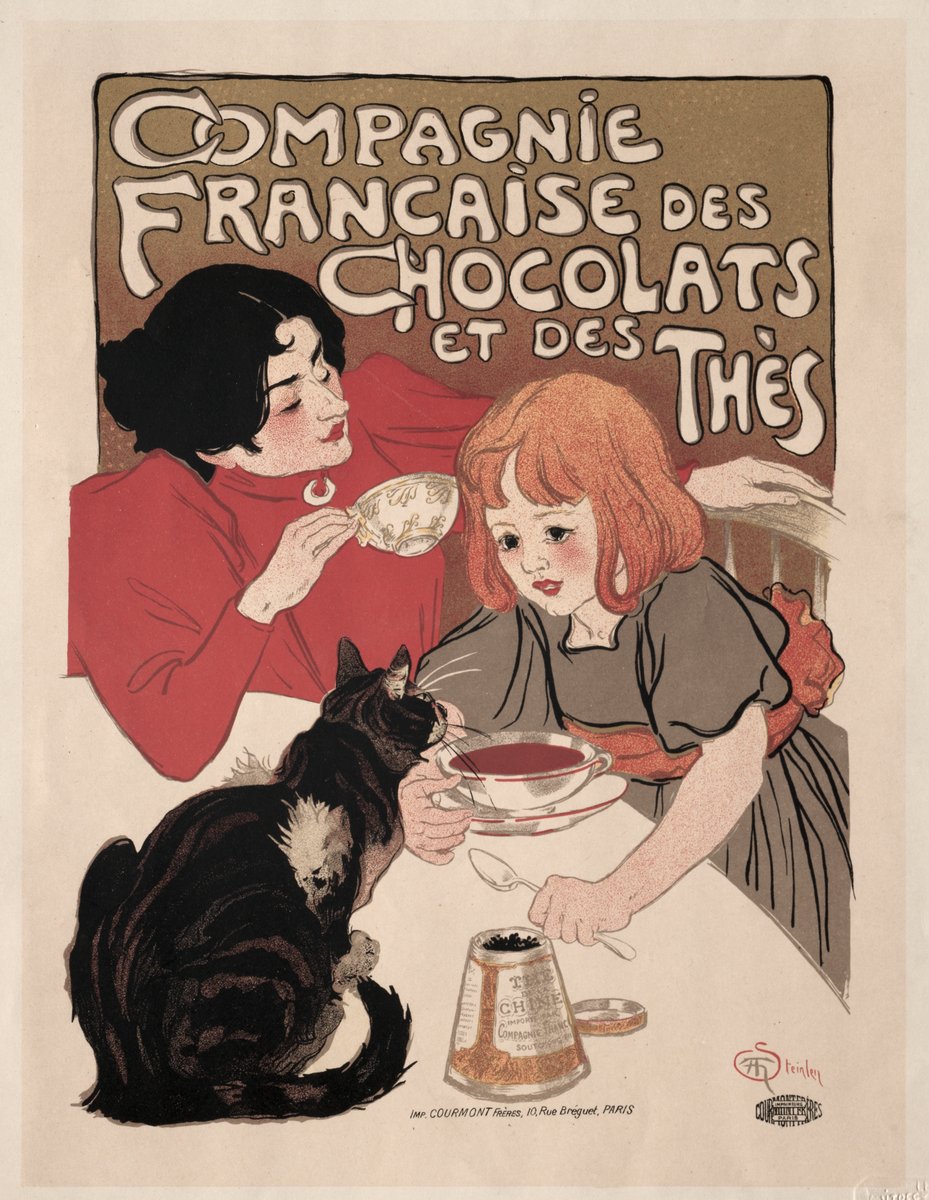
A color poster: a dark-haired woman in red drinks from a cup, while a red-haired girl and a black cat lean over a bowl on a white table, under large white lettering on a brown band
#85403F#844F43#927656#342926
PosterPoster for a chocolate and tea company, by Steinlen (1895)

Théophile-Alexandre Steinlen’s lithograph for a French seller of chocolate and tea shows a woman sipping from a cup while a girl and a black cat lean over a bowl. The drink in the bowl prints as a reddish chocolate brown, about #85403F, and the brown band behind the lettering shades from olive at the top to reddish brown.

#85403F#844F43#927656#342926
Source: Cleveland Museum of Art
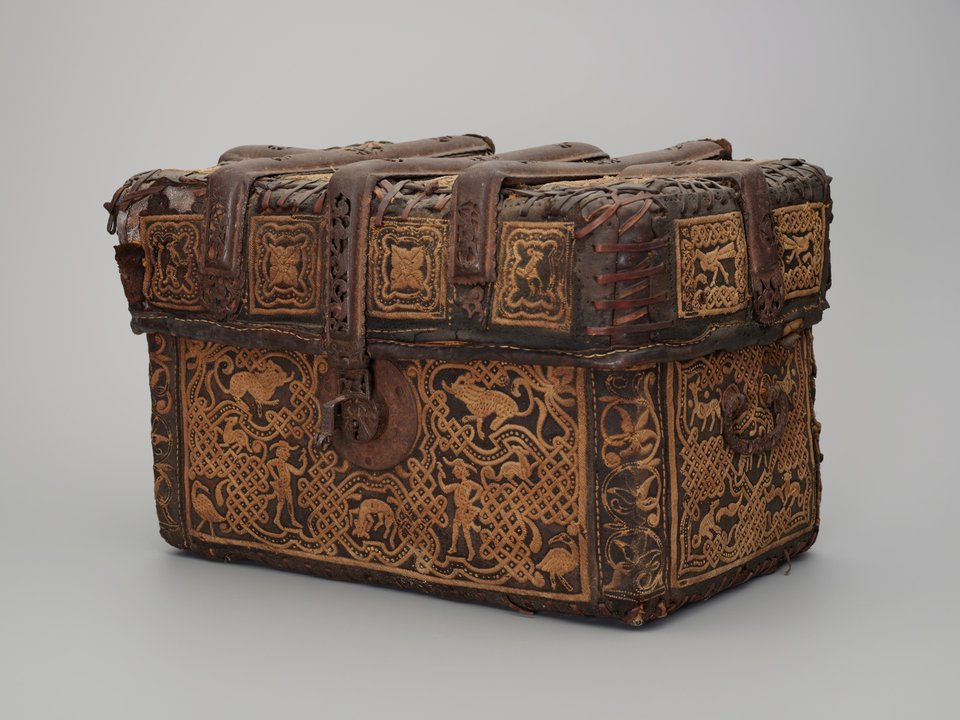
A rectangular leather trunk with a domed lid and leather straps, its dark brown sides covered in tan embroidery of interlaced knots, hunters, dogs, deer and birds
#966F51#845A3C#4D3223#352319
FurnishingChocolate trunk, New Spain (1700s)

A petaca chocolatera, a trunk of cane, palm and wood covered with leather, made in colonial Mexico. Hunters, dogs, deer and birds are embroidered across it in agave fiber. The dark leather reads about #4D3223 to #352319 in the photo, much duller than the web code, while the embroidery, about #966F51, is almost exactly the color of natural cocoa powder.

#966F51#845A3C#4D3223#352319
Source: Art Institute of Chicago

Palettes are sampled in-house.

Questions

What color is chocolate?

A deep, warm brown with an orange glow. The code used here is #7B3F00 (RGB 123, 63, 0).

Why is the CSS color chocolate orange?

CSS took most of its color names from the X11 list, where chocolate is #D2691E, an orange brown. The CSS standard itself says these names are kept because they are widely used, not because they are good. For a color closer to real chocolate, use #7B3F00 or darker.

What is the difference between milk and dark chocolate color?

Milk chocolate is lighter. US rules require at least 10% chocolate liquor in milk chocolate and 35% in semisweet or bittersweet. In the xkcd survey, people’s average milk chocolate was #7F4E1E and their average chocolate #3D1C02, almost black. Measured 70% dark chocolates run from about #785145 to #593F3E.

Why is white chocolate white?

It is made from cocoa butter, milk and sweeteners, with no chocolate liquor, the ground cocoa bean that holds the brown cocoa solids. US rules also require it to be free of coloring, so it stays pale.

What is the difference between chocolate and cocoa color?

Cocoa is lighter. Natural cocoa powder measures about #976F50, and Merriam-Webster defines cocoa as a medium brown. Dutch-process cocoa, treated with alkali, is darker and redder.

Is chocolate the same as coffee brown?

Close, but not the same. Coffee (#6F4E37) is about as dark but grayer and softer. Chocolate (#7B3F00) is warmer and more vivid.

What colors go with chocolate?

Cream and pink for a soft, sweet look, mint or sky blue for a fresh contrast, and orange for warmth. White text reads well on chocolate, at a contrast of 8.2 to 1.