Feldgrau

A dark gray-green named after German army uniforms, which never came in just one shade.

Overview

Feldgrau, German for “field gray,” is a dark gray with a green cast. Its usual code, #4D5D53, has green a little stronger than red or blue, all at about a third of full strength. On screen it sits almost on top of ebony, a touch greener and cooler.

The name belongs to the German army. A cabinet order of 1907 made field gray the color of its field uniform in place of Prussian blue, and German soldiers wore it in both World Wars. In World War I the word came to stand for the soldier himself, and a dye maker even sold it as the fashion of 1915. After 1945, East Germany’s army kept a similar cut in a browner stone gray, and armies from Italy to Finland wore field grays of their own.

There was never one feldgrau. The shade shifted with dyes, suppliers, shortages and the years, from a light gray-green before 1915 to darker greens, grays and browns, and in 1915 a German textile journal wrote that field gray could have no single definition. The web code is much younger: it was sampled in 2006 from a small photo of a 1927 industrial color standard, which measures lighter and less green.

As a design color, feldgrau is quiet and serious. It carries white text well (7:1) and pairs with cream, brass, rust and mustard. Its name still points to German uniforms, which is worth weighing before building a brand on it.
HEX#4D5D53
RGBrgb(77, 93, 83)
HSLhsl(143, 9%, 33%)
HSV143°, 17%, 36%
CMYK17, 0, 11, 64
OKLCHoklch(46.2% 0.025 157.8)
Every code converts from the HEX value #4D5D53. No army or color standard defines #4D5D53. It first appeared on German Wikipedia in October 2006 as a sample “after RAL 7009,” read from a small product photo on a shop’s website, and English Wikipedia copied it the next day. RAL 7009 green gray, the 1927 standard first named Feldgrau No. 2, measures lighter and less green, about #656760, and no color dictionary lists feldgrau. CMYK is a screen-based estimate; print results vary.
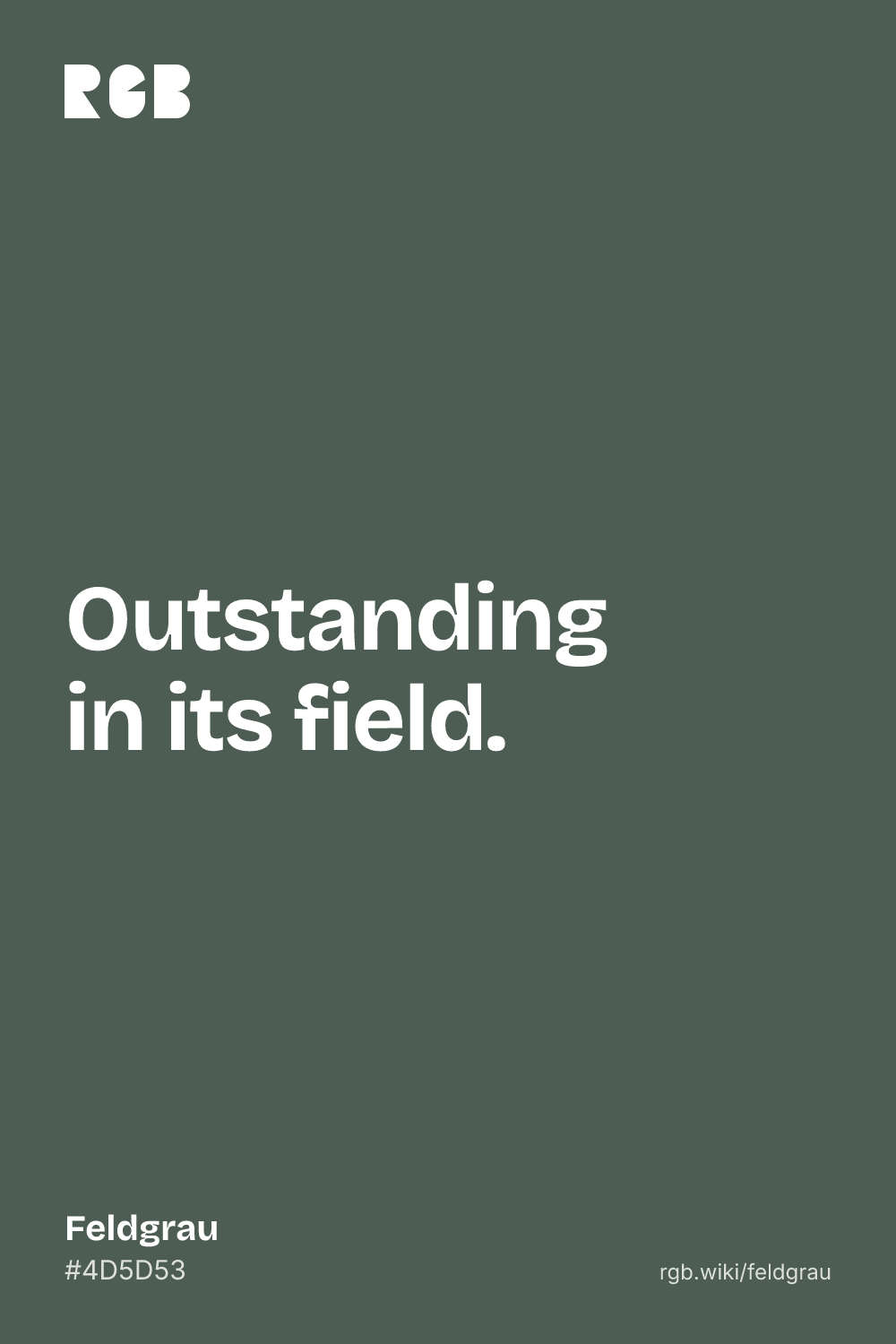
Feldgrau color card, hex #4D5D53: “Outstanding in its field”

Feldgrau on the color map

RAL 7009, the standard the code was sampled from, sits above and to the left of the code, outside the outline: lighter and more olive. The nearest ISCC-NBS center, dark greenish gray, sits on the right edge just below the code: a little darker and bluer. Dark grayish green, the name Wikipedia gives the code, lies lower on the right, darker still. The outline is an approximate range, not a measured one.

Shades and tints

Tints with white

Shades with black

Tones with gray

Feldgrau sits in the middle. Tints add white, shades add black and tones add gray, in 10% steps out from it. Tap any swatch to copy its code.

Light and dark feldgrau

#B8BEBA
Pale feldgrauMixed 60% with white. A soft gray-green for backgrounds.
#949E98
Light feldgrauMixed 40% with white. A misty sage gray.
#4D5D53
FeldgrauThe reference color.
#656760
Green gray (Feldgrau No. 2)About RAL 7009 green gray, the 1927 standard first named Feldgrau No. 2, converted from published CIELAB values. Lighter and less green.
#555D50
EbonyAlmost the same darkness, a little more olive, with a page of its own. See ebony
#2E3832
Deep feldgrauMixed 40% with black. Nearly black, with a green trace.

Colors that go with feldgrau

Pairings that work in rooms, outfits and interfaces.

Feldgrau and cream

Soft and steady. Good for editorial sites, menus and outdoor brands.

Feldgrau and brass

Gray-green with warm metal. Formal and confident, for labels, watches and stationery.

Feldgrau and bottle green

After the dark bottle-green collar of the German army’s 1936 tunic, later replaced by plain field gray.

Feldgrau and rust

A warm accent against cool gray-green. Earthy and grown-up.

Field and stone grays

Gray-green with the darker stone gray that German army trousers kept until 1940. Quiet and tonal.

Feldgrau and mustard

A bright accent on a dark field. Bold enough for posters and outdoor gear.

Color-wheel palettes

Pick a palette to see where its colors sit on the color wheel. The caret marks feldgrau. Tap a band to copy its code.

Similar colors

Wenge79%Umber77%Ebony94%Hunter green74%FeldgrauSpruce69%Payne's gray69%

Lined up by hue around feldgrau. Hover a color to see how similar it is.The bar under each name shows how similar it is. Similarity comes from the distance between the two colors in OKLab, a model of how we see color.

Feldgrau vs ebony

Feldgrau#4D5D53 · hue 143°
  • A touch greener and cooler
  • Named after German army uniforms
  • Sampled in 2006 from a 1927 standard
Ebony#555D50 · hue 97°
  • A touch more olive and warmer
  • Named after a black wood
  • No published standard

Meaning

  • Uniforms
  • Camouflage
  • Propaganda
  • Wartime fashion

Feldgrau’s meanings come from the battlefield and the home front. It was chosen to make soldiers hard to see, and in World War I it became a word for the soldier himself, a slogan on war-loan posters and even a fashion color. Today it calls up Germany’s armies of both World Wars. Research on color and emotion tests basic words such as gray or green, not field gray, so this section sticks to the historical record.

Gray for the field

Word history

Feldgrau is German for field gray, from Feld, field, and grau, gray: the color of the uniform worn in the field, while colorful coats were kept for parades. Merriam-Webster defines field gray as “a dark gray (as of some military field uniforms).”1, 3

Chosen to hide soldiers

Historical record

As weapons reached farther, soldiers needed to be hard to see at a distance, and armies traded bright coats for colors that blended with the land, British khaki first. In November 1900 a Berlin newspaper reported that cloth mills had begun making field-gray cloth, which it found a nicer gray than khaki’s clay color, and a cabinet order of 1907 made field gray the German army’s war uniform.2

A name for the soldier

Historical record

In World War I, Germans often called the ordinary soldier a Feldgrauer, “a field-gray.” A war-loan poster told people to subscribe because “Unsere Feldgrauen schützen Euch und Euer Haus”: our field grays protect you and your home.2, 3

Sold as wartime fashion

Historical record

A leading German dye maker issued a sample card titled Feldgrau. Die Mode des Jahres 1915, “Field gray: the fashion of 1915.” Field gray turned up in shop windows, poems, fairy tales and children’s rooms, and the historian Ricarda Hüpel argues it became a symbol of military strength and national unity on the home front.2

Never one exact shade

Contemporary account

In 1915 a German textile journal wrote that there was not, and could not be, one fixed idea of field gray as a shade: it appeared “in the most varied variations,” like a sudden fashion color. That 1915 fashion card alone ran from dark blue to dull brown, gray and black, and in World War II many suppliers and wartime shortages kept the range wide.2, 4

Sources (4)
  1. Merriam-Webster, “field gray”.
  2. Hüpel, R. (2021). Feldgrau im Ersten Weltkrieg. Textile Farbigkeit zwischen Kriegswirtschaft und Mode [Field gray in World War I: textile color between war economy and fashion]. Doctoral dissertation, TU Dortmund, pp. 4, 98–102, 151–152, 172 and 192–194.
  3. Wikipedia (German), “Feldgrau”, history of the field-gray uniform.
  4. Wikipedia, “Uniforms of the German Army (1935–1945)”, note on the M36 tunic.

History

Field gray began as an experiment around 1900 and dressed German soldiers through two World Wars. Its shade never stood still, and the web code came much later, from a 2006 sample of a 1927 color standard.

  1. 1900

    The Berlin newspaper Vorwärts reports that cloth mills have begun making field-gray uniform cloth, “a beautiful fashion gray” it finds nicer than khaki’s clay color. Troops sent to China that year try out early gray uniforms.1

  2. 1907

    A cabinet order of 25 February makes field gray the color of the German army’s war uniform. Until then most infantry regiments wore Prussian blue tunics.1, 2

  3. 1910

    A cabinet order of 23 February prescribes the new field-gray uniform for the whole army, while the colorful uniforms stay for parades and off-duty wear. In August 1914 all German soldiers go to war in field gray.1, 3

  4. 1915

    A simpler field blouse arrives, and field gray turns a darker gray-green. A textile journal remarks that field gray can have no single shade, and a dye maker’s card sells it as “the fashion of 1915.”1, 2, 3

  5. 1917

    War-loan posters, so far text only, begin to carry pictures. One for the seventh war loan reads “Stützt unsere Feldgrauen”: support our field grays, meaning the soldiers.1

  6. 1927

    The first RAL color register, 40 colors, includes the World War I shade as Feldgrau No. 2. It is known today as RAL 7009, green gray.3, 4

  7. 1936

    The Wehrmacht’s new tunic keeps field-gray wool, now with a bottle-green collar. With many suppliers and later wartime shortages, “field gray” covers a wide range of shades.5

  8. 1944

    A cheaper, shorter field blouse comes in a new shade, Feldgrau 44. Descriptions of it disagree, from a drab greenish brown to a blue-green.5, 3

  9. 1956

    East Germany’s new National People’s Army adopts uniforms cut much like the Wehrmacht’s, but in a brownish stone gray with far less green, worn until 1989. In the West, the Bundeswehr’s army wears its own gray, Heeresgrau (army gray), and orders in 1980 and 2015 try to end the spread of shades in its service jackets.6, 3, 7

  10. 2006

    German Wikipedia gives feldgrau as #4D5D53, a sample “after RAL 7009” taken from a small product photo on a car-parts shop’s website. English Wikipedia copies the code the next day, and color lists still use it.8, 9

Sources (9)
  1. Hüpel, R. (2021). Feldgrau im Ersten Weltkrieg. Textile Farbigkeit zwischen Kriegswirtschaft und Mode [Field gray in World War I: textile color between war economy and fashion]. Doctoral dissertation, TU Dortmund, pp. 4, 101–102, 151–152 and 172, citing Vorwärts, 24 November 1900, and von der Osten-Sacken, Deutschlands Armee in feldgrauer Kriegs- und Friedens-Uniform (1916).
  2. Wikipedia, “Feldgrau”, history.
  3. Wikipedia (German), “Feldgrau”, citing von der Osten-Sacken and Casberg (1916), Schlicht and Kraus (2005) and Knötel and Sieg (1971).
  4. RAL gGmbH, “RAL Colours history”, 1927.
  5. Wikipedia, “Uniforms of the German Army (1935–1945)”, field blouses M36 and M44.
  6. Wikipedia, “National People’s Army”, uniforms.
  7. Wiegold, T. (2015). “Das Heer macht Schluss mit 50 Shades of Grey”. Augen geradeaus!, June 2015.
  8. Wikipedia (German), “Feldgrau”, revision of 8 October 2006, citing a RAL 7009 product image on a car-parts shop’s website.
  9. Wikipedia, “Feldgrau”, revision of 9 October 2006 (“color swatch and stub”).

Questions

What color is feldgrau?

A dark gray with a green cast. The name is German for field gray, the color of German army uniforms. The usual code is #4D5D53 (RGB 77, 93, 83), but real uniforms came in many shades.

What does feldgrau mean?

Field gray. Grau means gray, and Feld is the field of military service, as in the battlefield. It named the color of German army field uniforms from 1907 to 1945.

Is there an official feldgrau hex code?

No. No army or standard set #4D5D53. It first appeared on German Wikipedia in 2006, sampled from a small photo of RAL 7009, a 1927 industrial color standard once called Feldgrau No. 2. The army itself set its cloth colors with physical samples, not screen codes.

When did the German army start wearing field gray?

A cabinet order of February 1907 made field gray the color of the German army’s war uniform, and a 1910 order prescribed it for the whole army. Soldiers went to war in it in August 1914.

Was feldgrau the same in both World Wars?

No. It was never one fixed shade. World War I cloth turned darker and greener after 1915, and wartime shortages added grays and browns. In World War II, many suppliers and shortages again produced a wide range, and a new shade, Feldgrau 44, arrived late in the war.

What is the difference between feldgrau and ebony?

On screen they are almost the same. Feldgrau (#4D5D53) is a touch greener and cooler. Ebony (#555D50), named after a black wood, is a touch more olive.

Did other armies wear field gray?

Yes. Italy adopted a similar gray-green, grigio-verde, in 1908, and Austria-Hungary moved from pike gray to field gray from 1915. Portugal, Sweden and Finland also wore field-gray uniforms, and East Germany’s army wore a browner stone gray from 1956 to 1989.

What colors go with feldgrau?

Cream and brass for a classic look, rust or mustard for a warm accent, and bottle green or stone gray for a quiet, tonal palette.