Chestnut

A medium reddish brown, the color of a ripe chestnut and a chestnut horse.

Overview

Chestnut is a medium reddish brown. The code most color lists use is #954535: red at under 60% strength, with about half as much green and less blue, which gives a warm brown with a clear red lean.

The name comes from the nut of the chestnut tree, from Latin castanea. It has described color in English since at least 1656, and it also names one of the most common horse coats and a shade of brown hair. Maroon is named after the chestnut too, through French marron.

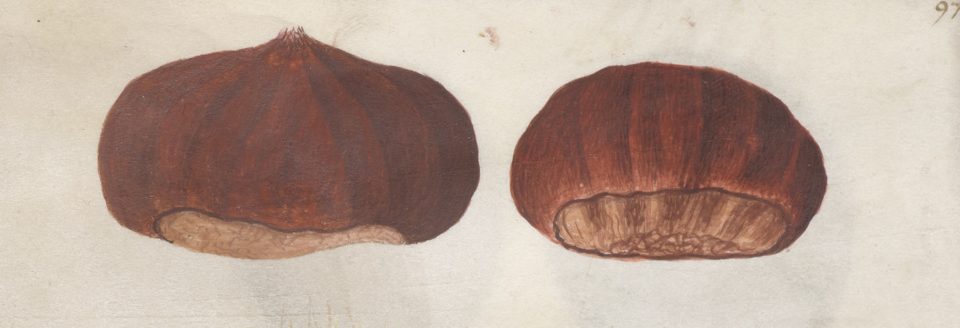
Real chestnuts are grayer than the code. Merriam-Webster defines chestnut as “a grayish to reddish brown”, and the chestnuts in a French book of flower paintings from 1608 sample at about #7E5248: the same hue and lightness as the code, with half the color. In the xkcd survey, people’s average chestnut was darker and more orange.

Chestnut is a warm, easygoing brown. It suits autumn designs and pairs well with cream, sage, dusty blue and gold. It carries white text comfortably.

HEX#954535
RGBrgb(149, 69, 53)
HSLhsl(10, 48%, 40%)
HSV10°, 64%, 58%
CMYK0, 54, 64, 42
OKLCHoklch(49.0% 0.112 32.8)
Every code converts from the HEX value #954535. #954535 is the code most references use, but no standard defines it. Wikipedia credits it to Maerz and Paul’s A Dictionary of Color (1930) without a page reference, while the 1955 ISCC-NBS dictionary files Maerz and Paul’s chestnut as a grayish brown, about #635147. CMYK is a screen-based estimate; print results vary.
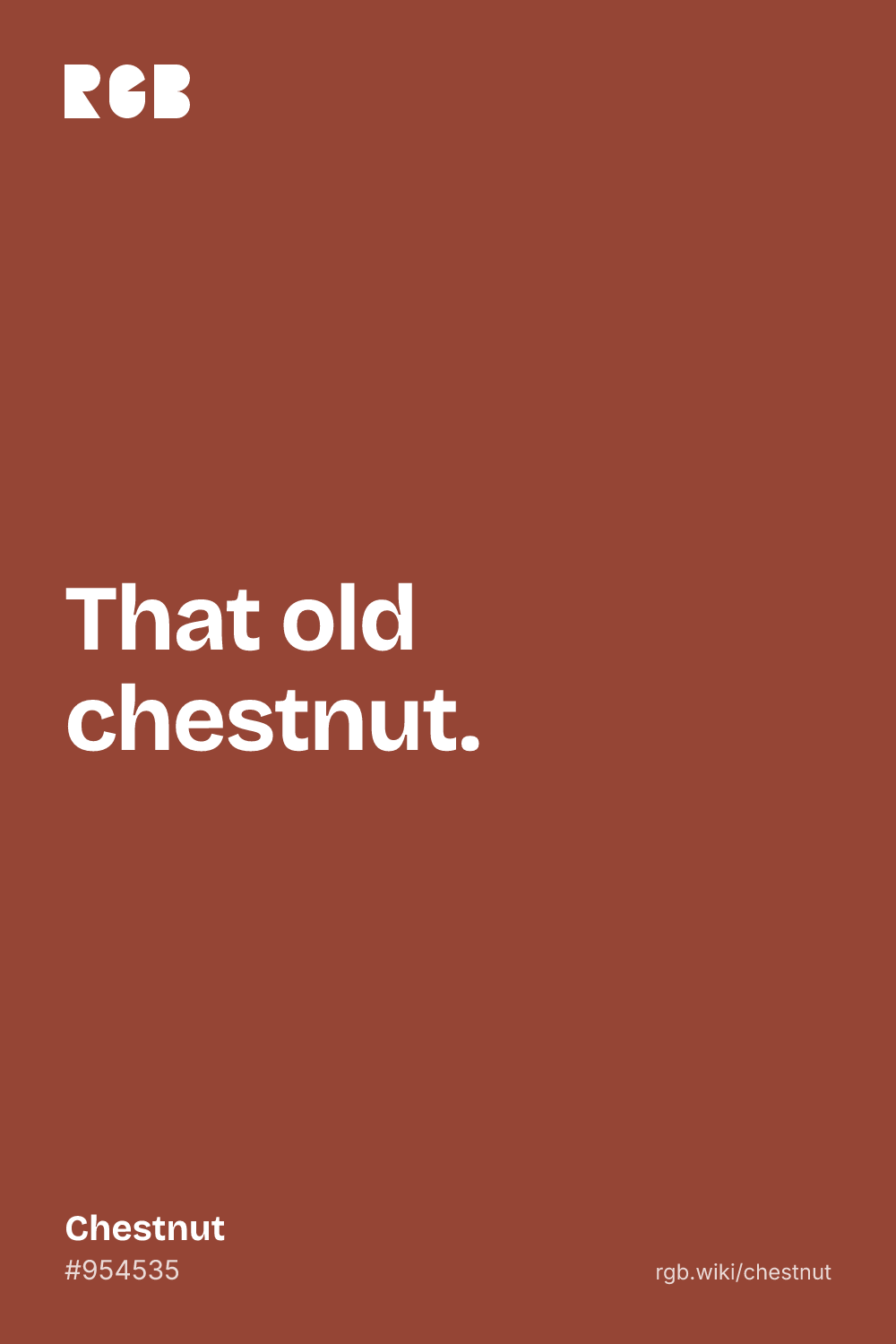
Chestnut color card, hex #954535: “That old chestnut”

Chestnut on the color map

People’s average chestnut in the xkcd survey is darker and more orange, at the bottom edge of the outline. The 1608 painted chestnuts sit almost on top of the reference value: same hue and lightness, but much grayer, which this map of hue and lightness does not show. The ISCC-NBS grayish brown sits to the right, and is grayer still. The outline is an approximate range, not a measured one.

Shades and tints

Tints with white

Shades with black

Tones with gray

Chestnut sits in the middle. Tints add white, shades add black and tones add gray, in 10% steps out from it. Tap any swatch to copy its code.

Light and dark chestnut

#BF8F86
Light chestnutMixed 40% with white. A soft, rosy taupe.
#9A463D
CognacAlmost the same, a touch redder, with a page of its own. See cognac
#954535
ChestnutThe reference color.
#7E5248
Chestnut shellSampled from chestnuts painted in 1608. Grayer, like the real nut.
#592920
Dark chestnutMixed 40% with black. A deep, coffee-like red-brown.

Colors that go with chestnut

Pairings that work in rooms, outfits and interfaces.

Chestnut and cream

Warm and cozy. A safe choice for long text.

Chestnut and sage

Earthy and calm, like a garden in autumn.

Chestnut and dusty blue

Warm against cool, softly. Good for homes and stationery.

Chestnut and gold

Rich and autumnal. Suits food, drink and harvest themes.

Chestnut and blush

Soft and romantic. Good for weddings and beauty brands.

Chestnut and forest green

Woodland colors. Traditional and outdoorsy.

Color-wheel palettes

Pick a palette to see where its colors sit on the color wheel. The caret marks chestnut. Tap a band to copy its code.

Similar colors

Cordovan80%Red-brown74%Cognac93%ChestnutSienna78%Mummy brown87%Saddle brown80%

Lined up by hue around chestnut. Hover a color to see how similar it is.The bar under each name shows how similar it is. Similarity comes from the distance between the two colors in OKLab, a model of how we see color.

Chestnut vs maroon

Chestnut#954535 · hue 10°
  • A medium reddish brown
  • Named after the nut, in English
  • Real chestnuts are grayer
Maroon#800000 · hue 0°
  • Darker: pure red, no green or blue
  • Named after the chestnut, in French
  • A classic school color

Meaning

  • Nuts
  • Horses
  • Forests
  • Autumn

Chestnut is a homely, comforting brown: roasted nuts, glossy horses and autumn woods. It names one of the most common horse coat colors and a shade of brown hair. In North America it also carries a loss: the American chestnut, once one of the main trees of the eastern forests, was nearly wiped out by a blight in the early 1900s. As with most named colors, color research tests broad hues, not chestnut itself.

A horse color set by one gene

Genetics study

Chestnut horses carry two copies of a recessive form of the MC1R gene, and they grow no black hair. In a 1996 study of 144 horses from 12 breeds, a single mutation in that gene matched coat color perfectly. The same part of the gene is linked to red hair in people.1
A forest tree lost to blight

Historical record

American chestnuts once dominated forests along the East Coast, up to one tree in four in some places. A fungal blight found at the Bronx Zoo in 1904 had killed an estimated 4 billion of them by about 1950.2

Named twice

Dictionary record

English took “chestnut” from Latin castanea, through Anglo-French. Then in 1779 it borrowed a second chestnut color: maroon, from French marron, a chestnut. Today the two names point to quite different colors.3, 4

Sources (4)
  1. Marklund, L., Moller, M. J., Sandberg, K. & Andersson, L. (1996). A missense mutation in the gene for melanocyte-stimulating hormone receptor (MC1R) is associated with the chestnut coat color in horses. Mammalian Genome, 7(12), 895–899. doi:10.1007/s003359900264
  2. NPR / WAMU, “The American chestnut was wiped out a century ago. Could it make a comeback?” (2021).
  3. Merriam-Webster, “chestnut”, definition, etymology and first known use.
  4. Merriam-Webster, “maroon”, etymology and first known use.

History

Chestnuts have fed people for thousands of years. The color name is almost 400 years old, and it has followed the nut into horses, hair and another color’s name.

  1. 1519

    First known use of “chestnut” for the nut in English. The word comes, through French, from Latin castanea.1

  2. 1608

    A French florilegium paints two chestnuts in rich browns beside a nut tree. The book is now at the Cleveland Museum of Art.2

  3. 1656

    First known use of “chestnut” as a color word, for something of the color chestnut.1

  4. 1779

    “Maroon” enters English as a color name, from French marron, chestnut.3

  5. 1904

    Chestnut blight is found at the Bronx Zoo in New York. By about 1950 it has killed an estimated 4 billion American chestnut trees.4

  6. 1973

    Secretariat, a chestnut colt nicknamed Big Red, wins the U.S. Triple Crown, setting records in all three races.5

  7. 1996

    Swedish geneticists identify the single mutation in the MC1R gene behind the chestnut coat of horses.6

Sources (6)
  1. Merriam-Webster, “chestnut”, definition, etymology and first known use.
  2. Cleveland Museum of Art, “Chestnuts with Nut Tree, folio 43 (recto), from Florilegium (A Book of Flower Studies)”, France, 1608 (1963.594.43.a).
  3. Merriam-Webster, “maroon”, etymology and first known use.
  4. NPR / WAMU, “The American chestnut was wiped out a century ago. Could it make a comeback?” (2021).
  5. Wikipedia, “Secretariat (horse)”.
  6. Marklund, L., Moller, M. J., Sandberg, K. & Andersson, L. (1996). A missense mutation in the gene for melanocyte-stimulating hormone receptor (MC1R) is associated with the chestnut coat color in horses. Mammalian Genome, 7(12), 895–899. doi:10.1007/s003359900264

Chestnut in use

Two painted chestnuts with glossy, ribbed reddish-brown shells and pale bases, on cream vellum
#7E5248#6A4741#9F6E5B#B8907A
ArtChestnuts from a florilegium (1608)

A detail from a French book of flower paintings at the Cleveland Museum of Art. The painted nuts sample at about #7E5248: the same hue and lightness as the chestnut code, but much grayer, closer to Merriam-Webster’s “grayish to reddish brown”.

#7E5248#6A4741#9F6E5B#B8907A
Source: Cleveland Museum

Palettes are sampled in-house.

Questions

What color is chestnut?

A medium reddish brown, named after the nut. The usual code is #954535 (RGB 149, 69, 53).

Is chestnut red or brown?

Brown with a red lean. Merriam-Webster defines it as a grayish to reddish brown, so real chestnuts are often grayer than the web code.

What is the difference between chestnut and auburn?

Auburn is redder and chestnut is browner. Auburn (#922724) is darker and closer to red, while chestnut (#954535) is a warmer, softer brown. Both are common names for hair colors.

What is a chestnut horse?

A horse with a reddish-brown coat and a mane and tail of the same shade or lighter, with no black hairs. Chestnut horses carry two copies of a recessive gene that rules out black pigment. A brown horse with a black mane, tail and lower legs is a bay, not a chestnut.

Is maroon named after chestnut?

Yes. Maroon comes from French marron, a chestnut, and has been an English color name since 1779. Today maroon (#800000) is a darker, purer red than chestnut.

What colors go with chestnut?

Cream and sage for a warm, earthy look, dusty blue for soft contrast, gold for autumn, and forest green for a woodland feel.