Russet

A warm reddish brown, named after the plain wool cloth of medieval working people.

Overview

Russet is a warm brown with a red-orange cast. Its code, #80461B, has red at half strength, green at about a quarter and very little blue. On screen it is almost the same color as walnut, a touch lighter, and much browner than rust.

Before it was a color, russet was a cloth: a coarse wool, gray or brown, worn by working people. An English law of 1363 limited carters, ploughmen, shepherds and other poor workers to “blanket and russet” worth twelve pence an ell, an old cloth measure. The word comes through Anglo-French from Latin russus, red.

The code comes from a standard. #80461B is the center of the ISCC-NBS color group strong brown, where the 1955 dictionary files Maerz and Paul’s russet brown. People picture russet redder: in the xkcd color survey the average russet came out #A13905, a burnt orange close to rust.

Today the word lives on in apples and potatoes with rough brown skins, and museums use it for the brown glazes of some Chinese bowls made almost a thousand years ago. Russet carries white text and pairs well with cream, forest green, slate and soft gold.

HEX#80461B
RGBrgb(128, 70, 27)
HSLhsl(26, 65%, 30%)
HSV26°, 79%, 50%
CMYK0, 45, 79, 50
OKLCHoklch(45.7% 0.097 53.6)
Every code converts from the HEX value #80461B. #80461B is the center of ISCC-NBS color group 55, strong brown, in John Foster’s sRGB version. The 1955 ISCC-NBS dictionary files the russet brown of Maerz and Paul’s A Dictionary of Color (1930) in that group and in moderate brown, #6F4E37 (Jaffer’s table). In the xkcd color survey (2010), people’s average russet is much redder, #A13905. CMYK is a screen-based estimate; print results vary.
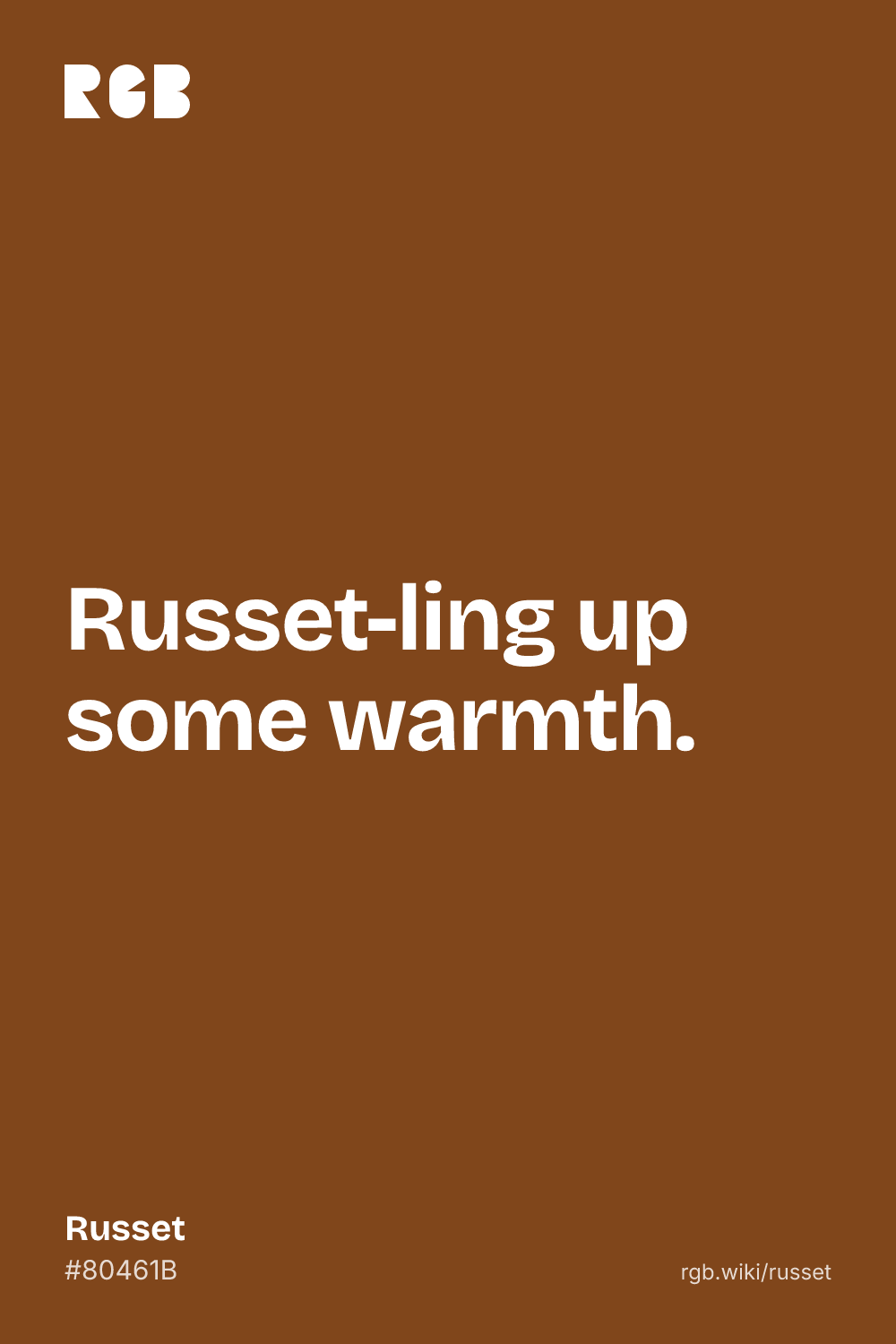
Russet color card, hex #80461B: “Russet-ling up some warmth”

Russet on the color map

Most of the brown values sit close together near the code: walnut, the dictionary’s moderate brown (same hue and lightness, but grayer) and the glaze of the first Song bowl. The lobed Yaozhou bowl lies a little to the left, redder. The two surveys lie to the left of the outline, much redder and brighter: what people call russet is closer to rust. The outline is an approximate range, not a measured one.

Shades and tints

Tints with white

Shades with black

Tones with gray

Russet sits in the middle. Tints add white, shades add black and tones add gray, in 10% steps out from it. Tap any swatch to copy its code.

Light and dark russet

#D9C8BB
Pale russetMixed 70% with white. A soft, pinkish beige for backgrounds.
#B39076
Light russetMixed 40% with white. A muted tan.
#80461B
RussetThe reference color.
#A13905
Survey russetWhat people called russet in the xkcd color survey, on average. Redder and brighter, close to rust. See rust
#4D2A10
Dark russetMixed 40% with black. A deep chocolate brown.

Colors that go with russet

Pairings that work in rooms, outfits and interfaces.

Russet and cream

Warm and plain, with a soft tan in between.

Autumn orchard

Russet skins, red apples and late gold.

Russet and forest green

Brown and green, like a hedgerow in fall.

Homespun

Undyed grays and browns, like plain wool cloth.

Russet and slate

Warm brown against a cool blue-gray.

Song russet glaze

The glaze and pale stoneware of an 11th-century Chinese bowl.

Color-wheel palettes

Pick a palette to see where its colors sit on the color wheel. The caret marks russet. Tap a band to copy its code.

Similar colors

Mummy brown82%Saddle brown89%Walnut87%RussetToffee81%Chocolate88%Sepia82%

Lined up by hue around russet. Hover a color to see how similar it is.The bar under each name shows how similar it is. Similarity comes from the distance between the two colors in OKLab, a model of how we see color.

Russet vs rust

Russet#80461B · hue 26°
  • Darker and browner
  • Named after a wool cloth
  • Center of the ISCC-NBS strong brown
Rust#B7410E · hue 18°
  • Brighter and more orange
  • Named after iron oxide
  • Close to what people call russet in surveys

Meaning

  • Wool cloth
  • Plain speech
  • Russet apples
  • Russet potatoes

Russet stands for the plain and the homemade. It was the cloth of working people, then a byword for honest plainness, and now it names rough-skinned apples and potatoes. Color research tests broad words like brown, not russet, so the claims here are about the cloth, the word and the crops.

The cloth of working people

Historical record

Russet was a coarse woolen cloth, gray or brown. England’s Act of October 1363 ruled that carters, ploughmen, oxherds, shepherds, dairymaids, threshers and anyone with less than forty shillings in goods might wear no cloth “except blanket and russet of twelve pence for the ell”.1
Plain and honest

Historical record

Russet became a word for plainness. In Shakespeare’s Love’s Labor’s Lost, Berowne swears to woo “in russet yeas and honest kersey noes”, kersey being another coarse cloth. In 1643 Oliver Cromwell wrote that he would rather have “a plain russet-coated Captain that knows what he fights for, and loves what he knows” than a mere gentleman.2, 3

Rough-skinned apples

Well established

Russet on an apple is a rough, brownish skin. It forms when the fruit’s waxy cuticle micro-cracks and a corky layer grows in its place. Buyers usually see it as a flaw, but russet apples are varieties known for their rough, russet-colored skins.4, 5

The french fry potato

Well established

Russet Burbank potatoes have long tubers with lightly to heavily netted, russeted brown skin and white flesh. The variety is a mutation of Luther Burbank’s Burbank potato and is the world’s foremost french fry potato.6, 7

Sources (7)
  1. Sylvester, L. M., Chambers, M. C. & Owen-Crocker, G. R. (eds) (2014). Medieval Dress and Textiles in Britain: A Multilingual Sourcebook, introduction. Boydell Press.
  2. Shakespeare, W. Love’s Labor’s Lost, Act 5, scene 2. Folger Shakespeare Library.
  3. Carlyle, T. (ed.) Oliver Cromwell’s Letters and Speeches, vol. 1, Letter XVI, to Sir William Spring and Maurice Barrow, Cambridge, September 1643.
  4. Lashbrooke, J., Aharoni, A. & Costa, F. (2015). “Genome investigation suggests MdSHN3 … to be a positive regulator of apple fruit cuticle formation and an inhibitor of russet development”. Journal of Experimental Botany, 66(21), 6579–6589.
  5. Merriam-Webster, “russet”, definitions.
  6. Canadian Food Inspection Agency, “Russet Burbank”, potato variety description.
  7. Bethke, P. C., Nassar, A. M. K., Kubow, S., et al. (2014). “History and Origin of Russet Burbank (Netted Gem) a Sport of Burbank”. American Journal of Potato Research, 91, 594–609.

History

Russet was a cloth for centuries before it was a color, and a color long before it had a code. Its story runs from medieval clothing laws to the potato.

  1. 1000s

    Potters in northern China make bowls with a brown glaze that museums now catalog as russet.1

  2. 1200s

    First known use of russet in English, for a coarse homespun cloth. The word comes through Anglo-French from Latin russus, red.2

  3. 1363

    An English law on dress limits carters, ploughmen, shepherds and other poor workers to “blanket and russet” cloth at twelve pence the ell.3

  4. 1400s

    First known use of russet as an adjective, for things of the color russet.2

  5. 1643

    Oliver Cromwell, raising cavalry in the English Civil War, writes from Cambridge that he would rather have “a plain russet-coated Captain that knows what he fights for” than a mere gentleman.4

  6. About 1880

    Luther Burbank breeds and selects the Burbank potato in Santa Rosa, California.5

  7. 1902

    L. L. May & Co. of St. Paul, Minnesota, probably releases a russet-skinned mutation of the Burbank as May’s Netted Gem. It becomes known as Russet Burbank.6

  8. 1955

    The ISCC-NBS dictionary files Maerz and Paul’s russet brown under strong brown and moderate brown. The center of strong brown, #80461B, is the code used here.7

  9. 2010

    In the xkcd color survey, the average of the colors people named russet comes out at #A13905, a burnt orange much redder than the standard.8

Sources (8)
  1. Art Institute of Chicago, “Conical Bowl”, Northern Song dynasty, 11th century, Northern russet ware (2013.253).
  2. Merriam-Webster, “russet”, etymology and first known use.
  3. Sylvester, L. M., Chambers, M. C. & Owen-Crocker, G. R. (eds) (2014). Medieval Dress and Textiles in Britain: A Multilingual Sourcebook, introduction, on the Act of October 1363.
  4. Carlyle, T. (ed.) Oliver Cromwell’s Letters and Speeches, vol. 1, Letter XVI.
  5. Canadian Food Inspection Agency, “Russet Burbank”, origin and breeding.
  6. Bethke, P. C., Nassar, A. M. K., Kubow, S., et al. (2014). “History and Origin of Russet Burbank (Netted Gem) a Sport of Burbank”. American Journal of Potato Research, 91, 594–609.
  7. Jaffer, A. “Maerz and Paul color names”, with ISCC-NBS centroids from “Color-Name Dictionaries”, MIT CSAIL.
  8. Munroe, R. (2010). “Color Survey Results”, xkcd blog, with the survey’s color list (CC0).

Russet in use

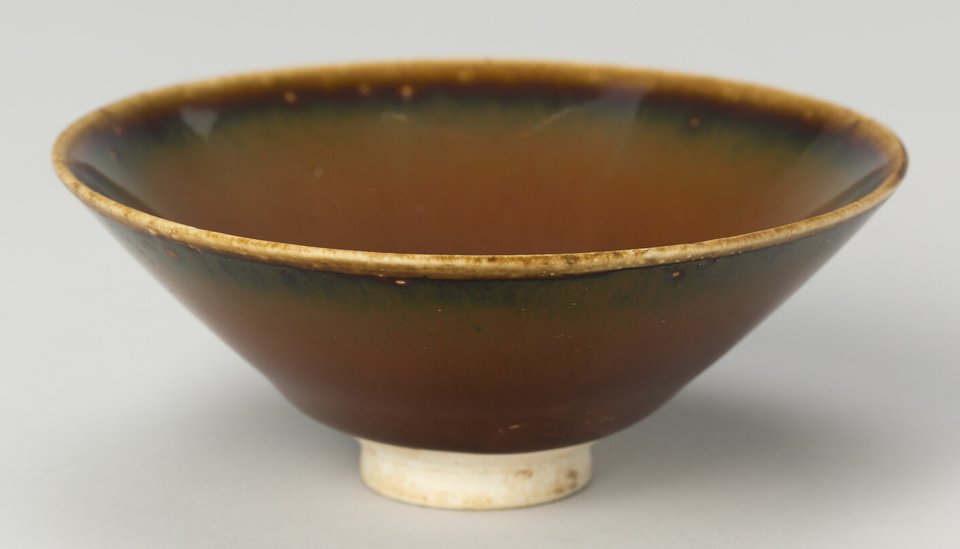
A small conical stoneware bowl with a glossy reddish-brown glaze that darkens near the rim, a pale tan rim edge and an unglazed white foot
#724421#704A25#4F3722#C5A05F
CeramicConical bowl, Northern Song dynasty (1000s)

A small bowl, 9.5 cm across, of gray stoneware that the museum catalogs as Northern russet ware. Inside, the glaze reads about #724421, close to the russet code; outside it darkens toward black near the rim, which is edged in pale tan.

#724421#704A25#4F3722#C5A05F
Source: Art Institute of Chicago
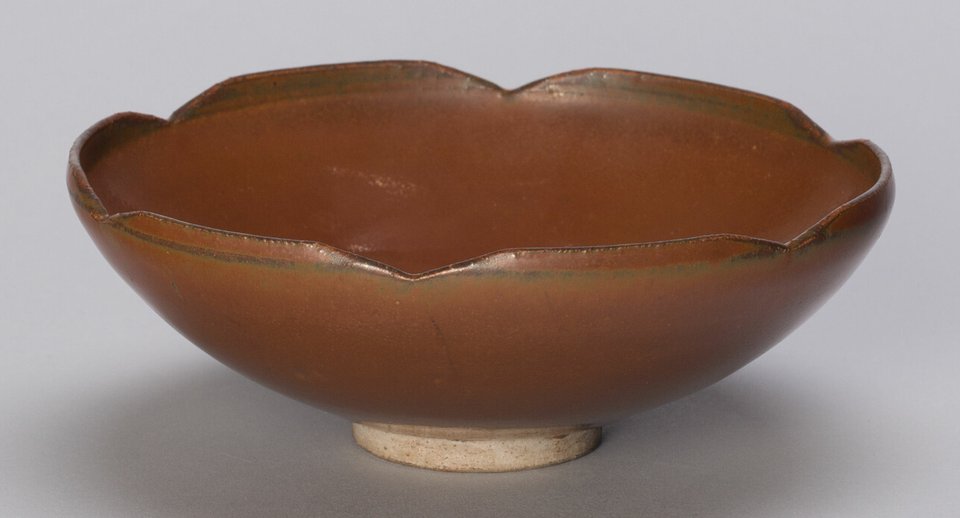
A shallow stoneware bowl with a scalloped, lobed rim and a smooth reddish-brown glaze, on a small pale foot
#723D23#845437#603927#78442B
CeramicPersimmon bowl, Northern Song dynasty (1000s–1100s)

A lobed bowl of Yaozhou ware whose dark brown glaze has a russet surface, in the museum’s words. It reads about #723D23, a little redder than the code.

#723D23#845437#603927#78442B
Source: Art Institute of Chicago

Palettes are sampled in-house.

Questions

What color is russet?

A warm reddish brown. The standard code is #80461B (RGB 128, 70, 27), the center of the ISCC-NBS color group strong brown.

Is russet the same as rust?

No. Rust (#B7410E) is brighter and more orange. Russet (#80461B) is darker and browner. Many people picture russet closer to rust, though: the xkcd survey’s average russet is #A13905.

Is russet the same color as walnut?

Almost. The usual codes, #80461B for russet and #773F1A for walnut, are very close; russet is a touch lighter. The names differ: russet comes from a wool cloth, walnut from the tree.

Where does the word russet come from?

From Anglo-French, from a word for red that goes back to Latin russus. In English it first named a coarse homespun cloth, in the 1200s, and later the color.

Why are some potatoes and apples called russet?

For their skins. Russet apples have rough, brownish skins where a corky layer replaces the waxy cuticle, and russet potatoes such as Russet Burbank have netted brown skins.

What colors go with russet?

Cream, forest green, slate blue-gray and soft gold. Russet is dark enough to carry white text.