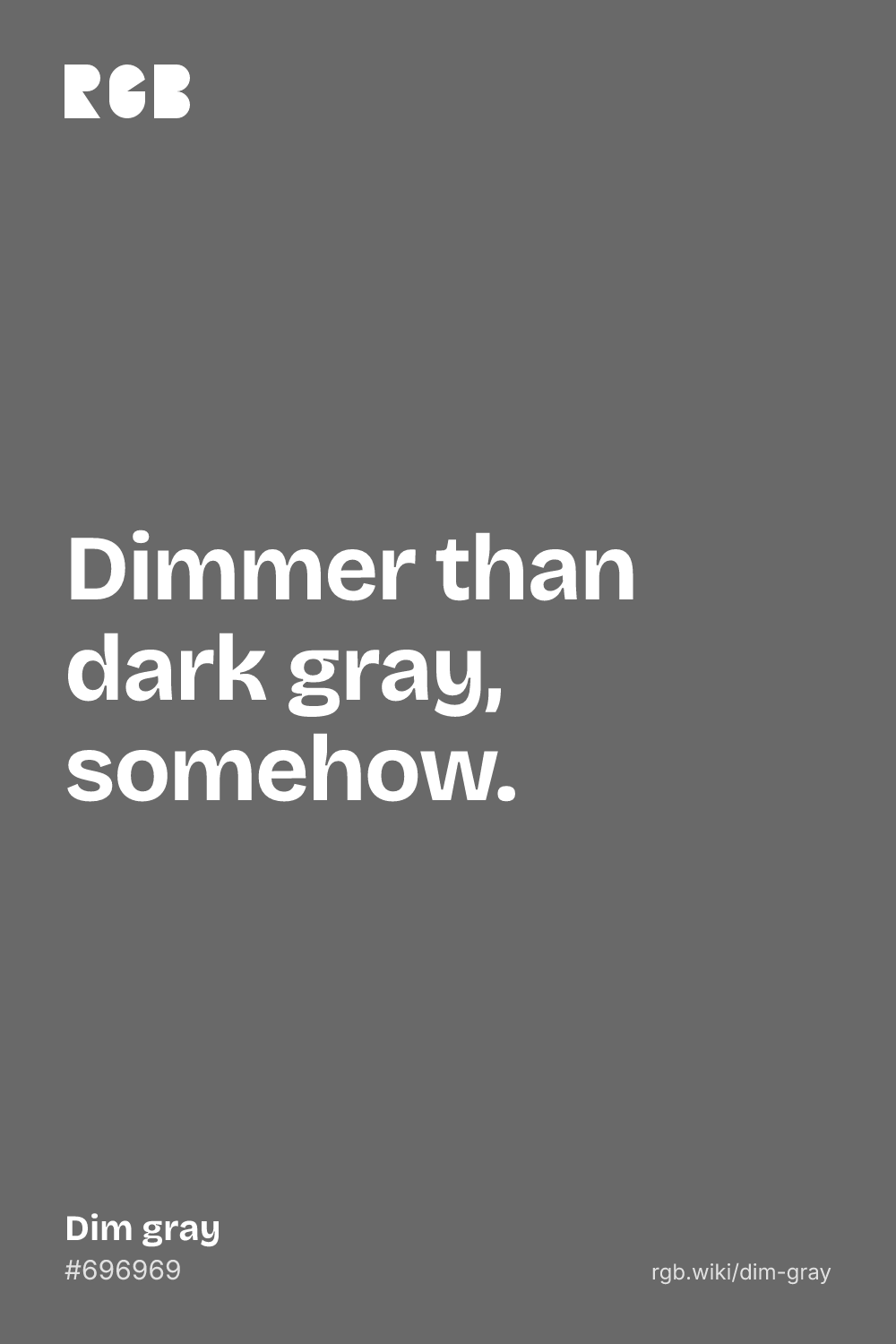
Dim gray is a dark, perfectly neutral gray, like wet concrete or a pencil line. Its code is #696969: red, green and blue all at 105 out of 255, about 41%. Hex 69 is simply 105 written in base 16, repeated three times. With no tint at all, it is the darkest of the neutral grays CSS names, darker than gray, #808080, and much darker than dark gray, #A9A9A9.
The name is the CSS keyword dimgray, and CSS accepts dimgrey too. Both spellings were already in the X Window System’s first color list, from 1986, as a darker 84 84 84. In 1989 John Thomas at Tektronix and Paul Raveling at USC’s Information Sciences Institute each revised the list on their own, and both set dim gray to 105 105 105. X11 Release 4 shipped that value in December 1989, and the web adopted it in 2001. It matches the numbered X11 gray41 exactly, just as the 1986 value matched gray33.
“Dim” is an Old English word, and Merriam-Webster’s first sense is “having a limited or insufficient amount of light”, with “dull, lusterless” as in “dim colors” close behind. No record says why the list’s authors picked dim rather than dark. Dark gray arrived later and lighter, which is why the CSS standard itself notes that the names are “not even internally consistent”. Maerz and Paul’s 1930 Dictionary of Color has no dim gray; the nearest ISCC-NBS centers are medium gray, #848482, and dark gray, #555555, and dim gray sits between them.
On screens, dim gray takes white text: white on it has a contrast of about 5.5:1, enough for body text, while black reaches only about 3.8:1. Turned around, it is the lightest gray CSS names that still passes 4.5:1 as text on white, where plain gray manages only about 4:1. It pairs well with mustard, coral, navy and warm off-whites.