
Aubergine

A dark grayish purple named after the skin of the eggplant.

Overview

Aubergine is a dark purple with a gray, slightly brownish cast, named after the glossy skin of the eggplant. Its usual code is #614051: a dim mix of red and blue with enough green to mute it. In American English the same color is called eggplant.

Aubergine is the British word for the vegetable, borrowed from French in the 18th century. The French word came through Catalan, Arabic and Persian from an ancient word of southern India. Americans and Australians say eggplant, a name first given to white varieties that look like hen’s eggs. As color names, aubergine dates from 1794 and eggplant from 1915.

Real eggplants are darker than the code. Merriam-Webster defines the color as “a dark grayish or blackish purple”, and people in the xkcd color survey picked much deeper, more saturated purples for both aubergine and eggplant. Maerz and Paul’s 1930 color dictionary goes further still, with a sample close to black.

#614051 is soft enough to cover large areas: walls, upholstery, packaging. It pairs well with brass, saffron and olive green, and light text reads clearly on it.

HEX#614051
RGBrgb(97, 64, 81)
HSLhsl(329, 20%, 32%)
HSV329°, 34%, 38%
CMYK0, 34, 16, 62
OKLCHoklch(41.5% 0.052 347.4)
Every code converts from the HEX value #614051. There is no standard aubergine. #614051 is the code most color references use. Maerz and Paul’s A Dictionary of Color (1930) places aubergine and eggplant much darker, on one near-black sample that the ISCC-NBS dictionary (1955) files as blackish purple and purplish black. CMYK is a screen-based estimate; print results vary.
Aubergine color card, hex #614051: “Pure auber-genius”

Aubergine on the color map

Everyday aubergine is darker than this code. People’s average aubergine and eggplant in the xkcd survey sit below the outline, a little to the left: darker, more saturated and slightly bluer. The dictionary’s blackish purple sits lower still and grayer. The outline is an approximate range, not a measured one.

Shades and tints

Tints with white

Shades with black

Tones with gray

Aubergine sits in the middle. Tints add white, shades add black and tones add gray, in 10% steps out from it. Tap any swatch to copy its code.

Light and dark aubergine

#A08C97
Light aubergineMixed 40% with white. A dusty grayish mauve.
#614051
AubergineThe reference color.
#3A2631
Dark aubergineMixed 40% with black. Closer to the skin of a ripe eggplant.
#271A20
Blackish aubergineMixed 60% with black. Close to the near-black sample in Maerz and Paul’s dictionary.

Colors that go with aubergine

Pairings that work in rooms, outfits and interfaces.

Aubergine and brass

Warm metal on a deep ground. Good for bars, restaurants and labels.

Aubergine and olive

Earthy and grown-up, like a vegetable garden in autumn.

Aubergine and blush

Soft and warm. Works for bedrooms, stationery and beauty brands.

Aubergine and sage

Quiet contrast. Good for living rooms and wellness brands.

Aubergine and saffron

Bright against dark. Let saffron be the accent.

Aubergine and gray

Cool and modern. Strong for apps and dark themes.

Color-wheel palettes

Pick a palette to see where its colors sit on the color wheel. The caret marks aubergine. Tap a band to copy its code.

Similar colors

Graphite71%AubergineWine72%Garnet73%Wenge70%Umber71%Taupe64%

Lined up by hue around aubergine. Hover a color to see how similar it is.The bar under each name shows how similar it is. Similarity comes from the distance between the two colors in OKLab, a model of how we see color.

Aubergine vs plum

Aubergine#614051 · hue 329°
  • Dark and grayish, with a brownish cast
  • Named after the eggplant’s skin
  • No standard code
Plum#8E4585 · hue 307°
  • Lighter and brighter
  • A bluer, cleaner purple
  • Named after the fruit

Meaning

  • Vegetable
  • Two names
  • Glazed ceramics
  • Plant pigment

Aubergine is named after a food, so its associations come from the kitchen and the market more than from symbolism. Studies of color and emotion test basic words like “purple”, not aubergine, so there is no measured mood for this shade. What can be said with sources is where the vegetable came from, where its color comes from, and why it has two names.

Named after a vegetable from Asia

Historical record

The eggplant was first grown in Asia. The earliest reliably dated record of it as a crop is a Chinese text from 59 BC, and later Chinese records show the fruit growing larger and sweeter under cultivation.1
The color is in the skin

Lab study

The purple of eggplant skin comes from anthocyanins, a family of plant pigments. The main one, nasunin, has been isolated from eggplant peel as purple crystals.2

Two names, one color

Dictionaries

Aubergine is chiefly British and eggplant is usual in North American and Australian English. The name eggplant was first given to white varieties shaped like hen’s eggs, which is why the word says nothing about purple.3, 4

Sources (4)
  1. Wang, J.-X., Gao, T.-G. & Knapp, S. (2008). Ancient Chinese literature reveals pathways of eggplant domestication. Annals of Botany, 102(6), 891–897. doi:10.1093/aob/mcn179
  2. Noda, Y., Kneyuki, T., Igarashi, K., Mori, A. & Packer, L. (2000). Antioxidant activity of nasunin, an anthocyanin in eggplant peels. Toxicology, 148(2–3), 119–123. doi:10.1016/s0300-483x(00)00202-x
  3. Merriam-Webster, “aubergine”.
  4. Wikipedia, “Eggplant”, Etymology.

History

The eggplant traveled from Asia to Europe over many centuries, picking up a new name in almost every language on the way. Its color names in English came late, long after the vegetable.

  1. 59 BC

    A Chinese text gives the earliest reliably dated record of eggplant grown as a crop.1

  2. 12th century

    Ibn al-Awwam’s book on farming in Muslim Spain explains how to grow aubergines.2

  3. 1578

    The name “mad-apple” appears in English, from an old belief that eating eggplant could cause madness.2

  4. 1662–1722

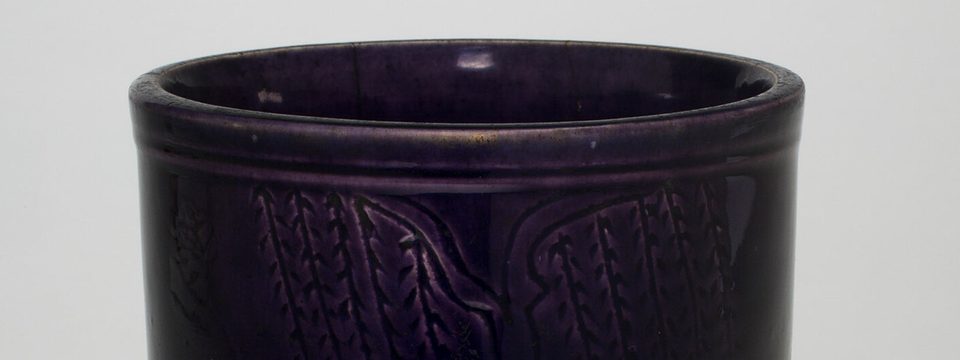
    Potters in China’s Kangxi era make porcelain with a deep aubergine glaze, like the brushpot shown below.3

  5. 1760s

    The word eggplant first appears in English, for white varieties that look like eggs.2, 4

  6. 1794

    First known use of aubergine as a color name in English.5

  7. 1915

    First known use of eggplant as a color name in English.5

  8. 1930

    Maerz and Paul’s A Dictionary of Color prints aubergine and eggplant on the same near-black purple sample.5

Sources (5)
  1. Wang, J.-X., Gao, T.-G. & Knapp, S. (2008). Ancient Chinese literature reveals pathways of eggplant domestication. Annals of Botany, 102(6), 891–897. doi:10.1093/aob/mcn179
  2. Wikipedia, “Eggplant”, Etymology and History.
  3. Art Institute of Chicago, Brushpot with a Bird Flying by a Willow Tree (1939.225).
  4. Merriam-Webster, “eggplant”, first known use 1767.
  5. Maerz, A. & Paul, M. R. (1930). A Dictionary of Color. New York: McGraw-Hill. Index, pp. 189 and 194; plate 48, sample H12. Internet Archive.

Aubergine in use

Upper half of a cylindrical Chinese porcelain brush pot in a glossy near-black purple glaze, with willow leaves incised under the glaze
#150F1C#2A202D#433C42#5E5359
CeramicsAubergine-glazed brushpot (1662–1722)

A porcelain brush holder from the Kangxi reign of China’s Qing dynasty, at the Art Institute of Chicago, which describes its glaze as aubergine. A willow and a flying bird are incised under the glaze. In the photo the glaze is almost black, with a purple sheen, much darker than the web code.

#150F1C#2A202D#433C42#5E5359
Source: Art Institute of Chicago
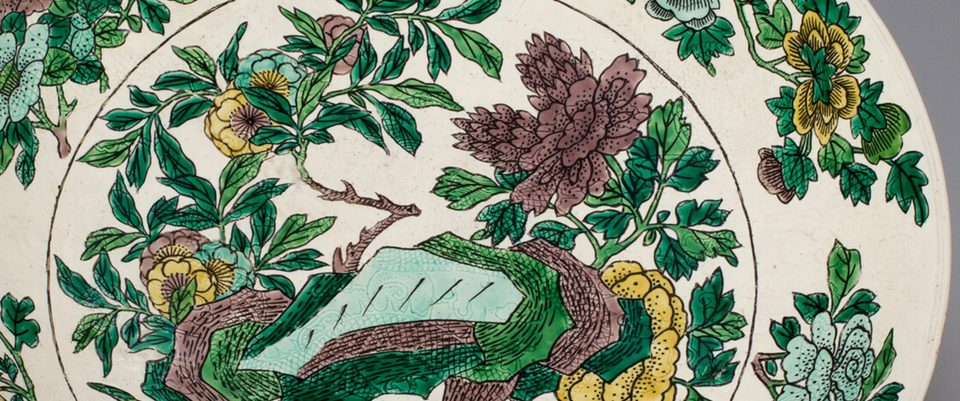
Center of a Chinese dish painted with a brownish-purple peony, green leaves, yellow flowers and a green and purple garden rock on a cream ground
#66534D#8E7D73#164D33#E1DBCF
CeramicsGreen and aubergine dish (1662–1722)

A Kangxi-era stoneware dish at the Art Institute of Chicago, painted with peonies and garden rocks in green, yellow and aubergine enamels. Here the aubergine is a soft brownish purple, close to the web code in depth but browner.

#66534D#8E7D73#164D33#E1DBCF
Source: Art Institute of Chicago

Palettes are sampled in-house.

Questions

What color is aubergine?

A dark grayish purple. The usual code is #614051 (RGB 97, 64, 81). Real eggplant skin, and most people’s idea of the color, are darker and more purple.

Is aubergine the same as eggplant?

Yes. Aubergine is the British name for the vegetable and the color, and eggplant is the American name. Both describe the dark purple of the vegetable’s skin.

Why is it called eggplant?

The name was first given to varieties with white, egg-shaped fruit that look like hen’s eggs. Purple varieties later became the usual kind in the West, but the name stuck.

Is aubergine purple or brown?

It is a purple, but a muted one. Dictionaries describe it as a dark grayish or blackish purple, and the usual code has enough green in it to give it a brownish cast.

What colors go with aubergine?

Brass and saffron for warmth, olive and sage greens for an earthy look, blush pink for softness, and cool grays for a modern feel.

What is the difference between aubergine and plum?

Plum (#8E4585) is lighter, brighter and bluer. Aubergine (#614051) is darker and grayer, with a brownish tint.