A warm golden yellow named after the world’s most precious spice.
Overview
Saffron is a warm golden yellow with a touch of orange. Its usual web code is #F4C430, a little softer and less intense than amber.
The name comes from the spice: the dried threads of the saffron crocus, Crocus sativus. The threads themselves are crimson, but their pigment, crocin, dyes food and cloth a rich golden yellow. The word came into English around 1200, by way of Arabic, and has been a color name since the late 1300s.
In India, saffron means something else: the deep orange of the top band of the national flag, called India saffron or kesari. Buddhist monks’ “saffron” robes are another story again. They are usually dyed with cheaper turmeric or jackfruit wood, not with the costly spice.
Use #F4C430 as a warm accent for food, festivals and sunny designs. It is a light color, so put dark text on it, and use a darker shade when you need text on white.
HEX
#F4C430
RGB
rgb(244, 196, 48)
HSL
hsl(45, 90%, 57%)
HSV
45°, 80%, 96%
CMYK
0, 20, 80, 4
OKLCH
oklch(84.0% 0.160 89.2)
Every code converts from the HEX value #F4C430. #F4C430 is the screen match Wikipedia gives for the “saffron” sample on plate 10 of Maerz and Paul’s A Dictionary of Color (1930). Wikipedia gives no source for the conversion, so treat it as close, not exact; the saffron of India’s flag is a different, much redder color. CMYK is a screen-based estimate; print results vary.
Saffron on the color map
LighterDarker
People’s average saffron in the xkcd survey is a little more orange and stronger, inside the outline to the left. The dictionary’s saffron is softer and slightly darker, also inside. India saffron is far to the left, off this view: it is a reddish orange, not a golden yellow. The outline is an approximate range, not a measured one.
Shades and tints
Tintswith white
Shadeswith black
Toneswith gray
Saffron sits in the middle. Tints add white, shades add black and tones add gray, in 10% steps out from it. Tap any swatch to copy its code.
Light and dark saffron
#F8DC83
Light saffronMixed 40% with white. A mellow, creamy yellow.
#F4C430
SaffronThe reference color.
#FFBF00
AmberBrighter and more intense, at almost the same hue. See amber
#F6673D
India saffronThe top band of India’s flag, as measured in 1947. A reddish orange.
#92761D
Dark saffronMixed 40% with black. It turns olive gold.
Colors that go with saffron
Pairings that work in rooms, outfits and interfaces.
Saffron and indigo
Golden yellow on deep blue. Rich, like printed textiles.
Saffron and crimson
The spice and its threads. Warm and festive.
Saffron and leaf green
Fresh and lively. Good for food and markets.
Saffron and charcoal
A bright accent on near-black. Clean and modern.
Saffron and plum
Complementary warmth and depth. Elegant for evening.
Saffron and sand
Soft and sunny. Relaxed, like a spice market at noon.
Color-wheel palettes
Pick a palette to see where its colors sit on the color wheel. The caret marks saffron. Tap a band to copy its code.
Lined up by hue around saffron. Hover a color to see how similar it is.The bar under each name shows how similar it is. Similarity comes from the distance between the two colors in OKLab, a model of how we see color.
Saffron vs India saffron
Saffron#F4C430 · hue 45°
Golden yellow
The color the spice gives to food
Code from a 1930 color dictionary sample
India saffron#F6673D · hue 14°
Reddish orange
The top band of India’s flag, also called kesari
Converted from the 1947 flag’s measured color
Meaning
Crocus
Spice
Dye
Flag of India
Buddhist robes
Saffron has meant luxury, cooking and faith for thousands of years. The spice was traded over long distances before the height of Minoan Crete, Buddhist monks wear “saffron” robes, and India flies saffron at the top of its flag. Mood studies test basic color words such as yellow or orange, not saffron, so the claims here are about history and materials.
Crimson threads, golden dye
Reference work
Saffron threads are the crimson stigmas of the saffron crocus, picked by hand: about 70,000 flowers for a pound of spice. Their pigment, crocin, gives food and textiles a rich golden yellow, which is the color the name describes.1
Monks’ robes are rarely real saffron
Reference works
Buddhist monks’ robes are called saffron, but they have been dyed with cheaper turmeric or the heartwood of the jackfruit tree, not the costly spice. Forest monks in Southeast Asia often wear a browner ochre.1, 2
India’s saffron was measured in 1947
Official standard
India’s flag standard, IS 1:1968, records lab measurements of the saffron, white and green of the flag presented to the Constituent Assembly on 22 July 1947. Converted for screens, its saffron is a strong reddish orange, about #F6673D, far from the golden web code.3
Sources (3)
Wikipedia, “Saffron”, sections on harvest, chemistry and history; the robe dyes cite Finlay, V. (2003), Colour: A Natural History of the Palette, p. 224.
Saffron has been gathered, traded and painted for at least 3,500 years. Its name reached English with the spice, and the color followed two centuries later.
1600–1500 BCE
Minoan painters show saffron in palace frescoes. A scene of saffron gatherers survives at Akrotiri, on the island of Santorini.1
About 1200
The word saffron enters English as the name of the spice, from French, Medieval Latin and Arabic zaʽfarān.2, 3
Late 1300s
First recorded use of saffron as a color name in English.3
1930
Maerz and Paul print a saffron sample on plate 10 of A Dictionary of Color. Today’s web code is a screen match for it.3
1947
On 22 July, India’s Constituent Assembly adopts a flag of saffron, white and green, with the navy blue Ashoka Chakra at its center.4
1955
The ISCC-NBS dictionary files Maerz and Paul’s saffron yellow under moderate orange and moderate orange yellow.5
1968
India’s flag standard, IS 1, publishes the measured colors of the 1947 flag, taken under the CIE’s standard daylight, illuminant C.6
Kelly, K. L. & Judd, D. B. (1955). The ISCC-NBS Method of Designating Colors and a Dictionary of Color Names. National Bureau of Standards Circular 553. Maerz and Paul entries as listed by Jaffer, A., “(M) Dictionary of Color”.
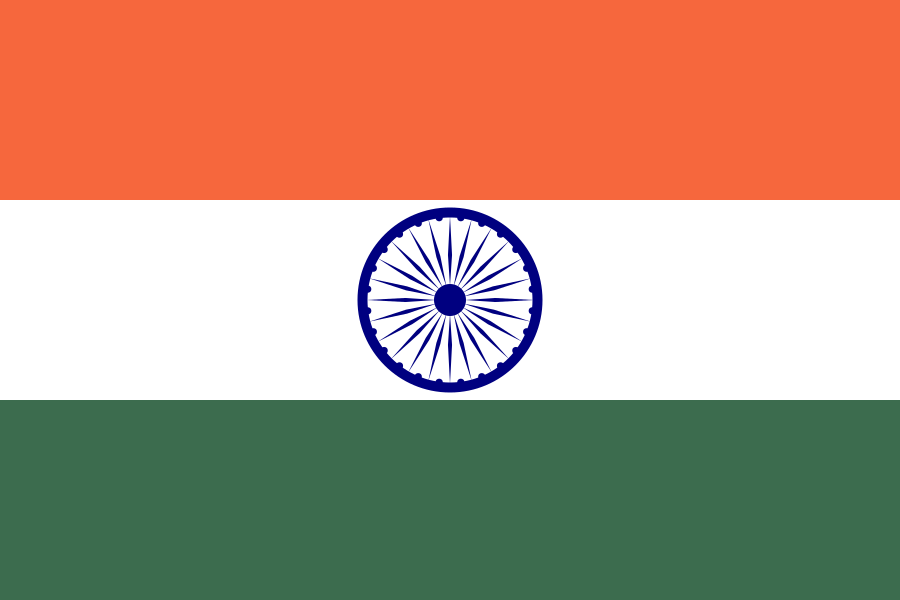
The top band is India saffron, or kesari. The flag standard records its color as measured on the flag presented in July 1947: a strong reddish orange, much deeper than the web’s golden saffron.
#F6673D#FFFFFF#3C6C4E
Source: IS 1:1968
Source
The codes are converted from the CIE measurements of the 1947 flag in India’s flag standard, IS 1:1968 (saffron x 0.538, y 0.360; green x 0.288, y 0.395; illuminant C), adapted to screen daylight with the cloth’s white set to screen white. The standard gives no measurement for the navy blue chakra, so it is drawn in the CSS color navy. The flag is drawn in-house from its official construction: 3:2, three equal bands, and a 24-spoke chakra in the center of the white band.
Palettes are sampled in-house.
Questions
What color is saffron?
A warm golden yellow with a touch of orange. The usual web code is #F4C430 (RGB 244, 196, 48).
Where does the code #F4C430 come from?
It is Wikipedia’s screen match for the saffron sample in Maerz and Paul’s A Dictionary of Color (1930). No source is given for the conversion, so treat it as close, not exact.
Is saffron yellow or orange?
Both, depending on who you ask. The spice dyes things golden yellow, and the web code is a golden yellow. In India, saffron usually means the reddish orange of the flag’s top band.
What color is the saffron on India’s flag?
India saffron, or kesari. Converted from the measurements in India’s flag standard, it is about #F6673D, a strong reddish orange.
Are Buddhist robes dyed with saffron?
Usually not. The robes are called saffron, but they have been dyed with cheaper turmeric or jackfruit heartwood rather than the expensive spice.
What is the difference between saffron and amber?
They share almost the same hue. Amber (#FFBF00) is brighter and more intense; saffron is a little softer and more golden.