Mulberry

A rich pinkish purple named after the fruit of the mulberry tree.

Overview

Mulberry is a rich purple with a strong pink side, named after the fruit of the mulberry tree. Its usual code is #C54B8C: plenty of red, a fair amount of blue and little green, at medium brightness.

As a color name, mulberry goes back to 1776 in English. An older word for the same color, murrey, was in use from the early 1400s. It comes through Old French from the Latin word for the fruit, and it survives in heraldry as a dark reddish purple.

The fruit itself is much darker than the code. Ripe black mulberries are a deep purple, almost black, colored by anthocyanin pigments. The dictionaries agree: Merriam-Webster defines the color mulberry as “a dark purple or purplish black”, and Maerz and Paul’s 1930 sample is close to black. People in the xkcd color survey picked a deep magenta-red. The common code is a lighter, pinker take on the color.

#C54B8C works as an accent in fashion, branding and interiors, and pairs well with sage green, navy and warm cream. Black text passes the usual contrast check on it; keep white text for large type.
HEX#C54B8C
RGBrgb(197, 75, 140)
HSLhsl(328, 51%, 53%)
HSV328°, 62%, 77%
CMYK0, 62, 29, 23
OKLCHoklch(59.5% 0.170 350.4)
Every code converts from the HEX value #C54B8C. There is no standard mulberry. #C54B8C is the code most color references use. Maerz and Paul’s A Dictionary of Color (1930) places mulberry much darker, on a sample it shares with murrey and that the ISCC-NBS dictionary (1955) files as purplish black. CMYK is a screen-based estimate; print results vary.
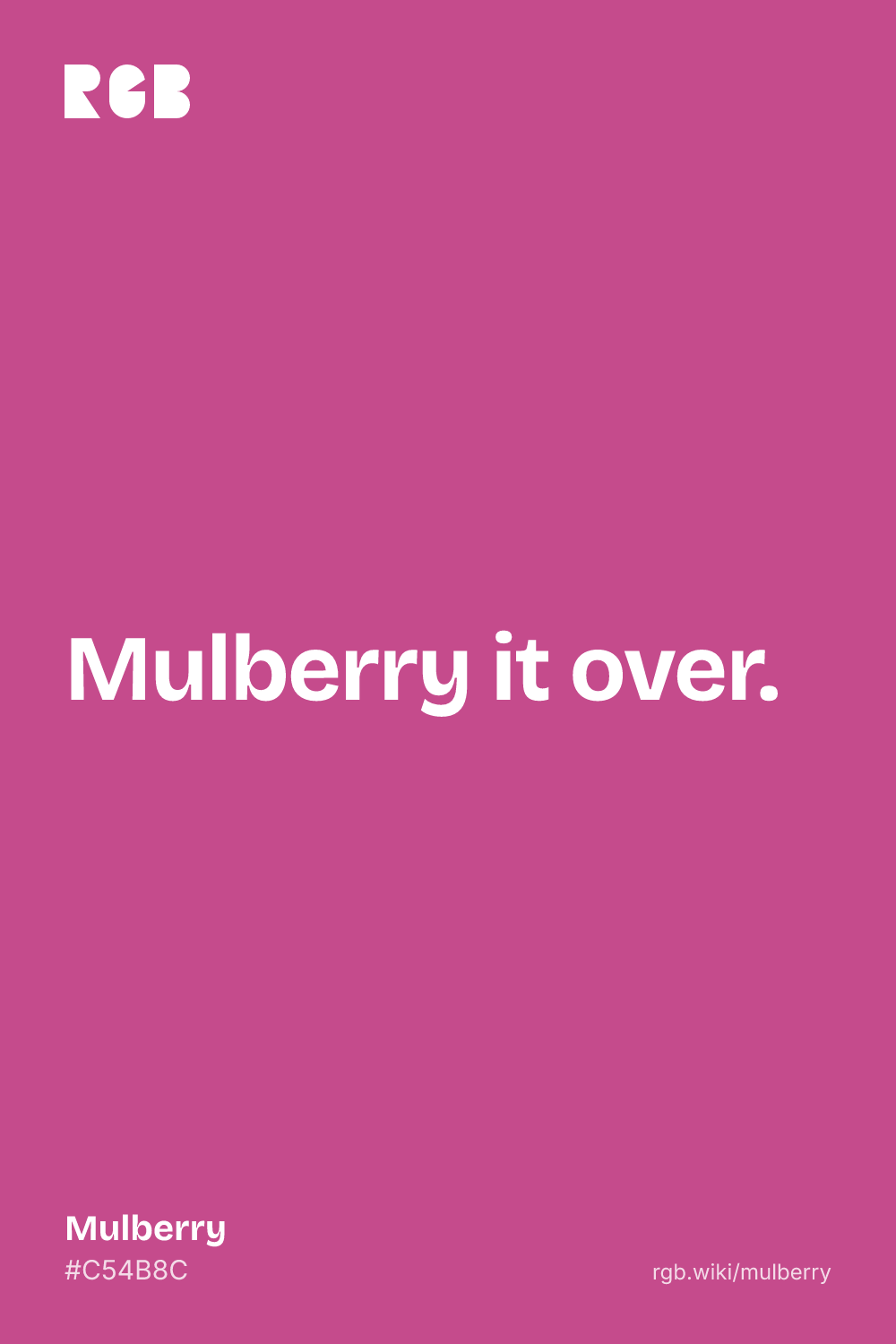
Mulberry color card, hex #C54B8C: “Mulberry it over”

Mulberry on the color map

Everyday mulberry is darker. People’s average mulberry in the xkcd survey sits below the outline and a little to the right: darker, redder and more saturated. The dictionary’s purplish black is far below the bottom of this view. The outline is an approximate range, not a measured one.

Shades and tints

Tints with white

Shades with black

Tones with gray

Mulberry sits in the middle. Tints add white, shades add black and tones add gray, in 10% steps out from it. Tap any swatch to copy its code.

Light and dark mulberry

#DC93BA
Light mulberryMixed 40% with white. A soft orchid pink.
#C54B8C
MulberryThe reference color.
#762D54
Dark mulberryMixed 40% with black. A deep plum-red, closer to the fruit.
#4F1E38
Deep mulberryMixed 60% with black. Near the color of a ripe black mulberry.

Colors that go with mulberry

Pairings that work in rooms, outfits and interfaces.

Mulberry and sage

Fruit and leaf. Fresh and natural, good for gardens and food brands.

Mulberry and navy

Confident and grown-up. Works for fashion and finance.

Mulberry and cream

Warm and classic, with a cocoa brown for text.

Mulberry and leaf green

Strong contrast taken from the tree itself. Use the green sparingly.

Mulberry and charcoal

Bold on dark. Good for nightlife, music and dark themes.

Mulberry and gold

Festive and rich. Works for invitations and packaging.

Color-wheel palettes

Pick a palette to see where its colors sit on the color wheel. The caret marks mulberry. Tap a band to copy its code.

Similar colors

Red-violet67%MulberryBlush65%Ruby57%Cerise63%Pink-red56%Brick red60%

Lined up by hue around mulberry. Hover a color to see how similar it is.The bar under each name shows how similar it is. Similarity comes from the distance between the two colors in OKLab, a model of how we see color.

Mulberry vs burgundy

Mulberry#C54B8C · hue 328°
  • A pinkish purple at medium depth
  • Named after a fruit
  • No standard code
Burgundy#800020 · hue 345°
  • A deep purplish red
  • Named after a wine
  • Much darker and redder

Meaning

  • Fruit tree
  • Silkworm food
  • Silk
  • Ovid’s lovers
  • Heraldry

Mulberry’s associations come from the tree: its dark fruit, its part in an old love story, and its leaves, which feed the silkworms behind the world’s silk. Studies of color and emotion test basic words like “purple” and “pink”, not mulberry, so there is no measured mood for this shade.

The silkworm’s food

Historical record

White mulberry leaves are the preferred food of silkworms, and the tree was grown in China to feed them more than 4,700 years ago. When silk farming reached Byzantium in the 6th century, the first worms there were raised on mulberry leaves.1, 2

A myth explains the dark fruit

Classical myth

In Ovid’s tale of Pyramus and Thisbe, the lovers meet under a mulberry tree covered with white fruit. Their blood stains the berries purple, and the gods make the ripe fruit darken forever in their memory.3

A color in heraldry

Historical record

Murrey, the old name for mulberry color, is a heraldic color between red and purple. In the 15th century the livery colors of the House of York were blue and murrey.4

Sources (4)
  1. Wikipedia, “Morus alba” (white mulberry), Uses and History.
  2. Procopius, History of the Wars, Book 8, chapter 17, translated by H. B. Dewing (Loeb, 1928). LacusCurtius.
  3. Ovid, Metamorphoses, Book 4, translated by Brookes More (1922). Perseus Digital Library.
  4. Wikipedia, “Murrey”, citing H. Stanford London, The Queen’s Beasts (1953).

History

The mulberry gave English two color names, centuries apart, and gave the world silk. Its story runs from a Roman poem to the color dictionaries of the 20th century.

  1. AD 8

    Ovid’s Metamorphoses tells how the white fruit of the mulberry was “dyed a purple tint” by the blood of Pyramus and Thisbe.1, 2

  2. 6th century

    Monks bring silkworm eggs to Byzantium from a land Procopius calls Serinda. The worms are fed on mulberry leaves, and silk farming takes root in the Byzantine Empire.3, 4

  3. 1403

    First known use of murrey, from the Old French for mulberry, as a color name in English.5

  4. 1400s

    Blue and murrey are the livery colors of the House of York.6

  5. 1776

    First known use of mulberry as a color name in English.5

  6. 1912–1928

    Mulberry purple (1912) and mulberry fruit (1928) join the list of English color names.5

  7. 1930

    Maerz and Paul’s A Dictionary of Color prints mulberry and murrey on the same dark sample, a purplish black.5

Sources (6)
  1. Ovid, Metamorphoses, Book 4, translated by Brookes More (1922). Perseus Digital Library.
  2. Wikipedia, “Metamorphoses”.
  3. Procopius, History of the Wars, Book 8, chapter 17, translated by H. B. Dewing (Loeb, 1928). LacusCurtius.
  4. Wikipedia, “Sericulture”, History.
  5. Maerz, A. & Paul, M. R. (1930). A Dictionary of Color. New York: McGraw-Hill. Note on murrey, p. 168; index, p. 199; plate 48, sample E9. Internet Archive.
  6. Wikipedia, “Murrey”.

Questions

What color is mulberry?

A rich pinkish purple. The usual code is #C54B8C (RGB 197, 75, 140). The ripe fruit, and the dictionary color, are much darker, close to purplish black.

What color are mulberries?

Black mulberries ripen to a deep purple, almost black. In Ovid’s myth the fruit was once white, until it was stained purple by the blood of two lovers.

What is murrey?

An old English name for mulberry color, in use since the 1400s. In heraldry it is a dark reddish purple, and it was a livery color of the House of York.

What is the connection between mulberry and silk?

Silkworms feed on mulberry leaves, and white mulberry leaves are their preferred food. China grew the tree to feed silkworms more than 4,700 years ago, and the first silkworms raised in Byzantium were fed on mulberry leaves too.

What colors go with mulberry?

Sage and leaf greens for a natural look, navy and charcoal for contrast, and cream or gold for warmth.

What is the difference between mulberry and burgundy?

Burgundy (#800020) is a dark purplish red. Mulberry (#C54B8C) is lighter and pinker, with more blue in it.