Gray-purple

A purple with the color turned down, the shade people picked when asked for gray purple.

Overview

Gray-purple is a purple with most of its color drained out. The code used here, #826D8C, is a medium tone where blue edges out red and green trails both, so it reads as a soft, smoky violet: too purple to be a gray, too gray to be a plain purple.

Most color-mix names have a code someone simply picked. This one comes from people. In the 2010 xkcd color survey, the average of the colors people named “gray purple” is exactly #826D8C. The other word orders land right beside it: grayish purple at #887191, purple gray at #866F85 and purplish gray at #7A687F, all within a few steps of each other.

Color systems are fussier about those same words. The 1955 ISCC-NBS dictionary keeps a grayish purple (centered on #796878) apart from a purplish gray (#8B8589), which is nearly neutral. The survey’s gray-purple sits close to grayish purple, with a little more color. Before that system, naturalists had dozens of names for the shade: Robert Ridgway’s 1912 color book alone has heliotrope gray, purple-drab, slate-violet and vinaceous-gray, all of which the dictionary files as grayish purple.

In design, gray-purple is quiet and grown-up, a purple that won’t shout. It sits almost exactly between light and dark: white text on it reaches 4.65 to 1 and black text 4.52 to 1, so both just pass for body text. For more comfortable reading, put white text on a deeper shade such as #4E4154, at 9.5 to 1.
HEX#826D8C
RGBrgb(130, 109, 140)
HSLhsl(281, 12%, 49%)
HSV281°, 22%, 55%
CMYK7, 22, 0, 45
OKLCHoklch(56.6% 0.053 314.8)
Every code converts from the HEX value #826D8C. #826D8C is exactly the average color named “gray purple” in the xkcd color survey (2010, CC0 data). No color standard defines gray-purple, and there is no CSS keyword for it. Its nearest group in the ISCC-NBS system is grayish purple, group 228, centered on #796878. CMYK is a screen-based estimate; print results vary.
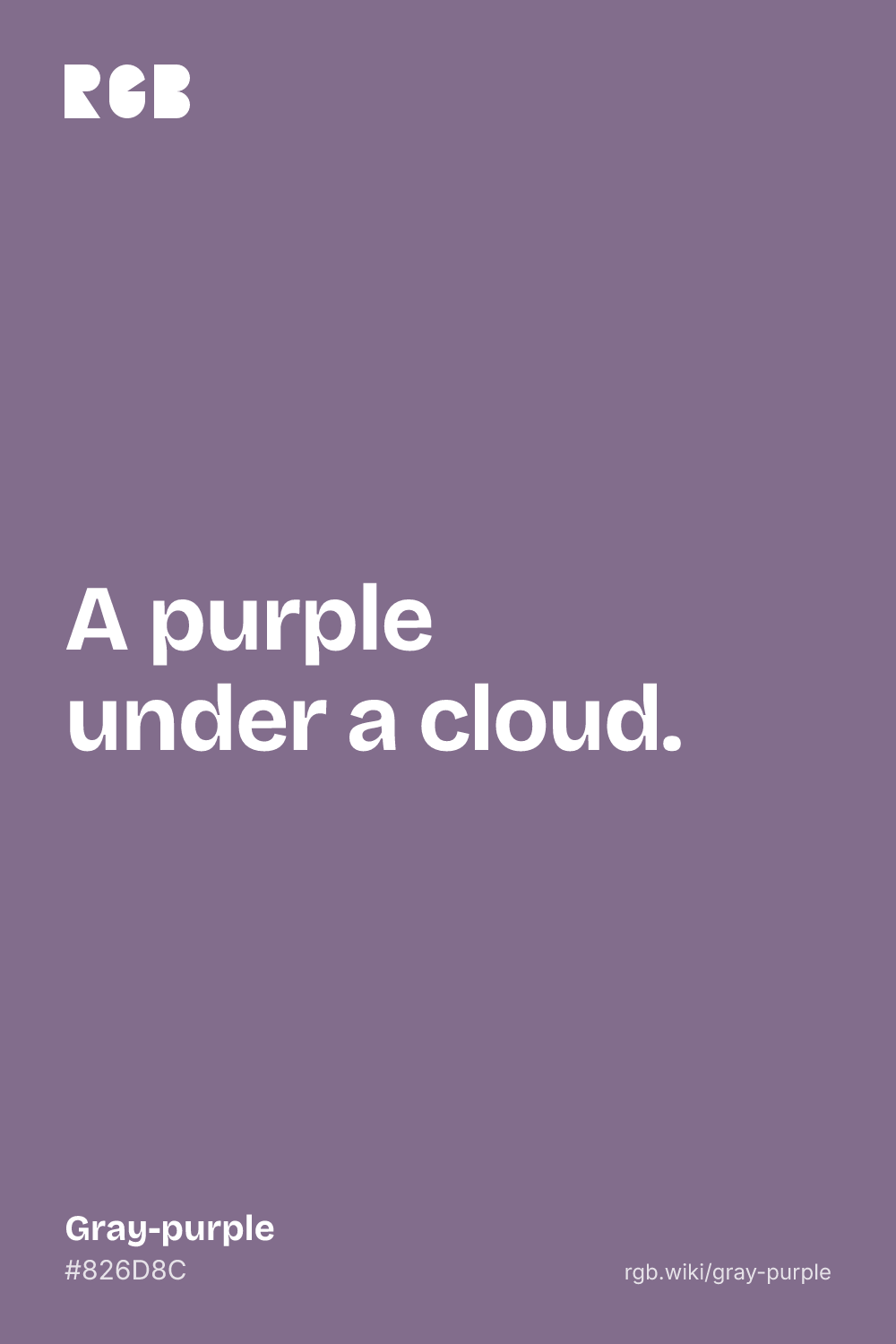
Gray-purple color card, hex #826D8C: “A purple under a cloud”

Gray-purple on the color map

This view shows hue and lightness, not how gray a color is, so it flatters the grays. People’s grayish purple sits almost on top of the reference, a touch lighter, and their purplish gray sits just below it. Purple gray sits a little to the right: slightly pinker. The ISCC-NBS grayish purple sits near the right edge of the outline and a little darker. The purplish gray sits outside it, to the right and a little lighter, but it is so close to neutral that its hue barely shows. The outline is an approximate range, not a measured one.

Shades and tints

Tints with white

Shades with black

Tones with gray

Gray-purple sits in the middle. Tints add white, shades add black and tones add gray, in 10% steps out from it. Tap any swatch to copy its code.

Light and dark gray-purple

#CDC5D1
Pale gray-purpleMixed 60% with white. A faint, cool tint for backgrounds.
#B39EB5
Pastel purpleLighter and a little pinker, with the same muted feel. See pastel purple
#B4A7BA
Light gray-purpleMixed 40% with white. Soft, with dark text.
#826D8C
Gray-purpleThe reference color.
#796878
Grayish purpleThe ISCC-NBS center for grayish purple (group 228). A little darker, pinker and grayer.
#4E4154
Dark gray-purpleMixed 40% with black. Deep enough for white text, at 9.5 to 1.
#614051
AubergineDarker and redder, the purple of eggplant skin. See aubergine

Colors that go with gray-purple

Pairings that work in rooms, outfits and interfaces.

Gray-purple and sage

Two muted colors from the garden. Calm for wellness brands and weddings.

Gray-purple and blush

Soft and romantic. Keep a dark color for text.

Gray-purple and mustard

Near opposites on the wheel. Mustard wakes the purple up; use it for small things.

Gray-purple and charcoal

Dark and understated. A quiet look for portfolios and apps.

Gray-purple and silver

Cool and elegant, like slate and pewter. Good for stationery.

Gray-purple and plum

Muted and rich shades of one family. Plum carries the accents.

Color-wheel palettes

Pick a palette to see where its colors sit on the color wheel. The caret marks gray-purple. Tap a band to copy its code.

Similar colors

Slate gray72%Light slate gray63%Woad66%Gray-purpleDove gray69%Dim gray65%Mink66%

Lined up by hue around gray-purple. Hover a color to see how similar it is.The bar under each name shows how similar it is. Similarity comes from the distance between the two colors in OKLab, a model of how we see color.

Gray-purple vs pastel purple

Gray-purple#826D8C · hue 281°
  • Medium, not pale
  • Bluer and a little more colorful
  • Code from the xkcd survey
Pastel purple#B39EB5 · hue 295°
  • Much lighter
  • A little pinker
  • Needs dark text

Meaning

  • Survey color
  • Bird-book names
  • Wine-gray
  • Muted, calm

Gray-purple’s meanings come from how it was named, not from lab tests: color studies use broad words like purple and gray, never gray-purple. Its code is a survey average, and its older names come from naturalists describing birds.

Word order barely matters to people

Large online survey

In the xkcd color survey, gray purple, grayish purple, purple gray and purplish gray averaged out within a few steps of each other, from #7A687F to #887191. Color systems separate a grayish purple from a purplish gray; everyday speakers mostly do not. The survey ran online on uncontrolled screens, so read the averages as a guide.1

Naturalists named it after things

Historical record

Robert Ridgway, a bird curator at the Smithsonian, published Color Standards and Color Nomenclature in 1912 so ornithologists could describe plumage. Its 1,115 colors include purplish gray, heliotrope gray, purple-drab, slate-violet and vinaceous-gray, and the ISCC-NBS dictionary files every one of them as grayish purple.2, 3

Vinaceous means wine-colored

Dictionary record

Several of Ridgway’s gray-purples carry the word vinaceous, which Merriam-Webster defines as of the color of red wine. A wine-gray is a fair description of this shade.4

Muted colors may feel calmer

Lab study

In a study of color chips, Valdez and Mehrabian found that more saturated colors were rated as more arousing. Gray-purple’s low saturation fits a calm reading, but the study tested saturation in general, not this color, and later research on color and mood has been mixed.5

Studies test purple and gray, not the mix

Cross-cultural survey

A survey of over 4,500 people in 30 nations found that feelings tied to basic color words, including purple and gray, are broadly similar across countries. It did not test mixes such as gray-purple, so what it found about each word may not carry over.6

Sources (6)
  1. Munroe, R. (2010). “Color Survey Results” and “The 954 most common RGB monitor colors”, xkcd color survey (CC0).
  2. Wikipedia, “Robert Ridgway”, section on his color books, citing Lewis, D. (2012), The Feathery Tribe: Robert Ridgway and the Modern Study of Birds.
  3. Jaffer, A. “Ridgway color names”, with ISCC-NBS centroids from “Color-Name Dictionaries”, MIT CSAIL.
  4. Merriam-Webster, “vinaceous”.
  5. Valdez, P. & Mehrabian, A. (1994). Effects of color on emotions. Journal of Experimental Psychology: General, 123(4), 394–409. doi:10.1037/0096-3445.123.4.394
  6. Jonauskaite, D. et al. (2020). Universal patterns in color-emotion associations are further shaped by linguistic and geographic proximity. Psychological Science, 31(10), 1245–1260. doi:10.1177/0956797620948810

History

Gray-purple’s story is one of names: naturalists who needed words for subtle bird colors, dictionaries that sorted those words into groups, and a survey that finally asked ordinary people.

  1. 1886

    Robert Ridgway publishes A Nomenclature of Colors for Naturalists, 186 colors for describing birds.1

  2. 1912

    Ridgway’s Color Standards and Color Nomenclature names 1,115 colors on 53 plates, among them purplish gray, heliotrope gray, purple-drab and vinaceous-gray.1, 2

  3. 1930

    Maerz and Paul’s A Dictionary of Color adds its own gray-purples, such as heliotrope gray, old lilac and Varley’s gray.3

  4. 1950

    Taylor, Knoche and Granville’s Descriptive Color Names Dictionary lists dusty lilac, heather, mauve gray and orchid gray in the same range.4

  5. 1955

    The ISCC-NBS dictionary sorts all these names into groups. Grayish purple, group 228, centers on #796878; purplish gray, group 233, is nearly neutral at #8B8589.5

  6. 2010

    The xkcd color survey gathers over five million color names from 222,500 sessions. Its average gray purple, #826D8C, becomes the code most color lists use for gray-purple.6

Sources (6)
  1. Wikipedia, “Robert Ridgway”, section on his color books, citing Lewis, D. (2012), The Feathery Tribe: Robert Ridgway and the Modern Study of Birds.
  2. Jaffer, A. “Ridgway color names”, with ISCC-NBS centroids from “Color-Name Dictionaries”, MIT CSAIL.
  3. Jaffer, A. “Maerz and Paul color names”, with ISCC-NBS centroids from “Color-Name Dictionaries”, MIT CSAIL.
  4. Jaffer, A. “Taylor, Knoche and Granville color names”, with ISCC-NBS centroids from “Color-Name Dictionaries”, MIT CSAIL.
  5. Kelly, K. L. & Judd, D. B. (1955). The ISCC-NBS Method of Designating Colors and a Dictionary of Color Names. National Bureau of Standards Circular 553, groups 228 and 233. NIST PDF.
  6. Munroe, R. (2010). “Color Survey Results” and “The 954 most common RGB monitor colors”, xkcd color survey (CC0).

Questions

What color is gray-purple?

A muted, medium purple with a lot of gray in it. The code used here is #826D8C (RGB 130, 109, 140), the average color people named gray purple in the xkcd color survey. No color standard defines it.

Is gray-purple a gray or a purple?

A purple. Color systems call a gray with a trace of purple a purplish gray, and a purple with a lot of gray a grayish purple. #826D8C is close to grayish purple, with a little more color.

Where does the hex code #826D8C come from?

From the 2010 xkcd color survey, where it is exactly the average of the colors people named gray purple. Grayish purple (#887191) and purple gray (#866F85) came out almost the same.

Is gray-purple the same as mauve?

No. Mauve’s classic code, #E0B0FF, is a pale, bright lilac. In everyday speech mauve often means a dusty pinkish purple, which is pinker than gray-purple.

What is the difference between gray-purple and pastel purple?

Pastel purple (#B39EB5) is much lighter and a little pinker. Both are muted, but gray-purple is a medium tone and pastel purple a pale one.

Does white or black text work on gray-purple?

Both, just barely. White text reaches 4.65 to 1 and black text 4.52 to 1, both above the 4.5 to 1 needed for body text. For easier reading, use a deeper shade such as #4E4154 behind white text.

What colors go with gray-purple?

Sage and blush for something soft, mustard as a warm near-opposite, silver and charcoal for a cool, modern look, and plum for depth.