Amethyst

A medium purple named after the quartz the Greeks thought would keep you sober.

Overview

Amethyst is a medium purple with a lean toward blue. The code most color lists use is #9966CC: blue strongest, red at 60% and green at 40%. All three values are steps of the old 216-color web-safe palette.

The color is named after the gem, the purple variety of quartz. The word comes from the Greek amethystos, “not drunk”. The Greeks linked the wine-colored stone with the god of wine and believed it kept its wearer sober. English has used amethyst as a color name since at least 1572.

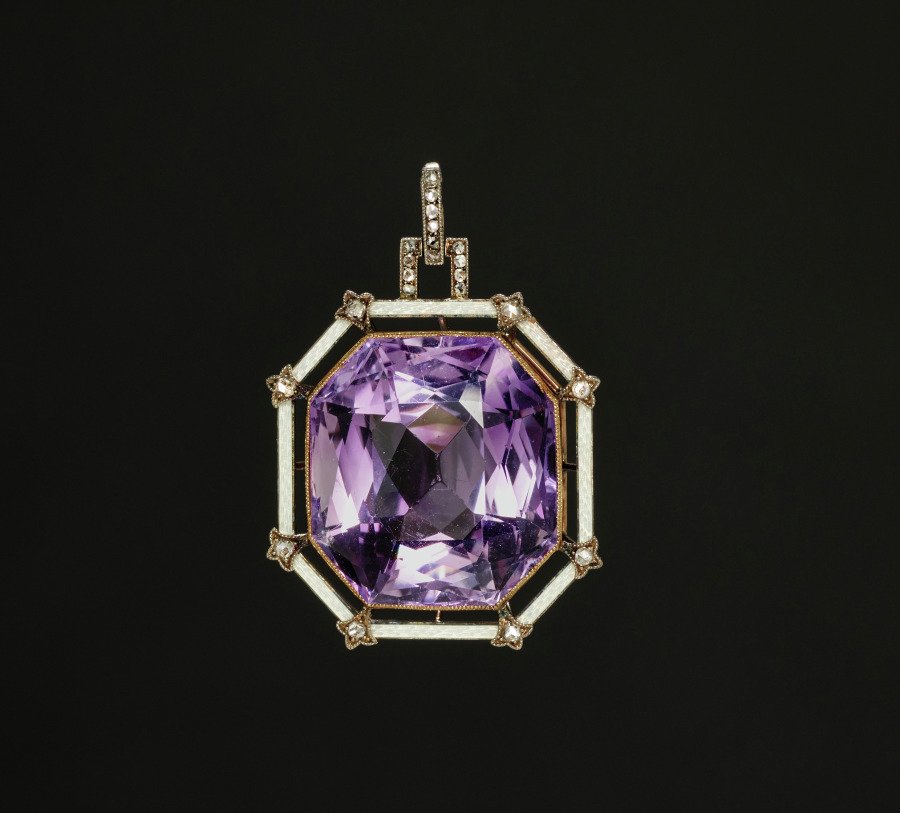
Real amethyst runs from pale lilac to a deep, almost black purple, and the stones dealers value most are a strong reddish purple. Next to them, the web code looks lighter and bluer. A 1955 color dictionary places the 1930 amethyst sample at a grayer, redder #86608E, and a cut amethyst in a Fabergé pendant samples close to it.

On screens, #9966CC works with black text. White text passes only at large sizes, so use a deeper shade such as #6B478F behind white text. It pairs well with silver and gray, with sage green, and with golden yellow, the color some amethyst turns when heated.

HEX#9966CC
RGBrgb(153, 102, 204)
HSLhsl(270, 50%, 60%)
HSV270°, 50%, 80%
CMYK25, 50, 0, 20
OKLCHoklch(60.8% 0.156 305.3)
Every code converts from the HEX value #9966CC. No color standard defines amethyst. #9966CC is the code most color lists use; Wikipedia gives it with only an online code converter as its source. The 1955 ISCC-NBS dictionary files the amethyst in Maerz and Paul’s A Dictionary of Color (1930) as a moderate purple, #86608E, which is grayer and redder; see the range below. CMYK is a screen-based estimate; print results vary.
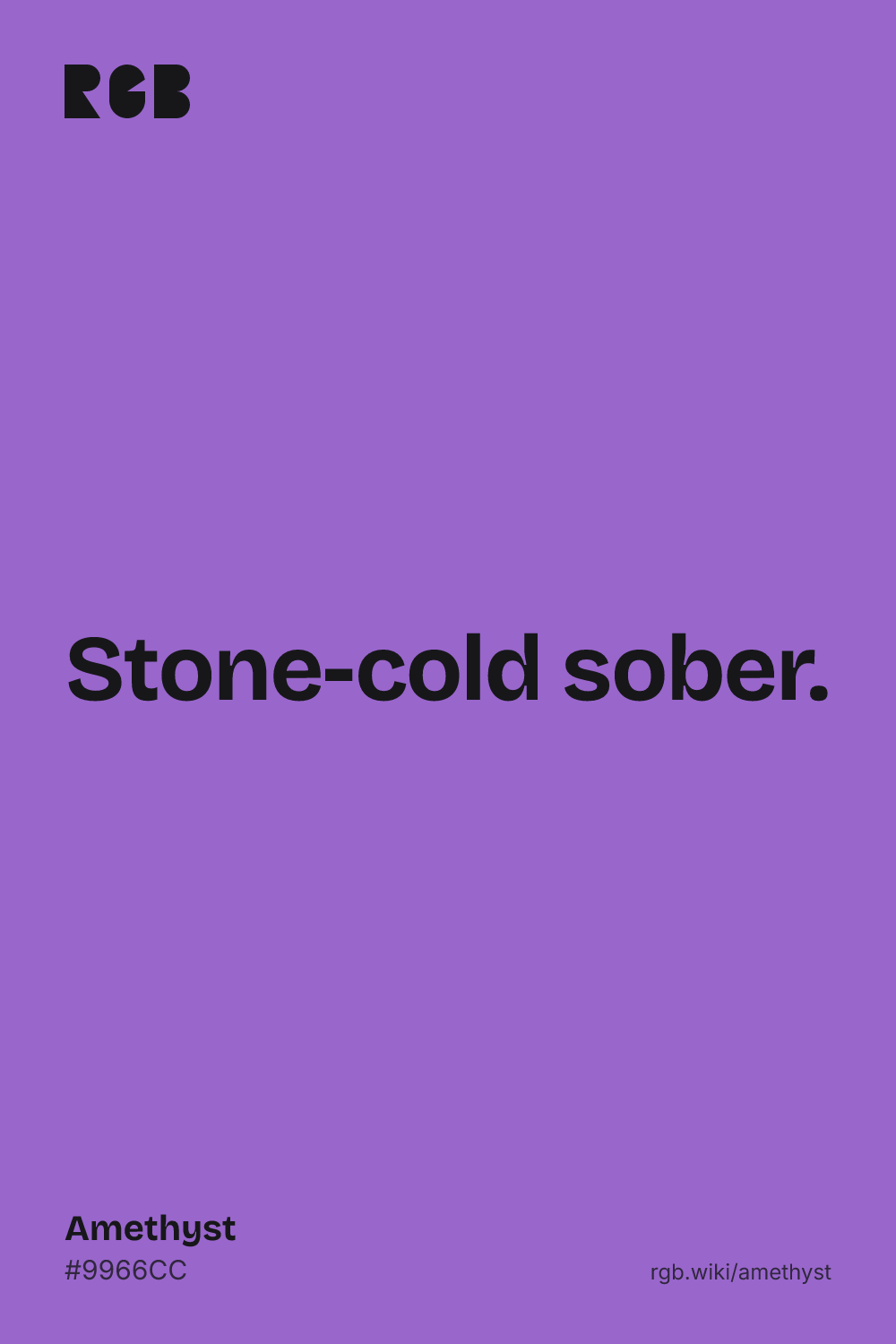
Amethyst color card, hex #9966CC: “Stone-cold sober”

Amethyst on the color map

People’s average amethyst in the xkcd survey sits almost on the code, a touch darker and redder. The dictionary’s moderate purple and the Fabergé stone lie to the right, redder and a little darker, and both are much grayer, which this map of hue and lightness doesn’t show. All three sit inside the outline. The outline is an approximate range, not a measured one.

Shades and tints

Tints with white

Shades with black

Tones with gray

Amethyst sits in the middle. Tints add white, shades add black and tones add gray, in 10% steps out from it. Tap any swatch to copy its code.

Light and dark amethyst

#E0D1F0
Pale amethystMixed 70% with white. A soft lilac for backgrounds.
#C2A3E0
Light amethystMixed 40% with white. A light lilac, like the palest amethyst.
#9966CC
AmethystThe reference color.
#86608E
Dictionary amethystThe ISCC-NBS moderate purple, where the 1955 dictionary files Maerz and Paul’s amethyst. Grayer and redder.
#6B478F
Deep amethystMixed 30% with black. Dark enough for white text.
#4C3366
Dark amethystMixed 50% with black. A deep purple for text and borders on light backgrounds.

Colors that go with amethyst

Pairings that work in rooms, outfits and interfaces.

Ametrine

Purple and golden yellow, the two colors that share one crystal in ametrine.

Amethyst and silver

Cool and jeweled. Suits invitations and jewelry shops.

Fabergé pendant

From the museum photo: amethyst facets framed in white enamel.

Amethyst and sage

Purple against a soft green. Calm and natural.

Amethyst and charcoal

Modern and moody. Good for interfaces and packaging.

Amethyst night

A dark theme with light amethyst as the accent.

Color-wheel palettes

Pick a palette to see where its colors sit on the color wheel. The caret marks amethyst. Tap a band to copy its code.

Similar colors

Dark periwinkle65%Medium slate blue65%Slate blue57%Medium purple85%AmethystLavender61%Medium orchid67%

Lined up by hue around amethyst. Hover a color to see how similar it is.The bar under each name shows how similar it is. Similarity comes from the distance between the two colors in OKLab, a model of how we see color.

Amethyst vs lavender

Amethyst#9966CC · hue 270°
  • Darker and deeper
  • Named after a purple gem
  • The February birthstone
Lavender#B57EDC · hue 275°
  • Lighter and softer
  • Named after a flower
  • Matches a 1930 dictionary sample

Meaning

  • Gemstone
  • Sobriety
  • Royal jewels
  • Bishops’ rings

Amethyst’s meanings come from the stone: its Greek name, its long run as a gem of queens and bishops, and its place as February’s birthstone. Research on color and emotion tests the broad word purple, not amethyst, so the claims here are about the gem and its history.

Quartz colored by iron and radiation

Well established

Amethyst is the purple variety of quartz, the same mineral as clear rock crystal. Its color comes from traces of iron in the crystal, changed by natural radiation in the rock. Heat drives the purple out: some amethyst turns yellow, like citrine, and some fades in strong light.1, 2, 3
Once as rare as ruby

Historical record

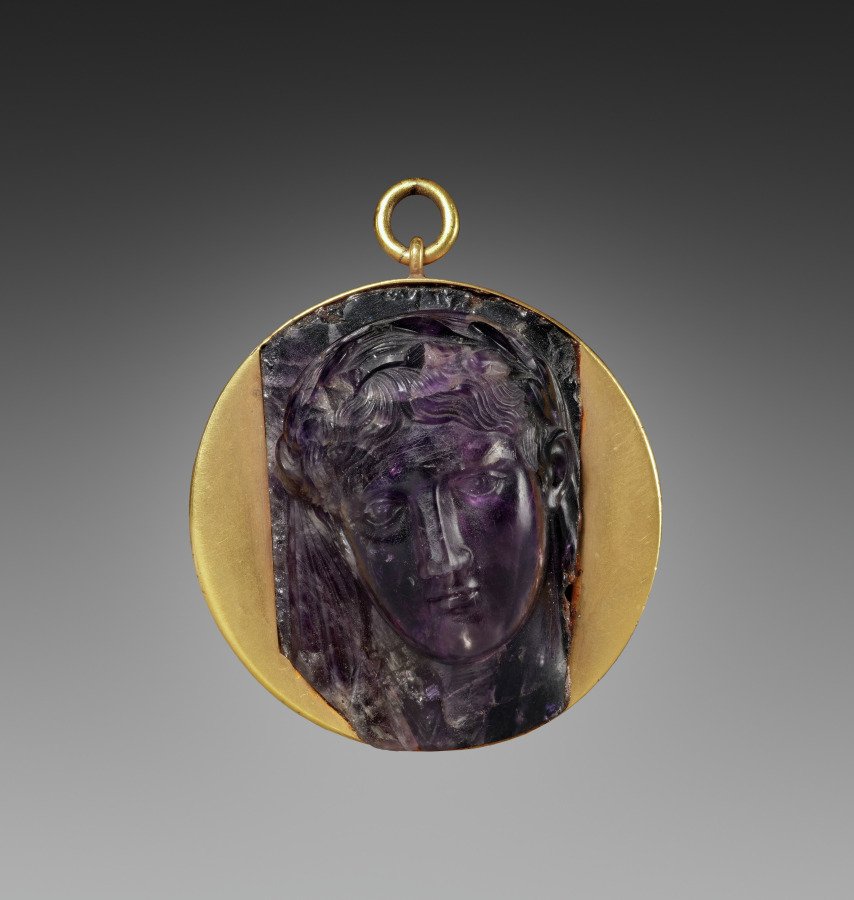
In ancient Rome only the elite could use amethyst, imported at great expense. Russia was the main source until the 1800s, when large deposits were found in Brazil. A stone once ranked with ruby and emerald became cheap enough for everyday jewelry.4, 3, 5

A charm against drunkenness

Folklore

Because the stone has the color of wine, early Greek legends tied it to the wine god, and people believed it kept them sober and clear-headed. Renaissance Europeans thought it calmed lovers overcome by passion. These are beliefs, not tested effects.6, 3

A bishop’s stone

Long tradition

Fine amethyst is set in bishops’ rings and in the British coronation regalia. Anglican bishops’ rings often carry an amethyst, a nod to the apostles, who were “not drunk” at Pentecost.7, 2

Sources (7)
  1. Gemological Institute of America, “Amethyst description”.
  2. Wikipedia, “Amethyst”, sections Structure and History, citing Rossman, “Colored varieties of the silica minerals” (1994) and O’Donoghue, Gems (2006).
  3. Gemological Institute of America, “February birthstones”.
  4. The Cleveland Museum of Art, “Cameo: Head of a Woman”, Roman, 1–100 CE (1958.92).
  5. Gemological Institute of America, “Amethyst quality factors”.
  6. Merriam-Webster, “amethyst”, etymology and word history.
  7. Gemological Institute of America, “Amethyst history and lore”.

History

Amethyst has been carved and worn for more than five thousand years. It went from a stone for queens and emperors to one of the most affordable colored gems.

  1. About 3500–2950 BCE

    In Predynastic Egypt, a carver shapes a bull’s head amulet from amethyst, one of the earliest of all Egyptian amulets.1

  2. 200s BCE

    A Greek epigram credited to Asclepiades of Samos (some give it to a later poet) describes a ring of a Queen Cleopatra, with Drunkenness carved in amethyst. It puns on methe, “drunkenness”, and the stone’s name.2

  3. 1–100 CE

    A Roman gem cutter carves a woman’s portrait in amethyst. Only elite Romans could use the stone.3

  4. 1572

    First recorded use of “amethyst” as a color name in English.4

  5. 1700s

    Catherine the Great of Russia wears amethyst necklaces, earrings and other ornaments. Russia is the main source of the stone.5

  6. 1800s

    Large deposits are found in Brazil. Amethyst, once as rare as ruby or emerald, is suddenly plentiful.5

  7. About 1910

    The Fabergé firm sets a large cut amethyst in white enamel and small diamonds, in the workshop of Albert Holmström.6

  8. 1930

    Maerz and Paul’s A Dictionary of Color prints an amethyst sample, plate 45.4

  9. 1955

    The ISCC-NBS dictionary files Maerz and Paul’s amethyst as a moderate purple.7

  10. 1970s

    Lab-grown amethyst appears. It has the same chemistry as the natural stone and is hard to tell apart without lab tests.5

Sources (7)
  1. The Cleveland Museum of Art, “Bull’s-Head Amulet”, Egypt, Predynastic, c. 3500–2950 BCE (1998.26).
  2. Asclepiades of Samos, “Kleopatra’s Ring”, in The Windflowers of Asklepiades and the Poems of Poseidippos, trans. Edward Storer (London: Egoist Press, 1920), p. 14. Internet Archive.
  3. The Cleveland Museum of Art, “Cameo: Head of a Woman”, Roman, 1–100 CE (1958.92).
  4. Wikipedia, “Lavender (color)”, section Amethyst, citing Maerz and Paul, A Dictionary of Color (1930), p. 189 and plate 45.
  5. Gemological Institute of America, “February birthstones”.
  6. The Cleveland Museum of Art, “Pendant”, House of Fabergé and Albert Holmström, c. 1910 (2022.114).
  7. Jaffer, A. “(M) Dictionary of Color”, the ISCC-NBS placements of Maerz and Paul’s color names (1955 dictionary).

Amethyst in use

A pendant with a large faceted lilac-purple amethyst in an octagonal frame of white enamel set with small diamonds, on a black background
#B697BC#8D6C92#423049#D6D7C5
JewelryPendant by the Fabergé firm (about 1910)

A large cut amethyst framed in white enamel and small diamonds, from the workshop of Albert Holmström. In the photo its facets run from a pale lilac, about #B697BC, through #8D6C92 to a near-black purple: redder and grayer than the web code.

#B697BC#8D6C92#423049#D6D7C5
Source: Cleveland Museum of Art
A dark purple amethyst carved with the face of a woman wearing a laurel wreath, set in a round gold mount with a loop at the top
#4F424B#3A2D37#251B24#B99C5E
JewelryCameo of a woman, Roman (1–100 CE)

A woman in a laurel wreath, perhaps a member of the imperial family, carved in amethyst. Only elite Romans could use the stone. Carved this deep, it reads as a dark, smoky purple, about #3A2D37, far darker than the web code. The gold mount is modern.

#4F424B#3A2D37#251B24#B99C5E
Source: Cleveland Museum of Art

Palettes are sampled in-house.

Questions

What color is amethyst?

A medium purple with a lean toward blue. The code most color lists use is #9966CC (RGB 153, 102, 204). Real amethyst ranges from pale lilac to a deep reddish purple.

Is amethyst the same as lavender?

No. Lavender (#B57EDC) is lighter and softer and is named after a flower. Amethyst (#9966CC) is darker and named after a gem.

Is amethyst purple or violet?

Both words fit. Merriam-Webster describes the gem as clear purple or bluish violet. The web code leans toward violet, while the stones dealers value most are a reddish purple.

What gives amethyst its color?

Traces of iron in quartz, changed by natural radiation in the rock. Heat removes the purple, and some amethyst turns yellow, like citrine.

What does the name amethyst mean?

It comes from the Greek amethystos, “not drunk”. The Greeks believed the wine-colored stone kept its wearer sober.

What colors go with amethyst?

Silver and gray for a cool, jeweled look, sage green for contrast, golden yellow like citrine for warmth, and charcoal for a modern dark theme.