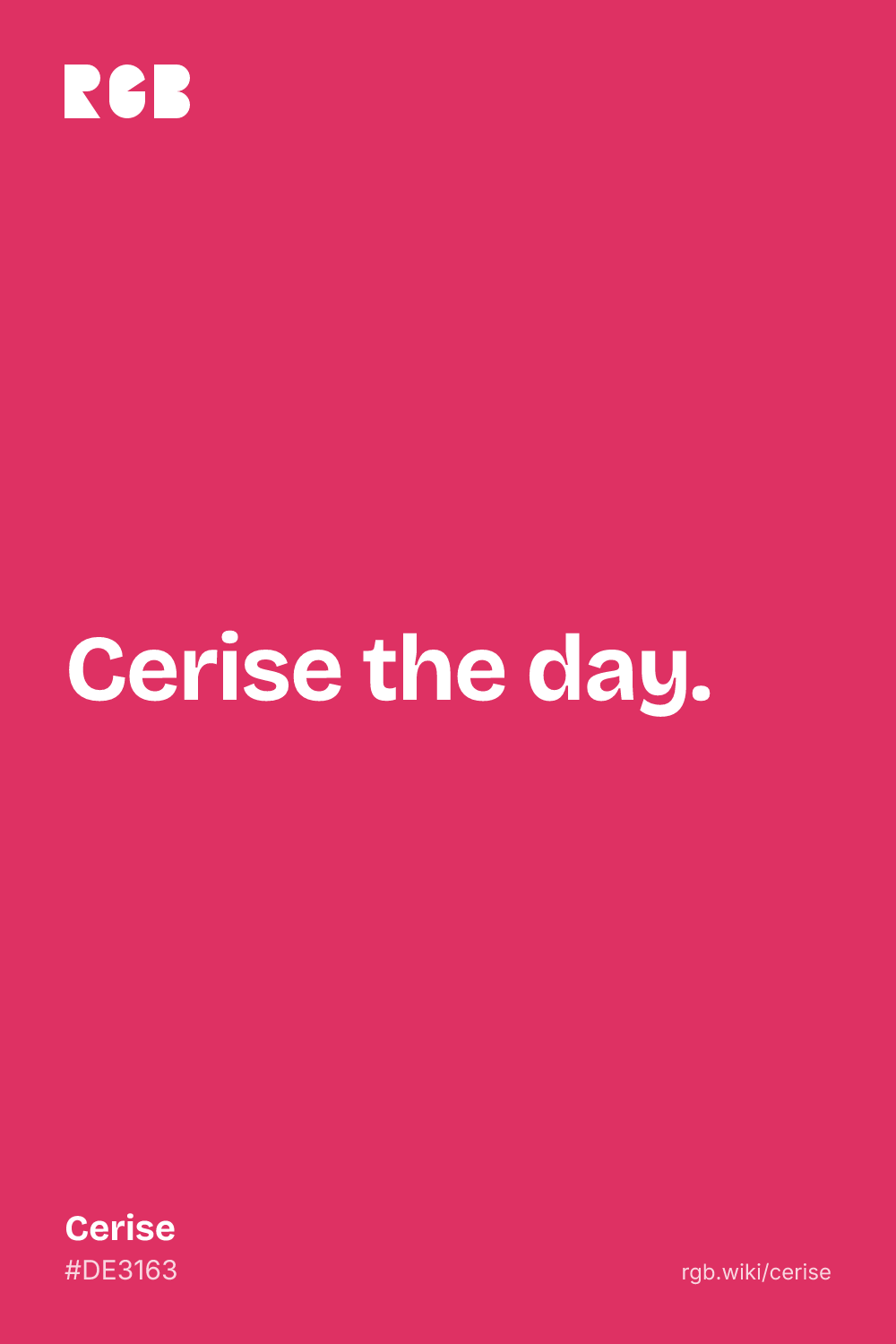
A vivid pinkish red whose name is French for cherry.
Overview
Cerise is a vivid red with a strong pink side, lighter and softer than crimson. Its usual code, #DE3163, is strong red with a little green and a fair amount of blue. The green softens it; the blue pulls it toward pink.
Cerise is French for cherry, and English has borrowed the word twice. In the 1300s it arrived as cherise, the final s was mistaken for a plural, and the fruit became a cherry. In 1838 the word came back unchanged, as the name of a color.
In French, cerise as a color still means a bright cherry red. English cerise has drifted toward pink. Merriam-Webster calls it a moderate red, and in an online survey people’s average cerise, #DE0C62, came out pinker and more intense, almost the same as the codes for raspberry and ruby.
Use cerise as an accent for buttons, headlines and packaging. Both white and black text sit near the usual contrast line on it, so keep text on cerise large. It pairs well with navy, charcoal, blush, mint and gold.
HEX
#DE3163
RGB
rgb(222, 49, 99)
HSL
hsl(343, 72%, 53%)
HSV
343°, 78%, 87%
CMYK
0, 78, 55, 13
OKLCH
oklch(59.8% 0.208 9.9)
Every code converts from the HEX value #DE3163. #DE3163 is Wikipedia’s long-standing screen version of the cerise sample in Maerz and Paul’s A Dictionary of Color (1930, plate 4, sample J6), as shown on Wikipedia until June 2026. No web standard defines it, and the ISCC-NBS dictionary files the same sample as moderate red, #AB4E52, a duller color. See the range below. CMYK is a screen-based estimate; print results vary.
Cerise on the color map
LighterDarker
People’s average cerise sits just below the reference and a little to the left, toward pink, and is more vivid. The stamp collectors’ cerise sits level with it, also a little toward pink. The dictionary cerise lies to the right and lower: redder and much grayer, which this map of hue and lightness doesn’t show. Horticultural cherry lies to the right and lower still, a deeper and purer red, closer to what cerise means in French. The outline is an approximate range, not a measured one.
Shades and tints
Tintswith white
Shadeswith black
Toneswith gray
Cerise sits in the middle. Tints add white, shades add black and tones add gray, in 10% steps out from it. Tap any swatch to copy its code.
Light and dark cerise
#F5C1D0
Pale ceriseMixed 70% with white. A soft pink for backgrounds.
#EB83A1
Light ceriseMixed 40% with white. A clear candy pink.
#DE3163
CeriseThe reference color.
#E30B5C
RaspberryMore intense, with almost no green. It has a page of its own. See raspberry
#9B2245
Dark ceriseMixed 30% with black. A rich berry red that carries white text.
Colors that go with cerise
Pairings that work in rooms, outfits and interfaces.
Cerise and navy
Bright against deep. Crisp for sport, fashion and campaigns.
Cerise and blush
Tonal pinks. Soft, sweet and easy to read.
Cerise and mint
Near-opposites, both light and fresh. Good for spring.
Cerise and charcoal
Modern and sharp. Cerise is the only color in the room.
Cherry orchard
The name’s origin: ripe fruit, dark cherries and leaves.
Cerise and gold
Warm and festive. Strong for party invitations and packaging.
Color-wheel palettes
Pick a palette to see where its colors sit on the color wheel. The caret marks cerise. Tap a band to copy its code.
Lined up by hue around cerise. Hover a color to see how similar it is.The bar under each name shows how similar it is. Similarity comes from the distance between the two colors in OKLab, a model of how we see color.
Cerise vs rose
Cerise#DE3163 · hue 343°
Softer, with a little green in it
Leans red: the name means cherry
Screen version of a 1930 color sample
Rose#FF007F · hue 330°
Pure and electric, with no green
Leans pink, halfway to magenta
The rose of the screen’s color wheel
Meaning
Cherries
Borrowed twice
Bandy balls
Cerise is bright, cheerful and a little sweet, a red on its way to pink. Its meanings are mostly about its name: the French word for cherry, which English has borrowed twice. On the ice, it is a traditional color for the ball in bandy. Research on color and emotion tests basic words such as red and pink, not cerise itself.
One word, borrowed twice
Dictionary record
English cherry and cerise come from the same word. Middle English took the Anglo-French cherise in the 1300s, heard the final s as a plural, and made a new singular, chery. The French word came back in 1838, this time as the name of a color.1, 2
Redder in French than in English
Dictionary record
French dictionaries define the color cerise as a bright red, like the fruit. Merriam-Webster defines English cerise as a moderate red, and when thousands of people named colors online, their average cerise was a vivid pinkish red. The same word names a redder color in French.3, 2, 4
The color of a bandy ball
Older rule
Bandy, a cousin of ice hockey played with a small ball, began with red balls, which later became orange or cerise. The sport’s federation listed those colors in its 2011 equipment rules. Its current rule book asks only for an easily visible color.5, 6
Sources (6)
Merriam-Webster, “cherry”, etymology and first known use.
Merriam-Webster, “cerise”, definition, etymology and first known use.
Larousse, “cerise”, adjective and noun: “Rouge vif.”
Munroe, R. (2010). “Color Survey Results”, xkcd blog, with the survey’s color list (CC0).
Wikipedia, “Bandy ball”, citing the Federation of International Bandy’s equipment rules of 27 September 2011.
English borrows the Anglo-French cherise, takes it for a plural and makes a new word for one fruit: cherry.2
1838
First known use of cerise as a color word in English.3
1930
Maerz and Paul’s A Dictionary of Color prints a cerise sample, the source of today’s code.4
1955
The ISCC-NBS dictionary of color names files Maerz and Paul’s cerise as moderate red, and the cerise of postage-stamp collectors as vivid to deep purplish red.5
2010
In the xkcd color survey, people’s average cerise is #DE0C62, pinker and more vivid than the code.6
2011
The Federation of International Bandy’s equipment rules allow red, orange or cerise balls. Its later rule books ask only for an easily visible color.7, 8
Sources (8)
Trésor de la langue française informatisé, “cerise”, etymology and history.
Merriam-Webster, “cherry”, etymology and first known use.
Merriam-Webster, “cerise”, definition, etymology and first known use.
Wikipedia, “Cerise (color)” (revision of April 2026), citing Maerz and Paul’s A Dictionary of Color (1930), p. 31, plate 4, sample J6.
A vivid pinkish red. Its usual code is #DE3163 (RGB 222, 49, 99). It sits between red and pink: lighter and softer than crimson, redder than rose.
Is cerise pink or red?
Both, depending on who you ask. In French, cerise means a bright cherry red. In English it has drifted pinker: dictionaries call it a moderate red, and people in an online survey picked a vivid pinkish red.
What does cerise mean?
It is French for cherry. English borrowed the same word in the 1300s, when it turned into cherry, and again in 1838 as the name of a color.
What is the difference between cerise and raspberry?
Raspberry (#E30B5C) is more intense, with almost no green. Cerise (#DE3163) has a little more green in it, which makes it softer and slightly lighter.
What is the difference between cerise and cherry red?
Cherry red is a deeper, purer red, closer to the fruit. Cerise has more blue in it and reads pinker, even though the two names mean the same thing.
What colors go with cerise?
Navy and charcoal for contrast, blush and mint for something soft, and gold for a festive look. Keep text on cerise large: neither white nor black has much contrast to spare.
How do you pronounce cerise?
In English, suh-REES or suh-REEZ. The French say it close to suh-REEZ.