Dark orchid

The one orchid whose numbers came through every revision of the old X color list untouched.

Overview

Dark orchid is a strong, medium-deep purple that leans slightly toward blue: richer than lilac, softer than the electric violets. Its code is #9932CC: red at 60%, green at 20% and blue at 80%. That bit of green grays it a little, so it reads as a velvety purple rather than a neon one, at a hue of 280°.

Its numbers are among the oldest on the web. The X Window System’s first color list, shipped in 1986, already had dark orchid as 153 50 204, and every X11 release since has shipped it unchanged. Its partners did not: the 1986 orchid, 219 112 219, became today’s #DA70D6, and the 1986 medium orchid, 147 112 219, now goes by medium purple. John Thomas’s crayon-tuned list of 1989 made dark orchid a deep plum, 106 37 102, but that list survives only as an alternative file in the X11 source tree. The same three numbers, 153, 50 and 204, reshuffled, also gave the 1986 list its sky blue, yellow green, medium aquamarine and violet red; no note says why.

The name borrows from the orchid, the flower family behind the lighter CSS orchid, but “dark” here also means bluer: dark orchid sits 20° away from orchid’s hue, closer to the violets. Its nearest look-alikes are dark violet, #9400D3, the same hue at full strength, and blue-violet, #8A2BE2, a little bluer. Amethyst, #9966CC, has exactly the same red and blue and only more green, which makes it paler and grayer.

White text works on dark orchid: about 5.7:1, enough for body text, while black reaches about 3.7:1. It pairs well with gold, leaf greens, soft lilac and near-black backgrounds.
HEX#9932CC
RGBrgb(153, 50, 204)
HSLhsl(280, 61%, 50%)
HSV280°, 75%, 80%
CMYK25, 75, 0, 20
OKLCHoklch(54.1% 0.227 311.5)
Every code converts from the HEX value #9932CC. #9932CC is the CSS keyword darkorchid, rgb(153, 50, 204), defined in the CSS Color Module Level 4 and first listed among the web’s color names in SVG 1.0 (2001). It comes from the X Window System’s color list, which has given dark orchid these numbers since its first version in X10 Release 3, 1986 (X10R3 archive; old-rgb.txt), through the merged X11 Release 4 list of December 1989 (X11R4 archive). No color dictionary defines this exact value. CMYK is a screen-based estimate; print results vary.
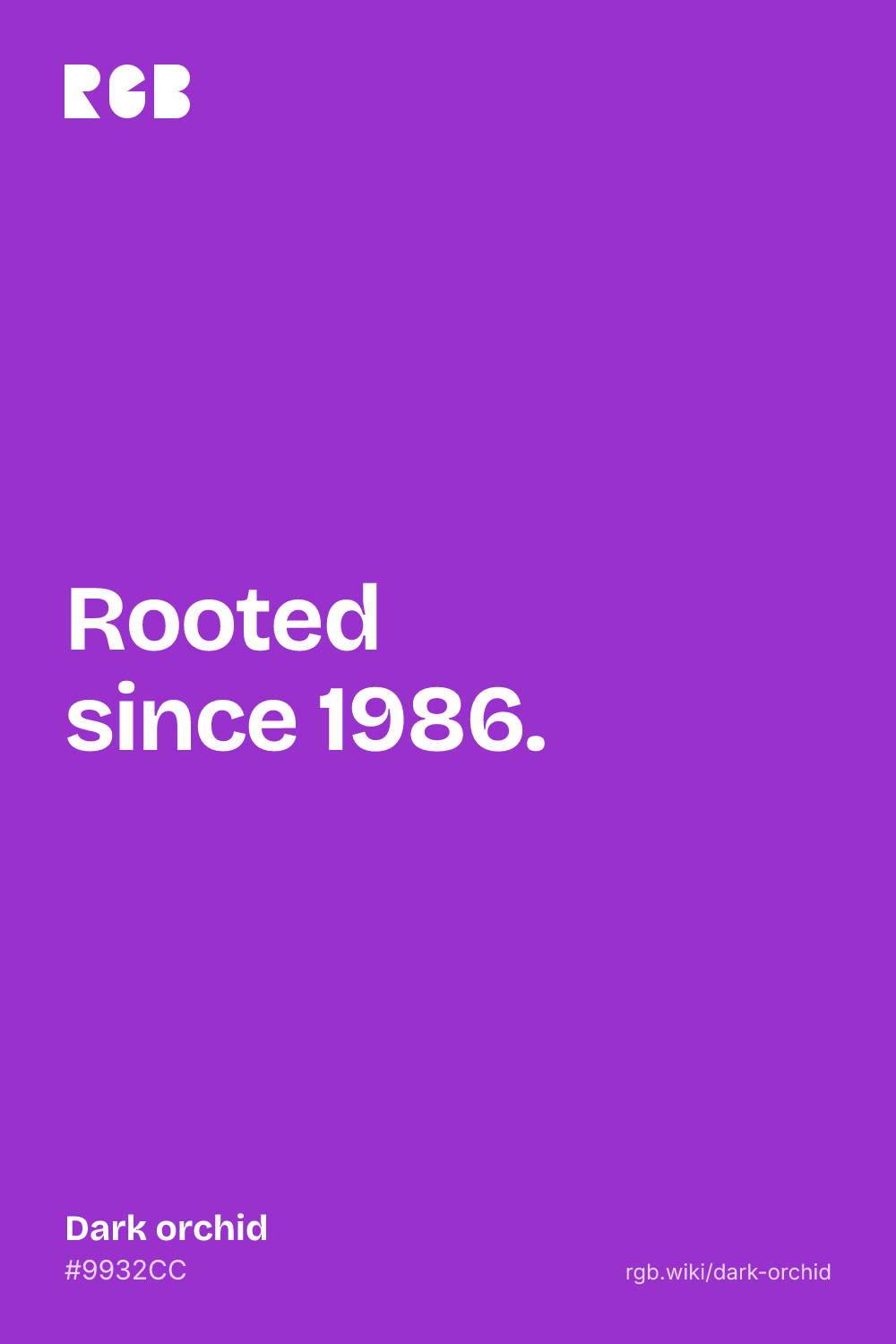
Dark orchid color card, hex #9932CC: “Rooted since 1986”

Dark orchid on the color map

The xkcd color survey has no entry for dark orchid. The center of the ISCC-NBS vivid purple group sits close in hue but lighter and grayer, and John Thomas’s 1989 dark orchid is far deeper and redder, below the outline. The outline is an approximate range, not a measured one.

Shades and tints

Tints with white

Shades with black

Tones with gray

Dark orchid sits in the middle. Tints add white, shades add black and tones add gray, in 10% steps out from it. Tap any swatch to copy its code.

Light and dark dark orchid

#C284E0
Dark orchid tintMixed 40% with white: a soft orchid lilac.
#BF3EFF
DarkOrchid1The brightest of the four numbered steps Paul Raveling added in 1989, 191 62 255; X11 Release 4 kept all four.
#9932CC
Dark orchidThe reference color. DarkOrchid3, 154 50 205, is a hair away from it.
#68228B
DarkOrchid4The darkest numbered step, 104 34 139: a deep grape purple.
#5C1E7A
Dark orchid shadeMixed 40% with black: a dusky aubergine purple.
#6A2566
Dark orchid (Thomas, 1989)John Thomas’s crayon-tuned value, 106 37 102: a deep plum close to byzantium, #702963. See byzantium

Colors that go with dark orchid

Pairings that work in rooms, outfits and interfaces.

Dark orchid and gold

Purple and gold, near-opposites. Rich without being loud.

Flower and leaf

Dark orchid with a soft leaf green. Botanical and calm.

Dark orchid on midnight

A dark theme. Use the lighter tint for links and buttons.

The 1986 shuffle

153, 50 and 204 in four orders: dark orchid with the 1986 list’s sky blue, yellow green and medium aquamarine.

The orchids

Dark orchid with its CSS siblings medium orchid and orchid, and CSS plum.

Dark orchid as background

For a banner or poster: white text, gold accents.

Color-wheel palettes

Pick a palette to see where its colors sit on the color wheel. The caret marks dark orchid. Tap a band to copy its code.

Similar colors

Violet56%Blue-violet76%Royal purple52%Grape51%Dark violet78%Dark orchidMedium orchid54%

Lined up by hue around dark orchid. Hover a color to see how similar it is.The bar under each name shows how similar it is. Similarity comes from the distance between the two colors in OKLab, a model of how we see color.

Dark orchid vs dark violet

Dark orchid#9932CC · hue 280°
  • Softened by a little green
  • In the X list since 1986, never changed
  • Comfortable for large areas
Dark violet#9400D3 · hue 282°
  • No green at all: fully saturated
  • Added by Paul Raveling in 1989
  • Plain violet in John Thomas’s 1989 list

Meaning

  • In the 1986 list
  • Named after orchids
  • Shuffled numbers
  • Vivid purple

No study has tested what dark orchid means to people, and the xkcd color survey has no entry for it. Color research tests broad words such as purple, so the claims below are about the name, the old computer color lists and how the value compares with dictionaries.

Unchanged since 1986

Historical record

The X Window System’s first color list, shipped with X10 Release 3 in 1986, gives dark orchid as 153 50 204, and X11 Releases 1 and 3 keep it. Paul Raveling’s 1989 revision and the merged X11 Release 4 list of December 1989 keep it too, while orchid, medium orchid and plum all got new numbers. The X Consortium’s 1994 list still has 153 50 204, and so does CSS.1, 2

The crayon version

Historical record

In 1989 John Thomas at Tektronix retuned the old list to a box of 72 crayons and made dark orchid 106 37 102, a deep reddish plum, with orchid 218 107 212 and medium orchid 172 77 166 between. His notes don’t say which crayon he matched. Raveling’s values, not Thomas’s, went into X11 Release 4’s main list.1, 2

Three numbers, five colors

List data

The 1986 list reuses the numbers 153, 50 and 204 in five of their six possible orders: dark orchid (153 50 204), violet red (204 50 153), sky blue (50 153 204), medium aquamarine (50 204 153) and yellow green (153 204 50). The list has no notes, so nothing says whether this was deliberate.1

Darker and bluer than orchid

Dictionary

Merriam-Webster defines orchid as a color as “a light purple”. Dark orchid is darker, but it is also bluer: 280° against orchid’s 302°. In the ISCC-NBS system Wikipedia files it as vivid purple, a group whose center, #9A4EAE, is lighter and grayer.3, 4

Sources (4)
  1. The X Window System’s color lists: the first list, shipped with X10 Release 3 in 1986 (X10R3 archive) and kept in X11 Release 1 (1987, X11R1) and Release 3 (1988, X11R3), also hosted by Aubrey Jaffer at MIT CSAIL as old-rgb.txt (dark orchid 153 50 204, orchid 219 112 219, medium orchid 147 112 219); John Thomas’s thomas.txt (dark orchid 106 37 102); Paul Raveling’s raveling.txt; the merged mit/rgb/rgb.txt of 7 December 1989 in the X11R4 archive (DarkOrchid1–4); and the X Consortium’s rgb.txt, revision 10.41, 20 February 1994.
  2. Aubrey Jaffer, “Color-Name Dictionaries”, MIT CSAIL, quoting the X11 README and the notes of John Thomas (Tektronix) and Paul Raveling (ISI).
  3. Merriam-Webster, “orchid”: sense 2, “a light purple”; first known use 1845, for the plant.
  4. Kelly, K. L. & Judd, D. B. (1955). The ISCC-NBS Method of Designating Colors and a Dictionary of Color Names, NBS Circular 553; centroid colors in John Foster’s conversion, nbs-iscc.txt (vivid purple #9A4EAE, deep reddish purple #702963); and Wikipedia, “Orchid (color)”, which gives dark orchid’s ISCC-NBS name as vivid purple.

History

Orchid has been a plant name in English since 1845. Dark orchid as a computer color is older than most web colors: its numbers were set in the very first X Window System color list and never moved.

  1. 1845

    First known use of “orchid” in English, for the plant; Merriam-Webster’s second sense is the color, “a light purple”.1

  2. 1955

    Kelly and Judd’s ISCC-NBS dictionary of color names sets out groups such as vivid purple, the group Wikipedia later gives for dark orchid; John Foster’s conversion puts its center at #9A4EAE.2

  3. 1986

    X10 Release 3 ships the first X color list with dark orchid as 153 50 204, beside orchid 219 112 219 and medium orchid 147 112 219. X11 Release 1 (1987) and Release 3 (1988) keep all three.3

  4. 1989

    John Thomas at Tektronix retunes the list to a box of 72 crayons and sets dark orchid to 106 37 102. Paul Raveling at USC’s Information Sciences Institute keeps 153 50 204 and adds four numbered steps, DarkOrchid1 to DarkOrchid4.3, 4

  5. Dec 1989

    X11 Release 4 ships the merged list, dated 7 December, with dark orchid at 153 50 204 and its four steps; orchid becomes 218 112 214, and 147 112 219 now belongs to medium purple.3

  6. 2001

    SVG 1.0 lists “darkorchid”, rgb(153, 50, 204), among the web’s color keywords.5

  7. 2011

    CSS Color Module Level 3 becomes a W3C Recommendation on June 7 and makes darkorchid, #9932cc, an official CSS keyword. Level 4 keeps it.6, 7

Sources (7)
  1. Merriam-Webster, “orchid”: sense 2, “a light purple”; first known use 1845, for the plant.
  2. Kelly, K. L. & Judd, D. B. (1955). The ISCC-NBS Method of Designating Colors and a Dictionary of Color Names, NBS Circular 553; centroid colors in John Foster’s conversion, nbs-iscc.txt (vivid purple #9A4EAE, deep reddish purple #702963); and Wikipedia, “Orchid (color)”, which gives dark orchid’s ISCC-NBS name as vivid purple.
  3. The X Window System’s color lists: the first list, shipped with X10 Release 3 in 1986 (X10R3 archive) and kept in X11 Release 1 (1987, X11R1) and Release 3 (1988, X11R3), also hosted by Aubrey Jaffer at MIT CSAIL as old-rgb.txt (dark orchid 153 50 204, orchid 219 112 219, medium orchid 147 112 219); John Thomas’s thomas.txt (dark orchid 106 37 102); Paul Raveling’s raveling.txt; the merged mit/rgb/rgb.txt of 7 December 1989 in the X11R4 archive (DarkOrchid1–4); and the X Consortium’s rgb.txt, revision 10.41, 20 February 1994.
  4. Aubrey Jaffer, “Color-Name Dictionaries”, MIT CSAIL, quoting the X11 README and the notes of John Thomas (Tektronix) and Paul Raveling (ISI).
  5. W3C (2001). Scalable Vector Graphics (SVG) 1.0, recognized color keyword names: darkorchid, rgb(153, 50, 204).
  6. W3C (2011). CSS Color Module Level 3, extended color keywords, W3C Recommendation, June 7, 2011.
  7. W3C, CSS Color Module Level 4, named colors: darkorchid, #9932cc, 153 50 204.

Questions

What color is dark orchid?

A strong, medium-deep purple that leans slightly blue. Its code is #9932CC (RGB 153, 50, 204), the CSS keyword darkorchid.

Is dark orchid a darker version of orchid?

Not exactly. It is darker, but also bluer: its hue is 280°, while CSS orchid (#DA70D6) sits at 302°, close to magenta. Orchid mixed with black would give a dusty plum, not dark orchid.

How old is the dark orchid color code?

Its numbers, 153 50 204, are in the X Window System’s first color list, shipped in 1986, and no later X11 list changed them. The web adopted the name in SVG 1.0 in 2001 and CSS made it official in 2011.

What is the difference between dark orchid and dark violet?

They share almost the same hue. Dark violet (#9400D3) has no green at all and is fully saturated; dark orchid (#9932CC) mixes in a little green, which makes it softer and slightly grayer.

What is the difference between dark orchid and amethyst?

Amethyst (#9966CC) has exactly the same red and blue as dark orchid, but twice as much green, so it is lighter and grayer.

Is dark orchid a CSS color?

Yes. darkorchid, #9932CC and rgb(153, 50, 204) all give exactly the same color.

What text color works on dark orchid?

White. White on dark orchid has a contrast of about 5.7:1, enough for body text. Black reaches only about 3.7:1.

What colors go with dark orchid?

Gold or warm yellow for contrast, leaf greens for a botanical look, soft lilac for a tonal palette and near-black for a dark theme.