Berry

A deep pinkish red, the color people picture when a fruit name says only “berry”.

Overview

Berry is a deep red with a strong pink, almost purple lean. Its code, #990F4B, is mostly red with a third as much blue and very little green. It is darker than raspberry and redder than Tyrian purple.

The code comes from a crowd, not a color book. In the 2010 xkcd color survey, people named over five million colors online, and #990F4B is the average of the colors they called berry. No color dictionary has a plain berry. The 1930 A Dictionary of Color has a crushed berry, which the 1955 ISCC-NBS dictionary files as a soft grayish red.

The same survey put mulberry, cranberry and raspberry within a few degrees of berry on the color wheel. Real berries range from red to almost black to blue, but most get their color from one family of plant pigments, the anthocyanins, and their juice stains in this same deep pink-red.

Berry is dark enough for white text at any size (contrast about 8.3:1), so it works for buttons, headings and backgrounds. It pairs well with leaf green, blush pink, cream and slate.

HEX#990F4B
RGBrgb(153, 15, 75)
HSLhsl(334, 82%, 33%)
HSV334°, 90%, 60%
CMYK0, 90, 51, 40
OKLCHoklch(44.6% 0.171 3.0)
Every code converts from the HEX value #990F4B. No color standard defines berry. #990F4B is the average of the colors people called berry in the xkcd color survey (2010, CC0), and it is the code most color lists use. CMYK is a screen-based estimate; print results vary.
Berry color card, hex #990F4B: “Berry nice to meet you”

Berry on the color map

The survey’s mulberry, cranberry and raspberry crowd around the reference, all at nearly the same hue: mulberry a touch darker and more purple, cranberry a touch redder, raspberry lighter. The Fabergé agate berry sits below and to the right, darker and much redder. The dictionary’s crushed berry sits far to the right, toward plain red, and higher; it is also much grayer, which this map of hue and lightness doesn’t show. The outline is an approximate range, not a measured one.

Shades and tints

Tints with white

Shades with black

Tones with gray

Berry sits in the middle. Tints add white, shades add black and tones add gray, in 10% steps out from it. Tap any swatch to copy its code.

Light and dark berry

#F0DBE4
Pale berryMixed 85% with white. A faint pink for backgrounds.
#C26F93
Light berryMixed 40% with white. A dusty orchid pink, like berry yogurt.
#990F4B
BerryThe reference color.
#6B0A34
Dark berryMixed 30% with black. Close to a ripe berry’s skin.
#4C0826
Deep berryMixed 50% with black. Near black, like a berry stain on cloth.

Colors that go with berry

Pairings that work in rooms, outfits and interfaces.

Berry and leaf

Fruit on the bush. The green makes the berry look riper.

Berry and blush

Tonal pinks, from pale to deep. Soft but readable.

Berry and cream

Jam on toast. Warm, homely and good for food brands.

Berry and slate

Calm and grown-up. Berry as the one bright note on cool gray.

Berry and gold

Rich and festive. Suits invitations, labels and winter sales.

Berry and midnight

Dark and moody, for night themes. Use the light berry for links.

Color-wheel palettes

Pick a palette to see where its colors sit on the color wheel. The caret marks berry. Tap a band to copy its code.

Similar colors

Boysenberry72%BerryClaret68%Cochineal77%Carmine67%Auburn65%Cranberry64%

Lined up by hue around berry. Hover a color to see how similar it is.The bar under each name shows how similar it is. Similarity comes from the distance between the two colors in OKLab, a model of how we see color.

Berry vs mulberry

Berry#990F4B · hue 334°
  • A deep pinkish red
  • The average of what people call berry
  • White text reads well on it
Mulberry#C54B8C · hue 328°
  • Lighter, softer and more purple
  • The usual web code, with no standard behind it
  • People’s survey mulberry, #920A4E, is berry’s near twin

Meaning

  • Berry juice
  • Natural pH test
  • Seen by birds
  • Botanical berries

Berry suggests ripe fruit, jam and juice stains, sweet but deeper than candy pink. Behind the color sits real plant science: the pigment that colors most berries, the way fruit stands out to the animals that eat it, and a botanical idea of a berry that includes grapes and tomatoes. Color and emotion research tests basic words such as red and pink, not berry, so the claims here are about the fruit.

One pigment family, red to blue

Well established

Most berry colors come from anthocyanins, water-soluble plant pigments behind the reds, purples and blues of fruit and vegetables. Their color depends on acidity: in acid they look red, and they turn blue as the pH rises. That is why berry juice can shift toward blue when something alkaline, such as baking soda, gets into it.1
A blueberry’s blue is in its wax

Lab study

Blueberries contain no blue pigment worth the name. Their skin is dark, and the blue comes from a thin coat of wax whose tiny, randomly arranged crystals scatter blue and ultraviolet light. Rub the bloom off and the berry looks almost black. The same holds for plums and juniper cones.2

Colored to stand out to the animals that eat them

One field study

Ripe fruit contrasts with leaves, which helps seed-spreading animals find it. A study comparing two forests found that fruits in Uganda, where birds and day-active primates see color well, contrast more in red against green, while fruits in Madagascar, eaten mostly by red-green color-blind lemurs, contrast more in blue against yellow.3

To a botanist, a grape is a berry and a strawberry is not

Dictionary record

In botany, a berry is a fleshy fruit grown from a single ovary. Grapes, blueberries, cranberries, tomatoes and bananas qualify. Raspberries and blackberries are aggregate fruits made of many small fruitlets, and the strawberry’s flesh grows from the base of the flower, not the ovary.4, 5

Sources (5)
  1. Khoo, H. E., Azlan, A., Tang, S. T. & Lim, S. M. (2017). Anthocyanidins and anthocyanins: colored pigments as food, pharmaceutical ingredients, and the potential health benefits. Food & Nutrition Research, 61(1), 1361779. doi:10.1080/16546628.2017.1361779
  2. Middleton, R., Tunstad, S. A., Knapp, A., Winters, S., McCallum, S. & Whitney, H. (2024). Self-assembled, disordered structural color from fruit wax bloom. Science Advances, 10(6), eadk4219. doi:10.1126/sciadv.adk4219
  3. Nevo, O., Valenta, K., Razafimandimby, D., Melin, A. D., Ayasse, M. & Chapman, C. A. (2018). Frugivores and the evolution of fruit colour. Biology Letters, 14(9), 20180377. doi:10.1098/rsbl.2018.0377
  4. Merriam-Webster, “berry”, senses 1a and 1b.
  5. Wikipedia, “Berry (botany)”, sections on true berries and aggregate fruits.

History

Berry is one of the oldest fruit words in English, but it never made it into the color books as a plain name. Its code came from an online survey in 2010.

  1. Before 1100

    Old English berie, berry or grape, is in use. It is one of only two fruit names in modern English, with apple, that come from native Germanic words.12

  2. About 1885–1915

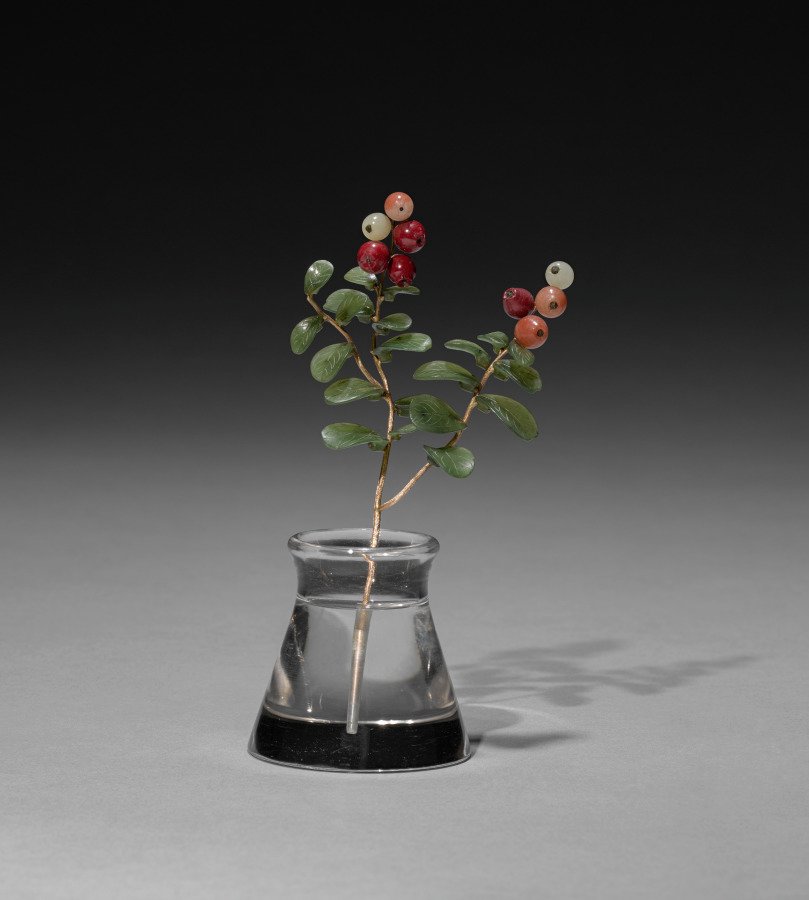
    The Fabergé firm in St. Petersburg carves a sprig of lingonberry in jade, with berries of milky chalcedony and deep red agate to show the fruit ripening.3

  3. 1930

    Maerz and Paul’s A Dictionary of Color names many berry colors, from raspberry to gooseberry, and a crushed berry, but no plain berry. The 1955 ISCC-NBS dictionary files its crushed berry as grayish red.4

  4. 2010

    The xkcd color survey publishes about 950 color names with average codes. People’s berry is #990F4B, today’s code, and their mulberry, cranberry and raspberry land close by.5

  5. 2018

    A study of two forests in Uganda and Madagascar finds that fruit colors stand out against leaves in the way local seed-spreading animals see best.6

  6. 2024

    Researchers at the University of Bristol show that the blue of blueberries comes from the structure of their wax bloom, not from a blue pigment.7

Sources (7)
  1. Merriam-Webster, “berry”, etymology and first known use.
  2. Wikipedia, “Berry”, section Etymology.
  3. Cleveland Museum of Art, “Flower Study of a Lowbush Cranberry or Lingonberry, c. 1885–1915”, House of Fabergé (1966.446).
  4. Jaffer, A. “(M) Dictionary of Color”, the ISCC-NBS placements of Maerz and Paul’s color names (1955 dictionary), MIT CSAIL.
  5. Munroe, R. (2010). “Color Survey Results”, xkcd blog, with the survey’s color list (CC0).
  6. Nevo, O. et al. (2018). Frugivores and the evolution of fruit colour. Biology Letters, 14(9), 20180377. doi:10.1098/rsbl.2018.0377
  7. Middleton, R. et al. (2024). Self-assembled, disordered structural color from fruit wax bloom. Science Advances, 10(6), eadk4219. doi:10.1126/sciadv.adk4219

Berry in use

A small carved sprig with green jade leaves and round berries in deep red, coral and milky white, standing in a clear crystal vase
#771924#A04F3A#A59C81#566239
Decorative artFabergé lingonberry flower study (about 1885–1915)

A sprig of lowbush cranberry, or lingonberry, small enough to hold in one hand: jade leaves, a gold stem and a rock-crystal vase carved to look like water. The ripe berries are red agate and read about #771924 in the photo, darker and redder than the web code. Unripe ones are milky chalcedony. Lingonberries are true berries in the botanical sense.

#771924#A04F3A#A59C81#566239
Source: Cleveland Museum of Art

Palettes are sampled in-house.

Questions

What color is berry?

A deep pinkish red with a purple lean. Its usual code is #990F4B (RGB 153, 15, 75).

Where does the berry hex code come from?

From the xkcd color survey of 2010. #990F4B is the average of the colors people named berry. No color standard or dictionary defines a plain berry.

What is the difference between berry and raspberry?

Raspberry’s usual code, #E30B5C, is much lighter and brighter. Berry, #990F4B, is darker and a little more purple. In the survey, people’s raspberry (#B00149) was only a little lighter than their berry.

Is berry pink, red or purple?

Somewhere between all three. Its hue sits between red and magenta, and its darkness makes it read as a deep red. RGB.wiki files it with the pinks.

Why are so many berries red, purple or blue?

Most get their color from anthocyanins, plant pigments that look red in acid and turn blue as the pH rises. Blueberries are an exception: their blue comes from a wax coating that scatters light.

What colors go with berry?

Leaf green for contrast, blush and cream for softness, slate gray or deep navy for a calm, modern look, and gold for something festive.