Wisteria

A soft light purple named after a climbing vine, and the vine after a doctor.

Overview

Wisteria is a soft, light purple, named after the climbing vine whose flowers hang in long clusters every spring. Its usual code is #C9A0DC: blue highest, red close behind and green lower, which gives a pale purple a little lighter and pinker than lavender. No color standard defines it. The code traces to a crayon color of 1993.

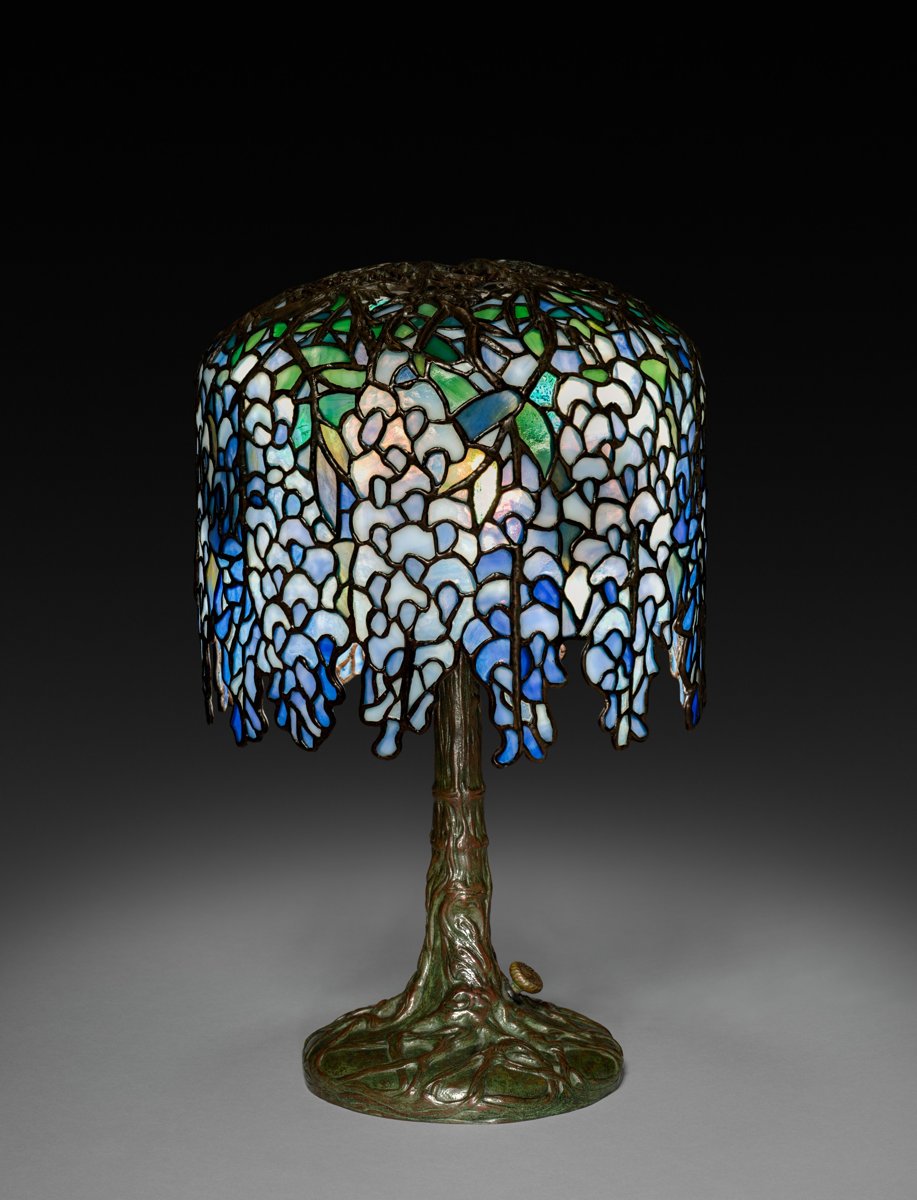
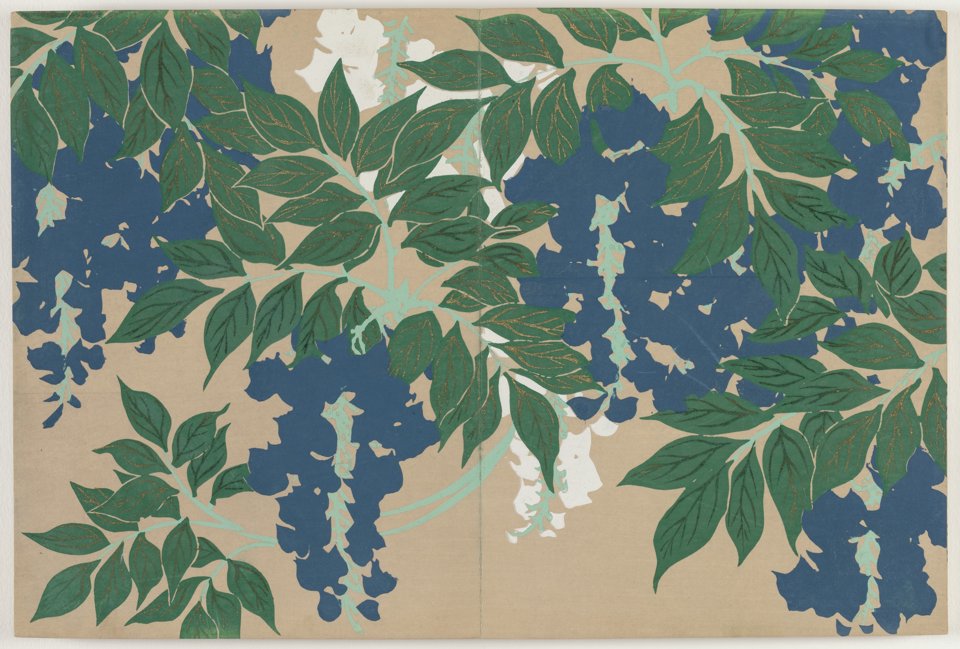
Real wisteria is bluer. A U.S. Forest Service review describes the flowers of Chinese and Japanese wisteria as blue-violet, and artists have often shown them as blues: the leaded glass of a wisteria lamp designed around 1902 and a 1909 Japanese print both do. A 1930 color dictionary leans the same way. Its wistaria is a grayish light violet, and it lists a wistaria blue as well.

The name honors a doctor. In 1818 the botanist Thomas Nuttall named the plant in memory of Caspar Wistar, a Philadelphia anatomist, and spelled it Wisteria, a choice he later put down to its sound. The spelling wistaria lives on as a variant. In Japan, where wisteria is called fuji, it is one of the five most common family crests.

On screens, #C9A0DC is a pastel. Use dark text on it; white text does not read. It is gentle with sage green, cream and gray, and a deeper wisteria such as #796084 works for buttons and headings.

HEX#C9A0DC
RGBrgb(201, 160, 220)
HSLhsl(281, 46%, 75%)
HSV281°, 27%, 86%
CMYK9, 27, 0, 14
OKLCHoklch(76.3% 0.095 314.9)
Every code converts from the HEX value #C9A0DC. No color standard defines wisteria. #C9A0DC is the code most color lists use, and Wikipedia traces it to a crayon color of 1993. Maerz and Paul’s A Dictionary of Color (1930) spells it wistaria; the ISCC-NBS dictionary (1955) files its wistaria as light violet, centered on #8C82B6, and its wistaria blue as light purplish blue, #8791BF. CMYK is a screen-based estimate; print results vary.
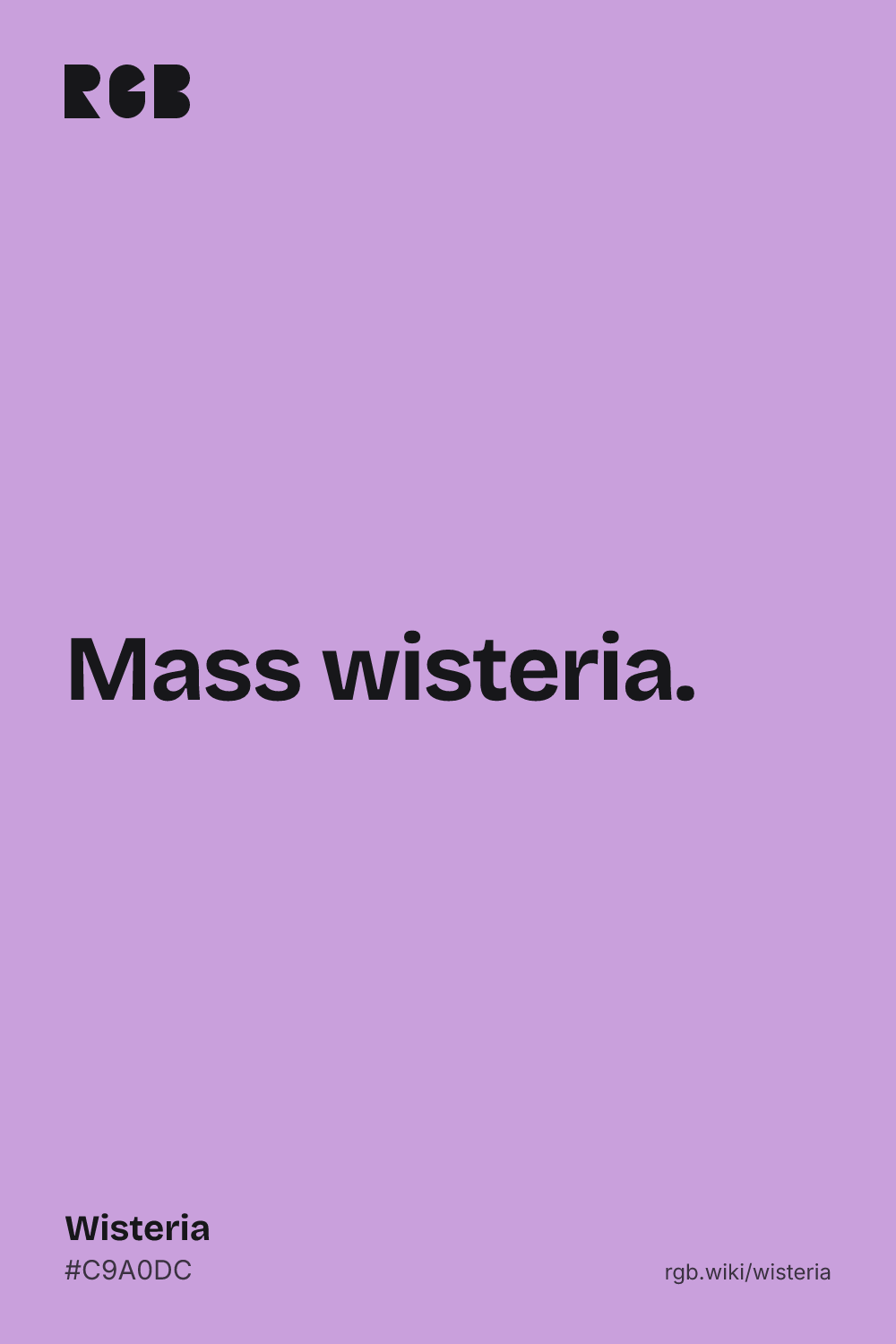
Wisteria color card, hex #C9A0DC: “Mass wisteria”

Wisteria on the color map

Every other value sits below the reference and most sit to its left: darker and bluer. People’s average wisteria lies just below the outline, almost straight down. The dictionary’s wistaria and wistaria blue fall outside it to the lower left, and the lamp glass sits far to the left, a true blue. The outline is an approximate range, not a measured one.

Shades and tints

Tints with white

Shades with black

Tones with gray

Wisteria sits in the middle. Tints add white, shades add black and tones add gray, in 10% steps out from it. Tap any swatch to copy its code.

Light and dark wisteria

#E9D9F1
Pale wisteriaMixed 60% with white. A barely-there lilac for backgrounds.
#C9A0DC
WisteriaThe reference color.
#9778A5
Dusky wisteriaMixed 25% with black. A muted, grayish purple.
#796084
Deep wisteriaMixed 40% with black. Dark enough for white text, for buttons and headings.
#8C82B6
Dictionary wistariaThe ISCC-NBS light violet, where the 1930 dictionary’s wistaria sits. Grayer and bluer.
#8791BF
Wistaria blueThe ISCC-NBS light purplish blue, for the 1930 dictionary’s wistaria blue.

Colors that go with wisteria

Pairings that work in rooms, outfits and interfaces.

Wisteria and sage

Soft purple with gray-green. Calm and natural.

Wisteria arbor

Hanging blossoms and fresh leaves. Bright and spring-like.

Leaded glass

From the wisteria lamp: blue glass, green leaves and bronze. Rich and handmade.

Wisteria and cream

Light and romantic. Popular for spring weddings and stationery.

Wisteria and gray

A quiet, modern pairing for interfaces and interiors.

Wisteria dusk

A dark theme with wisteria as the accent.

Color-wheel palettes

Pick a palette to see where its colors sit on the color wheel. The caret marks wisteria. Tap a band to copy its code.

Similar colors

Lavender53%Mauve66%WisteriaPastel purple66%Thistle56%Lilac84%Carnation pink53%

Lined up by hue around wisteria. Hover a color to see how similar it is.The bar under each name shows how similar it is. Similarity comes from the distance between the two colors in OKLab, a model of how we see color.

Wisteria vs lilac

Wisteria#C9A0DC · hue 281°
  • Bluer and a little more colorful
  • Named after a climbing vine
  • Code traces to a crayon
Lilac#C8A2C8 · hue 300°
  • Grayer, with red and blue equal
  • Named after the lilac shrub
  • Code from an online converter

Meaning

  • Named for a doctor
  • Japanese crest
  • Marriage charm
  • Invasive vine

Wisteria’s meanings come from the vine. Its name honors an American doctor, in Japan it is a family crest and a good-luck charm, and in the American South it has escaped from gardens into the wild. Studies of color and emotion test basic words like purple, not wisteria.

Named for a Philadelphia anatomist

Historical record

Thomas Nuttall named the genus in 1818 in memory of Caspar Wistar (1761–1818), a physician and anatomist at the University of Pennsylvania. Asked later about the spelling, Nuttall said he chose Wisteria for euphony. Because the spelling was deliberate, botanists keep it, and wistaria survives as a variant.1
One of Japan’s five great crests

Cultural record

Wisteria is one of the godaimon, the five symbols most often used in Japanese family crests. Botanical crests such as wisteria stand for fortune and high status, and for elegance.2

A charm for a good marriage

Museum record

The Wisteria Maiden, a young woman carrying a branch of wisteria, is a subject of Ōtsu-e, Japanese folk paintings thought to be inspired by popular dances. Such paintings were often sold as good-luck charms for marriages.3

Beautiful, and invasive

Government review

Chinese wisteria reached the United States in 1816 and Japanese wisteria around 1830. Both are planted widely in the South and mid-Atlantic, and most wild infestations come from vines that escaped from gardens and porches.4

Sources (4)
  1. Wikipedia, “Wisteria”, taxonomy and spelling, citing Nuttall, T. (1818), The Genera of North American Plants, vol. I, p. 115, and Graustein, J. E. (1967), Thomas Nuttall, Naturalist.
  2. Nippon.com (2023), “‘Kamon’: Japan’s Family Crests”.
  3. The Cleveland Museum of Art, “Wisteria Maiden (Fuji Musume)”, Japan, 1615–99 (1963.96).
  4. Stone, K. R. (2009). “Wisteria floribunda, W. sinensis”. Fire Effects Information System, U.S. Department of Agriculture, Forest Service.

History

Wisteria came to the West from China and Japan in the early 1800s, and the color name followed the garden craze. Artists in both hemispheres made the hanging blossoms a favorite.

  1. 1816

    Chinese wisteria is brought to the United States as a garden plant.1

  2. 1818

    Thomas Nuttall names the genus Wisteria after the Philadelphia anatomist Caspar Wistar.2

  3. About 1830

    Japanese wisteria, with its longer flower clusters, follows.1, 2

  4. About 1839–42

    Utagawa Hiroshige prints the wisteria at Kameido Tenjin Shrine for his series Famous Places in the Eastern Capital.3

  5. 1892

    First recorded use of “wisteria” as a color name in English.4

  6. 1902

    A wisteria lamp designed by Clara Wolcott Driscoll, with a bronze base that rises into the branches of the vine, wins a grand prize for Tiffany Studios at the international exposition in Turin.5

  7. 1909–10

    Kamisaka Sekka publishes Flowers of a Hundred Worlds, with a print of wisteria in flat deep blue.6

  8. 1930

    Maerz and Paul’s A Dictionary of Color gives samples for wistaria and wistaria blue. The 1955 ISCC-NBS dictionary files them as light violet and light purplish blue.7

  9. 1993

    Wisteria becomes a crayon color. Its screen value, #C9A0DC, is the code most color lists now use.4

  10. 2010

    In the xkcd color survey, the average color people call wisteria is #A87DC2, deeper than the code.8

Sources (8)
  1. Stone, K. R. (2009). “Wisteria floribunda, W. sinensis”. Fire Effects Information System, U.S. Department of Agriculture, Forest Service.
  2. Wikipedia, “Wisteria”, citing Nuttall, T. (1818), The Genera of North American Plants, vol. I, p. 115.
  3. Art Institute of Chicago, “Wisteria at Kameido (Kameido Tenjin fuji hana)”, Utagawa Hiroshige, about 1839–42 (1933.3).
  4. Wikipedia, “Lavender (color)”, Wisteria, citing Maerz, A. & Paul, M. R. (1930), A Dictionary of Color, p. 207 and plate 41.
  5. The Cleveland Museum of Art, “‘Pony’ Wisteria Lamp”, Clara Wolcott Driscoll for Tiffany Studios, about 1902–10 (2018.261).
  6. The Cleveland Museum of Art, “Flowers of a Hundred Worlds (Momoyogusa): Wisteria (Fuji)”, Kamisaka Sekka, 1909–10 (1988.23.2.16).
  7. Jaffer, A. “(M) Dictionary of Color”, the ISCC-NBS placements of Maerz and Paul’s color names (1955 dictionary).
  8. Munroe, R. (2010). “Color survey results”. xkcd blog. The survey’s color averages are released as CC0 data.

Wisteria in use

A table lamp with a domed shade of leaded glass in white, pale blue and deep blue, shaped like hanging wisteria blossoms with green leaves at the top, on a bronze base like a tree trunk
#5281BB#9BB0C2#1F5581#438648
Glass“Pony” Wisteria Lamp, Clara Wolcott Driscoll for Tiffany Studios (about 1902–10)

Leaded glass hangs in clusters of wisteria above a bronze base shaped like the vine’s trunk. The glass runs from near white to a clear blue, about #5281BB, with deep #1F5581 at the tips: wisteria as a blue flower, nothing like the pinkish web code. The design won a grand prize at the 1902 Turin exposition.

#5281BB#9BB0C2#1F5581#438648
Source: Cleveland Museum of Art
A Japanese woodblock print of hanging wisteria clusters in flat deep blue and white among green leaves with gold veins, on a tan background
#3F5A71#496B52#BCB095#DEDBD1
PrintWisteria (Fuji), from Flowers of a Hundred Worlds, Kamisaka Sekka (1909–10)

Sekka printed the hanging clusters as flat shapes of deep blue, about #3F5A71, with a few white ones, behind green leaves veined in gold on a tan ground. The museum notes that his designs follow the Rinpa style of the 1600s. Like the lamp, it shows wisteria far bluer and darker than the web code.

#3F5A71#496B52#BCB095#DEDBD1
Source: Cleveland Museum of Art

Palettes are sampled in-house.

Questions

What color is wisteria?

A soft, light purple. The code most color lists use is #C9A0DC (RGB 201, 160, 220). Real wisteria flowers are usually bluer, closer to a blue-violet.

Is wisteria purple or blue?

The color is a light purple, but the flowers lean blue. A U.S. Forest Service review calls Chinese and Japanese wisteria flowers blue-violet, and garden varieties also come in white, pink and deeper purple.

Is wisteria the same as lilac?

Close, but not the same. Lilac (#C8A2C8) is grayer, with red and blue equal. Wisteria (#C9A0DC) has more blue, so it looks a little cooler and more colorful.

Is it spelled wisteria or wistaria?

Both are used. The botanist Thomas Nuttall spelled the plant’s name Wisteria in 1818, although it honors Caspar Wistar. Wistaria is a common variant, and a 1930 color dictionary uses it.

Is there an official wisteria hex code?

No. No color standard defines wisteria. #C9A0DC traces to a crayon color, and people’s average wisteria in the xkcd survey was a deeper #A87DC2.

What colors go with wisteria?

Sage and leaf green for a garden look, cream for weddings and stationery, soft gray for a modern feel, and a deeper purple such as #796084 for text and buttons.