A strong red named after fired clay bricks, pinker on screen than most real ones.
Overview
Brick red is a strong red with a slight lean toward pink. The code most color lists use, #CB4154, is strong red with a little more blue than green, which tips it to the cool side of red. Real bricks rarely look like that: most are browner and more orange.
The name has been in English since 1748, and dictionaries treat it as a brown. Merriam-Webster defines brick red as a moderate reddish brown, and the 1955 ISCC-NBS dictionary files Maerz and Paul’s brick red under strong brown and moderate brown. People in the xkcd color survey chose a dark red, about #8F1402.
Bricks are red because of iron. Fired with plenty of air, the iron in clay forms hematite, a red iron oxide, and hotter kilns make the red darker. Change the clay or the fire and the red goes: Milwaukee’s lime-rich red clay fired to cream-yellow bricks, and Staffordshire’s red marl, fired hot in a kiln short of oxygen, turns deep blue. For the colors of other fired earth, see terracotta and clay.
Brick red is warm and grounded. It pairs well with mortar gray, cream, ivy green and navy. White text on it reaches 4.8:1, enough for body text; black text reaches only 4.4:1.
HEX
#CB4154
RGB
rgb(203, 65, 84)
HSL
hsl(352, 57%, 53%)
HSV
352°, 68%, 80%
CMYK
0, 68, 59, 20
OKLCH
oklch(57.7% 0.174 16.6)
Every code converts from the HEX value #CB4154. No color standard defines brick red. #CB4154 is the code most color lists use, and it traces to a crayon color, not a color dictionary. Merriam-Webster defines brick red as a moderate reddish brown, and the 1955 ISCC-NBS dictionary files the brick red of Maerz and Paul’s A Dictionary of Color (1930) under strong brown and moderate brown. CMYK is a screen-based estimate; print results vary.
Brick red on the color map
LighterDarker
The nearest dictionary color, strong red, sits just below the reference, inside the outline. Caillebotte’s painted villas sit just below too, at almost the same hue, but they are far less intense, which this map of hue and lightness doesn’t show. Everything else sits to the right, toward orange and brown. Merriam-Webster’s moderate reddish brown and people’s average brick red from the xkcd survey sit below the outline: much darker. Maerz and Paul’s brick red, a strong brown, sits further right, and Murray’s watercolor bricks sit far to the right at about the same lightness. The outline is an approximate range, not a measured one.
Shades and tints
Tintswith white
Shadeswith black
Toneswith gray
Brick red sits in the middle. Tints add white, shades add black and tones add gray, in 10% steps out from it. Tap any swatch to copy its code.
Light and dark brick red
#EAB3BB
Pale brick redBrick red with a lot of white. A dusty pink.
#DB7A87
Light brick redA softer rose red.
#CB4154
Brick redThe reference color.
#B22222
FirebrickThe CSS color keyword. Deeper, purer and less pink. See fire brick
#8E2E3B
Dark brick redBrick red with black mixed in. A deep, wine-tinged red.
Colors that go with brick red
Pairings that work in rooms, outfits and interfaces.
Brick and mortar
Brick with pale mortar and soot black. Solid and familiar.
Cream City
Red brick beside the creamy yellow of Milwaukee’s lime-rich bricks.
Blue brick
Red brick with the dark blue-gray of brick fired without enough air.
Ivy wall
Brick, ivy and a navy door. Classic campus.
Trouville
Brick villas, slate roofs and a pale green sea, after Caillebotte.
Brick night
A dark theme where the red glows like a lit kiln.
Color-wheel palettes
Pick a palette to see where its colors sit on the color wheel. The caret marks brick red. Tap a band to copy its code.
Lined up by hue around brick red. Hover a color to see how similar it is.The bar under each name shows how similar it is. Similarity comes from the distance between the two colors in OKLab, a model of how we see color.
Brick red vs terracotta
Brick red#CB4154 · hue 352°
Deeper and cooler, leaning pink
Named after fired bricks
Carries white text (4.8:1)
Terracotta#E2725B · hue 10°
Lighter and warmer, leaning orange
Named after fired clay pottery
Needs dark text (6.8:1 with black)
Meaning
Brick walls
Fired in a kiln
Redbrick universities
Brick red is named after a building material, and its story is chemistry: iron in the clay makes the red, and lime, heat and the kiln’s air can turn the same clay yellow, darker red or blue. In Britain, red brick even names a group of universities. No study tests how people feel about brick red itself; color research uses broad words such as red and brown.
Iron makes the red
Industry guide, lab studies
Clay holds varying amounts of metal oxides, and iron has the greatest effect on color. Fired with plenty of air, clay containing iron in practically any form turns a shade of red, says the Brick Industry Association. Lab studies trace the red to hematite, an iron oxide: one Chinese red clay went from orange-red at 950 °C to dark red at 1050 °C, and bricks with less hematite came out a lighter red.1, 2, 3
Cut the air, darken the brick
Industry guide
Fire the same clay in a kiln short of oxygen, a step brickmakers call flashing or reduction firing, and it turns dark or even black. England’s Staffordshire blue bricks are made this way: the local red marl, fired hot in a low-oxygen kiln, takes on a deep blue color and a very hard surface.1, 4
Lime turns red clay yellow
Historical record, lab study
Milwaukee’s 19th-century brickmakers fired the local red lake clay, high in calcium and magnesium, into soft golden-yellow bricks, which gave the city its nickname, the Cream City. Red and yellow bricks also stand side by side at the Casa di Diana in Ostia, near Rome, built around 130 CE: a lab study found the red ones were fired at about 800–900 °C and the yellow ones above 900 °C.5, 6
A brown, by the book
Dictionaries, survey
Merriam-Webster defines brick red as a moderate reddish brown, first recorded in 1748. The 1955 ISCC-NBS dictionary files Maerz and Paul’s brick red under two browns, and the same 1930 book has a Milwaukee brick color that is pale yellow. People in the xkcd color survey chose a dark red. The web code is pinker and brighter than all of them.7, 8, 9
Redbrick universities
Dictionary
In Britain, “redbrick” names the universities founded in the 19th and early 20th centuries, mostly in industrial cities such as Liverpool. They tended to be built of red brick rather than the stone of Oxford and Cambridge, and Merriam-Webster notes that the word can sound a little uncomplimentary.10
Merriam-Webster, “brick red”, definition and first known use.
Jaffer, A., “(M) Dictionary of Color”, the ISCC-NBS groups for the color names in Maerz and Paul’s A Dictionary of Color (1930).
Munroe, R. (2010). “Color survey results”. xkcd blog. The survey’s color averages are released as CC0 data.
Merriam-Webster, “redbrick”, definitions, “Did you know?” note and first known use.
History
Brick red’s history is the history of brick colors: chosen by builders, changed by kilns and filed by dictionaries.
About 130 CE
The Casa di Diana is built at Ostia, the port of Rome, from red and yellow fired bricks. The red ones were fired at about 800–900 °C, the yellow ones above 900 °C.1
1748
First known use of “brick red” as a color name in English.2
1769
First known use of “redbrick,” meaning built of red brick.3
1846
A New York journalist calls Milwaukee’s pale yellow brick one of the city’s “remarkable features.” The brick gives Milwaukee its nickname, the Cream City.4
1800s–early 1900s
New universities in British industrial cities tend to be built of red brick, not stone. They become known as the redbrick universities.3
1920s
Milwaukee stops making Cream City brick, replaced by harder, cheaper, standardized red bricks.4
1930
Maerz and Paul’s A Dictionary of Color includes brick red, brickdust and a pale yellow Milwaukee brick.5
1955
The ISCC-NBS dictionary files Maerz and Paul’s brick red under two browns, strong brown and moderate brown.5
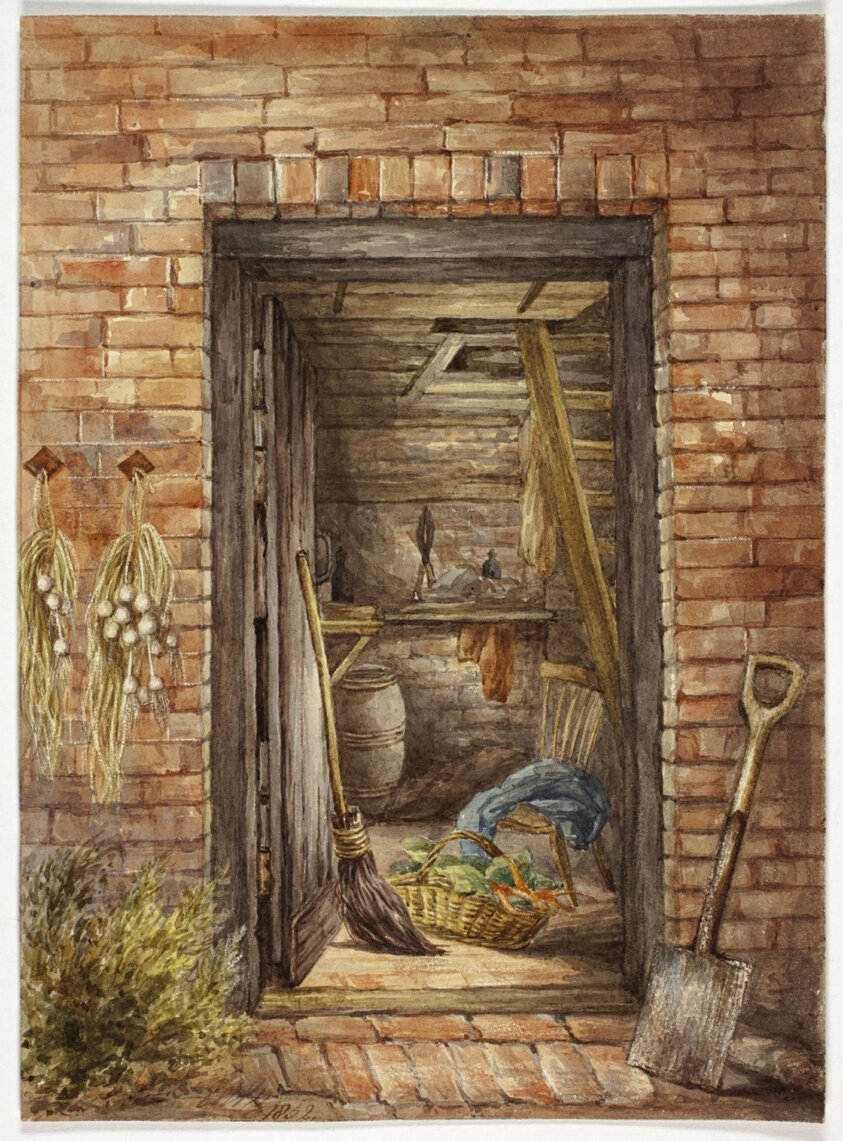
PaintingElizabeth Murray’s Brick Wall with Open Door and Shovel (1852)
A watercolor of a brick shed wall, its door open on a broom, a barrel and a basket. Murray painted the bricks in warm orange-browns, and their reddest patches sample at about #A66E40: far more orange and less intense than the web’s #CB4154.
#A66E40#926845#734B32#C3A47B
Source: Art Institute of Chicago
Source
Sampled from the Art Institute of Chicago’s image (1993.248.402), released as CC0 (public domain). The date and medium come from the museum’s record. Colors in a photo shift with the lighting, so read the codes as close, not exact.
#985457#555F73#A0AA9E#4A4A42
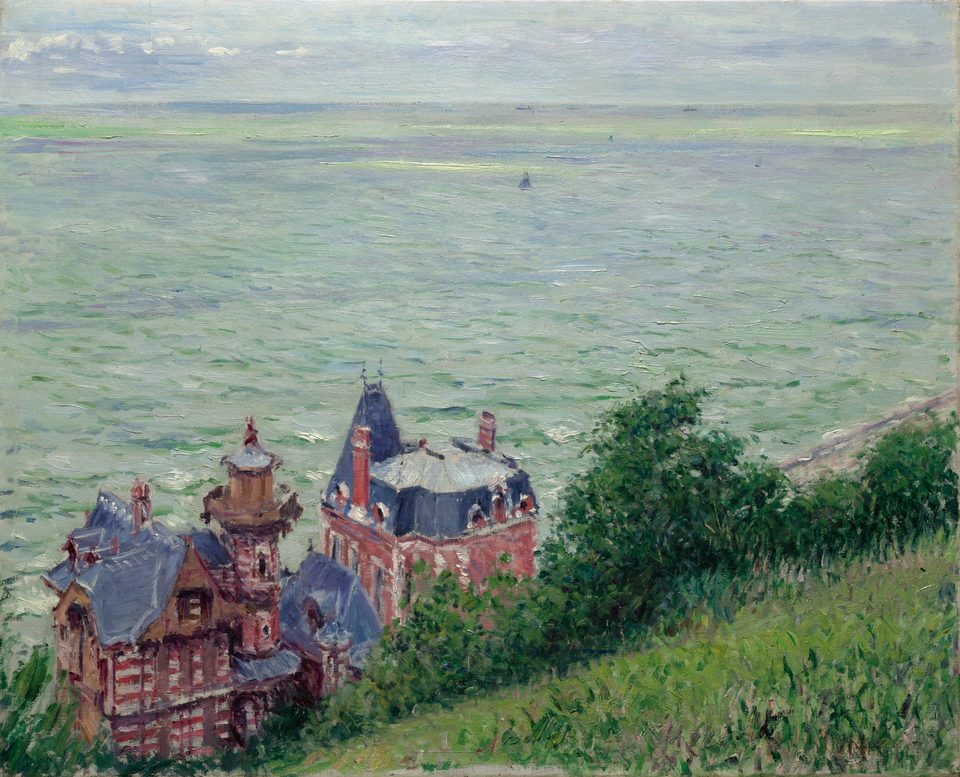
PaintingGustave Caillebotte’s Villas at Trouville (1884)
Caillebotte looked down from a cliff on the Normandy coast at brick villas with blue slate roofs. The Cleveland Museum of Art calls them brick villas. Their red samples at about #985457, almost the same hue as the web code but much grayer: the closest of these painted bricks to the screen color.
#985457#555F73#A0AA9E#4A4A42
Source: Cleveland Museum
Source
Sampled from the villas in the Cleveland Museum of Art’s photograph (2020.105), released as CC0 (public domain). The description of the villas comes from the museum’s record. Colors in a photo shift with the lighting, so read the codes as close, not exact.
#C74634
BrandingOracle
Oracle’s red, #C74634, is a little more orange than this page’s code, at nearly the same lightness. The software company sets its wordmark in this red, which its site header uses too.
#C74634
Source: Oracle logo file
Source
The red is the fill in Oracle’s own logo file, served on the About Oracle page of its website. The logo shown is that file.
Logos belong to their owners and are shown unaltered, only to show where each palette comes from. Palettes are sampled in-house.
Questions
What color is brick red?
A strong red with a slight pink lean. The usual code is #CB4154 (RGB 203, 65, 84). Real bricks are usually browner and more orange, and dictionaries define brick red as a reddish brown.
What is the hex code for brick red?
#CB4154 is the code most color lists use, but it comes from a crayon color, not a color standard. People in the xkcd color survey picked a much darker red on average, #8F1402, and Merriam-Webster’s moderate reddish brown is about #79443B.
Why are bricks red?
Because clay contains iron. Fired in a kiln with plenty of air, the iron forms hematite, a red iron oxide. Hotter firing makes the red darker, and less iron makes it lighter.
Why are some bricks yellow or blue?
Clay rich in lime and magnesium fires yellow or cream, as in Milwaukee’s Cream City brick, even when the raw clay is red. Fired hot in a kiln short of oxygen, red clay turns dark, as in England’s Staffordshire blue brick.
Is brick red the same as firebrick?
No. Firebrick (#B22222) is a CSS color keyword: a deeper, purer red. Brick red (#CB4154) is lighter and leans toward pink.
What is the difference between brick red and terracotta?
Terracotta (#E2725B) is lighter and more orange, the color of flowerpots. Brick red (#CB4154) is deeper and cooler, with a slight pink lean.
What colors go with brick red?
Mortar gray and cream for a classic wall, ivy green and navy for a campus look, and slate blue or blue-gray for contrast.