Reserved for emperors
Historical recordBy the 4th century AD, Roman laws on dress allowed only the emperor to wear Tyrian purple. Later, in Byzantium, a child born to a reigning emperor was called “born in the purple”.1
A deep reddish purple named after the sea-snail dye of ancient Tyre.
Tyrian purple is a deep reddish purple, close to the color of dried blood. Its usual code is #66023C: mostly red, almost no green and a little blue, at very low brightness. No standard defines the code. It is a common web value meant to show the dark, blood-colored shade that the Romans prized most.
The name comes from Tyre, a Phoenician port in what is now Lebanon, famous in the ancient world for a dye made from sea snails. The word purple itself comes, through Latin purpura, from Greek porphyra, the ancient names of this dye.
The real dye was never one fixed color. Pliny the Elder wrote that the best was “exactly the colour of clotted blood”, blackish at first sight but shining when held up to the light, and that redder batches were worth less. In 1930 Maerz and Paul left it out of the color samples in their Dictionary of Color: the old method, they wrote, had probably not been recovered, and modern “Tyrian” colors had no standing at all.
On screens, #66023C reads as a dark wine-purple with a hint of red. It suits formal invitations, heritage brands and dark themes, and it pairs naturally with gold and cream. Use light text on it: the color is too dark to carry dark text.
| HEX | #66023C | |
|---|---|---|
| RGB | rgb(102, 2, 60) | |
| HSL | hsl(325, 96%, 20%) | |
| HSV | 325°, 98%, 40% | |
| CMYK | 0, 98, 41, 60 | |
| OKLCH | oklch(33.5% 0.136 353.6) |
There is no survey average for Tyrian purple. The two renderings Wikipedia gives as a rough guide to the real dye both sit outside the outline, up and to the right: redder and a little lighter than the web code. The outline is an approximate range, not a measured one.
Tints with white
Shades with black
Tones with gray
Pairings that work in rooms, outfits and interfaces.
The imperial pairing, as on Roman triumphal robes. Formal and rich.
Purple against warm stone. Calm and classical, good for museums and books.
A Mediterranean pairing. The blue cools the purple and keeps it from feeling heavy.
Soft and romantic. Works for weddings and beauty brands.
Earthy and old-world. Good for wine labels and food packaging.
Dark and polished. Good for evening themes and jewelry.
Pick a palette to see where its colors sit on the color wheel. The caret marks tyrian purple. Tap a band to copy its code.
Lined up by hue around tyrian purple. Hover a color to see how similar it is.The bar under each name shows how similar it is. Similarity comes from the distance between the two colors in OKLab, a model of how we see color.
Tyrian purple’s meaning comes from history, not psychology. For well over a thousand years it was the color of rank and power around the Mediterranean, because the dye was so hard to make. Studies of color and emotion test basic words like “purple”, not this dye, so its regal feel today is inherited convention.
By the 4th century AD, Roman laws on dress allowed only the emperor to wear Tyrian purple. Later, in Byzantium, a child born to a reigning emperor was called “born in the purple”.1
Pliny the Elder wrote in the 1st century AD that purple set senators apart from knights, and that generals wore it mixed with gold at their triumphs.2
Ancient writers stressed the price. Theopompus said purple dye fetched its weight in silver, and Pliny quotes a writer of Augustus’s day who said double-dyed Tyrian wool could not be bought for 1,000 denarii a pound.1, 3
Tyrian purple is one of the oldest luxury goods on record. Its story runs from Bronze Age shell heaps to Roman law, a crusade and a chemistry lab.
Large numbers of murex shells on Crete suggest that the Minoans were making purple dye centuries before Tyre became famous for it.1
Wool dyed with true murex purple is left at an Iron Age copper-smelting camp at Timna, in today’s Israel. Chemical tests published in 2021 confirmed the dye: these are the oldest dyed textiles yet found in the southern Levant.2
The Greek historian Theopompus reports that purple dye fetched its weight in silver at Colophon, in Asia Minor.1
The emperor Nero bans amethyst and Tyrian purple dyes. When he sees a woman wearing the banned color at one of his recitals, he has her dragged out and stripped of her clothes and her property.3
Pliny the Elder’s Natural History names Tyre as the source of Asia’s best purple and describes the most prized shade as “exactly the colour of clotted blood”.4
Roman dress laws are tightened until only the emperor may wear Tyrian purple.1
The sack of Constantinople in the Fourth Crusade ends the making of murex purple for the Byzantine court.1
In England, William Cole describes how the juice of dog whelks, spread on linen, changes in sunlight from pale green through blue to a very deep purple-red.5
The chemist Paul Friedländer extracts the glands of 12,000 snails and gets just 1.4 grams of dye, almost 9,000 snails per gram. He finds that it is 6,6′-dibromoindigo, a close relative of indigo that contains bromine.5
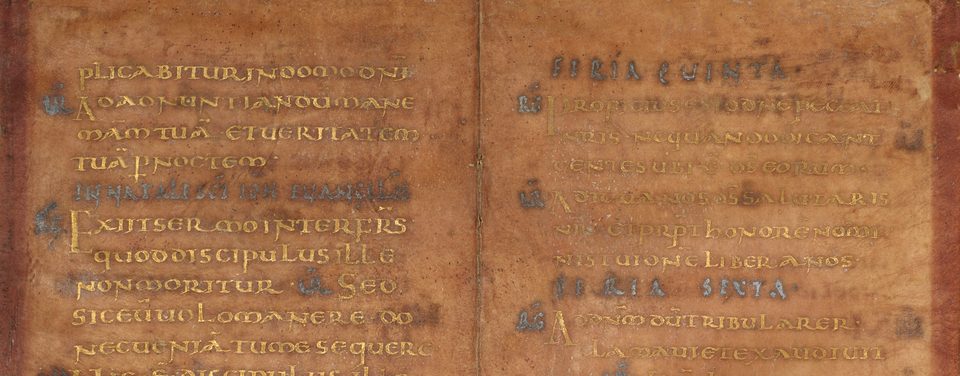
A double leaf from a Carolingian chant book, written in gold and silver on parchment stained purple, a luxury look that goes back to classical antiquity. The museum notes that the purple has faded to a deep pink; today it reads as a warm pinkish brown. Around the Mediterranean the dye came from murex snails, but in northern Europe plant dyes were used instead.
Sampled from the Cleveland Museum of Art’s photograph (1933.446), released as CC0 (public domain). The fading and the dye sources come from the museum’s description. The picture shown is a detail of the top of the leaf. Colors in a photo shift with the lighting, so read the codes as close, not exact.
Palettes are sampled in-house.
A deep reddish purple. The usual code is #66023C (RGB 102, 2, 60). The ancient dye ranged from reddish to blackish purple, and the Romans prized the blackish shade most.
From a gland of predatory sea snails in the murex family. Phoenician Tyre, in today’s Lebanon, was the most famous center of the trade, which is why the dye is named after it.
A great many. In 1909 the chemist Paul Friedländer used 12,000 snails to get 1.4 grams of pure dye, almost 9,000 snails for each gram.
Because the dye was so costly. Ancient writers said it was worth its weight in silver, and by the 4th century AD only the Roman emperor was allowed to wear it.
Only in tiny amounts. A way to dye cloth with the snails was worked out again by trial and error in 1998. Chemists first made the compound in the lab in 1903, before anyone knew it was the ancient dye.
Royal purple (#7851A9) is a lighter, bluer purple. Tyrian purple (#66023C) is much darker and redder, closer to the ancient dye. “Royal purple” is also an old name for the dye itself, which adds to the confusion.