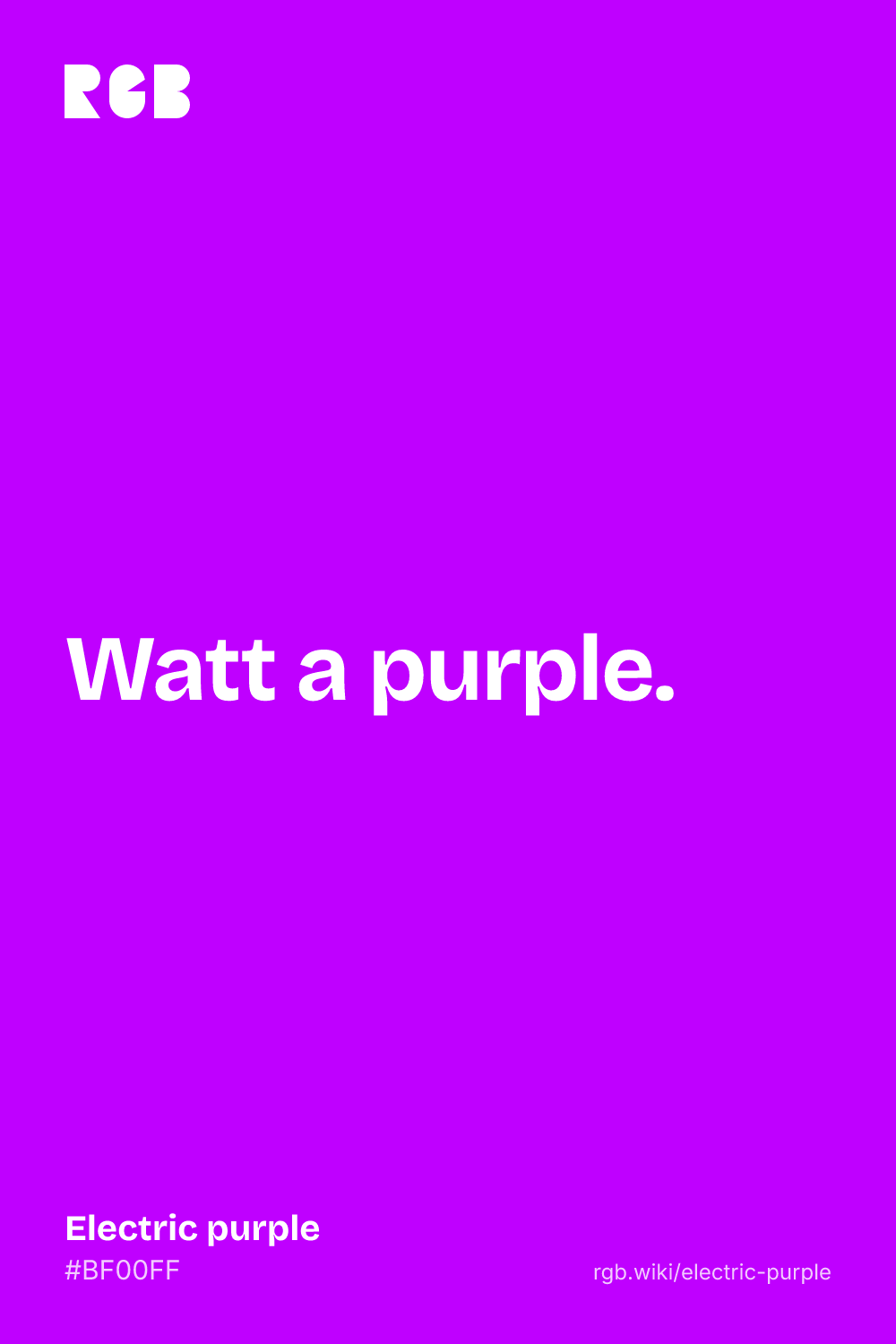
The purest purple a screen can make, halfway between violet and magenta.
Overview
Electric purple is the most vivid purple a screen can show. Its code is #BF00FF: blue at full strength, red at 75% and no green at all. On the screen’s color wheel it sits at hue 285°, exactly halfway between color-wheel violet at 270° and the screen’s magenta, CSS fuchsia, at 300°.
Violet stands for a band of the rainbow. Purple does not: it is a mix of red and blue light that appears nowhere in the spectrum. In 1912 the ornithologist Robert Ridgway defined purple as “the intermediate between violet and red” and listed its full-strength form as “true purple”. Dyes struggled to reach it, because mixing them darkened and dulled the result. A screen adds light instead of absorbing it, so its purples stay bright.
No one has traced the first use of the name. It follows electric blue, a fashion color of the 1890s, and today “electric” marks the loudest version of a hue. When people name colors online, their electric purple lands close to the code, a little bluer.
At full strength it sits right at the middle for text: white and black both reach about 4.5:1 contrast on it. It glows on black and deep navy and pairs with cyan or lime for a retro look. For long text, use a darker shade.
HEX
#BF00FF
RGB
rgb(191, 0, 255)
HSL
hsl(285, 100%, 50%)
HSV
285°, 100%, 100%
CMYK
25, 100, 0, 0
OKLCH
oklch(60.9% 0.303 312.9)
Every code converts from the HEX value #BF00FF. No color standard defines electric purple. #BF00FF is the code most color lists use: hue 285° at full saturation and brightness, halfway between violet and magenta on the HSV color wheel. Wikipedia credits it to the X11 color names, but the X11 color list has no such color. Its nearest entry there is DarkOrchid1, #BF3EFF. CMYK is a screen-based estimate; print results vary.
Electric purple on the color map
LighterDarker
People’s average electric purple in the xkcd survey sits inside the outline, to the left: bluer, at about the same lightness. The HP Labs average sits almost on top of the code, a little duller. X11’s DarkOrchid1 is just above and to the left, a touch lighter and softer. The ISCC-NBS vivid purple sits lower right: darker, and far less intense than this map can show, because surface colors cannot match a screen’s purest purple. The outline is an approximate range, not a measured one.
Shades and tints
Tintswith white
Shadeswith black
Toneswith gray
Electric purple sits in the middle. Tints add white, shades add black and tones add gray, in 10% steps out from it. Tap any swatch to copy its code.
Light and dark electric purple
#E599FF
Pale electric purpleMixed 60% with white. A bright lilac for backgrounds, with dark text.
#BF00FF
Electric purpleThe reference color.
#8000FF
Color-wheel violetFifteen degrees bluer, at hue 270° on the HSV wheel. Violet has a page of its own. See violet
#FF00FF
FuchsiaFifteen degrees redder, at hue 300°: the screen’s magenta, the CSS keyword fuchsia. See fuchsia
#730099
Dark electric purpleMixed 40% with black. White text reads easily on it (9.6:1), so it suits buttons and headings.
#4C0066
Deep electric purpleMixed 60% with black. A near-black purple for dark themes.
Colors that go with electric purple
Pairings that work in rooms, outfits and interfaces.
Electric purple and black
A glowing accent on near-black. Made for night themes, music and gaming.
Electric purple and lime
Near-opposites on the screen’s color wheel. Loud, playful and a little retro.
Electric purple and cyan
Two pure screen colors on deep indigo. The look of 1980s arcade and synth art.
Electric purple and lilac
One hue at two strengths. The pale tint calms the glare.
Electric purple and warm gray
A quiet neutral lets one loud color lead. Clean for interfaces.
Electric purple and gold
Purple and gold at full voltage. Use the dark shade for buttons and text.
Color-wheel palettes
Pick a palette to see where its colors sit on the color wheel. The caret marks electric purple. Tap a band to copy its code.
Lined up by hue around electric purple. Hover a color to see how similar it is.The bar under each name shows how similar it is. Similarity comes from the distance between the two colors in OKLab, a model of how we see color.
Electric purple vs violet
Electric purple#BF00FF · hue 285°
Halfway between violet and magenta
A purple: a mix of red and blue light, not in the rainbow
Brighter and redder, with red at 75%
Violet#8F00FF · hue 274°
Leans toward blue
Stands for the rainbow’s last band of light
Named after a spring flower
Meaning
Made of light
Beyond dyes
Red and blue focus apart
Electric names
Electric purple reads as loud, synthetic and modern: a color that exists at full strength only on a lit screen. Its name puts it in the family of “electric” colors, the brightest version of each hue. Most of what can be said about it is physics and naming, not mood. Studies of color and emotion test the basic word purple, not electric purple, so claims that it sparks creativity or calm are guesswork.
The purest purple on a screen
By definition
In the HSV color model, which Alvy Ray Smith published in 1978 for computer painting programs, all the fully saturated, fully bright hues lie on one plane. Electric purple is the one at 285°, halfway between violet at 270° and magenta at 300°. At that hue, a screen cannot make a more saturated purple.1
Dyes could not match it
Historical record
To build his 1912 color standards, Robert Ridgway colored disks with dyes and spun them to mix hues. For the hues between violet and red, he warned that several aniline dyes “do not combine satisfactorily with the violets, the mixture soon becoming dark or dull”, and that none gave “quite as pure a purple”.2
Red and blue focus apart
Optics, small study
Electric purple is strong blue light plus strong red light. The eye bends the two by different amounts, which is why red often seems nearer than blue when the two sit side by side, an effect called chromostereopsis that also works on flat screens. In a small 2026 study, blue text on black was the hardest for 30 young adults to focus on and read. No study has tested electric purple text itself.3, 4, 5
People picture it a little bluer
Two online surveys
In the xkcd color survey of 2010, people’s average electric purple was #AA23FF, slightly bluer than the code. In HP Labs’ online naming experiment it was #B23BDD, the same hue but duller. Both land close to #BF00FF, so the name is fairly settled. Neither survey controlled people’s screens.6, 7
Ridgway, R. (1912). Color Standards and Color Nomenclature. Washington, D.C.: the author. “Dyes and Pigments for Maxwell Disks”, pp. 26–27. Internet Archive.
Cauquil, A. S. et al. (2009). Neural correlates of chromostereopsis: an evoked potential study. Neuropsychologia, 47(12), 2677–2681. doi:10.1016/j.neuropsychologia.2009.05.002
Ozolinsh, M. & Muizniece, K. (2015). Color difference threshold of chromostereopsis induced by flat display emission. Frontiers in Psychology, 6, 337. doi:10.3389/fpsyg.2015.00337
Ramasubramanian, V. S. et al. (2026). Effect of chromostereoscopic stimulus on accommodative response and subjective perception. British and Irish Orthoptic Journal, 22(1), 73–83. doi:10.22599/bioj.515
Munroe, R. (2010). “Color survey results”. xkcd blog. The survey’s color averages are released as CC0 data.
Moroney, N. HP Labs online color naming experiment, results as of 2007, as compiled in Jaffer, A., “Color-Name Dictionaries”, MIT CSAIL.
History
A purple at full strength was an ideal for color scientists long before screens could show one. Computers turned it into a number.
1912
Robert Ridgway’s Color Standards and Color Nomenclature defines purple as “the intermediate between violet and red” and lists “Purple (true)” among its full-strength colors, on plate XI as hue 65.1
1978
Alvy Ray Smith publishes the HSV color model, already used for years in painting programs at Xerox PARC and the New York Institute of Technology. It arranges a screen’s pure hues around a wheel, where 285° is exactly halfway between violet and magenta.2
1996
Hewlett-Packard and Microsoft propose sRGB, a standard meaning for screen color numbers such as 191, 0, 255. It becomes the international standard IEC 61966-2-1 and the color space of the web.3
2007
In HP Labs’ online color naming experiment, people’s average electric purple is #B23BDD.4
2010
In the xkcd color survey, people’s average electric purple is #AA23FF, one of five “electric” colors in its results, alongside electric blue, green, lime and pink.5
Sources (5)
Ridgway, R. (1912). Color Standards and Color Nomenclature. Washington, D.C.: the author. Pp. 17–19 and index. Internet Archive.
Moroney, N. HP Labs online color naming experiment, results as of 2007, as compiled in Jaffer, A., “Color-Name Dictionaries”, MIT CSAIL.
Munroe, R. (2010). “Color survey results”. xkcd blog. The survey’s color averages are released as CC0 data.
Questions
What color is electric purple?
A fully saturated purple, halfway between violet and magenta. Its code is #BF00FF (RGB 191, 0, 255), hue 285° on the screen’s color wheel.
Is electric purple the same as violet?
No. Violet (#8F00FF) leans toward blue and stands for the last band of the rainbow. Electric purple (#BF00FF) has more red, so it sits halfway to magenta. It is a true purple, a mix of red and blue light.
Where does the code #BF00FF come from?
No standard defines it. It is simply hue 285° at full saturation and brightness. Wikipedia credits the X11 color list, but that list has no electric purple; its nearest color is DarkOrchid1, #BF3EFF.
Should I use white or black text on electric purple?
Either works, just barely: white text reaches about 4.5:1 contrast and black about 4.7:1, right at the usual minimum for body text. For small text, use the dark shade #730099 with white (9.6:1).
Can electric purple be printed or painted?
Not at full strength. Paints and dyes mix by absorbing light, so mixed purples come out darker and duller. Robert Ridgway complained of this in 1912. On paper, expect a deeper, softer purple than on a screen.
Why is it called electric purple?
No one has traced the first use. “Electric” names go back to electric blue, a color of the 1890s named after electric sparks, and today the word marks the most vivid version of a hue: electric blue, green, lime, pink and purple.
What colors go with electric purple?
Black and deep navy make it glow. Cyan and lime give a loud, retro contrast, gold a festive one. Pale lilac and warm gray calm it down for everyday designs.