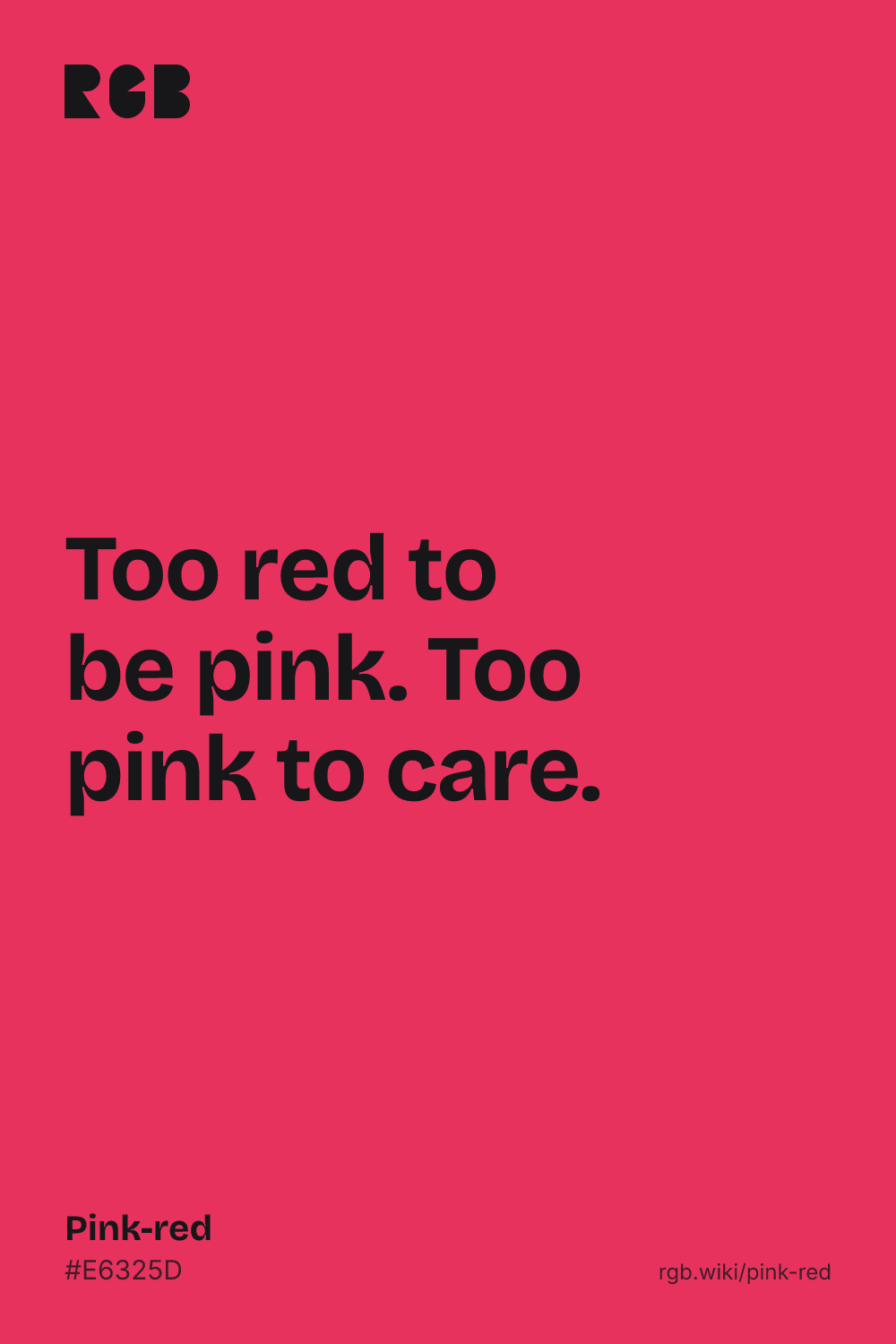
Pink-red is a vivid red that leans toward pink. Its usual code, #E6325D, is strong red with about a fifth green and a little over a third blue. The blue cools it toward pink, and the green softens it. No color standard defines it.
Unlike red-orange or blue-green, pink-red is not a step on the painter’s color wheel. Pink is not a hue of its own but a light, soft red. Merriam-Webster defines it as bluish red to red in hue, fairly light and not very saturated. Pink-red takes pink’s cool lean and keeps red’s full strength.
That is why mixing the two parents doesn’t work. Half CSS red and half CSS pink makes a coral, #FF6066, because CSS pink is so pale. Red mixed with hot pink comes much closer, #FF345A, and pink-red is a slightly darker, softer version of that. On screen it is almost the same color as amaranth and cerise.
When people in the xkcd color survey named colors themselves, their pink red, pinkish red, red pink and reddish pink all came out brighter and more intense than this code, and very close to each other. Use #E6325D as an accent for buttons, sale tags, sport and packaging. Black text passes the usual contrast line on it. Keep white text large.
HEX
#E6325D
RGB
rgb(230, 50, 93)
HSL
hsl(346, 78%, 55%)
HSV
346°, 78%, 90%
CMYK
0, 78, 60, 10
OKLCH
oklch(61.1% 0.214 13.3)
Every code converts from the HEX value #E6325D. No color standard defines pink-red. #E6325D is the code most color lists use. It has no CSS keyword. The nearest one, crimson (#DC143C), is darker and redder. CMYK is a screen-based estimate; print results vary.
Pink-red on the color map
LighterDarker
All four of people’s compound names sit inside the outline, a little to the right of the reference, toward red. Pink red and pinkish red are level with it; red pink and reddish pink sit a little higher, lighter. All four are also more intense than the code, which this map of hue and lightness doesn’t show. The ISCC-NBS vivid purplish red sits near the left edge, pinker. Vivid red sits just below the outline, darker and to the right. The outline is an approximate range, not a measured one.
Shades and tints
Tintswith white
Shadeswith black
Toneswith gray
Pink-red sits in the middle. Tints add white, shades add black and tones add gray, in 10% steps out from it. Tap any swatch to copy its code.
Light and dark pink-red
#F8C2CE
Pale pink-redMixed 70% with white. A soft pink for backgrounds.
#F0849E
Light pink-redMixed 40% with white. A clear, warm pink.
#E6325D
Pink-redThe reference color.
#E52B50
AmaranthAlmost the same color, a touch redder. It has a page of its own. See amaranth
#A12341
Dark pink-redMixed 30% with black. A deep berry red that carries white text.
Colors that go with pink-red
Pairings that work in rooms, outfits and interfaces.
Pink-red and navy
Bright against deep. Crisp for sport, campaigns and sale banners.
Pink-red and blush
One hue at two strengths. Sweet, soft and easy to read.
Pink-red and mint
Near opposites on the wheel. Fresh and lively for spring.
Pink-red and charcoal
Modern and graphic. Good for dark themes and tech.
Pink-red and marigold
Warm and festive. Use for food, summer events and posters.
Pink-red and deep teal
Rich and dramatic, with a lighter pink-red for buttons.
Color-wheel palettes
Pick a palette to see where its colors sit on the color wheel. The caret marks pink-red. Tap a band to copy its code.
Lined up by hue around pink-red. Hover a color to see how similar it is.The bar under each name shows how similar it is. Similarity comes from the distance between the two colors in OKLab, a model of how we see color.
Pink-red vs crimson
Pink-red#E6325D · hue 346°
Lighter and a little softer
Leans further toward pink
No standard code
Crimson#DC143C · hue 348°
Darker and more intense
Reads as a red, not a pink
A CSS keyword
Meaning
Between two names
Light red
Named for a flower
Hunting pink
Pink-red sits on the line between two color words, so its meaning is mostly about language. English treats pink as its own color, while many languages call it light red. Red was one of the first color words languages gain and pink one of the last. Research on color and emotion tests basic words like red and pink, not pink-red, so there is no measured mood for it.
Pink is a light red
Dictionary definition
Merriam-Webster defines pink as a group of colors bluish red to red in hue, of medium to high lightness and low to moderate saturation. By that definition pink-red is not a pink at all. It has pink’s cool hue but red’s strength.1
Many languages say “light red”
Language record
Danish calls pink lyserød and Finnish vaaleanpunainen, both meaning light red. Several Celtic languages use words for “whitish red”, and Chinese uses a compound meaning “powder red”. In many other languages pink is named after the rose.2
Red came first, pink last
Influential theory
Brent Berlin and Paul Kay argued in 1969 that languages gain color words in a set order. Red is the first word after dark and light. Pink comes in the last stage, with purple, orange and gray. The order is influential but still debated.3
Boundary colors collect extra names
One study, 51 people
In a 2014 study, 51 American English speakers named 330 color chips freely. Most of their nonbasic color names went to chips on the borders between basic categories, where people agreed least. Pink-red is that kind of name. The study did not test pink-red itself.4
Pink once named a red coat
Dictionary record
In English, “pink” also means the scarlet color of a fox hunter’s coat, and the coat itself. So one old use of pink names a full red.1
Sources (4)
Merriam-Webster, “pink”, noun (3), senses 1 and 2a.
Wikipedia, “Basic Color Terms”, on Berlin, B. & Kay, P. (1969), Basic Color Terms: Their Universality and Evolution.
Lindsey, D. T. & Brown, A. M. (2014). The color lexicon of American English. Journal of Vision, 14(2), 17. doi:10.1167/14.2.17
History
Red is one of the oldest color words. Pink began as the name of a flower, and the line between the two has been drawn differently ever since.
1566
First known use of pink as the name of the Dianthus flowers, the garden pinks.1
About 1669
Pink is first recorded as the name of a color, after the flower.1, 2
1955
The ISCC-NBS dictionary of color names sorts colors into 267 groups. It has no pink red: “pinkish” appears only in pinkish white and pinkish gray. A color like #E6325D falls between its vivid red, strong red and vivid purplish red.3, 4
1969
Brent Berlin and Paul Kay’s Basic Color Terms puts red at stage II of their sequence and pink at stage VII, the last.5
2010
In the xkcd color survey, people’s average pink red is #F5054F and their red pink #FA2A55: almost the same hue, with red pink a little lighter.6
2014
A study of American English color names finds pink among the 11 basic color categories, with most nonbasic names falling on the borders between them.7
Sources (7)
Merriam-Webster, “pink”, first known use of noun (2) and noun (3).
Wikipedia, “Pink”, citing the Oxford English Dictionary for the late 17th century.
Kelly, K. L. & Judd, D. B. (1955). The ISCC-NBS Method of Designating Colors and a Dictionary of Color Names. NBS Circular 553. NIST PDF.
Wikipedia, “Basic Color Terms”, on Berlin, B. & Kay, P. (1969), Basic Color Terms: Their Universality and Evolution.
Munroe, R. (2010). “Color Survey Results”, xkcd blog, with the survey’s color list (CC0).
Lindsey, D. T. & Brown, A. M. (2014). The color lexicon of American English. Journal of Vision, 14(2), 17. doi:10.1167/14.2.17
Questions
What color is pink-red?
A vivid red that leans toward pink. Its usual code is #E6325D (RGB 230, 50, 93). No color standard defines it.
Is pink-red a tertiary color?
No. Tertiary colors like red-orange mix two neighboring hues on the color wheel. Pink is not a separate hue but a light, soft red, so pink-red is a red with a cool, pinkish lean.
Is pink a shade of red?
Strictly, pink is a tint: a lighter, softer version of red, often with a slight blue lean. Many languages simply call it light red, while English treats it as a color of its own.
What is the difference between pink-red and crimson?
Crimson (#DC143C) is darker and more intense and reads as a red. Pink-red (#E6325D) is lighter and softer and leans further toward pink.
Is pink-red the same as amaranth or cerise?
Almost. Amaranth (#E52B50) is a touch redder and cerise (#DE3163) a touch pinker, but side by side the three are hard to tell apart. Each name has its own history.
What colors go with pink-red?
Navy and charcoal for contrast, blush for a soft tonal look, mint and teal as near opposites, and marigold for something warm and festive.
What is the opposite of pink-red?
On a screen color wheel, the color directly opposite pink-red is a bright mint green, about #32E6BB.