Blue-violet

The in-between color where blue meets violet on the color wheel.

Overview

Blue-violet is the color between blue and violet: a vivid purple that leans toward blue. On screens its standard code is #8A2BE2, the CSS color named blueviolet, with strong blue, a good deal of red and very little green.

On the painter’s color wheel, blue-violet is a tertiary color: an even mix of the primary blue and the secondary violet, one of six in-between colors. Albert Munsell’s color system of 1905 calls the same stretch of hues purple-blue and notes that it is “popularly called violet”.

Violet and purple are not quite the same. Violet is a color of the spectrum, the shortest wavelengths of light we can see, at about 380–435 nanometers. Purple is a mix of red and blue light that appears nowhere in the rainbow. Screens cannot produce spectral violet, so they imitate it by mixing blue with some red: every screen violet, this one included, is strictly a purple.

#8A2BE2 is bright and saturated, so it works best as an accent: buttons, links, highlights and logos. White text reads clearly on it. Pair it with gold or coral for contrast, or with lavender and slate for something calmer.

HEX#8A2BE2
RGBrgb(138, 43, 226)
HSLhsl(271, 76%, 53%)
HSV271°, 81%, 89%
CMYK39, 81, 0, 11
OKLCHoklch(53.4% 0.250 301.4)
Every code converts from the HEX value #8A2BE2. #8A2BE2 is blueviolet in the CSS color names defined by the W3C in CSS Color Module Level 4. Like most CSS names, it comes from the X11 color list for Unix computers, by way of SVG. CMYK is a screen-based estimate; print results vary.
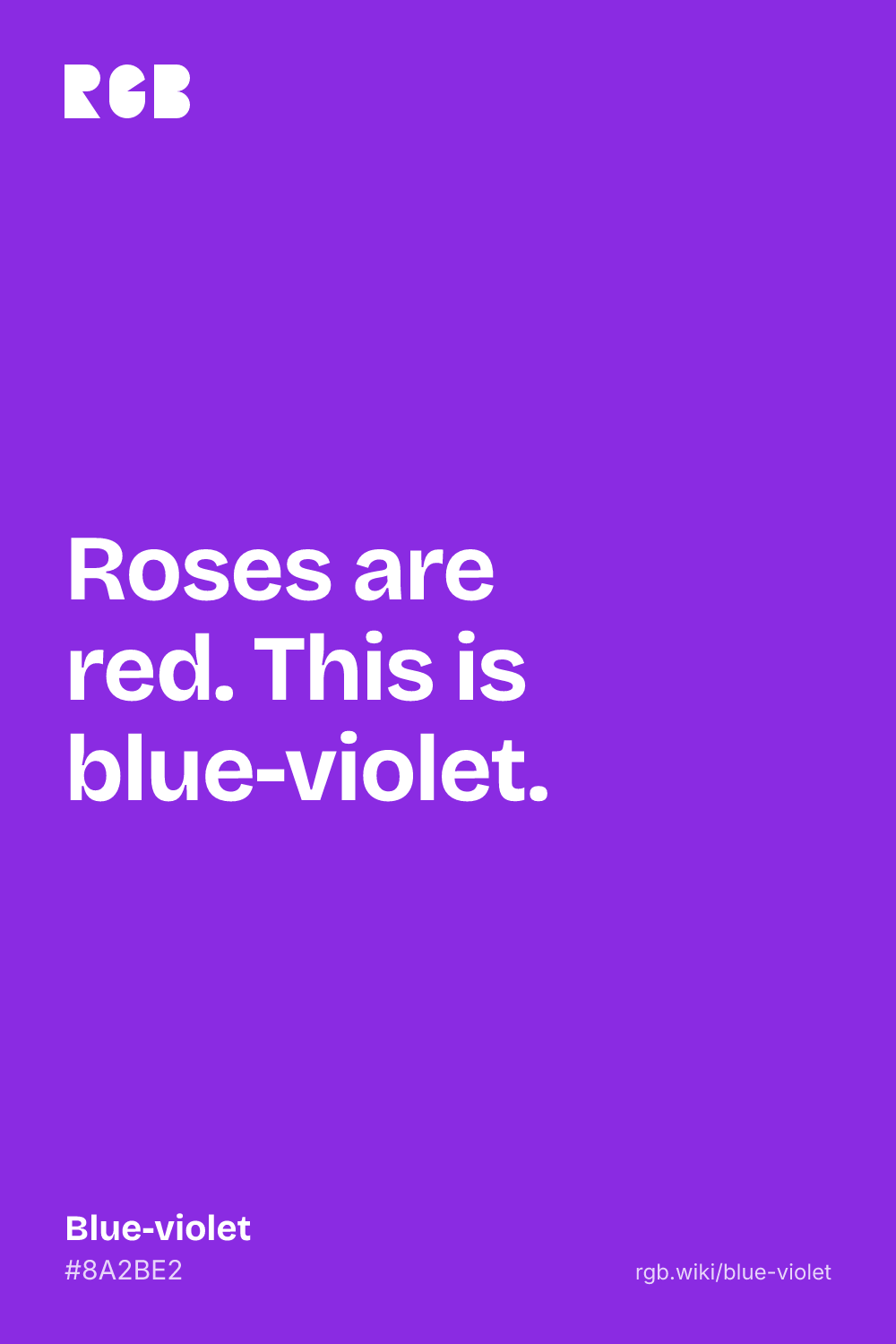
Blue-violet color card, hex #8A2BE2: “Roses are red. This is blue-violet”

Blue-violet on the color map

People’s average blue violet in the xkcd survey is a little darker and bluer than the CSS color, inside the outline on its left side, and so is their purply blue. Their violet blue sits just outside the left edge, darker still. CSS dark violet sits inside, to the right: a redder purple. The outline is an approximate range, not a measured one.

Shades and tints

Tints with white

Shades with black

Tones with gray

Blue-violet sits in the middle. Tints add white, shades add black and tones add gray, in 10% steps out from it. Tap any swatch to copy its code.

Light and dark blue-violet

#D0AAF3
Pale blue-violetMixed 60% with white. A soft lilac with a cool edge.
#B980EE
Light blue-violetMixed 40% with white. A bright lavender.
#8A2BE2
Blue-violetThe reference color.
#531A88
Dark blue-violetMixed 40% with black. A deep purple close to CSS indigo.

Colors that go with blue-violet

Pairings that work in rooms, outfits and interfaces.

Blue-violet and gold

Purple and gold, a classic contrast. Bold and festive; let gold be the accent.

Blue-violet and lavender

One hue, two strengths. Soft and friendly, good for apps and stationery.

Blue-violet and mint

Cool and fresh. Strong for tech brands and games.

Blue-violet and coral

Warm against cool, playful and loud. Good for events and posters.

Blue-violet and slate

Calm and modern. The gray lets the violet glow in dark interfaces.

Blue-violet and white

Clean and simple. White text on blue-violet passes the usual contrast check.

Color-wheel palettes

Pick a palette to see where its colors sit on the color wheel. The caret marks blue-violet. Tap a band to copy its code.

Similar colors

Iris50%Slate blue51%Violet76%Blue-violetGrape49%Dark violet78%Dark orchid76%

Lined up by hue around blue-violet. Hover a color to see how similar it is.The bar under each name shows how similar it is. Similarity comes from the distance between the two colors in OKLab, a model of how we see color.

Blue-violet vs violet

Blue-violet#8A2BE2 · hue 271°
  • A violet pulled toward blue
  • A tertiary color on the painter’s wheel
  • The CSS color blueviolet
Violet#8F00FF · hue 274°
  • Brighter, with no green at all
  • A secondary color on the painter’s wheel
  • Named after the violet flower

Meaning

  • Color wheel
  • Spectrum
  • Light
  • Screen color
  • Art class

Blue-violet is a color of theory more than of symbols: a step on the painter’s color wheel and a name in the list of web colors. Studies of color and emotion test basic words like “blue” and “purple”, not blue-violet, so there is no measured mood for it. What it does carry is the old confusion between violet and purple.

A tertiary color

Color theory

In today’s usual definition, a tertiary color is an even mix of a primary and a neighboring secondary color, which gives six of them. Blue-violet is the one between blue and violet. An older definition, used by painters such as Moses Harris in the 18th century, mixes two secondaries instead.1
Violet is in the rainbow, purple is not

Physics

Violet light has the shortest wavelength we can see, about 380 nanometers at the edge. Purple is a mix of red and blue light, so it has no place in the spectrum.2, 3

The names have never agreed

Color system

Munsell’s 1905 system called the mix of blue and purple “purple-blue” and said it was popularly called violet. Historically, violet has meant the bluer hues and purple the redder ones, but in everyday speech the two overlap.4, 3

Sources (4)
  1. Wikipedia, “Secondary color”, Tertiary color.
  2. NASA Science, “Visible Light”.
  3. Wikipedia, “Violet (color)”, Relationship to purple.
  4. Munsell, A. H. (1905). A Color Notation. Boston: G. H. Ellis. Paragraph 58, p. 28. Internet Archive.

History

Blue-violet is a product of color wheels. Its story runs from Newton’s circle to the color names built into every web browser.

  1. 1704

    Isaac Newton’s Opticks arranges the colors of the spectrum in a circle, the ancestor of every color wheel.1

  2. 1888

    Paul Signac makes a color print applying the chromatic circle of the scientist Charles Henry, whose color theories shaped Neo-Impressionism.2, 3

  3. 1905

    Albert Munsell’s A Color Notation names the hues between blue and purple “purple-blue”, “popularly called violet”.4

  4. 1989

    The X11 color list for Unix computers, first shipped in 1986, reaches roughly its present form. It includes blue violet as #8A2BE2.5

  5. 2001

    SVG 1.0 adopts the X11 names as color keywords, blueviolet among them. CSS later takes the same list.6, 7

Sources (7)
  1. Wikipedia, “Color wheel”, History.
  2. Art Institute of Chicago, Paul Signac, Chromatic Circle (1985.965).
  3. Wikipedia, “Charles Henry (librarian)”.
  4. Munsell, A. H. (1905). A Color Notation. Boston: G. H. Ellis. Paragraph 58, p. 28. Internet Archive.
  5. Wikipedia, “X11 color names”.
  6. W3C (2001). Scalable Vector Graphics (SVG) 1.0, Recognized color keyword names.
  7. W3C. CSS Color Module Level 4, Named Colors.

Blue-violet in use

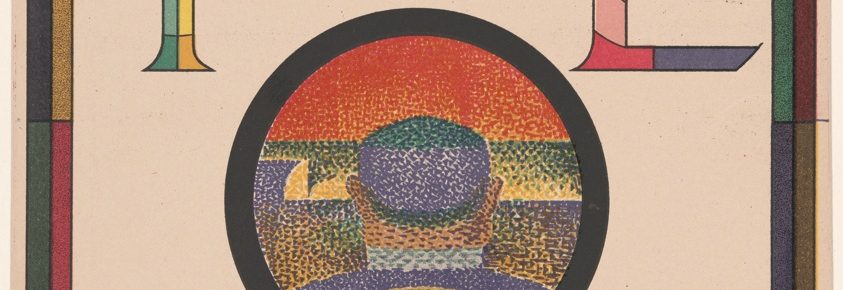
Detail of a Neo-Impressionist color print: a figure in violet and green dots seen from behind against an orange-red sky, inside a black circle, between bands of violet, green and yellow
#695E6E#4E4551#BF4C38#E5CBB4
PrintSignac’s Chromatic Circle (1888)

A small color lithograph by Paul Signac, inscribed “Application du Cercle Chromatique de Mr. Ch. Henry”, at the Art Institute of Chicago. The museum lists violet among its inks. Signac set violet against orange-red, and the violet, about #695E6E, is a muted grayish blue-violet, far softer than the screen color.

#695E6E#4E4551#BF4C38#E5CBB4
Source: Art Institute of Chicago

Palettes are sampled in-house.

Questions

What color is blue-violet?

A vivid purple that leans toward blue. Its standard screen code is #8A2BE2 (RGB 138, 43, 226), the CSS color named blueviolet.

Is blue-violet a tertiary color?

Yes. On the painter’s color wheel it is the tertiary color between the primary blue and the secondary violet, one of six tertiary colors.

What is the difference between violet and purple?

Violet is a spectral color, the shortest wavelengths of light we can see. Purple is a mix of red and blue light and does not appear in the rainbow. In everyday speech the words overlap, with violet usually meaning the bluer shades.

Is blue-violet the same as indigo?

No. Indigo is darker. The CSS indigo, #4B0082, has about the same hue as blue-violet but far less light in it.

What colors go with blue-violet?

Gold and yellow give the strongest contrast. Coral and mint are lively partners, and lavender or slate gray make calmer pairings.

What is the complementary color of blue-violet?

On a screen color wheel, the color directly opposite blue-violet is a bright yellow-green, about #83E22B.