Ruby

A vivid pinkish red named after the July birthstone, a gem that is usually darker than its code.

Overview

Ruby is a vivid red that leans toward pink. Its code, #E0115F, is full-strength red with a measure of blue, which cools it. On screen it is almost the same as raspberry, and next to crimson it looks pinker.

The gem behind the name is corundum, the same mineral as sapphire, turned red by a trace of chromium. Real rubies run from slightly orangy red to purplish red, and the finest are deeper and purer than the web code. The dictionaries agree: Merriam-Webster calls ruby a dark red, and the ISCC-NBS dictionary files the 1930 color sample behind the code as dark red.

Not every ruby is what it seems. Some of the most famous crown jewel rubies are spinels, light stones may be sold as pink sapphire, and ruby glass gets its red from gold. The name also went to the first laser and to a programming language named after a birthstone.

Ruby carries white text at a pinch (contrast about 4.8:1), so keep it to buttons, labels and large type. It pairs well with gold, sapphire blue, crisp white and charcoal.

HEX#E0115F
RGBrgb(224, 17, 95)
HSLhsl(337, 86%, 47%)
HSV337°, 92%, 88%
CMYK0, 92, 58, 12
OKLCHoklch(58.4% 0.228 8.9)
Every code converts from the HEX value #E0115F. #E0115F is the screen version of the ruby sample in Maerz and Paul’s A Dictionary of Color (1930, plate 6, sample G6) that most color lists use, as Wikipedia records. No web standard defines it, and the ISCC-NBS dictionary files the same sample as dark red, #722F37, a much darker color. See the range below. CMYK is a screen-based estimate; print results vary.
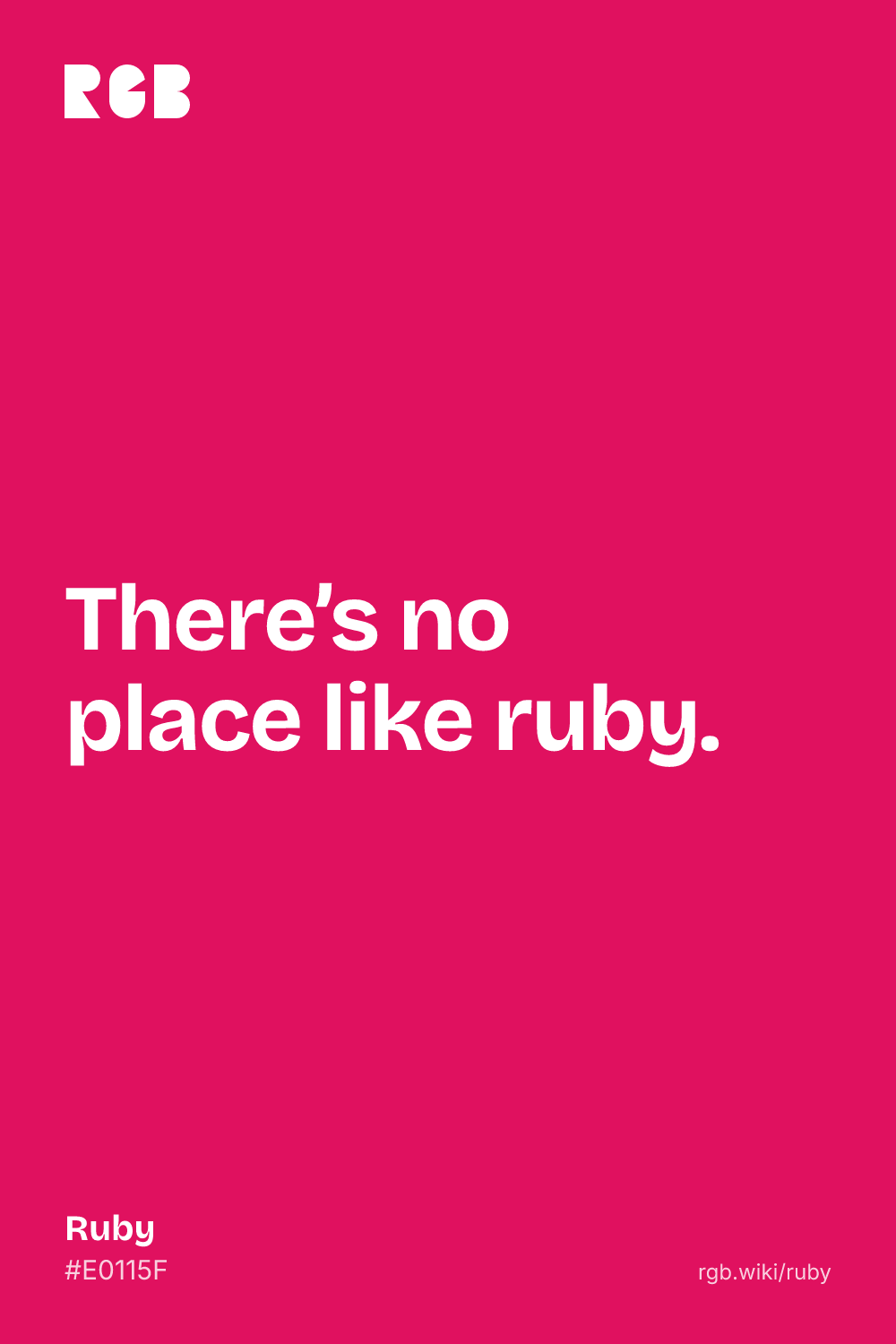
Ruby color card, hex #E0115F: “There’s no place like ruby”

Ruby on the color map

People’s average ruby sits a little below the reference and slightly to the right: darker and a touch redder. The Ruby logo’s red sits at the same lightness but well to the right, a warm, pure red. The two dictionary rubies sit far below and to the right, and both are much grayer, which this map of hue and lightness doesn’t show. The Fabergé stone, photographed on black, sits lowest of all. The outline is an approximate range, not a measured one.

Shades and tints

Tints with white

Shades with black

Tones with gray

Ruby sits in the middle. Tints add white, shades add black and tones add gray, in 10% steps out from it. Tap any swatch to copy its code.

Light and dark ruby

#F6B8CF
Pale rubyMixed 70% with white. A soft rose pink.
#EC709F
Light rubyMixed 40% with white. A bright, warm pink.
#E0115F
RubyThe reference color.
#E30B5C
RaspberryAlmost the same on screen, named after the fruit. See raspberry
#9D0C42
Dark rubyMixed 30% with black. Closer to the color of a fine stone.

Colors that go with ruby

Pairings that work in rooms, outfits and interfaces.

Ruby and gold

A jeweler’s pairing: ruby set in yellow gold.

Ruby and sapphire

Red and blue from the same mineral. Rich and regal.

Ruby and diamond

Crisp white and cool gray. Clean and bright.

Ruby and blush

Pale pink softens the bright red. Romantic and light.

Ruby and charcoal

Bold and modern. Gray grounds the vivid red.

Ruby night

A dark theme with a lighter ruby as the accent.

Color-wheel palettes

Pick a palette to see where its colors sit on the color wheel. The caret marks ruby. Tap a band to copy its code.

Similar colors

RubyCerise88%Raspberry97%Pink-red83%Amaranth81%Crimson77%Alizarin crimson70%

Lined up by hue around ruby. Hover a color to see how similar it is.The bar under each name shows how similar it is. Similarity comes from the distance between the two colors in OKLab, a model of how we see color.

Ruby vs garnet

Ruby#E0115F · hue 337°
  • Bright, with a pink lean
  • Red corundum, colored by chromium
  • The July birthstone
Garnet#733635 · hue 1°
  • Deep, soft and brownish
  • A family of more than twenty minerals
  • The January birthstone

Meaning

  • Red corundum
  • July birthstone
  • 40th anniversary
  • First laser
  • Programming language

Ruby stands for passion, love and wealth. It is the July birthstone and, according to GIA, the traditional gift for 15th and 40th wedding anniversaries. Fine rubies can fetch the highest prices of any colored gem. The name has also gone to the first laser and to a programming language. Research on color and emotion tests basic words such as red, not ruby itself.

Red from chromium

Well established

Ruby is corundum, the mineral that is called sapphire in every other color. Pure corundum is colorless, and a trace of chromium makes it red: the more chromium, the stronger the red. Chromium can also make rubies glow red under ultraviolet light. Rubies from iron-poor marble glow even in sunlight, which deepens their red, while iron in other rubies masks the glow.1
Ruby or pink sapphire?

Trade practice

There is no fixed line between a ruby and a pink sapphire. GIA’s lab calls a stone ruby only when red is its dominant hue, while in Sri Lanka pink stones were always considered ruby. The trade term “pigeon’s blood” has long described a red to slightly purplish or pinkish red ruby with a soft, glowing fluorescence.2

Crown jewel rubies that are spinels

Historical record

Red spinel was long mistaken for ruby. The Black Prince’s Ruby in England’s Imperial State Crown is a spinel, and so is the Timur Ruby in the Crown Jewels, which weighs over 350 carats.3

The first laser was a ruby

Historical record

In 1960, Theodore Maiman built the first working laser around a small rod of synthetic ruby. Its chromium ions gave out a pulse of deep red light at a wavelength of 694.3 nanometers, a pure red that no screen can show exactly.4, 5

Sources (5)
  1. Gemological Institute of America, “Ruby description”.
  2. Gemological Institute of America, “Ruby quality factors”.
  3. Gemological Institute of America, “Spinel history and lore”.
  4. Wikipedia, “Ruby laser”, citing Maiman, T. H. (1960). Stimulated optical radiation in ruby. Nature, 187, 493–494.
  5. HRL Laboratories, “History”, on the 1960 ruby laser at Hughes Research Laboratories.

History

Rubies have been prized for two thousand years, and the color name followed the stone into English. In the last century the word moved to a new birth month, a laser and a computer language.

  1. 1st century

    The Roman scholar Pliny describes rubies in his Natural History, noting their hardness and density.1

  2. 1300s

    First known use of “ruby” in English, from Anglo-French rubi and Latin rubeus, “reddish”.2

  3. 1367

    Edward, the Black Prince, receives a large red gem as payment for a battle victory. Now set in the Imperial State Crown and known as the Black Prince’s Ruby, it is a spinel.3

  4. 1400s

    “Ruby” is first used as an adjective for the color.2

  5. 1679

    Johann Kunckel takes charge of the glassworks of Brandenburg, where he makes gold ruby glass on a large scale: red glass colored by tiny particles of gold, not chromium.4, 5

  6. 1912

    American jewelers move ruby from December to July in their birthstone list, on the grounds that the warmer gem suits a summer month. The gem scholar George F. Kunz argued the opposite: it is in winter that we seek warmth.6

  7. 1930

    Maerz and Paul’s A Dictionary of Color prints the ruby sample behind today’s code, on the same plate as raspberry.7

  8. 1955

    The ISCC-NBS dictionary of color names files Maerz and Paul’s ruby as dark red.8

  9. 1960

    Theodore Maiman fires the first laser at Hughes Research Laboratories in California. Its heart is a rod of synthetic pink ruby.9

  10. 1993

    Yukihiro Matsumoto names his new programming language Ruby, after a colleague’s birthstone. Ruby is July’s stone; pearl, as in Perl, is June’s.10, 11

Sources (11)
  1. Gemological Institute of America, “Ruby history and lore”.
  2. Merriam-Webster, “ruby”, etymology and first known use of the noun and the adjective.
  3. Gemological Institute of America, “Spinel history and lore”.
  4. Wikipedia, “Johann von Löwenstern-Kunckel”, after the Encyclopædia Britannica (1911).
  5. Montanarella, F., & Kovalenko, M. V. (2022). Three millennia of nanocrystals. ACS Nano, 16(4), 5085–5102. doi:10.1021/acsnano.1c11159
  6. Kunz, G. F. (1913). The Curious Lore of Precious Stones, chapter on birthstones, “The list suggested and adopted in Kansas City”. Project Gutenberg.
  7. Wikipedia, “Ruby (color)”, citing Maerz and Paul’s A Dictionary of Color (1930), p. 35, plate 6, sample G6.
  8. Jaffer, A. “(M) Dictionary of Color”, the ISCC-NBS placements of Maerz and Paul’s color names (1955 dictionary).
  9. Wikipedia, “Ruby laser”, history, citing Maiman (1960) and Townes (1999).
  10. Ruby, “Official Ruby FAQ”, “Why the name ‘Ruby’?”, after Matsumoto’s post of June 11, 1999.
  11. Wikipedia, “Ruby (programming language)”, early concept: the name was chosen on February 24, 1993.

Ruby in use

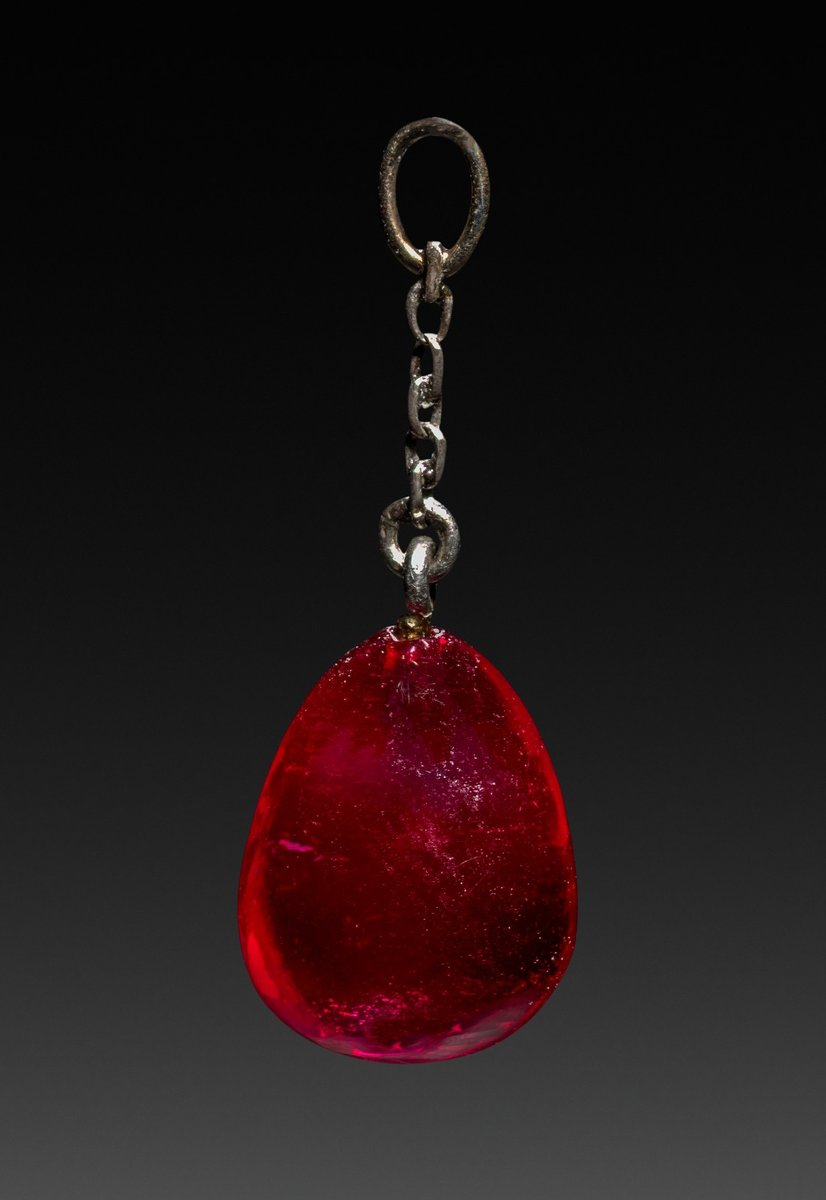
A smooth, egg-shaped red stone hanging from a small silver chain against a dark background
#860E1F#61030B#460103#C6BFB4
JewelryRuby or pink sapphire surprise, attributed to Fabergé (about 1885–90)

This stone hung on a chain inside a tiny imperial crown, the surprise hidden in a Fabergé Easter egg. The museum calls it a ruby or a pink sapphire, the very line gem dealers debate. Photographed on black, it reads as a deep red, about #61030B, with lit edges near #860E1F, far darker than the screen code.

#860E1F#61030B#460103#C6BFB4
Source: Cleveland Museum of Art
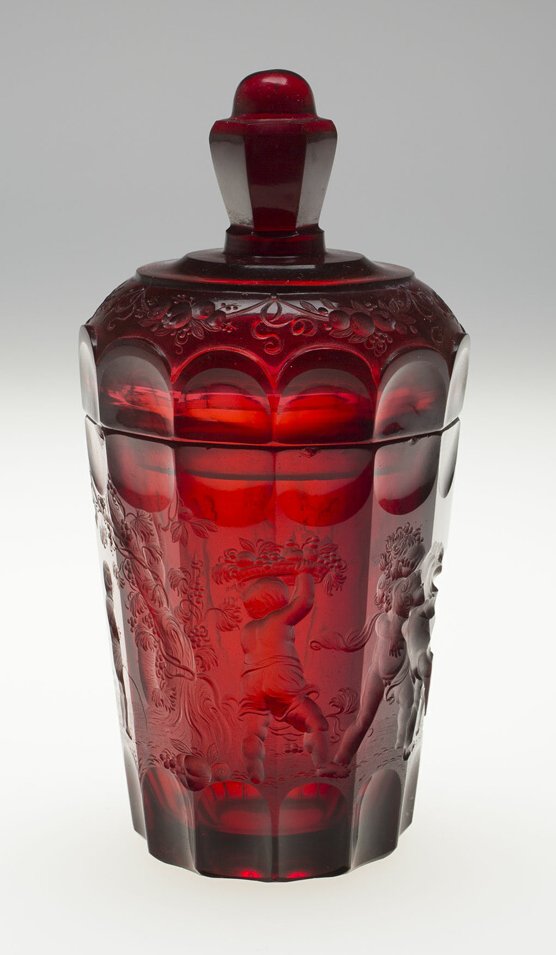
A tall, faceted red glass beaker with a lid and knob, engraved with cherubs among vines
#A42023#4B161B#946865
GlassGold ruby glass beaker, Potsdam (1685–1700)

A covered beaker of gold ruby glass from Brandenburg, wheel-engraved with a Bacchic scene by Gottfried Spiller. Its red comes from gold, not chromium, and it is warmer than the web code: about #A42023 where light passes through, #4B161B in the thickest glass.

#A42023#4B161B#946865
Source: Art Institute of Chicago

Logos belong to their owners and are shown unaltered, only to show where each palette comes from. Palettes are sampled in-house.

Questions

What color is ruby?

A vivid pinkish red on screens. Its usual code is #E0115F (RGB 224, 17, 95). Real rubies are usually darker, from slightly orangy red to purplish red.

Is ruby the same color as raspberry?

On screen, nearly. Raspberry’s usual code, #E30B5C, is almost impossible to tell from ruby’s #E0115F: both are screen versions of samples on the same plate of a 1930 color dictionary.

What gives a ruby its red color?

Chromium. Pure corundum is colorless, and a trace of chromium turns it red. The more chromium, the stronger the red, and chromium also makes rubies glow red under ultraviolet light.

Are ruby and sapphire the same stone?

They are the same mineral, corundum. Red corundum is ruby, and every other color is sapphire. Where pink ends and red begins is a matter of judgment, so the same stone can be sold as ruby in one market and pink sapphire in another.

What is a pigeon’s blood ruby?

A trade term for the most prized ruby color: red to slightly purplish or pinkish red, with a soft, glowing red fluorescence.

What is the difference between ruby and garnet?

Ruby (#E0115F) is bright and leans pink. Garnet (#733635) is deep and brownish. As gems, ruby is red corundum and the July birthstone, while garnet is a family of minerals and the January birthstone.

What colors go with ruby?

Gold for a jeweled look, sapphire blue for contrast, white and charcoal for a clean, modern feel, and pale pink to soften it.