Royal purple

A medium bluish purple with a name borrowed from royal robes.

Overview

Royal purple is a medium purple with a lean toward blue. Its usual code is #7851A9: blue at about two-thirds strength, red just under half and green lowest, so the color is rich but a little muted, never neon. No color standard defines it. The code traces to a crayon color of 1990.

The name is far older than the code. English has used “royal purple” as a color name since at least 1661, but the idea is older. In the Middle Ages the phrase could cover crimson and dark reds as well as purple. Tudor dress laws kept purple silk for the royal family, and British monarchs still leave their coronations in robes of purple velvet. The ancient sea-snail dye behind all this has its own page, Tyrian purple.

Most people picture royal purple darker than the code. In the xkcd color survey the average royal purple was #4B006E, a deep, intense purple, and the royal purple sample in a 1930 color dictionary is a darker, grayer violet, #604E97. Kansas State University, whose students chose royal purple as the school color in 1896, uses #512888.

On screens, #7851A9 carries white text at a contrast of 5.9 to 1. It pairs with gold and cream for a regal look, with silver and gray for something cooler, and with lavender for a soft, tonal palette.

HEX#7851A9
RGBrgb(120, 81, 169)
HSLhsl(267, 35%, 49%)
HSV267°, 52%, 66%
CMYK29, 52, 0, 34
OKLCHoklch(51.8% 0.138 302.3)
Every code converts from the HEX value #7851A9. No color standard defines royal purple. #7851A9 is the code most color lists use, and Wikipedia traces it to a crayon color of 1990. Maerz and Paul’s A Dictionary of Color (1930) has a royal purple sample, which the ISCC-NBS dictionary (1955) files as strong violet, centered on the darker, grayer #604E97. CMYK is a screen-based estimate; print results vary.
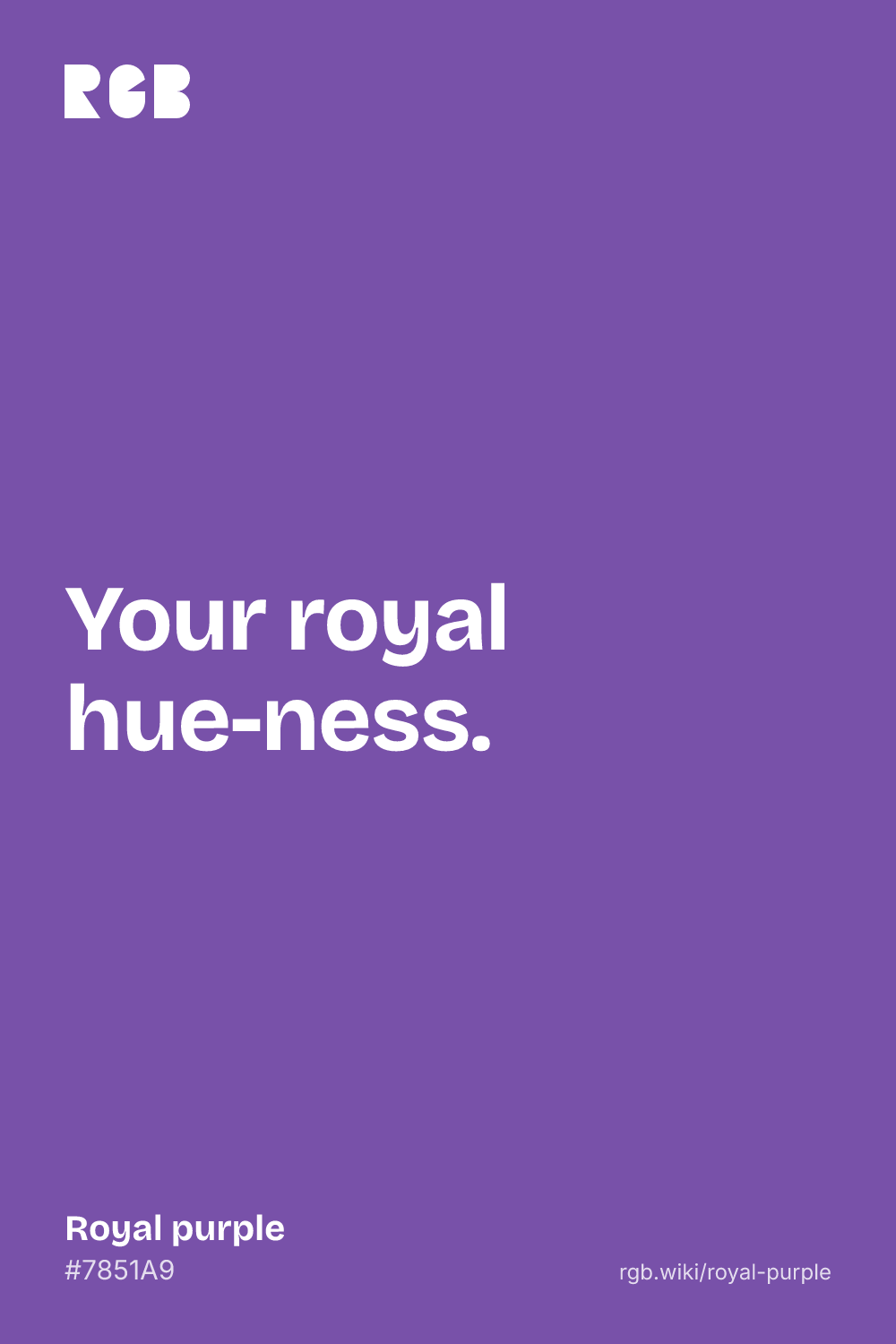
Royal purple color card, hex #7851A9: “Your royal hue-ness”

Royal purple on the color map

The survey average sits far below the outline: much darker, a little redder and more intense. The dictionary’s strong violet lies inside, a little to the left and lower, and it is grayer than the code. K-State’s purple sits just below the outline, darker and slightly more intense. The outline is an approximate range, not a measured one.

Shades and tints

Tints with white

Shades with black

Tones with gray

Royal purple sits in the middle. Tints add white, shades add black and tones add gray, in 10% steps out from it. Tap any swatch to copy its code.

Light and dark royal purple

#D6CBE5
Pale royal purpleMixed 70% with white. A soft lilac-gray for backgrounds.
#AE97CB
Light royal purpleMixed 40% with white. A muted lavender.
#7851A9
Royal purpleThe reference color.
#604E97
Dictionary royal purpleThe ISCC-NBS strong violet, where the 1930 dictionary’s royal purple sample sits. Grayer and darker.
#5A3D7F
Deep royal purpleMixed 25% with black. A velvety purple for text and borders.
#3C2854
Dark royal purpleMixed 50% with black. Nearly black, with a purple glow.

Colors that go with royal purple

Pairings that work in rooms, outfits and interfaces.

Royal purple and gold

The regal pairing. Warm, formal and festive.

Robe of estate

Purple velvet, gold lace and ermine white, as on a coronation robe.

Royal purple and silver

Cool and polished. Good for evening events and jewelry.

Purple on purple

A tonal palette from pale to deep. Calm and easy to read.

Royal purple and sage

A soft green tempers the purple. Natural and grown-up.

Royal purple night

A dark theme with a lighter purple as the accent.

Color-wheel palettes

Pick a palette to see where its colors sit on the color wheel. The caret marks royal purple. Tap a band to copy its code.

Similar colors

Iris60%Slate blue69%Royal purpleRebecca purple60%Grape60%Amethyst54%Plum65%

Lined up by hue around royal purple. Hover a color to see how similar it is.The bar under each name shows how similar it is. Similarity comes from the distance between the two colors in OKLab, a model of how we see color.

Royal purple vs amethyst

Royal purple#7851A9 · hue 267°
  • Darker and a little grayer
  • Named after royal robes
  • Carries white text
Amethyst#9966CC · hue 270°
  • Lighter and brighter
  • Named after a purple quartz
  • Reads better with black text

Meaning

  • Royalty
  • Dress laws
  • Coronation robes
  • School color

Royal purple’s meaning is in its name. In England, purple was the crown’s color for centuries, set apart by law and still worn at coronations. Studies of color and emotion test the basic word “purple”, not this shade, so the regal feel of royal purple is inherited custom, not a measured effect.

Purple silk for the royal family

Historical record

Elizabeth I’s Statutes of Apparel of 1574 allowed silk of purple only to the monarch, the monarch’s mother, children, brothers and sisters, uncles and aunts. Dukes, marquises and earls could wear it in doublets, jerkins, linings and hose, and Knights of the Garter in their mantles only.2

Once a name for several colors

Historical record

England’s first known law to restrict “royal purple” dates from 1463. At the time the term covered not only the purple of antiquity but also crimson, dark reds and royal blue.1

Still worn at coronations

Official record

King Charles III left Westminster Abbey after his coronation in 2023 wearing a Robe of Estate of purple silk velvet with gold lace, first worn by his grandfather George VI in 1937. Queen Camilla’s robe was purple velvet too.3

A school color chosen to stand out

School record

Kansas State students picked royal purple in 1896, “both because of the beauty of royal purple, and because it could not be found in use in any other school.” Many schools wear purple today, but K-State still calls its color royal purple.4

Sources (4)
  1. Wikipedia, “Sumptuary law”, England, citing Sylvester, L. M., Chambers, M. C. & Owen-Crocker, G. R. (eds.) (2014), Medieval Dress and Textiles in Britain, Boydell Press, p. 208.
  2. Elizabeth I, Enforcing Statutes of Apparel, Greenwich, 15 June 1574, in a transcription with modern spelling at elizabethan.org.
  3. Royal Collection Trust (2023), “Coronation outfits worn by King Charles III and Queen Camilla to go on display at Buckingham Palace”.
  4. K-State Alumni Association (2024), “The history of K-State purple”, an excerpt from K-Stater magazine.

History

Royal purple was a phrase for the crown’s colors long before it was a single shade. The story runs from medieval dress laws to a Kansas college, a crayon and a coronation.

  1. 1463

    England’s first comprehensive law on dress, under Edward IV, is the first known English law to restrict “royal purple”, a term that then also covered crimson, dark reds and royal blue.1

  2. 1574

    Elizabeth I’s Statutes of Apparel keep silk of purple for the royal family, with narrow exceptions for dukes, marquises, earls and Knights of the Garter.2

  3. 1661

    First recorded use of “royal purple” as a color name in English.3

  4. 1896

    A student committee at Kansas State Agricultural College recommends royal purple as the college color, because no other school was using it.4

  5. 1909

    The college yearbook is named Royal Purple. It still appears under that name.4

  6. 1921

    The faculty finally make royal purple K-State’s official color. The college paper scolds white for “impersonating a college color”.4

  7. 1930

    Maerz and Paul print a royal purple sample in A Dictionary of Color. The 1955 ISCC-NBS dictionary files it as strong violet.3, 5

  8. 1937

    George VI leaves his coronation in a Robe of Estate of purple silk velvet with gold lace.6

  9. 1990

    Royal purple becomes a crayon color. Wikipedia gives it as #7851A9, the code most color lists now use.3

  10. 2010

    In the xkcd color survey, the average color people call royal purple is #4B006E, far darker than the code.7

  11. 2023

    Charles III wears his grandfather’s purple Robe of Estate, over a new purple coronation tunic, to leave Westminster Abbey after his coronation.6

Sources (7)
  1. Wikipedia, “Sumptuary law”, England, citing Sylvester, L. M., Chambers, M. C. & Owen-Crocker, G. R. (eds.) (2014), Medieval Dress and Textiles in Britain, Boydell Press, p. 208.
  2. Elizabeth I, Enforcing Statutes of Apparel, Greenwich, 15 June 1574, in a transcription with modern spelling at elizabethan.org.
  3. Wikipedia, “Shades of purple”, Royal purple, citing Maerz, A. & Paul, M. R. (1930), A Dictionary of Color, p. 203 and plate 43.
  4. K-State Alumni Association (2024), “The history of K-State purple”, an excerpt from K-Stater magazine.
  5. Jaffer, A. “(M) Dictionary of Color”, the ISCC-NBS placements of Maerz and Paul’s color names (1955 dictionary).
  6. Royal Collection Trust (2023), “Coronation outfits worn by King Charles III and Queen Camilla to go on display at Buckingham Palace”.
  7. Munroe, R. (2010). “Color survey results”. xkcd blog. The survey’s color averages are released as CC0 data.

Royal purple in use

All brand colors

Logos belong to their owners and are shown unaltered, only to show where each palette comes from. Palettes are sampled in-house.

Questions

What color is royal purple?

A medium purple that leans toward blue. The code most color lists use is #7851A9 (RGB 120, 81, 169). Many people picture it darker: the average royal purple in the xkcd color survey was #4B006E.

Is there an official royal purple hex code?

No. No color standard defines royal purple, and #7851A9 traces to a crayon color. Kansas State University, which calls its school color royal purple, uses #512888.

Is royal purple the same as Tyrian purple?

No, though the names overlap. Tyrian purple (#66023C) is the dark, reddish color of the ancient sea-snail dye, which was also called royal or imperial purple. Today’s royal purple is lighter and bluer.

Why is purple the color of royalty?

Because purple dye was rare and costly for most of history, so only the rich could wear it. In England, laws kept purple silk for the royal family, and British monarchs still wear purple velvet robes at their coronations.

Is royal purple dark or light?

In between. #7851A9 is a medium purple, dark enough for white text at a contrast of 5.9 to 1, but much lighter than the deep purple many people imagine.

What colors go with royal purple?

Gold and cream for a regal look, silver and gray for something cooler, sage green for a natural feel, and lavender for a soft, tonal palette.
