Indian red

A web red named after an iron oxide earth, and much lighter than the pigment itself.

Overview

Indian red is a muted, medium red, like dusty clay or a faded red barn. Its code is #CD5C5C: red at about 80%, with green and blue equal at about 36%. Because green and blue are equal, its hue sits exactly on red, at 0°, and the gray in the mix keeps it soft rather than bright.

The name comes from a pigment. Indian red is a red iron oxide earth, first imported from India and later also made artificially, and Merriam-Webster dates the name to 1672. Arthur Church’s 1915 handbook on paints describes it as about 95% ferric oxide with “a slightly purplish hue”. The pigment is much darker than the web color: Maerz and Paul’s 1930 Dictionary of Color puts its Indian red samples among the reddish browns, around #79443B and #882D17.

The code started out closer to the pigment. The X Window System’s first color list, from 1986, gave indian red as a dark brown red, #4F2F2F. Two 1989 revisions made it lighter, and the merged list that shipped with X11 Release 4 that December set today’s #CD5C5C, keeping Paul Raveling’s darker value as IndianRed4. The web adopted the list in 2001. The name refers to India, not to Native Americans, but it has often been read that way: Crayola renamed its Indian Red crayon chestnut in 1999, and the CSS standard now notes that the name has “been found to be offensive”.

On screens, Indian red takes black text best, at about 5.3:1. White on it reaches only about 4.0:1, enough for large headings but not body text. It sits between light coral and fire brick on the same hue, and pairs well with cream, deep teal, ochre and charcoal.
HEX#CD5C5C
RGBrgb(205, 92, 92)
HSLhsl(0, 53%, 58%)
HSV0°, 55%, 80%
CMYK0, 55, 55, 20
OKLCHoklch(61.5% 0.144 22.2)
Every code converts from the HEX value #CD5C5C. #CD5C5C is the CSS keyword indianred, rgb(205, 92, 92), defined in the CSS Color Module Level 4 and first listed among the web’s color names in SVG 1.0 (2001). It comes from the X Window System’s color list as merged for X11 Release 4, December 1989 (mit/rgb/rgb.txt in the X11 Release 4 archive, 205 92 92). No color dictionary defines this exact value. CMYK is a screen-based estimate; print results vary.
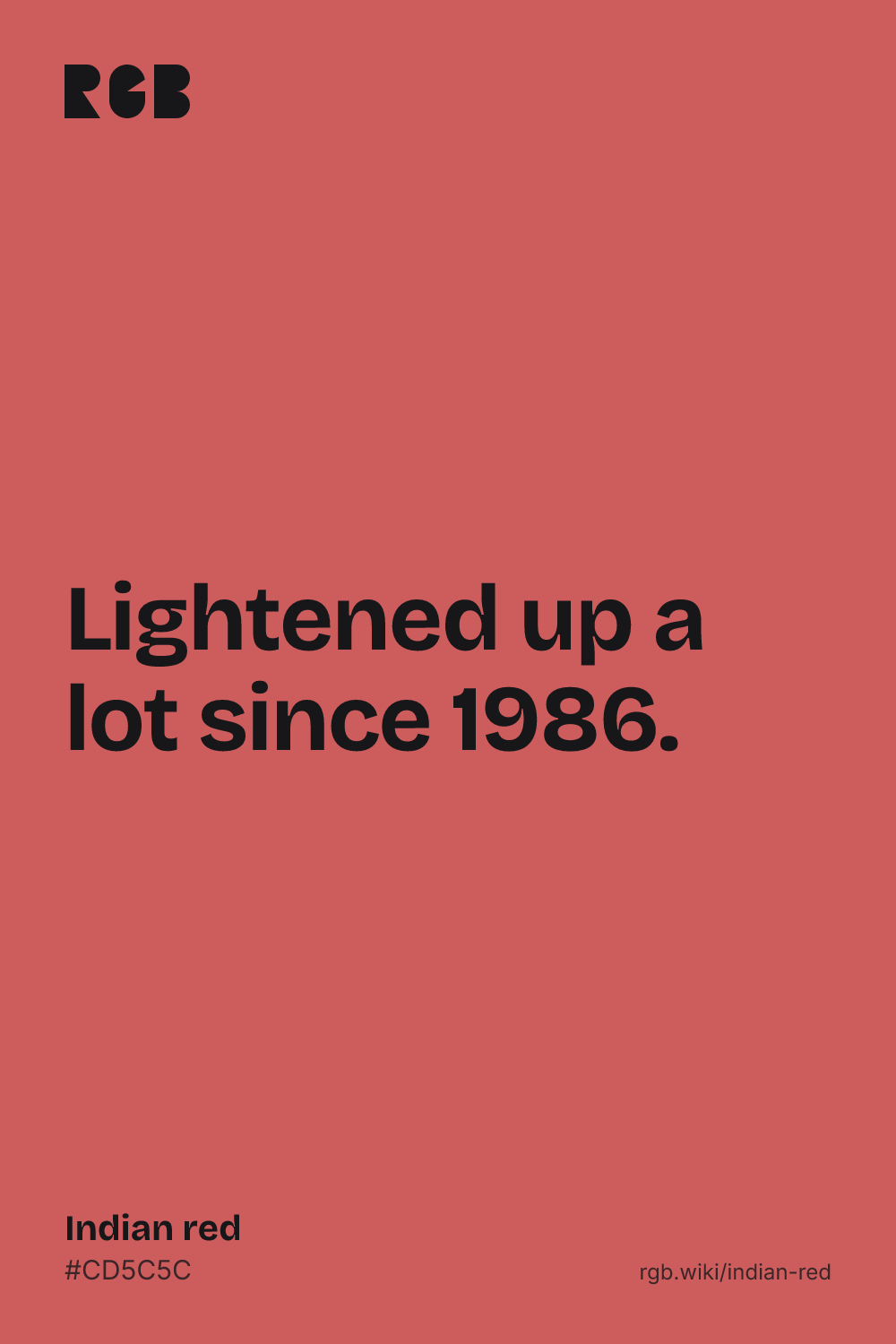
Indian red color card, hex #CD5C5C: “Lightened up a lot since 1986”

Indian red on the color map

The pigment and the name as people use it sit well below the code: the dictionary Indian reds are dark reddish browns, and the survey average is a deep, slightly orange red. The web value is much lighter than either. The outline is an approximate range, not a measured one.

Shades and tints

Tints with white

Shades with black

Tones with gray

Indian red sits in the middle. Tints add white, shades add black and tones add gray, in 10% steps out from it. Tap any swatch to copy its code.

Light and dark indian red

#E19D9D
Light Indian redMixed 40% with white: a dusty rose.
#FF6A6A
IndianRed1The brightest of the four numbered steps in the X11 list, at the edge of the color cube.
#CD5C5C
Indian redThe reference color, set in the X11 Release 4 list of December 1989.
#8B3A3A
IndianRed4Paul Raveling’s 1989 value for indian red, kept as the darkest numbered step when the merged list chose a lighter base.
#79443B
Dictionary Indian redThe moderate reddish brown center the 1955 ISCC-NBS dictionary gives for one of Maerz and Paul’s Indian red samples.
#4F2F2F
Indian red (1986)The value in the first X color list, used from 1986 until 1989: a dark brown red, much nearer the pigment.

Colors that go with indian red

Pairings that work in rooms, outfits and interfaces.

Indian red and cream

Warm and easy, like a painted shop front. Dark brown text, Indian red buttons.

Indian red and teal

Its complement, deepened. Teal text and buttons stay crisp beside the soft red.

Earth pigments

The red with an ochre, an umber and the darker IndianRed4, like a box of iron oxide paints.

Storm-cloud watercolor

English watercolorists mixed Indian red with ultramarine or indigo for the lilac grays of stormy skies. Cool and quiet.

Indian red on charcoal

A dark theme with a warm accent. Use the light tint for text links.

Indian red as background

For a banner or a card. Near-black text, not white, and the 1986 brown red as the button.

Color-wheel palettes

Pick a palette to see where its colors sit on the color wheel. The caret marks indian red. Tap a band to copy its code.

Similar colors

Blush69%Rose gold72%Brick red75%Indian redVermilion70%Cinnabar70%Clay72%

Lined up by hue around indian red. Hover a color to see how similar it is.The bar under each name shows how similar it is. Similarity comes from the distance between the two colors in OKLab, a model of how we see color.

Indian red vs chestnut

Indian red#CD5C5C · hue 0°
  • Lighter, a soft pure red
  • A CSS keyword since 2001
  • Named after an iron oxide pigment
Chestnut#954535 · hue 10°
  • Darker and browner
  • Not a CSS keyword
  • Named after the nut; Crayola’s new name for its Indian Red crayon in 1999

Meaning

  • CSS keyword
  • Named for an iron oxide earth
  • A crayon renamed in 1999
  • Flagged in the CSS standard

Indian red is known less for a mood than for its name and its history. It is named after a red earth pigment from India, not after any people, but the name has been misread often enough that a crayon maker changed it and the CSS standard flags it. Color research tests broad words such as red, never indian red, so the claims below are about the pigment, the code and the name.

Named for an earth pigment

Paint handbook

Indian red is “a variety of red ochre, or red haematite”, Arthur Church wrote in 1915, about 95% ferric oxide with a slightly purplish hue. Most of it imported from India was natural, he noted, but some so-called Indian red came from Hormuz in the Persian Gulf or the Forest of Dean in England, and it could also be made artificially by heating green vitriol with other salts. Merriam-Webster defines it as any of various usually dark red pigments consisting chiefly of iron oxide.1, 2

Darker in the dictionaries

Dictionaries and survey

Merriam-Webster’s second sense of Indian red is “a strong or moderate reddish brown”. Those are the two groups the 1955 ISCC-NBS dictionary gives for Maerz and Paul’s two 1930 Indian red samples, centered on #882D17 and #79443B. In Randall Munroe’s 2010 color survey, people’s average indian red was #850E04, a deep red. All three are far darker than the web’s #CD5C5C.2, 3, 4

Lighter with every revision

Historical record

The first X color list, in 1986, had indian red at 79 47 47, a dark brown red. In 1989 John Thomas, matching a box of 72 Crayola crayons, made it 101 46 46, and Paul Raveling, tuning colors on his HP monitor, made it 139 58 58. The merged list for X11 Release 4 chose a much lighter 205 92 92 and kept Raveling’s value as IndianRed4. No record says why.5, 6

Crayola chose chestnut

Company record

Crayola introduced an Indian Red crayon in 1958 and renamed it Chestnut in 1999. The crayon was named for the pigment, but teachers worried that children would take it as a reference to Native Americans’ skin color.7

Kept, but discouraged

Standards record

In July 2020 a request asked the CSS Working Group to rename indianred “ChestnutRose”, along with moccasin and navajowhite. The standard’s editor replied that the name comes from a pigment from India and has no connection to Native Americans. A count found indianred on 7,139 of about 98 million mobile pages. The group kept the name, because sites depend on it, and added a note that discourages named colors and says some, “such as indianred”, have “been found to be offensive”.8, 9

Sources (9)
  1. Arthur H. Church (1915). The Chemistry of Paints and Painting, 4th edition, London: Seeley, Service & Co., pp. 201–203, “Venetian Red” and “Indian Red”. Scan at the Internet Archive.
  2. Merriam-Webster, “Indian red”, definitions and first known use.
  3. Kelly, K. L. & Judd, D. B. (1955). The ISCC-NBS Method of Designating Colors and a Dictionary of Color Names. National Bureau of Standards Circular 553. PDF at NIST. Maerz and Paul’s two Indian red samples are tabulated with their ISCC-NBS centroids (43, #79443B; 40, #882D17) in Jaffer’s “Maerz and Paul color names”.
  4. Randall Munroe (2010), “Color Survey Results”, and the survey’s 954 most common color names (indian red #850e04), CC0.
  5. The X Window System’s color lists: the first list, in the X10 Release 3 archive (1986; unchanged in X11R1 and X11R3), indian red 79 47 47; John Thomas’s thomas.txt (101 46 46); Paul Raveling’s raveling.txt (139 58 58, with IndianRed1 to IndianRed4); and the merged mit/rgb/rgb.txt (7 December 1989) in the X11 Release 4 archive (205 92 92). Copies hosted by Aubrey Jaffer, MIT CSAIL.
  6. Aubrey Jaffer, “Color-Name Dictionaries”, MIT CSAIL, quoting the X11 README and the notes of John Thomas (Tektronix) and Paul Raveling (ISI).
  7. Crayola, “When was the Crayola Crayon color Chestnut introduced?” (“Originally introduced as Indian Red in 1958, the color was renamed to Chestnut in 1999.”); Mental Floss, “5 Times Crayola Retired Its Crayons”, on the teachers’ concern.
  8. CSS Working Group, issue #5284, “Change three color names” (July to October 2020), read in the W3C mirror: the request, replies, the usage count and the resolution.
  9. W3C, CSS Color Module Level 4, named colors, including the note on why the names are kept.

History

Indian red was a painter’s pigment for centuries before it was a code. Its story runs from imported earth to railway paint, a crayon, a computer list that kept getting lighter, and a note in the CSS standard.

  1. 1672

    First known use of “Indian red” in English, for a dark red pigment made chiefly of iron oxide.1

  2. 1865

    The Talyllyn Railway in Wales receives its first locomotive, painted Indian red, as is its second, in 1866. For the line’s 150th anniversary in 2015, both are repainted in the color, matched from photographic archives.2

  3. 1915

    Arthur Church’s The Chemistry of Paints and Painting describes Indian red as about 95% ferric oxide, slightly purplish, mostly a natural earth imported from India, and gives a recipe for making it artificially.3

  4. 1930

    Maerz and Paul’s A Dictionary of Color prints two Indian red samples. The 1955 ISCC-NBS dictionary files them as strong and moderate reddish brown.4

  5. 1958

    Crayola introduces a crayon called Indian Red.5

  6. 1986

    The X Window System’s first color list, shipped with X10 Release 3, includes indian red as 79 47 47, a dark brown red. It stays the same through X11 Release 3 in 1988.6

  7. 1989

    John Thomas retunes indian red to 101 46 46 and Paul Raveling to 139 58 58. The merged list in X11 Release 4, dated December 7, sets a much lighter 205 92 92 and keeps Raveling’s value as IndianRed4.6, 7

  8. 1999

    Crayola renames its Indian Red crayon Chestnut, after teachers worried that children would read the name as a reference to Native Americans’ skin color.5

  9. 2001

    SVG 1.0 lists “indianred”, rgb(205, 92, 92), among the web’s color keywords.8

  10. 2011

    CSS Color Module Level 3 becomes a W3C Recommendation on June 7 and makes indianred, #cd5c5c, an official CSS keyword.9

  11. 2020

    A request asks the CSS Working Group to rename indianred. In October the group keeps it and adds a note to the standard that names indianred as an example of a name “found to be offensive” and discourages named colors.10, 11

Sources (11)
  1. Merriam-Webster, “Indian red”, definitions and first known use.
  2. BBC News (8 January 2015). “Talyllyn steam locomotives get secret 150th paint job”.
  3. Arthur H. Church (1915). The Chemistry of Paints and Painting, 4th edition, London: Seeley, Service & Co., pp. 201–203, “Venetian Red” and “Indian Red”. Scan at the Internet Archive.
  4. Kelly, K. L. & Judd, D. B. (1955). The ISCC-NBS Method of Designating Colors and a Dictionary of Color Names. National Bureau of Standards Circular 553. PDF at NIST. Maerz and Paul’s two Indian red samples are tabulated with their ISCC-NBS centroids (43, #79443B; 40, #882D17) in Jaffer’s “Maerz and Paul color names”.
  5. Crayola, “When was the Crayola Crayon color Chestnut introduced?” (“Originally introduced as Indian Red in 1958, the color was renamed to Chestnut in 1999.”); Mental Floss, “5 Times Crayola Retired Its Crayons”, on the teachers’ concern.
  6. The X Window System’s color lists: the first list, in the X10 Release 3 archive (1986; unchanged in X11R1 and X11R3), indian red 79 47 47; John Thomas’s thomas.txt (101 46 46); Paul Raveling’s raveling.txt (139 58 58, with IndianRed1 to IndianRed4); and the merged mit/rgb/rgb.txt (7 December 1989) in the X11 Release 4 archive (205 92 92). Copies hosted by Aubrey Jaffer, MIT CSAIL.
  7. Aubrey Jaffer, “Color-Name Dictionaries”, MIT CSAIL, quoting the X11 README and the notes of John Thomas (Tektronix) and Paul Raveling (ISI).
  8. W3C (2001). Scalable Vector Graphics (SVG) 1.0, recognized color keyword names.
  9. W3C (2011). CSS Color Module Level 3, extended color keywords, W3C Recommendation, June 7, 2011.
  10. CSS Working Group, issue #5284, “Change three color names” (July to October 2020), read in the W3C mirror: the request, replies, the usage count and the resolution.
  11. W3C, CSS Color Module Level 4, named colors, including the note on why the names are kept.

Questions

What color is Indian red?

A muted, medium red. Its code is #CD5C5C (RGB 205, 92, 92), the CSS keyword indianred. It sits exactly on the red hue, softened with gray.

Why is it called Indian red?

It is named after a pigment: a red iron oxide earth that was first imported from India and is now mostly made artificially. The name has been used in English since at least 1672. It has no connection to Native Americans.

Is the real Indian red pigment this color?

No. The pigment is a dark, slightly purplish red brown. Color dictionaries file it as a strong or moderate reddish brown, much darker than the web color. The first computer value, from 1986, was much closer.

Is indianred still valid CSS?

Yes. indianred, #CD5C5C and rgb(205, 92, 92) all give exactly the same color in every browser. The CSS standard discourages named colors in general and notes that some, such as indianred, have been found offensive, so many developers write the hex code instead.

Why did Crayola rename Indian Red?

Crayola introduced an Indian Red crayon in 1958 and renamed it Chestnut in 1999, after teachers worried that children would think the name referred to Native Americans’ skin color.

What is the difference between Indian red and chestnut?

Indian red (#CD5C5C) is lighter and a pure, soft red. Chestnut (#954535) is darker and browner. Indian red is a CSS keyword; chestnut is not.

What text color works on Indian red?

Black or a very dark brown. Black on Indian red has a contrast of about 5.3:1, fine for body text. White reaches only about 4.0:1, so keep it for large headings.

What colors go with Indian red?

Cream for a warm, classic look, deep teal as its complement, ochre and umber for an earthy palette, and charcoal for a dark theme.