Named for gold
Word historyOrpiment comes from Latin auripigmentum, from aurum, gold, and pigmentum, pigment. Its color drew alchemists in both China and Europe who were looking for a way to make gold.1, 2
A golden yellow named after an arsenic mineral, once one of the few bright yellows a painter could get.
Orpiment is a warm golden yellow. Its web code, #F2B33D, has strong red, about 70 percent green and little blue, which tips it toward orange. It sits almost on top of honey, a touch lighter, and it is softer than chrome yellow.
The name comes from Latin auripigmentum, “gold pigment,” and reached English in the 1300s. Orpiment is a mineral, arsenic sulfide (As₂S₃), found in hot springs, volcanic vents and low-temperature veins. It is soft enough to scratch with a fingernail, so it grinds easily into paint. Painters used it from ancient Egypt to Renaissance Venice, until chrome and cadmium yellows replaced it in the 1800s.
The web code is more orange than the mineral. Mineral handbooks describe orpiment as lemon-yellow to golden, with a pale lemon-yellow powder, and the 1955 ISCC-NBS color dictionary filed Maerz and Paul’s orpiment sample as brilliant yellow, #FADA5E. The web code lands nearer the strong orange yellow where the same dictionary filed their sample of realgar, orpiment’s orange-red sister mineral.
Orpiment is a light color. White text on it reaches only about 1.9:1, so use black (11.3:1) or a dark brown. It looks at home beside ultramarine, vermilion and black, the colors it shared on old manuscripts and icons.
| HEX | #F2B33D | |
|---|---|---|
| RGB | rgb(242, 179, 61) | |
| HSL | hsl(39, 87%, 59%) | |
| HSV | 39°, 75%, 95% | |
| CMYK | 0, 26, 75, 5 | |
| OKLCH | oklch(80.6% 0.147 79.0) |
The dictionary’s orpiment sits to the right of the web code, toward pure yellow: brilliant yellow above and just outside the outline, strong yellow on its right edge, a little darker. Wikipedia’s value sits upper right, near the edge. Maerz and Paul’s realgar sits just below and to the left: darker and a little more orange, and closer to the web code than their orpiment is. The outline is an approximate range, not a measured one.
Tints with white
Shades with black
Tones with gray
Pairings that work in rooms, outfits and interfaces.
The manuscript pairing: gold-yellow, deep blue and pale vellum.
Bright yellow and red on black, like a painted icon.
Painters mixed the two for green. Calm and earthy.
Strong contrast. Clean and modern, good for signs and buttons.
The two arsenic minerals that grow side by side. Warm and fiery.
Soft and sunny. Suits kitchens, gardens and packaging.
Pick a palette to see where its colors sit on the color wheel. The caret marks orpiment. Tap a band to copy its code.
Lined up by hue around orpiment. Hover a color to see how similar it is.The bar under each name shows how similar it is. Similarity comes from the distance between the two colors in OKLab, a model of how we see color.
Orpiment’s name promises gold, and alchemists hoped it held some. What it really holds is arsenic. For thousands of years it gave painters a clear, bright yellow for manuscripts, icons and Venetian paintings. But it is poisonous, it breaks down in light, and it can harm the paint around it. The claims below rest on dictionaries, reference works and conservation science. No study has tested how the color orpiment makes people feel.
Orpiment comes from Latin auripigmentum, from aurum, gold, and pigmentum, pigment. Its color drew alchemists in both China and Europe who were looking for a way to make gold.1, 2
Orpiment is arsenic sulfide. It was used as a fly poison and to tip arrows. In 2023 the UK recalled decorative bookends made of the mineral, warning that arsenic sulfide can irritate the skin and is toxic if swallowed or breathed in.2, 3, 4
Light breaks orpiment down into white, crumbly arsenic oxides that dissolve in water. A 2016 study of five paint samples containing orpiment, realgar or a later arsenic green found that arsenic had moved through every layer of each one, from the support to the varnish. The authors advise low light, steady humidity and no water-based cleaning.5
Reference works describe orpiment as incompatible with lead and copper pigments. Painters did mix them anyway: in Raphael’s Sistine Madonna, the green curtain contains orpiment with lead white and malachite, a copper green.3, 6
In Chinese, orpiment is ci huang, “female yellow,” and realgar is xiong huang, “male yellow,” names that pair the two minerals that are found together. Orpiment was also used as a medicine in China, despite being very toxic.2
Orpiment is one of the oldest yellows people have painted with. Its story runs from Egyptian tombs and Himalayan manuscripts through Venice to a product recall in 2023.
Lumps of orpiment pigment are left in an Egyptian tomb of the 14th century BCE. Orpiment is also found in the wall decoration of Tutankhamun’s tomb.1
The Greek writer Theophrastus calls orpiment arsenikon, from a word for “male,” after the belief that metals had sexes.1
Painters in Kashmir or western Tibet illustrate a Buddhist sutra with gold, lapis lazuli, cinnabar, indigo and orpiment. A leaf is now at the Metropolitan Museum of Art.2
“Orpiment” enters English, through Anglo-French, from Latin auripigmentum.3
Raphael paints the Sistine Madonna. The green curtain at the top mixes orpiment with lead white, charcoal black and malachite.4
Tintoretto paints the gold embroidery on Vincenzo Morosini’s stole with orpiment and realgar.5
Records in Venice show orpiment bought for a Romanian prince.1
A workshop in Ethiopia paints a diptych of the apostles. Scientific analysis later confirms orpiment as its yellow.6
Chrome yellow, first used in a painting before 1810, then cadmium yellows and aniline colors replace orpiment on painters’ palettes.1, 7
The UK recalls orpiment bookends sold in 2022, because arsenic sulfide is toxic if swallowed or breathed in.8
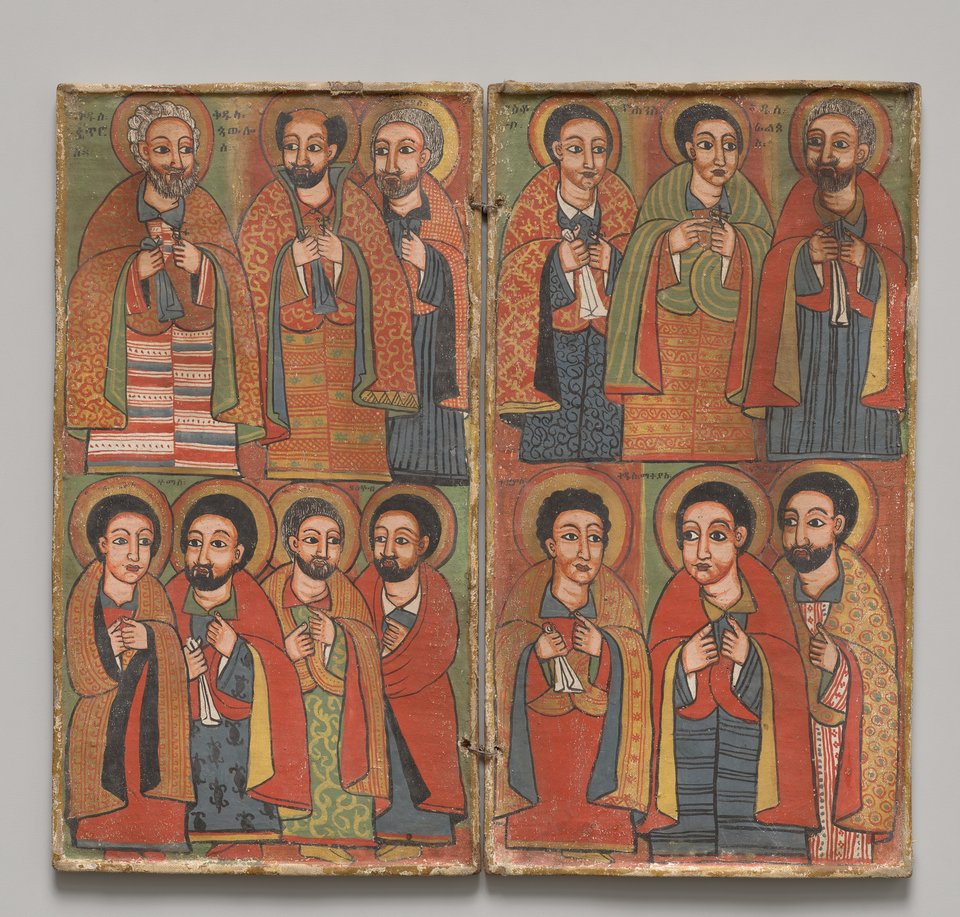
A two-panel painting from the workshop or circle of Wäldä Maryam in Ethiopia, now at the Cleveland Museum of Art. Analysis confirmed orpiment as its yellow, with smalt, indigo, vermilion and red lake. The yellow cloak linings sample as a muted gold, duller and darker than the web code.
Sampled from the Cleveland Museum of Art’s photograph (2023.4), released as CC0 (public domain). The pigments come from the conservation statement in the museum’s record. Colors in a photo shift with the lighting, so read the codes as close, not exact.

A fragment of a Buddhist manuscript from Kashmir or western Tibet, now at the Metropolitan Museum of Art. The museum lists gold, lapis lazuli, cinnabar, indigo and orpiment among its pigments, but not where each one sits. The yellow band of the rainbow halo samples close to the web code.
Sampled from the Metropolitan Museum of Art’s photograph (2020.74.4), released under its Open Access policy as CC0 (public domain). The date, place and pigments come from the museum’s record. Colors in a photo shift with the lighting, so read the codes as close, not exact.
Palettes are sampled in-house.
A warm golden yellow. The usual web code is #F2B33D (RGB 242, 179, 61): strong red, about 70 percent green and little blue. The mineral itself ranges from lemon-yellow to golden.
Yes. Orpiment is arsenic sulfide, and it was once used as a fly poison. In 2023 the UK recalled bookends made of it. The color on a screen is just a code and is harmless.
From Latin auripigmentum, gold pigment, because of its deep yellow. The word reached English through Anglo-French in the 1300s.
Both are arsenic sulfide minerals and are often found together. Orpiment is golden yellow, while realgar is orange to red. In Chinese they are called female yellow and male yellow.
Chrome yellow, first used in painting in the early 1800s, followed by cadmium yellows and synthetic dyes. Orpiment’s toxicity, and its clashes with lead and copper pigments, made the newcomers welcome.
Yes. King’s yellow is an old name for orpiment used as a pigment.
Deep blue such as lapis or ultramarine, vermilion red, black and cream, as on old manuscripts. For a modern look, try charcoal or sage.