Naples yellow

A warm, creamy yellow named after one of the oldest pigments people ever made, and a city that may have had little to do with it.

Overview

Naples yellow is a light, warm yellow with a soft, creamy edge. Its web code, #FADA5E, has almost full red, about 85 percent green and a little blue, which takes the sting out of it. On screen it is nearly the same color as mustard yellow, and a touch stronger than jasmine.

The name comes from a pigment, lead antimonate, made by roasting lead and antimony compounds together. It is one of the oldest synthetic pigments known. Glassmakers in Egypt and Mesopotamia used it to color glass yellow from the 1400s BCE, and for about seventeen centuries it was the only yellow in general use in glass. It came back in Italian maiolica pottery around 1500, reached European oil painting in the 1600s and was most popular between about 1750 and 1850.

Nobody knows for sure why it is named after Naples. The name first appears in print as luteolum Napolitanum, in a treatise by the painter Andrea Pozzo published in Rome between 1693 and 1700. Writers long believed the pigment was a product of Vesuvius, possibly because Naples is built of a yellow volcanic stone. In fact it was always made in the workshop. Since the mid-1800s most paint sold as Naples yellow has been an imitation, mixed from other pigments, so the name now stands for a range of soft yellows from greenish to pinkish.

Naples yellow is a very light color. White text on it reaches only about 1.4:1, so use black (15.3:1) or a dark brown or blue. It looks at home beside turquoise and deep blue, as on old glass and glazed brick, and beside warm reds and creamy whites.

HEX#FADA5E
RGBrgb(250, 218, 94)
HSLhsl(48, 94%, 67%)
HSV48°, 62%, 98%
CMYK0, 13, 62, 2
OKLCHoklch(89.2% 0.145 94.8)
Every code converts from the HEX value #FADA5E. #FADA5E is the center of ISCC-NBS color group 83, brilliant yellow, in John Foster’s sRGB version, and Wikipedia gives it for Naples yellow, citing the ISCC-NBS dictionary. The 1955 dictionary files the Horticultural Colour Chart’s Naples yellow under brilliant yellow and light yellow (Jaffer’s table), and Maerz and Paul’s (1930) under light yellow, #F8DE7E, and three duller groups (Maerz and Paul). The National Gallery of Art’s pigment handbook measured its dry samples of the real pigment within brilliant yellow. CMYK is a screen-based estimate; print results vary.
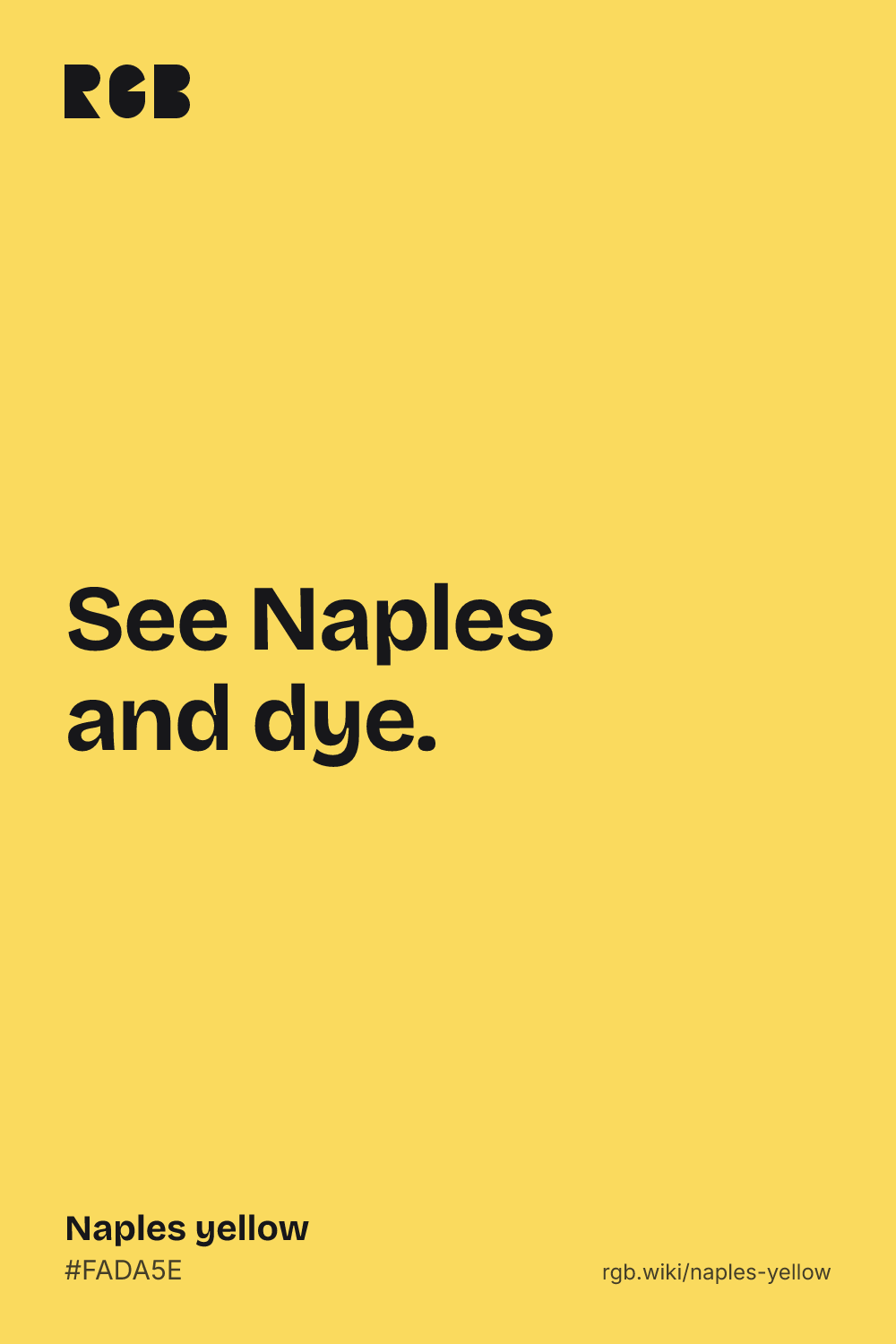
Naples yellow color card, hex #FADA5E: “See Naples and dye”

Naples yellow on the color map

All the dictionary values sit at almost the same hue as the reference. Maerz and Paul’s light yellow sits just above it, a little lighter and softer, and pale yellow sits higher still, toward cream. Moderate and grayish yellow sit well below, darker and duller, just outside the outline. The outline is an approximate range, not a measured one.

Shades and tints

Tints with white

Shades with black

Tones with gray

Naples yellow sits in the middle. Tints add white, shades add black and tones add gray, in 10% steps out from it. Tap any swatch to copy its code.

Light and dark naples yellow

#FDF0BF
Pale Naples yellowMixed 60% with white. A soft butter cream.
#F3E5AB
Pale yellowISCC-NBS pale yellow, one of the groups the 1955 dictionary gives for Maerz and Paul’s Naples yellow. See vanilla
#F8DE7E
Light yellowISCC-NBS light yellow, the main group for Maerz and Paul’s Naples yellow (1930) and Ridgway’s (1912). See jasmine
#FADA5E
Naples yellowThe reference color.
#C9AE5D
Moderate yellowISCC-NBS moderate yellow, a darker group the dictionary also gives for Maerz and Paul’s sample.
#968338
Dark Naples yellowMixed 40% with black. A dull olive gold.

Colors that go with naples yellow

Pairings that work in rooms, outfits and interfaces.

Babylon glaze

Yellow and cream on deep turquoise, like the glazed lion bricks of Babylon.

Egyptian glass

Yellow and white threads on dark blue, as on core-formed glass bottles.

Maiolica

Yellow, cobalt blue and orange on tin-white, like Italian painted pottery.

Painter’s palette

Naples yellow, vermilion, lead white and umber. Warm and classic.

Naples yellow and slate

Soft yellow on a dark blue-gray. Clean and modern, good for buttons and highlights.

Nursery cream

Pale Naples yellow with powder blue and gray. Gentle and calm.

Color-wheel palettes

Pick a palette to see where its colors sit on the color wheel. The caret marks naples yellow. Tap a band to copy its code.

Similar colors

Mustard yellow96%Jasmine86%Naples yellowBuff84%Flax83%Banana yellow82%Straw83%

Lined up by hue around naples yellow. Hover a color to see how similar it is.The bar under each name shows how similar it is. Similarity comes from the distance between the two colors in OKLab, a model of how we see color.

Naples yellow vs mustard yellow

Naples yellow#FADA5E · hue 48°
  • A hair softer, with slightly less red
  • Named after an ancient lead antimonate pigment
  • A painter’s and glassmaker’s yellow
Mustard yellow#FFDB58 · hue 47°
  • Full red, a touch brighter on screen
  • Named after the condiment
  • Most people picture it darker than the code

Meaning

  • Early synthetic
  • Ancient glass
  • Puzzling name
  • Painters’ yellow

Naples yellow is a color with a long past and a misleading name. People made it on purpose, from lead and antimony, more than three thousand years ago, and it colored glass and glazed brick long before it reached a painter’s palette. The claims below rest on a pigment handbook, museum records and conservation sources. No study has tested how the color Naples yellow makes people feel.

Why Naples is unclear

Word history

The name first appears in print as luteolum Napolitanum, in Andrea Pozzo’s treatise published in Rome in 1693–1700. Writers long thought the pigment came from Vesuvius. The pigment handbook suggests the belief may come from the yellow volcanic stone used for building in Naples, but no source shows the pigment was ever made there in particular.1, 2
One of the oldest synthetic pigments

Reference works

Lead antimonate does occur in nature, as the mineral bindheimite, but there is no evidence painters or glassmakers used it. The pigment was made by roasting lead and antimony compounds. Like Egyptian blue, it is one of the oldest pigments people made on purpose.1, 3

A glassmakers’ yellow first

Historical record

Lead antimonate colors Egyptian glass from the reign of Amenhotep II in the 1400s BCE, and Mesopotamian glass and glazed bricks soon after. Studies of ancient glass found it was the only yellow in general use for about the first seventeen centuries of glassmaking.1

Most “Naples yellow” is an imitation

Reference works

Most makers stopped producing genuine lead antimonate around the middle of the 1800s. The pigment handbook warns that unless a composition is given, a mention of Naples yellow after about 1850 may well mean a substitute, and that modern versions are mixed from other pigments, notably cadmium yellow with a white.1, 2

Lead makes it darken

Conservation science

Because it contains lead, the real pigment darkens in air polluted with hydrogen sulfide, which made it more useful in oil than in watercolor. The chemist George Field warned in the 1800s that it could turn black and advised painters to mix it with an ivory or horn knife rather than a metal one.1, 2

Sources (3)
  1. Ian N. M. Wainwright, John M. Taylor and Rosamond D. Harley, “Lead Antimonate Yellow,” in Artists’ Pigments, vol. 1, ed. Robert L. Feller (1986), pp. 219–254, PDF from the National Gallery of Art.
  2. Wikipedia, “Naples yellow”, citing St. Clair, The Secret Lives of Color (2017), Maerz and Paul, A Dictionary of Color (1930), and Wainwright et al. (1986).
  3. ColourLex, “Naples Yellow”, composition, names, preparation and examples of use.

History

Naples yellow spent most of its life as a colorant for glass and glaze. Painters came to it late, used it for about two centuries, and then let the name pass to imitations.

  1. 1400s BCE

    A glass fragment with white, blue and yellow threads from the palace of Amenhotep II at Thebes is among the earliest known uses of lead antimonate yellow. It also colors yellow glass from Tell el-Amarna and from Nuzi in Mesopotamia.1

  2. 722–705 BCE

    Cakes of lead antimonate pigment are left in the palace of the Assyrian king Sargon II at Khorsabad, where it may have glazed a doorway arch.1

  3. About 604–562 BCE

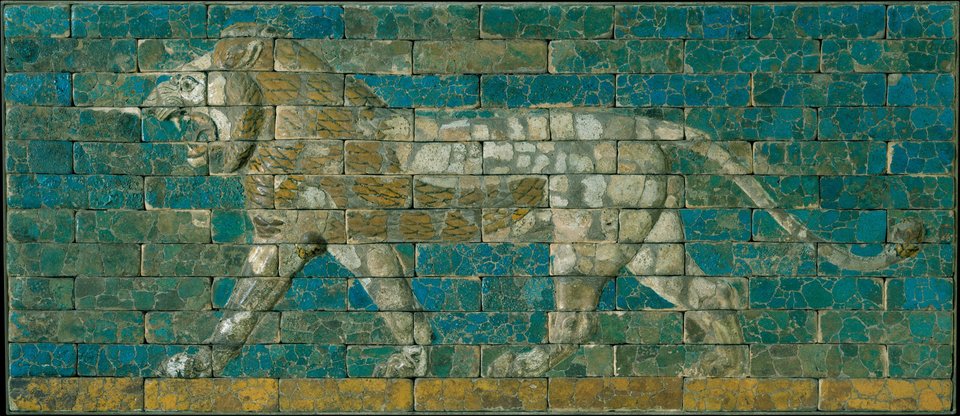
    In Babylon, glazed tiles line the processional street. The pigment handbook cites reports of lead antimonate in their glaze. Two lion panels from the street are now at the Metropolitan Museum of Art.1, 3

  4. 1540

    Vannoccio Biringuccio’s Pirotechnia describes antimony for yellow on earthenware, enamels and glass.1

  5. 1556–1559

    Cipriano Piccolpasso writes the earliest known recipes for the pigment, seven versions for yellow maiolica glazes.1

  6. 1630–1632

    Matthias Stom paints The Arrest of Christ, now in the National Gallery of Canada, the earliest known use of the pigment in Western painting.1

  7. 1693–1700

    Andrea Pozzo’s treatise, published in Rome, calls the pigment luteolum Napolitanum, the first recorded “Naples yellow.”1

  8. 1738

    “Naples yellow” first appears in print in English.2

  9. 1750–1850

    The pigment’s most popular century, as lead-tin yellow drops out of use. After 1850 chrome and cadmium yellows take its place.1

  10. 1975

    The only maker of the pigment listed in the Colour Index tells researchers it has stopped making it. A few artists’ suppliers still sell the real pigment when the handbook appears in 1986.1

Sources (3)
  1. Ian N. M. Wainwright, John M. Taylor and Rosamond D. Harley, “Lead Antimonate Yellow,” in Artists’ Pigments, vol. 1, ed. Robert L. Feller (1986), pp. 219–254, PDF from the National Gallery of Art.
  2. Wikipedia, “Naples yellow”, citing St. Clair, The Secret Lives of Color (2017), pp. 76–77, and Maerz and Paul, A Dictionary of Color (1930), p. 205.
  3. Metropolitan Museum of Art, “Panel with striding lion” (31.13.1), collection record.

Naples yellow in use

A wall panel of glazed bricks showing a roaring lion striding left, pale gray-white with a yellow mane, on a turquoise-blue ground above a yellow band
#9B8135#796D3A#ACAD92#15615C
Glazed brickPanel with striding lion, Babylon (about 604–562 BCE)

One of the glazed brick lions that lined Babylon’s processional street, now at the Metropolitan Museum of Art. The pigment handbook cites reports of lead antimonate in the glaze of this street’s tiles, but we found no analysis of this panel itself, so its yellow is likely, not confirmed. The yellow mane and base band sample as a dull ochre, far darker than the web code after 2,600 years.

#9B8135#796D3A#ACAD92#15615C
Source: Metropolitan Museum of Art

Palettes are sampled in-house.

Questions

What color is Naples yellow?

A light, warm, slightly creamy yellow. The usual web code is #FADA5E (RGB 250, 218, 94), the center of the ISCC-NBS brilliant yellow group. Real Naples yellow paint ranges from greenish to pinkish yellow.

Is Naples yellow from Naples?

Probably not in particular. The name first appears in a treatise published in Rome in the 1690s, and writers long believed the pigment came from Vesuvius. It was always made in workshops, by roasting lead and antimony, and it was used in glass for thousands of years before the name existed.

What is Naples yellow made of?

The original pigment is lead antimonate. Since about 1850 most paint sold as Naples yellow has been an imitation mixed from other pigments, such as cadmium yellow and a white, or ochre and white.

Is Naples yellow toxic?

The genuine pigment contains lead and should be handled like any lead pigment. Many modern paints with the name contain none. The color on a screen is just a code and is harmless.

Is Naples yellow the same as mustard yellow?

On screen they are almost identical: #FADA5E and #FFDB58. The names come from different places, an old pigment and a condiment, and most people picture mustard darker.

What is the difference between Naples yellow and lead-tin yellow?

Both are old lead-based yellows. Lead-tin yellow was the painters’ main yellow from about 1300 to 1750. Lead antimonate, Naples yellow, took its place in painting from the 1600s, though it had colored glass far longer.

What colors go with Naples yellow?

Turquoise and deep blue, as on ancient glazed brick and glass; vermilion, umber and cream for a classic painter’s look; or slate and charcoal for a modern one. Use dark text on it, never white.