Banana yellow

A bright, warm yellow named after a ripe banana peel, one stop on the way from green to flecked.

Overview

Banana yellow is a bright, warm yellow named after the peel of a ripe banana. Its usual code is #FFE135: red at full strength, green at 88% and blue at 21%. That makes it a shade warmer and softer than canary yellow, and almost the same as golden yellow.

The banana behind the name is almost always the Cavendish, which makes up nearly half of the world’s bananas and almost all of those traded between countries. It took over the export trade in the mid-1900s, after Panama disease wiped out plantations of the older Gros Michel. Other bananas ripen to other colors: the Fe’i bananas of the Pacific, which Paul Gauguin painted in Tahiti, turn bright orange.

Banana yellow is also a moment, not a fixed color. Bananas are cut and shipped green, then ripened with ethylene gas, and the trade grades the peel on a seven-step scale, from 1, green, to 7, yellow flecked with brown. The yellow shows as the peel’s chlorophyll breaks down. In the U.S. Department of Agriculture’s ripening guide, the all-yellow stage samples near #FBCF5B, warmer and softer than the web code, while people in the xkcd color survey picked a lighter, greener banana yellow, #FAFE4B.

On screens, #FFE135 is very light: black text on it reads at about 16 to 1, and white text fails. Pair it with chocolate brown, navy or leaf green, and keep it away from thin lines or text on white.
HEX#FFE135
RGBrgb(255, 225, 53)
HSLhsl(51, 100%, 60%)
HSV51°, 79%, 100%
CMYK0, 12, 79, 0
OKLCHoklch(90.8% 0.176 98.5)
Every code converts from the HEX value #FFE135. No color standard defines banana yellow. #FFE135 is the code most color lists use; Wikipedia’s list of colors gives it, citing a color-name website, not a dictionary. The 1955 ISCC-NBS dictionary files Plochere’s banana (1948) as light yellow, about #F8DE7E, and Maerz and Paul’s banana (1930) as grayish yellow, about #C2B280. In the xkcd color survey, people’s banana yellow averaged #FAFE4B. CMYK is a screen-based estimate; print results vary.
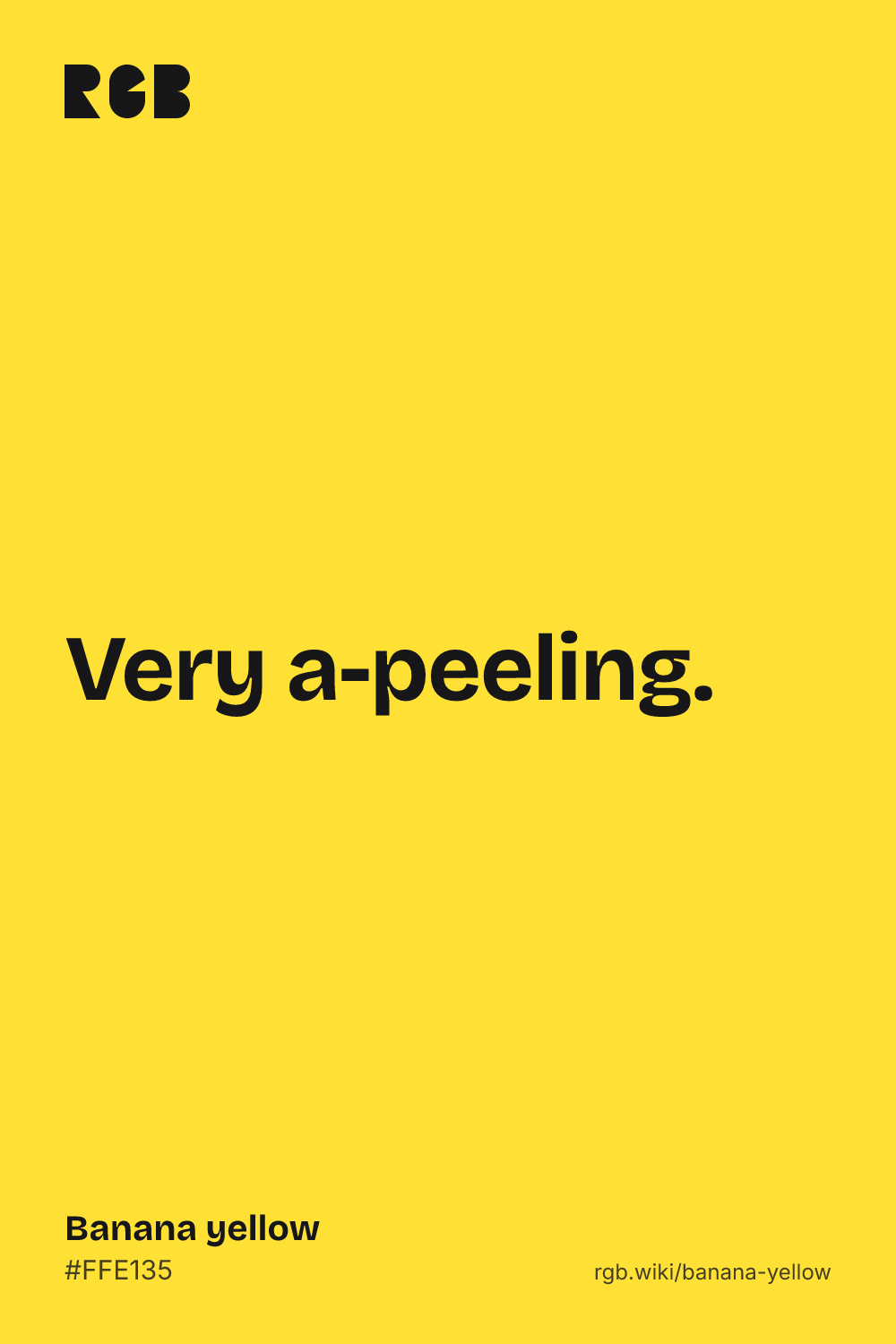
Banana yellow color card, hex #FFE135: “Very a-peeling”

Banana yellow on the color map

People’s average banana yellow in the xkcd survey sits above and to the right of the code, inside the outline: lighter and greener. The USDA’s painted ripe banana sits a little below and to the left, deeper and warmer. Plochere’s banana sits just left of the code at about the same lightness, but much softer. Maerz and Paul’s banana lies below the outline, a dull grayish yellow, so it is pinned to the edge. The outline is an approximate range, not a measured one.

Shades and tints

Tints with white

Shades with black

Tones with gray

Banana yellow sits in the middle. Tints add white, shades add black and tones add gray, in 10% steps out from it. Tap any swatch to copy its code.

Light and dark banana yellow

#FFF3AE
Pale bananaMixed 60% with white. A soft cream-yellow for backgrounds.
#FFE135
Banana yellowThe reference color.
#F8DE7E
Plochere bananaThe ISCC-NBS light yellow, where the 1955 dictionary files Plochere’s banana (1948). The same code is used for jasmine. See jasmine
#B9B459
Green bananaThe ISCC-NBS moderate greenish yellow, one of two groups where the 1955 dictionary files Plochere’s green banana.
#C2B280
Dictionary bananaThe ISCC-NBS grayish yellow, where the 1955 dictionary files Maerz and Paul’s banana (1930). The same code is used for ecru. See ecru
#80701A
Deep bananaMixed 50% with black. It turns olive, dark enough for white text.

Colors that go with banana yellow

Pairings that work in rooms, outfits and interfaces.

Banana and chocolate

A dessert pairing. Warm and rich, with the yellow as the highlight.

Ripening scale

Green, turning, ripe and flecked, as on the trade’s color chart. Good for food and grocery design.

Banana and navy

Strong contrast for sports, signs and bold headings. Confident and clear.

Banana leaf

Banana yellow with the deep green of the plant’s leaves. Fresh and summery.

Ia Orana Maria

From Gauguin’s 1891 painting: orange Fe’i bananas, pale fruit and deep green grass. Earthy and warm.

Banana and gray

Neutral gray calms the yellow. Clean and modern for interfaces.

Color-wheel palettes

Pick a palette to see where its colors sit on the color wheel. The caret marks banana yellow. Tap a band to copy its code.

Similar colors

Mustard yellow85%Naples yellow82%Gold88%Banana yellowGolden yellow94%Maize85%Dandelion89%

Lined up by hue around banana yellow. Hover a color to see how similar it is.The bar under each name shows how similar it is. Similarity comes from the distance between the two colors in OKLab, a model of how we see color.

Banana yellow vs canary yellow

Banana yellow#FFE135 · hue 51°
  • Warmer and a little softer
  • Named after the ripe Cavendish peel
  • One stage on a green-to-flecked scale
Canary yellow#FFEF00 · hue 56°
  • Brighter and slightly greener
  • Named after the pet songbird
  • Also a name for printer’s yellow ink

Meaning

  • Green turns yellow
  • Graded 1 to 7
  • Blue under UV
  • A memory color

Banana yellow is the color of a ripening stage. The peel turns from green to yellow as its chlorophyll breaks down, the fruit trade grades it on a seven-step color scale, and the yellow is so familiar that it changes how people see a banana. Research on color and emotion tests broad words such as yellow, not banana yellow, so the claims below are about the fruit and how people see it.

Yellow shows as the green fades

Lab studies

A banana peel is green from chlorophyll, then yellow from carotenoid pigments, and finally brown to black as phenolic compounds darken. Chlorophyll breakdown is the main driver of the visible change, uncovering the yellow underneath.1, 2

Too warm, and ripe bananas stay green

Lab study

Cavendish-type bananas fail to turn yellow when they ripen above about 24 °C (75 °F). In a 2009 study, fruit ripened at 30 °C softened and sweetened faster than fruit at 20 °C, but its peel stayed green: the heat held back chlorophyll breakdown, apparently because sugars built up in the peel.3

The trade grades bananas by peel color

Industry guides

Bananas are shipped green and ripened near where they are sold, with a day or two of ethylene gas in rooms at about 14 to 18 °C. The U.S. Department of Agriculture’s ripening guide numbers the peel colors from 1, green, through 4, more yellow than green, and 6, yellow, to 7, yellow flecked with brown. Chilling below 13 °C spoils the result: the peel ripens smoky or dull yellow instead of bright yellow.4, 5

Ripe peels glow blue under UV light

Lab studies, cause disputed

Under ultraviolet light, yellow bananas glow blue, and very ripe ones show bright blue rings around their brown spots. A 2009 study traced the glow to fluorescent products of chlorophyll breakdown that linger in banana peel. A 2018 study disputed this, finding the glow comes mostly from phenolic compounds bound to the cell walls, so the cause is still debated.6, 2

Memory makes a gray banana look yellow

Lab studies

In a 2006 study, 14 observers adjusted a photo of a banana on a screen until it looked gray. They pushed it past gray toward blue, the opposite of yellow; at true gray, the banana still looked yellowish to them. Other fruits showed the same effect, and the same lab later found it with familiar man-made objects.7, 8

Sources (8)
  1. Müller, T. & Kräutler, B. (2011). Chlorophyll breakdown as seen in bananas: sign of aging and ripening, a mini-review. Gerontology, 57(6), 521–527. doi:10.1159/000321877
  2. Tiessen, A. (2018). The fluorescent blue glow of banana fruits is not due to symplasmic plastidial catabolism but arises from insoluble phenols estherified to the cell wall. Plant Science, 275, 75–83. doi:10.1016/j.plantsci.2018.07.006
  3. Yang, X., Pang, X., Xu, L. et al. (2009). Accumulation of soluble sugars in peel at high temperature leads to stay-green ripe banana fruit. Journal of Experimental Botany, 60(14), 4051–4062. doi:10.1093/jxb/erp238
  4. U.S. Department of Agriculture, Agricultural Marketing Service (2001). “Banana Ripening Guide: Color Index Numbers for Banana Ripening” (BAN-C-1), reference copy of the inspection visual aid.
  5. World Food Logistics Organization (2018). “Bananas”, Commodity Storage Manual, revised with A. A. Kader (UC Davis) and E. Yahia. Global Cold Chain Alliance.
  6. Moser, S., Müller, T., Holzinger, A. et al. (2009). Fluorescent chlorophyll catabolites in bananas light up blue halos of cell death. PNAS, 106(37), 15538–15543. doi:10.1073/pnas.0908060106
  7. Hansen, T., Olkkonen, M., Walter, S. & Gegenfurtner, K. R. (2006). Memory modulates color appearance. Nature Neuroscience, 9(11), 1367–1368. doi:10.1038/nn1794
  8. Witzel, C., Valkova, H., Hansen, T. & Gegenfurtner, K. R. (2011). Object knowledge modulates colour appearance. i-Perception, 2(1), 13–49. doi:10.1068/i0396

History

Bananas are picked green and sold yellow, so banana yellow has always been a moment, not a fixed color. The name followed the fruit around the world, and the banana it describes changed in the mid-1900s.

  1. 1597

    First known use of the word banana in English, according to Merriam-Webster. It came through Spanish or Portuguese from a West African language; Wolof has banaana.1

  2. 1835–36

    At Chatsworth in Derbyshire, the gardener Joseph Paxton’s banana plant, grown from a specimen imported from Mauritius, flowers in 1835 and fruits the next May. He names it Musa cavendishii after his employers, the Cavendish family, Dukes of Devonshire. The Cavendish bananas of today’s export trade carry the name.2, 3

  3. 1891

    In Tahiti, Paul Gauguin paints Ia Orana Maria with, as he wrote, “bananas on the left”. A banana researcher later identifies them as Fe’i bananas, a Pacific group with upright bunches and bright orange ripe fruit.4, 5

  4. 1930

    Maerz and Paul’s A Dictionary of Color lists banana as a color name. In 1955 the ISCC-NBS dictionary files their sample as a grayish yellow, about #C2B280, nearer beige than a ripe peel.6

  5. 1948

    Plochere’s color system includes a banana, which the ISCC-NBS dictionary files as light yellow, about #F8DE7E, and a green banana, filed as a moderate or grayish greenish yellow.7

  6. Mid-1900s

    Fusarium wilt, known as Panama disease, wipes out the Gros Michel banana industry in Central America. Growers replace it with resistant Cavendish varieties, and the export trade expands on them.8

  7. 2001

    The U.S. Department of Agriculture’s banana ripening guide paints one banana for each of seven color index numbers, from 1, green, to 7, yellow flecked with brown.9

  8. 2003

    The UN Food and Agriculture Organization reports that the Cavendish group makes up 47% of world banana production and almost all bananas traded internationally, and that a new form of Panama disease, race 4, is already attacking it in South Africa, Australia and Asia.10

  9. 2009

    Chemists in Innsbruck report that ripe bananas glow blue under ultraviolet light, brightest in rings around the brown spots, and trace the glow to chlorophyll breakdown products. A 2018 study argues it comes mostly from phenolic compounds in the cell walls.11, 12

  10. 2010

    In the xkcd color survey, the average color people call banana yellow is #FAFE4B, lighter and greener than the web code. Plain banana averages #FFFF7E.13

Sources (13)
  1. Merriam-Webster, “banana”, etymology and first known use.
  2. Chatsworth (2022, July 31). “The Chatsworth banana”.
  3. Wikipedia, “Cavendish banana”, history section.
  4. The Metropolitan Museum of Art, “Ia Orana Maria (Hail Mary)”, Paul Gauguin, 1891 (51.112.2), with Gauguin’s letter of March 1892.
  5. Sharrock, S. (2001). “Diversity in the genus Musa: focus on Australimusa”. In Networking Banana and Plantain: INIBAP Annual Report 2000, pp. 14–19. Montpellier: INIBAP.
  6. Jaffer, A. “(M) Dictionary of Color”, the ISCC-NBS placements of Maerz and Paul’s color names (1955 dictionary).
  7. Jaffer, A. “(P) Plochere Color System”, the ISCC-NBS placements of Plochere’s color names (1955 dictionary).
  8. Dita, M., Barquero, M., Heck, D., Mizubuti, E. S. G. & Staver, C. P. (2018). Fusarium wilt of banana: current knowledge on epidemiology and research needs toward sustainable disease management. Frontiers in Plant Science, 9, 1468. doi:10.3389/fpls.2018.01468
  9. U.S. Department of Agriculture, Agricultural Marketing Service (2001). “Banana Ripening Guide: Color Index Numbers for Banana Ripening” (BAN-C-1).
  10. Arias, P., Dankers, C., Liu, P. & Pilkauskas, P. (2003). The World Banana Economy 1985–2002, chapter 2. Rome: Food and Agriculture Organization of the United Nations.
  11. Moser, S., Müller, T., Holzinger, A. et al. (2009). Fluorescent chlorophyll catabolites in bananas light up blue halos of cell death. PNAS, 106(37), 15538–15543. doi:10.1073/pnas.0908060106
  12. Tiessen, A. (2018). The fluorescent blue glow of banana fruits is not due to symplasmic plastidial catabolism but arises from insoluble phenols estherified to the cell wall. Plant Science, 275, 75–83. doi:10.1016/j.plantsci.2018.07.006
  13. Munroe, R. (2010). “Color survey results”. xkcd blog. The survey’s color averages are released as CC0 data.

Banana yellow in use

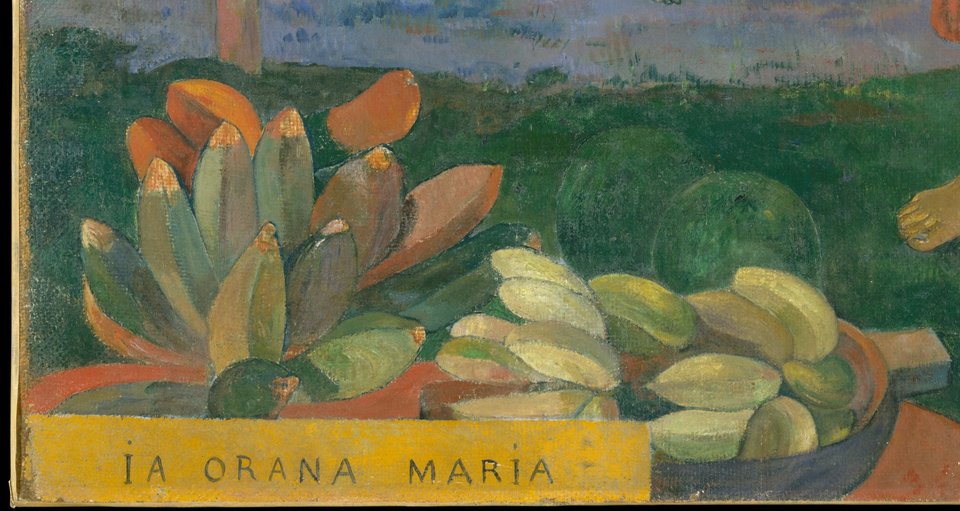
Detail of a painting: an upright bunch of green and orange-red bananas beside a bowl heaped with pale yellow-green bananas on green grass, above a yellow panel lettered IA ORANA MARIA
#C27834#757B5F#C9C486#C99A1A
PaintingIa Orana Maria (Hail Mary), Paul Gauguin (1891)

Gauguin’s first major Tahitian canvas sets an offering of fruit at the feet of a Tahitian Mary and Jesus; he wrote of “bananas on the left”. A banana researcher identified them as Fe’i bananas, which ripen bright orange. The orange fruit samples near #C27834, with green fruit at about #757B5F and paler bananas in the bowl near #C9C486. The yellowest thing here is not a banana but the painted name panel, about #C99A1A.

#C27834#757B5F#C9C486#C99A1A
Source: The Met
#738A5D#EED461#FBCF5B#A1692C
ChartBanana ripening guide, USDA (2001)

The U.S. Department of Agriculture’s visual aid paints one banana for each of the trade’s seven color index numbers. Stage 1 samples near #738A5D, stage 4, more yellow than green, near #EED461, and stage 6, all yellow, near #FBCF5B: warmer and softer than the web code. The brown flecks of stage 7, blurred in the scan, sample near #A1692C.

#738A5D#EED461#FBCF5B#A1692C
Source: USDA AMS

Palettes are sampled in-house.

Questions

What color is banana yellow?

A bright, warm yellow named after the peel of a ripe banana. The usual code is #FFE135 (RGB 255, 225, 53). No color standard defines it, and real banana peels run from green to yellow flecked with brown.

Is banana yellow the same as canary yellow?

No, but they are close. Banana yellow (#FFE135) is warmer and a little softer. Canary yellow (#FFEF00) is brighter and slightly greener.

Why do bananas turn from green to yellow?

As a banana ripens, the chlorophyll in its peel breaks down and the yellow carotenoid pigments show through. Later, brown spots appear as the peel ages.

What do the banana color stages mean?

The fruit trade grades bananas by peel color on a scale of 1 to 7. In the USDA’s guide, 1 is green, 4 is more yellow than green, 5 is yellow with green tips, 6 is yellow and 7 is yellow flecked with brown. Ripeners and stores use it to see how far along a box of bananas is.

Why are some ripe bananas still green?

Heat. Bananas that ripen above about 24 °C (75 °F) can soften and sweeten while the peel stays green, because the warmth holds back the breakdown of chlorophyll.

Which banana is banana yellow based on?

In practice, the Cavendish, the banana in almost every supermarket. It replaced the Gros Michel in the export trade after Panama disease wiped out Gros Michel plantations in the mid-1900s. Other bananas ripen to other colors, such as the orange Fe’i bananas of the Pacific.

Can you use white text on banana yellow?

No. White on #FFE135 has a contrast ratio of only about 1.3 to 1. Black text gives about 16 to 1.

What colors go with banana yellow?

Chocolate brown and navy give strong contrast, leaf green looks tropical, and soft gray calms it down.