Dandelion

A bright, sunny yellow named after the wildflower that turns lawns gold every spring.

Overview

Dandelion is a bright, sunny yellow with a faint green cast, named after the common wildflower. Its code, #F0E130, is red at 94%, green at 88% and blue at 19%. That puts it beside banana yellow and golden yellow, a shade greener and a touch darker than either.

The code is younger than it looks. On 19 December 2009 an anonymous editor added dandelion to Wikipedia’s list of colors, noting that it was a crayon color and setting the values “to closely match with the flower”. No color standard stands behind #F0E130, but it is now the code most color lists use, even though Wikipedia itself has since dropped it.

Older sources picture dandelion a little warmer. Maerz and Paul’s A Dictionary of Color (1930) has a dandelion sample that the 1955 ISCC-NBS dictionary files as brilliant yellow, #FADA5E. People in the xkcd color survey picked #FEDF08, and the University of Rochester, whose color has been dandelion yellow since 1893, uses #FFD82B. All three sit a few degrees toward orange from the web code. Real dandelion heads run from yellow to orange, and their main pigment, lutein epoxide, was first isolated from dandelions and is also called taraxanthin after them.

Dandelion is a very light color: white text on it reaches only about 1.35:1, so use black, navy or a deep green for text. It shines next to navy, as on the Rochester campus, looks fresh with grass green and white, and stands out against violet and deep blue across the color wheel. For paint or fabric, treat #F0E130 as a guide and check a real sample in your own light.

HEX#F0E130
RGBrgb(240, 225, 48)
HSLhsl(55, 86%, 56%)
HSV55°, 80%, 94%
CMYK0, 6, 80, 6
OKLCHoklch(89.4% 0.178 104.2)
Every code converts from the HEX value #F0E130. #F0E130 was added to Wikipedia’s list of colors on 19 December 2009 by an editor who set its values “to closely match with the flower”; no color standard defines it. The 1955 ISCC-NBS dictionary files Maerz and Paul’s dandelion (1930) as brilliant yellow, a warmer #FADA5E, and the xkcd color survey average for dandelion is #FEDF08. CMYK is a screen-based estimate; print results vary.
Dandelion color card, hex #F0E130: “Fine and dandelion”

Dandelion on the color map

The x-axis is hue, from orange on the left to green-yellow on the right. Every other dandelion sits to the left of the reference, toward orange. Inside the outline, the survey average is a little to the left and a hair lighter, the dictionary’s and Rochester’s values are further left at about the same lightness, and the 1950 dictionary’s deep dandelion is further left and lower, so darker. Hokusai’s printed flowers lie far to the left and below, outside the outline: a pale apricot. The outline is an approximate range, not a measured one.

Shades and tints

Tints with white

Shades with black

Tones with gray

Dandelion sits in the middle. Tints add white, shades add black and tones add gray, in 10% steps out from it. Tap any swatch to copy its code.

Light and dark dandelion

#F9F3AC
Pale dandelionMixed 60% with white. A soft, creamy yellow for backgrounds.
#FADA5E
Dictionary dandelionISCC-NBS brilliant yellow, where the 1955 dictionary files Maerz and Paul’s dandelion. Warmer and softer. See naples yellow
#F0E130
DandelionThe reference color.
#FEDF08
Survey dandelionWhat people in the xkcd survey called dandelion, on average: warmer and purer.
#FFD82B
Rochester dandelion yellowThe University of Rochester’s official dandelion yellow, from its brand guide.
#F3C300
Deep dandelionISCC-NBS vivid yellow, where the 1955 dictionary files the dandelion of Taylor, Knoche and Granville’s 1950 dictionary.
#787018
Dark dandelionMixed 50% with black. It turns olive, not gold. Dark enough for white text, or for text on white.

Colors that go with dandelion

Pairings that work in rooms, outfits and interfaces.

Dandelion and navy

The University of Rochester’s pairing: bright yellow on a deep navy. Bold and collegiate.

Spring lawn

Yellow flowers in green grass, with soft white and earthy brown. Fresh and natural.

Seed clock

The flower beside its silvery seed head. Soft, airy and calm.

Hokusai spring

From Hokusai’s print: blue-green leaves, pink clover and warm paper, with dandelion as the spark.

Dandelion and violet

Two spring wildflowers from opposite sides of the color wheel. Playful and lively.

Dandelion night

A dark theme with dandelion as the accent. It glows on near-black.

Color-wheel palettes

Pick a palette to see where its colors sit on the color wheel. The caret marks dandelion. Tap a band to copy its code.

Similar colors

Mustard yellow80%Gold85%Banana yellow89%Golden yellow89%Safety yellow82%Maize80%Dandelion

Lined up by hue around dandelion. Hover a color to see how similar it is.The bar under each name shows how similar it is. Similarity comes from the distance between the two colors in OKLab, a model of how we see color.

Dandelion vs banana yellow

Dandelion#F0E130 · hue 55°
  • A hair greener and darker
  • Named after a wildflower
  • Code chosen on Wikipedia in 2009
Banana yellow#FFE135 · hue 51°
  • A hair warmer and brighter
  • Named after the ripe banana peel
  • No standard defines it either

Meaning

  • Spring wildflower
  • Taraxanthin
  • University of Rochester
  • Make a wish

Dandelion yellow is the color of spring lawns: cheerful, common and hard to get rid of. Its meanings come from the flower: a pigment first found in its petals, a campus full of dandelions that gave the University of Rochester its color, and a seed head that Victorians read as a rustic oracle. Color research tests broad words such as yellow, not dandelion, so the claims here are about the flower and its history.

A pigment named after the dandelion

Lab analysis

In 1931 the chemists Richard Kuhn and Edgar Lederer isolated a new yellow pigment from dandelion flowers and called it taraxanthin, from the plant’s Latin name, Taraxacum. In 1968 it was shown to be lutein epoxide, a xanthophyll, and a 2006 analysis of dandelion petals found lutein epoxide to be their main carotenoid.1, 2, 3

Rochester’s school color since 1893

Historical record

The University of Rochester moved in 1861 to a campus whose open land was full of dandelions, and students took to wearing them in their lapels. Its Alumni Association chose dandelion yellow as the school color in 1893, and the trustees adopted it with navy in 1954. In 1923 a class song contest was won by “The Dandelion Yellow”.4, 5

A rustic oracle

Tradition

In the Victorian language of flowers, Kate Greenaway’s 1884 book gives the dandelion a single meaning: “Rustic oracle”. Its round seed heads are known as clocks, and blowing one away while making a wish is a Western tradition.6, 7

Named for its leaves

Word history

Dandelion comes through Anglo-French dent de lion, “lion’s tooth”, after the plant’s coarsely toothed leaves, not its flowers. English has used the word since the 14th century.8, 7

Sources (8)
  1. Kuhn, R., and Lederer, E. (1931). “Taraxanthin, ein neues Xanthophyll mit 4 Sauerstoffatomen” (Taraxanthin, a new xanthophyll with four oxygen atoms). Hoppe-Seyler’s Zeitschrift für physiologische Chemie, 200, 108–114.
  2. Egger, K. (1968). “Zur Identität von Taraxanthin und Luteinepoxid” (The identity of taraxanthin and lutein epoxide). Planta, 80, 65–76.
  3. Meléndez-Martínez, A. J., Britton, G., Vicario, I. M., and Heredia, F. J. (2006). “HPLC analysis of geometrical isomers of lutein epoxide isolated from dandelion (Taraxacum officinale F. Weber ex Wiggers)”. Phytochemistry, 67(8), 771–777.
  4. University of Rochester, “Color System”, University brand guidelines (brand.rochester.edu).
  5. University of Rochester, Rare Books, Special Collections and Preservation, “To the Dandelion Yellow We Will E’er Be True”, online exhibit.
  6. Greenaway, K. (1884). Language of Flowers. London: George Routledge and Sons. Internet Archive scan of the Smithsonian Libraries copy.
  7. Wikipedia, “Taraxacum”, etymology, description and cultural importance sections.
  8. Merriam-Webster, “dandelion”, definition, etymology and first known use.

History

The dandelion was a weed and a potherb for centuries before it was a color name. A college took its yellow in 1893, chemists named a pigment after it in 1931, and its web code is a 2009 match to the flower by a Wikipedia editor.

  1. 14th century

    The word dandelion is first recorded in English, as Middle English dendelyoun, from Anglo-French dent de lion, “lion’s tooth”.1

  2. 1861

    The University of Rochester moves to a new campus with one building and open “land full of dandelions”. Students start wearing dandelions in their lapels.2

  3. 1884

    Kate Greenaway’s Language of Flowers gives the dandelion the meaning “Rustic oracle”.3

  4. 1893

    The University of Rochester’s Alumni Association chooses dandelion yellow as the school color, believed to honor the dandelions on its Prince Street campus. The Board of Trustees adopts it officially, with navy, in 1954.4

  5. 1930

    Maerz and Paul’s A Dictionary of Color prints a dandelion sample (plate 9, L4) and gives 1919 as an early use of dandelion as a color name.5

  6. 1931

    Richard Kuhn and Edgar Lederer isolate a new yellow pigment from dandelion flowers and name it taraxanthin. In 1968 it is shown to be lutein epoxide.6, 7

  7. 1955

    The ISCC-NBS dictionary of color names files Maerz and Paul’s dandelion as brilliant yellow, #FADA5E, and the dandelion in Taylor, Knoche and Granville’s 1950 dictionary as vivid yellow, #F3C300.8

  8. 19 December 2009

    An anonymous editor adds dandelion to Wikipedia’s list of colors as #F0E130, noting it was a crayon color and setting the values “to closely match with the flower”.9

  9. 2010

    In the xkcd color survey, the color people called dandelion averages #FEDF08, warmer and purer than the web code.10

  10. 2017

    A major crayon maker retires its dandelion crayon, sold since 1990, to make room for a new blue: the first color it had ever taken out of its 24-count box. The crayon returns as a limited edition in 2025.5

Sources (10)
  1. Merriam-Webster, “dandelion”, definition, etymology and first known use.
  2. University of Rochester, Rare Books, Special Collections and Preservation, “To the Dandelion Yellow We Will E’er Be True”, online exhibit.
  3. Greenaway, K. (1884). Language of Flowers. London: George Routledge and Sons. Internet Archive scan of the Smithsonian Libraries copy.
  4. University of Rochester, “Color System”, University brand guidelines (brand.rochester.edu).
  5. Wikipedia, “Dandelion (crayon color)”, citing Maerz, A., and Paul, M. R. (1930), A Dictionary of Color, p. 194 and plate 9, sample L4, and news reports of the retirement and return.
  6. Kuhn, R., and Lederer, E. (1931). “Taraxanthin, ein neues Xanthophyll mit 4 Sauerstoffatomen” (Taraxanthin, a new xanthophyll with four oxygen atoms). Hoppe-Seyler’s Zeitschrift für physiologische Chemie, 200, 108–114.
  7. Egger, K. (1968). “Zur Identität von Taraxanthin und Luteinepoxid” (The identity of taraxanthin and lutein epoxide). Planta, 80, 65–76.
  8. Jaffer, A. “Maerz and Paul color names” and “Taylor, Knoche and Granville color names”, with ISCC-NBS centroids from “Color-Name Dictionaries”, MIT CSAIL.
  9. Wikipedia, “List of colors: A–F”, edit of 19 December 2009, which adds “Dandelion” as #F0E130 with the summary that its coordinates were changed “to closely match with the flower”.
  10. Munroe, R. “Color survey results”, xkcd blog (3 May 2010), and the survey’s color table (CC0).

Dandelion in use

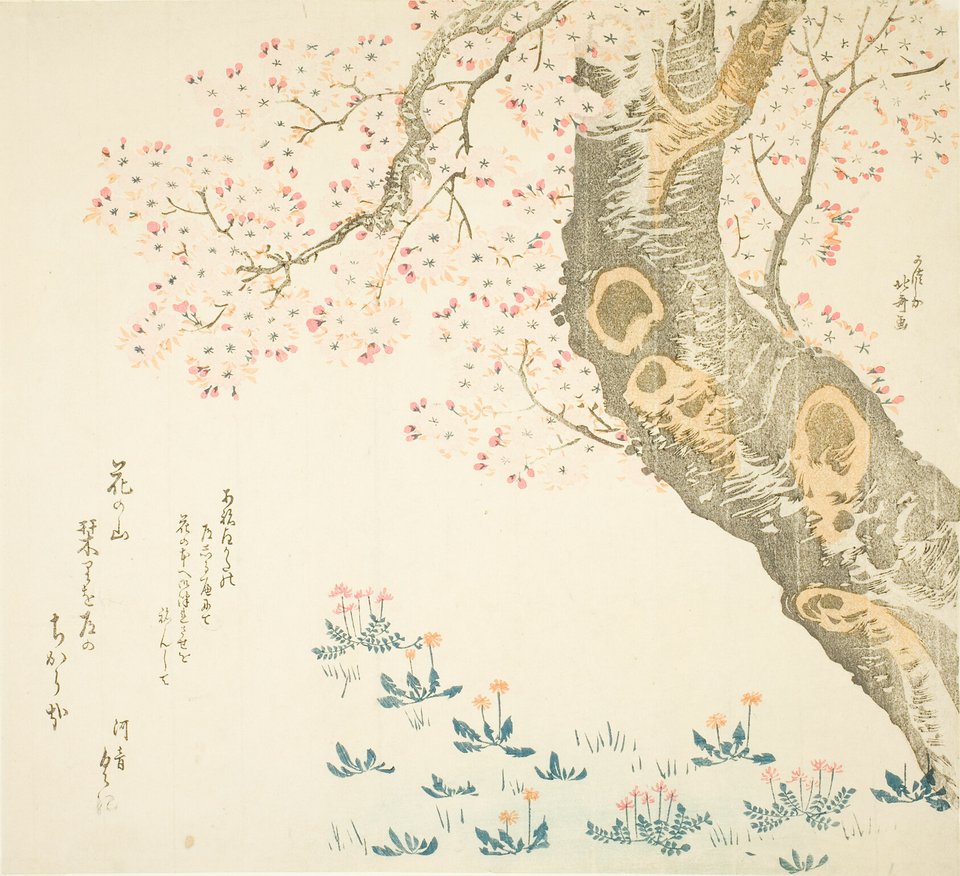
Japanese woodblock print of a gnarled gray cherry trunk with pink blossoms on spreading branches, above grass dotted with small orange-yellow dandelions, pink clover and blue-green leaves, with lines of calligraphy at the left
#F4BD88#678783#EBAA8E#F6EAD3
PrintDandelions and clovers beneath cherry tree, Katsushika Hokusai (about 1807)

A surimono, a privately issued print with poems, now at the Art Institute of Chicago: small dandelions and pink clover in the grass under a flowering cherry. In the museum’s photo the dandelion heads read as a pale apricot, about #F4BD88, beside blue-green leaves near #678783, far from the lemony web code. Old prints fade, so the photo can’t show how bright the yellow once was.

#F4BD88#678783#EBAA8E#F6EAD3
Source: Art Institute of Chicago

Logos belong to their owners and are shown unaltered, only to show where each palette comes from. Palettes are sampled in-house.

Questions

What color is dandelion?

A bright, sunny yellow with a faint green cast, named after the wildflower. The code used here is #F0E130 (RGB 240, 225, 48).

Where does the code #F0E130 come from?

An editor added it to Wikipedia’s list of colors in December 2009, choosing values to match the flower. No color standard defines it, but most color lists now use it.

What does the color dictionary say dandelion looks like?

Maerz and Paul’s Dictionary of Color (1930) has a dandelion sample that the 1955 ISCC-NBS dictionary files as brilliant yellow, about #FADA5E: a little warmer and softer than the web code. A 1950 dictionary put dandelion at a deeper vivid yellow, about #F3C300.

Why are dandelions yellow?

Their petals hold yellow carotenoid pigments, mainly lutein epoxide. Chemists first isolated it from dandelion flowers in 1931 and named it taraxanthin, after the plant’s Latin name, Taraxacum.

Is dandelion the same as banana yellow?

Nearly. Banana yellow (#FFE135) and golden yellow (#FFDF00) are a touch warmer and brighter. Side by side, dandelion looks a hair greener and darker than both.

Why is dandelion yellow a University of Rochester color?

Its Alumni Association chose dandelion yellow in 1893, believed to honor the dandelions that grew on the university’s Prince Street campus. The trustees adopted it officially, with navy, in 1954. The university’s brand guide sets it at #FFD82B.

Is there a dandelion crayon?

There was one from 1990. In 2017 its maker retired it to make room for a new blue, the first color it had ever taken out of its 24-count box, and it came back as a limited edition in 2025.

What colors go with dandelion yellow?

Navy, as at the University of Rochester; grass green and white for a spring look; soft grays like a seed head; and violet or deep blue for strong contrast. Use dark text on it, never white.