Chrome yellow

A hot orange yellow named after a cheap, bright and toxic lead pigment.

Overview

Chrome yellow is a strong yellow that leans toward orange. Its usual web code is #FFA700: full red, about two-thirds green and no blue. That puts it a little more orange than amber.

The name comes from a pigment, lead chromate. In 1797 the French chemist Louis Nicolas Vauquelin found a new metal in a red mineral from Siberia and called it chrome, from the Greek for color. Within a few years lead chromate was a painters’ yellow. It was cheap, opaque and strong, and makers could vary it from a pale greenish primrose to a deep orange.

Van Gogh painted the chairs and bed in his bedroom at Arles chrome yellow, and the first American school bus color was called national school bus chrome. But the pigment holds lead and hexavalent chromium, both toxic, and some kinds darken in light. Today the European Union classes it as a carcinogen, and lead chromate still turns up as an illegal colorant in turmeric.

On screens, #FFA700 is a light, loud color. Black text on it reads easily (contrast about 10.8:1), but white text fails (about 1.9:1). Pair it with deep blues, charcoal or black.

HEX#FFA700
RGBrgb(255, 167, 0)
HSLhsl(39, 100%, 50%)
HSV39°, 100%, 100%
CMYK0, 35, 100, 0
OKLCHoklch(79.6% 0.171 71.7)
Every code converts from the HEX value #FFA700. No color standard defines chrome yellow. #FFA700 is the code most color lists use; Wikipedia takes it from a color-conversion website. The pigment itself came in many shades, and the ISCC-NBS dictionary files Maerz and Paul’s light and deep chrome yellows under strong yellow and moderate orange yellow (Jaffer’s table). CMYK is a screen-based estimate; print results vary.
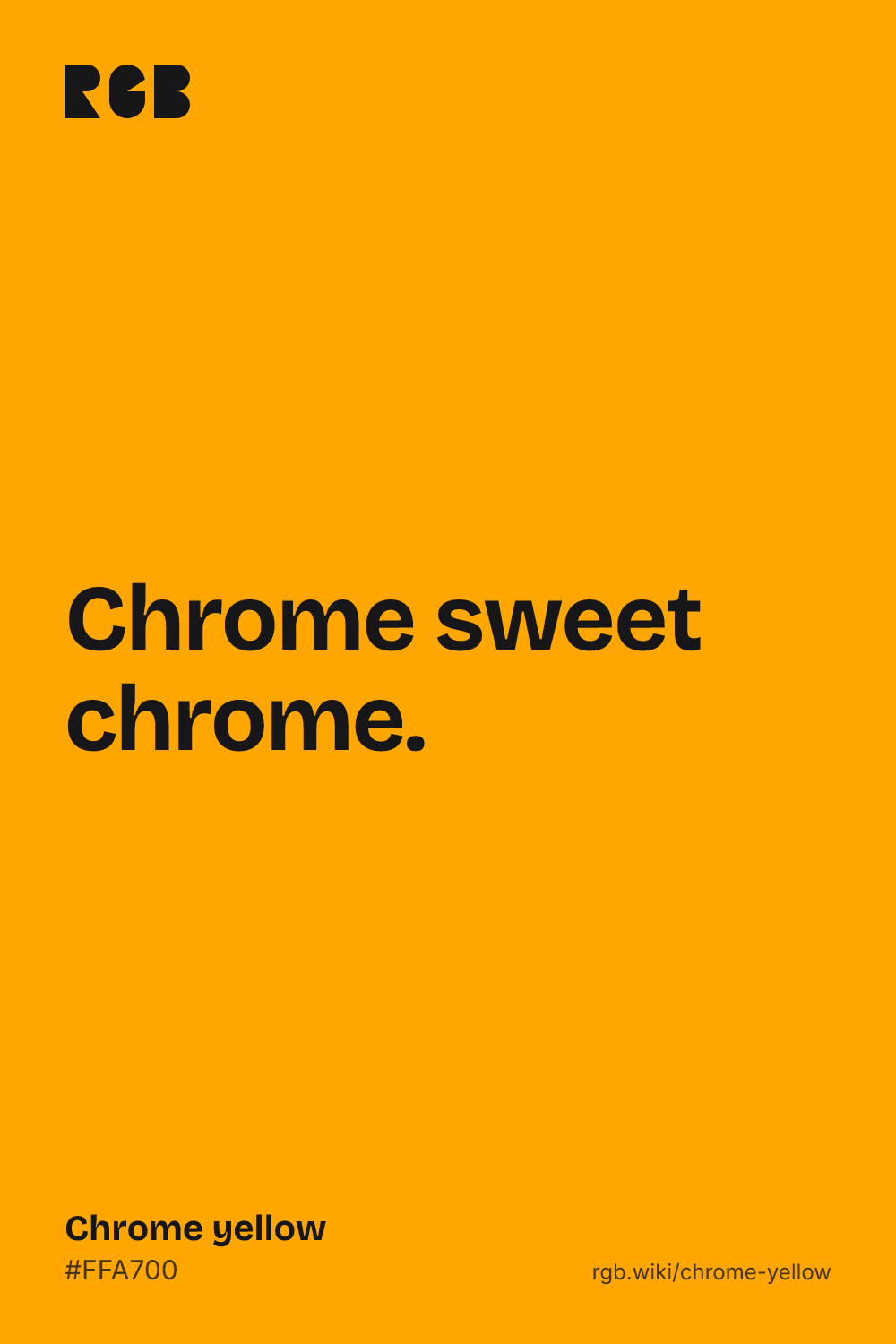
Chrome yellow color card, hex #FFA700: “Chrome sweet chrome”

Chrome yellow on the color map

The school bus match sits almost on top of the web code. The dictionary’s strong orange yellow and Maerz and Paul’s deep chrome yellow sit just right of it and a little lower: slightly yellower and duller. Light chrome yellow sits further right, at the edge of the outline. Gauguin’s lemon-colored paper falls outside to the upper right, and Van Gogh’s bed, as photographed today, falls far below: much darker. The outline is an approximate range, not a measured one.

Shades and tints

Tints with white

Shades with black

Tones with gray

Chrome yellow sits in the middle. Tints add white, shades add black and tones add gray, in 10% steps out from it. Tap any swatch to copy its code.

Light and dark chrome yellow

#FFE5B2
Pale chrome yellowChrome yellow with a lot of white (70%). A soft, warm cream.
#D4AF37
Light chrome yellowMaerz and Paul’s light chrome yellow, as placed by ISCC-NBS. “Light” chromes were the greener, lemon-leaning kinds.
#FFA700
Chrome yellowThe reference color.
#E3A857
Deep chrome yellowMaerz and Paul’s deep chrome yellow, as placed by ISCC-NBS. A softer, more orange yellow.
#F38400
Chrome orangeBasic lead chromate, made in alkaline solution. Maerz and Paul’s sample falls partly in ISCC-NBS vivid orange.
#B27500
Dark chrome yellowChrome yellow with 30% black. Close to how Van Gogh’s chrome yellow bed looks today.

Colors that go with chrome yellow

Pairings that work in rooms, outfits and interfaces.

Chrome yellow and Prussian blue

The 19th-century pair: mixed together, they made the paint called chrome green.

School bus

Chrome yellow with black lettering, chosen for legibility at dusk.

Van Gogh’s bedroom

The colors he listed for his room in Arles: chrome yellow, pale lilac, blood red and pale lemon green.

Chrome yellow and charcoal

Modern and graphic. The yellow does the shouting.

Chrome yellow and cream

Warm and sunny. Good for food and packaging.

Cobalt, chrome and vermilion

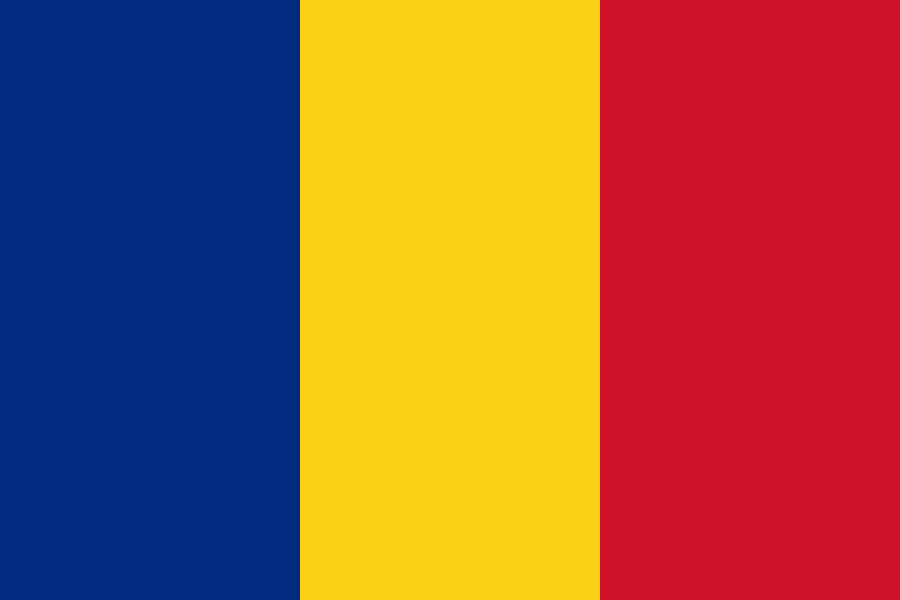
The three pigment names Romania’s 1994 flag law gave its colors.

Color-wheel palettes

Pick a palette to see where its colors sit on the color wheel. The caret marks chrome yellow. Tap a band to copy its code.

Similar colors

Sandy brown73%Mango94%Yellow-orange87%Chrome yellowMarigold81%Honey83%Orpiment84%

Lined up by hue around chrome yellow. Hover a color to see how similar it is.The bar under each name shows how similar it is. Similarity comes from the distance between the two colors in OKLab, a model of how we see color.

Chrome yellow vs amber

Chrome yellow#FFA700 · hue 39°
  • A little more orange
  • Named after a lead pigment
  • Its code has no standard
Amber#FFBF00 · hue 45°
  • A little more yellow and lighter
  • Named after fossil resin
  • Its code is halfway between yellow and orange

Meaning

  • Lead chromate
  • Van Gogh’s yellows
  • School buses
  • Toxic

Chrome yellow means a pigment first, and a color second. Lead chromate gave 19th-century painters a cheap, strong yellow, and later gave roads, taxis and school buses their warning color. It also carries lead and hexavalent chromium, and some kinds darken with light. The claims below are about the pigment; none of them tests how the color on a screen makes people feel.

Lead and hexavalent chromium

Regulation

Chrome yellow is lead chromate, often mixed with lead sulfate. The European Union classes lead chromate and lead sulfochromate yellow as carcinogenic and toxic for reproduction, and since 21 May 2015 they may only be used in the EU with an authorization. A pigment handbook notes that it dissolves very poorly, so a dry paint film poses little risk; breathing or swallowing the dust is the danger.1, 2
Some kinds darken in light

Lab studies

Chrome yellow was never fully lightfast. Studies of Van Gogh’s paint found that light turns some of the chromium at the surface into chromium(III) compounds, which darken the paint. The sulfur-rich kind is most at risk, and in the Sunflowers at the Van Gogh Museum it makes up more than half of the chrome yellow areas.2, 3, 4

The yellow of school buses and taxis

Documented use

The color picked for American school buses in 1939 was named national school bus chrome. A chemist writing for the Royal Society of Chemistry says chrome yellow was chosen for contrast and visibility at dusk, and has since largely given way to organic pigments. A 1986 handbook noted that taxi yellow and highway paints were mostly chrome yellow too.2, 5, 6

Still found in turmeric

Field studies

Lead chromate is sometimes added to turmeric to brighten its yellow. Researchers have named it a primary source of lead exposure in Bangladesh, and a 2024 survey found turmeric with lead levels suggesting lead chromate in cities in India and Pakistan. In Bangladesh, enforcement and public warnings cut market samples with detectable lead from 47% in 2019 to none in 2021.7, 8

Sources (8)
  1. European Commission, Regulation (EU) No 125/2012, amending Annex XIV to REACH, entries 10 and 11.
  2. Hermann Kühn and Mary Curran, “Chrome Yellow and Other Chromate Pigments,” in Artists’ Pigments, vol. 1, ed. Robert L. Feller (1986), pp. 187–217, PDF from the National Gallery of Art.
  3. Letizia Monico et al., “Degradation process of lead chromate in paintings by Vincent van Gogh … 1. Artificially aged model samples”, Analytical Chemistry 83 (2011), and part 2 in the same issue; and Monico et al., “Evidence for degradation of the chrome yellows in Van Gogh’s Sunflowers”, Angewandte Chemie (2015).
  4. Frederik Vanmeert et al., “Chemical mapping by macroscopic X-ray powder diffraction of Van Gogh’s Sunflowers”, Angewandte Chemie (2018).
  5. James Barron, “Why the School Bus Never Comes in Red or Green”, The New York Times, 19 February 2013.
  6. Royal Society of Chemistry, “Chromium”, Periodic Table, history and the Chemistry in its element podcast transcript (Christopher Blanford).
  7. Jenna E. Forsyth et al., “Evidence of turmeric adulteration with lead chromate across South Asia”, Science of the Total Environment (2024).
  8. Jenna E. Forsyth et al., “Food safety policy enforcement and associated actions reduce lead chromate adulteration in turmeric across Bangladesh”, Environmental Research (2023).

History

Chrome yellow is a child of the chemistry boom around 1800. It went from a rare Siberian mineral to a painters’ staple in about ten years, and from there onto roads and buses, before its toxicity caught up with it.

  1. 1760s

    The geologist Johann Gottlob Lehmann describes a red lead ore from Siberia. It is called Siberian red lead, and later crocoite. It is natural lead chromate.1, 2

  2. 1797

    Louis Nicolas Vauquelin reports a new metal in the mineral. Friends suggest the name chrome, from the Greek word for color, because its compounds are so colorful.1, 2

  3. 1804–1809

    Lead chromate is recognized as a pigment. In 1809 Vauquelin shows how the acidity of the solution changes its shade, from lemon yellow to the orange and red of basic lead chromate.1

  4. Before 1810

    The earliest known use in a painting: a portrait of a gentleman by Sir Thomas Lawrence, now in the Bavarian State Painting Collections in Munich.1

  5. 1815

    On 18 September the Danish painter C. W. Eckersberg buys an ounce of “jaune de crome” in Rome, the earliest known mention of the pigment in writing on artists’ materials.1

  6. 1818

    First recorded use of chrome yellow as a color name in English. A French dictionary of the same year notes that Russian painters pay dearly for lead chromate to color icons.1, 3

  7. 1888

    In Arles, Van Gogh paints his bedroom and tells his brother Theo that he painted “the chairs and the bed chrome yellow.”4

  8. 1939

    A conference led by Frank W. Cyr of Teachers College, Columbia University, sets the first national school bus standards. The color it picks is named national school bus chrome.5

  9. 2011

    Chemists show that darkened chrome yellow, in aged samples and in two paintings by Van Gogh, has been partly reduced to chromium(III) compounds.6

  10. 2012

    The European Union adds lead chromate and lead sulfochromate yellow to the list of substances that need an authorization. The deadline for unauthorized use is 21 May 2015.7

Sources (7)
  1. Hermann Kühn and Mary Curran, “Chrome Yellow and Other Chromate Pigments,” in Artists’ Pigments, vol. 1, ed. Robert L. Feller (1986), pp. 187–217, PDF from the National Gallery of Art.
  2. Royal Society of Chemistry, “Chromium”, Periodic Table, history and podcast transcript.
  3. Wikipedia, “Chrome yellow”, citing Maerz and Paul’s A Dictionary of Color (1930). Merriam-Webster dates the pigment name to 1819.
  4. Art Institute of Chicago, Vincent van Gogh, The Bedroom (1926.417), collection record quoting the letter.
  5. James Barron, “Why the School Bus Never Comes in Red or Green”, The New York Times, 19 February 2013.
  6. Letizia Monico et al., parts 1 and 2 of “Degradation process of lead chromate in paintings by Vincent van Gogh,” Analytical Chemistry 83 (2011).
  7. European Commission, Regulation (EU) No 125/2012 of 14 February 2012, amending Annex XIV to REACH.

Chrome yellow in use

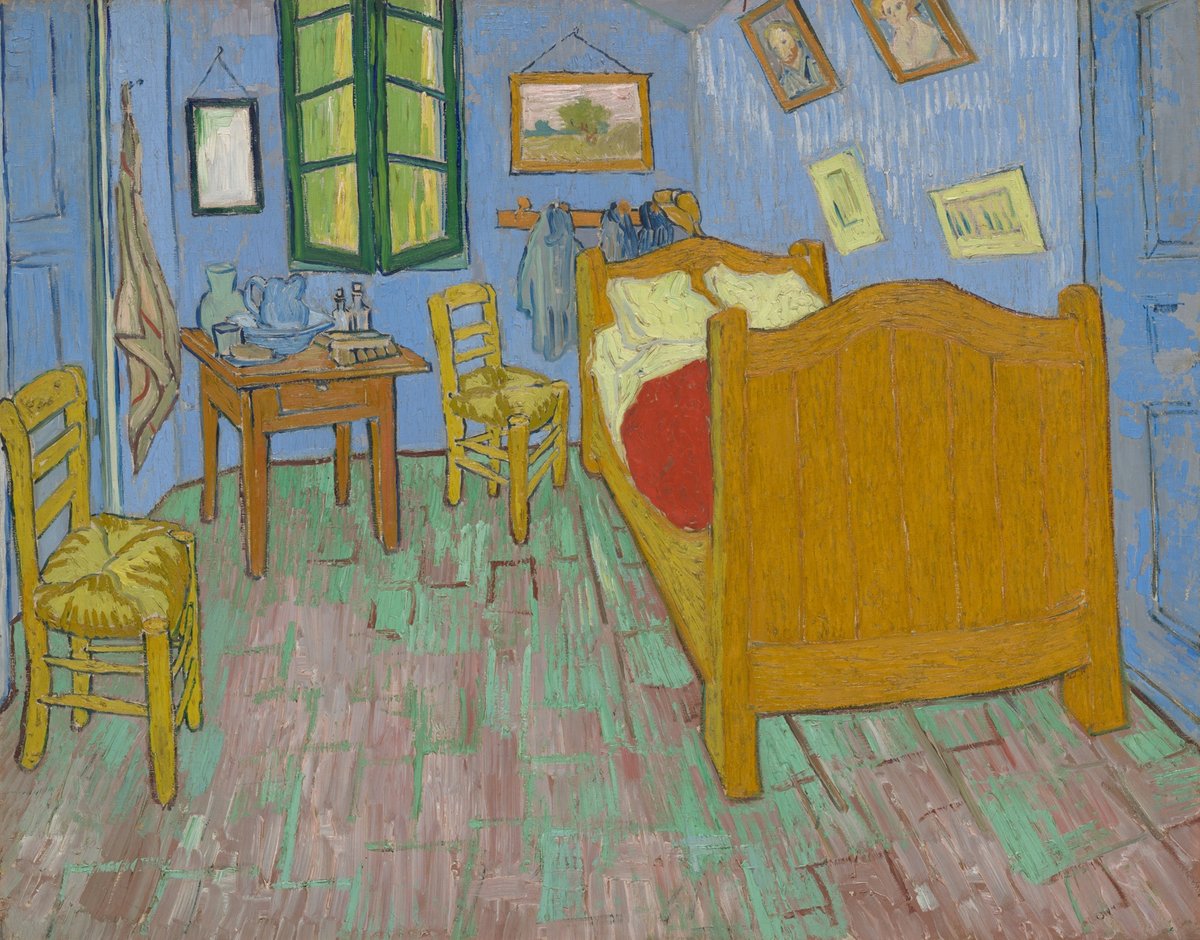
Van Gogh’s painting of his small bedroom in Arles: a golden wooden bed with a red cover, two yellow straw chairs, a small table and framed pictures on blue walls, with a green window
#AB7909#A9A051#7A93AF#A83E28
PaintingThe Bedroom, Vincent van Gogh (1889)

Van Gogh wrote that he painted “the chairs and the bed chrome yellow.” In this second version of the room, at the Art Institute of Chicago, the bed now reads as a dull golden brown, about #AB7909, and the chairs as an olive yellow near #A9A051, far from the bright web code. Lab studies show some of his chrome yellows darken in light, though this canvas was not among those tested.

#AB7909#A9A051#7A93AF#A83E28
Source: Art Institute of Chicago
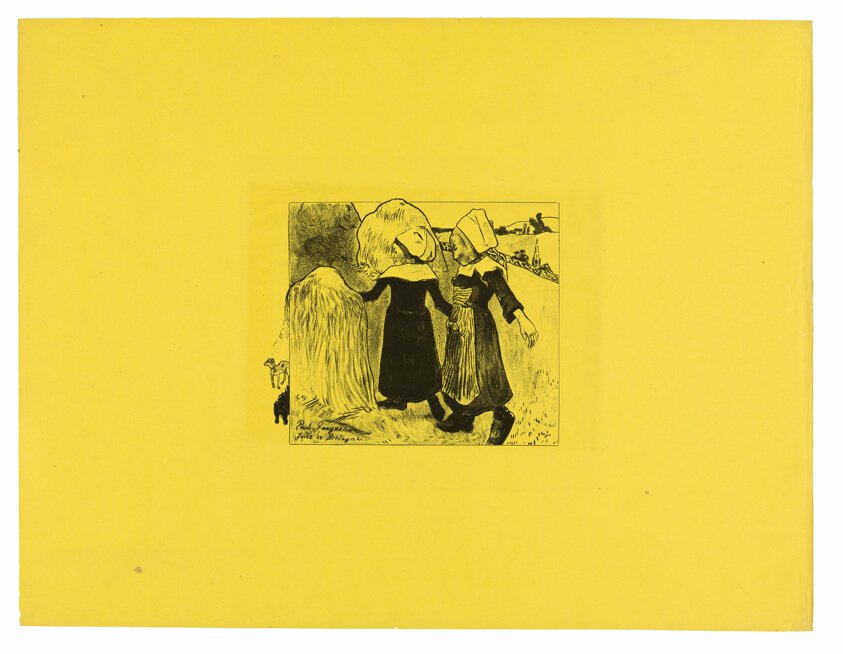
A black-ink print of two Breton girls in white caps and dark dresses dancing beside haystacks, printed in the middle of a large lemon-yellow sheet
#F3D747#322C0F#AF9C35
PrintJoys of Brittany, Paul Gauguin (1889)

A print from Gauguin’s Volpini Suite, printed in black on a large yellow sheet. The Art Institute of Chicago describes the paper as chrome yellow. It samples as a clear lemon yellow, about #F3D747: a reminder that “chrome yellow” once covered a whole range, from lemon to orange.

#F3D747#322C0F#AF9C35
Source: Art Institute of Chicago

Palettes are sampled in-house.

Questions

What color is chrome yellow?

A strong yellow that leans toward orange. The usual web code is #FFA700 (RGB 255, 167, 0): full red, about two-thirds green and no blue.

Why is it called chrome yellow?

It is named after its pigment, lead chromate. The metal chromium was named in 1797 from the Greek word for color, because its compounds come in so many colors.

Is chrome yellow toxic?

The pigment is. It contains lead and hexavalent chromium, and the European Union classes it as carcinogenic and toxic for reproduction. The color on a screen is just a code.

Did Van Gogh use chrome yellow?

Yes, often. He described the chairs and bed in his bedroom paintings as chrome yellow, and chemists have found several kinds of chrome yellow in his Sunflowers. Some of these kinds darken with light, so researchers have called for careful monitoring of the painting.

Are school buses chrome yellow?

They started that way. The color chosen in 1939 was named national school bus chrome, and lead chromate was the pigment behind it. The color is now called national school bus yellow, and most buses use other pigments.

What is the difference between chrome yellow and amber?

They are close. Chrome yellow (#FFA700) is a little more orange; amber (#FFBF00) is a little more yellow and lighter. Chrome yellow is named after a lead pigment, amber after fossil tree resin.

What replaced chrome yellow?

Artists moved to cadmium yellow once chrome yellow’s darkening became known. In industry, organic yellow pigments have largely taken its place, though lead chromate is still used in some industrial and marine paints.