A flower name from Persian
Word historyJasmine came into English in the 1560s, through Middle French jasmin from Arabic yāsamīn, which comes from Persian. Merriam-Webster also lists “a light yellow” as one of the word’s senses.1
A soft, warm light yellow named after a flower that is usually white.
Jasmine is a soft, warm light yellow named after the jasmine flower. Its usual code is #F8DE7E: red near full strength, green at 87% and blue at 49%. On the color map it sits almost on top of buff and flax, a touch lighter and warmer than both.
The name is a surprise for a yellow, because the jasmines grown for their scent, such as common jasmine and Arabian jasmine, have white flowers. A few species are yellow, among them winter jasmine, which flowers on bare stems in late winter and has no scent. In the American South, the “yellow jessamine” is not a jasmine at all but a poisonous vine, South Carolina’s state flower. Wikipedia’s article says the color shows the yellowish base of the white flower, but cites no source for that.
As a color name, jasmine comes from the American textile trade of the 1920s. Maerz and Paul’s A Dictionary of Color (1930) dates it to 1925 and lists it among the names on the Standard Color Card of America, the color card the Textile Color Card Association issued to the trade. The 1955 ISCC-NBS dictionary files that card’s jasmine as light yellow, and #F8DE7E is the center of the group. That is why some lists call this same code light yellow, though it is much deeper than the CSS keyword lightyellow.
On screens, #F8DE7E is a background or highlight color: black text on it is easy to read, white text is not. It looks at home with sage and gray-green, as in William Morris’s 1872 Jasmine wallpaper, and it warms up navy, terracotta and soft lavender.
| HEX | #F8DE7E | |
|---|---|---|
| RGB | rgb(248, 222, 126) | |
| HSL | hsl(47, 90%, 73%) | |
| HSV | 47°, 49%, 97% | |
| CMYK | 0, 10, 49, 3 | |
| OKLCH | oklch(90.2% 0.120 94.6) |
Brilliant yellow sits just below the reference at almost the same hue, a little darker and stronger, inside the outline. The cream of Morris’s jasmine flowers sits above it, also at almost the same hue: lighter and much less saturated, nearer an off-white than a yellow. The outline is an approximate range, not a measured one.
Tints with white
Shades with black
Tones with gray
Pairings that work in rooms, outfits and interfaces.
Sage and gray-green with cream, the colors of William Morris’s 1872 Jasmine wallpaper, with jasmine as the light.
A classic light and dark pair. Jasmine warms up deep blue without shouting.
Yellow flowers on bare green stems against gray winter light. Quiet and fresh.
Pale tea gold, white porcelain and a soft green. Calm and clean.
Jasmine against a sunbaked wall. Warm and Mediterranean.
Near-opposites on the color wheel, soft enough for spring.
Pick a palette to see where its colors sit on the color wheel. The caret marks jasmine. Tap a band to copy its code.
Lined up by hue around jasmine. Hover a color to see how similar it is.The bar under each name shows how similar it is. Similarity comes from the distance between the two colors in OKLab, a model of how we see color.
Jasmine’s meanings come from the flower, not from the color. The name is Persian, the best-known jasmines are white, and the yellow ones bloom in winter. The Victorian language of flowers read yellow jasmine as grace and elegance, and South Carolina chose a yellow vine called jessamine, not a true jasmine, as its state flower. The color itself began as a textile trade name in the 1920s. Research on color and emotion tests broad words such as yellow, not jasmine.
Jasmine came into English in the 1560s, through Middle French jasmin from Arabic yāsamīn, which comes from Persian. Merriam-Webster also lists “a light yellow” as one of the word’s senses.1
Common jasmine, the climber grown for its scent and its perfume oil, has white flowers. The yellow species are the exceptions: winter jasmine, brought to Britain from China by Robert Fortune in 1844, flowers bright yellow on bare stems in late winter, and it has no scent.2, 3, 4
Kate Greenaway’s Language of Flowers (1884) gives yellow jasmine the meaning “grace and elegance”. Plain jasmine stands for amiability, Indian jasmine for “I attach myself to you”, and Carolina jasmine for separation.5
South Carolina adopted the yellow jessamine as its state flower on February 1, 1924, saying its flower “suggests the pureness of gold”. Despite the name it is Gelsemium sempervirens, from another plant family, and every part of it is poisonous.6, 7
Jasmine was a flower name for more than three centuries before the American textile trade made it a color in the 1920s. The color dictionaries then pinned it to light yellow, even though the flower most people picture is white.
First known use of “jasmine” in English, for the plant. The word came through Middle French jasmin from Arabic yāsamīn, from Persian.1
The plant hunter Robert Fortune introduces winter jasmine, a hardy yellow-flowered species, from China to Britain.2
William Morris designs Jasmine, a wallpaper of cream-white jasmine flowers twining over gray-green leaves, block-printed for Morris and Company by Jeffrey and Co.3
Kate Greenaway’s Language of Flowers gives yellow jasmine the meaning “grace and elegance”, and white jasmine “amiability”.4
The Textile Color Card Association of the United States is founded and begins issuing its Standard Color Card of America, which becomes the accepted color authority of the American textile trade.5
On February 1, South Carolina adopts the yellow jessamine, a poisonous vine that is not a true jasmine, as its state flower.6
First recorded use of jasmine as a color name, according to Maerz and Paul’s dictionary.5
Maerz and Paul’s A Dictionary of Color prints a jasmine sample (plate 9, K4). It prints the name in capitals, its mark for names in constant daily use, and lists jasmine among the names of the eighth edition of the Standard Color Card of America.5
The ISCC-NBS dictionary of color names files the color card’s jasmine as light yellow. It files Maerz and Paul’s jasmine, and Taylor, Knoche and Granville’s jasmine yellow from 1950, across light yellow and brilliant yellow. The center of light yellow, #F8DE7E, is the code used today.7, 8, 9
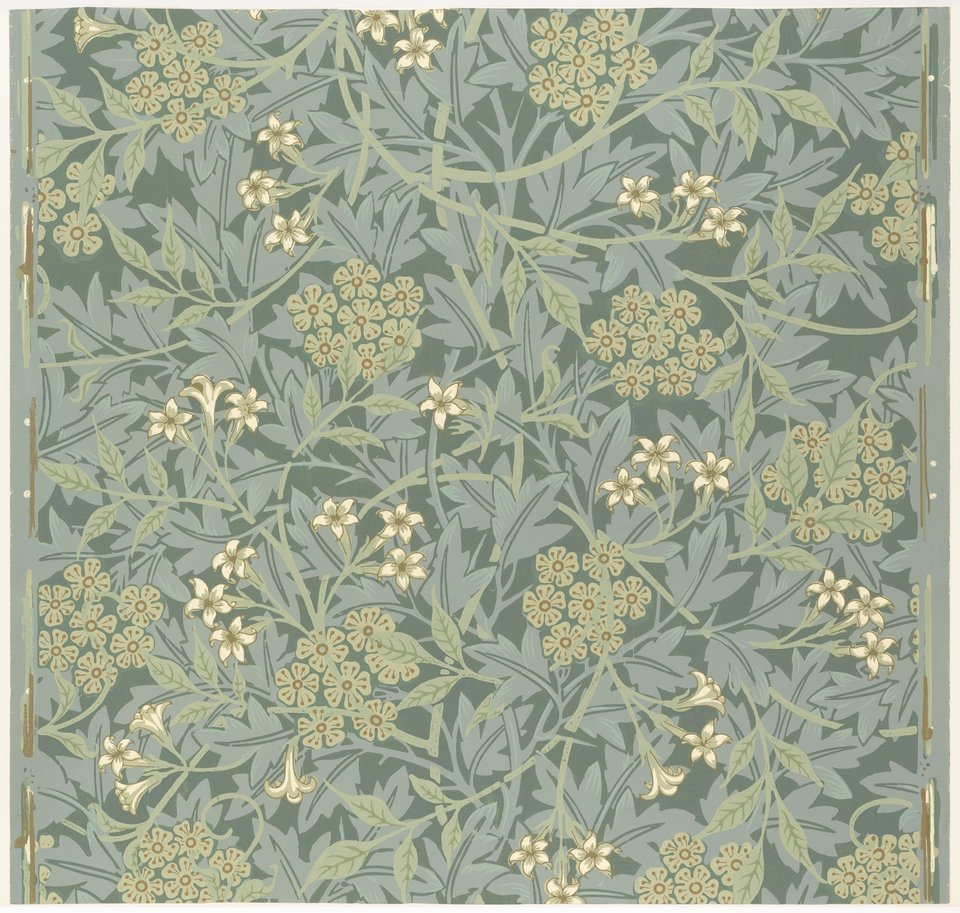
Morris drew his jasmine white: cream star flowers, about #EFE6C6 in the museum’s photo, twining over gray-green leaves near #A3ADA0 on a darker green ground, #778574. The round clusters of pale olive flowers, about #CCC69C, are the nearest thing to a yellow, and even they are far grayer than the jasmine code.
Sampled from the Metropolitan Museum of Art’s photograph (23.163.4j), released as CC0 (public domain). The picture shown is a detail. The flowers and clusters were measured on their own, apart from the leaves. Colors in a photo shift with the lighting, so read the codes as close, not exact.
Palettes are sampled in-house.
A soft, warm light yellow named after the jasmine flower. The usual code is #F8DE7E (RGB 248, 222, 126), the center of the ISCC-NBS light yellow group, where the color dictionaries file jasmine.
The best-known jasmines, such as common jasmine and Arabian jasmine, are white, but a few species, like winter jasmine, are yellow, and so is the yellow jessamine of the American South. The sources that record the color name do not say which flower it was meant to match.
Maerz and Paul’s A Dictionary of Color (1930) dates it to 1925. By 1930 it was one of the names on the Standard Color Card of America, the color card of the American textile trade.
In the ISCC-NBS system, yes: #F8DE7E is the center of its light yellow group, where jasmine is filed. The CSS keyword lightyellow is a different color, #FFFFE0, an almost white cream.
On screen they are nearly the same. Jasmine (#F8DE7E) is a touch lighter and warmer, and buff (#F0DC82) is a shade softer. Jasmine is named after a flower, buff after buffalo leather.
Winter jasmine and primrose jasmine are true jasmines with yellow flowers. The yellow jessamine or Carolina jasmine of the southern United States is not: it is Gelsemium sempervirens, a poisonous vine and the state flower of South Carolina.
No. White on #F8DE7E has a contrast ratio of only 1.3:1. Black text gives 15.7:1, and a dark olive brown such as #635932 also works for headings.
Sage and gray-green, as in William Morris’s Jasmine wallpaper, navy for contrast, terracotta for warmth, and soft lavender, its near-opposite on the color wheel.