A vivid reddish orange named after a fruit that is not always orange.
Overview
Pumpkin is a vivid reddish orange. Its code is #FF7518: red at full strength, green a little under half and almost no blue. Merriam-Webster lists the color as a sense of the word in its own right: “a strong orange color”.
The fruit is less uniform than the code. A pumpkin can come from any of five Cucurbita species, and Merriam-Webster says it is typically orange “but may be another color”; growers sell white pumpkins, tan ones and a deep red-orange kind. Inside, the flesh runs from pale yellow to deep orange, colored by carotenoids, and much of the canned pumpkin used in pies comes from tan-skinned Cucurbita moschata.
The orange shell became a Halloween face in America. Faces were carved into hollowed turnips in an older custom, and immigrants to America, finding turnips scarce, most likely used the native pumpkins instead.
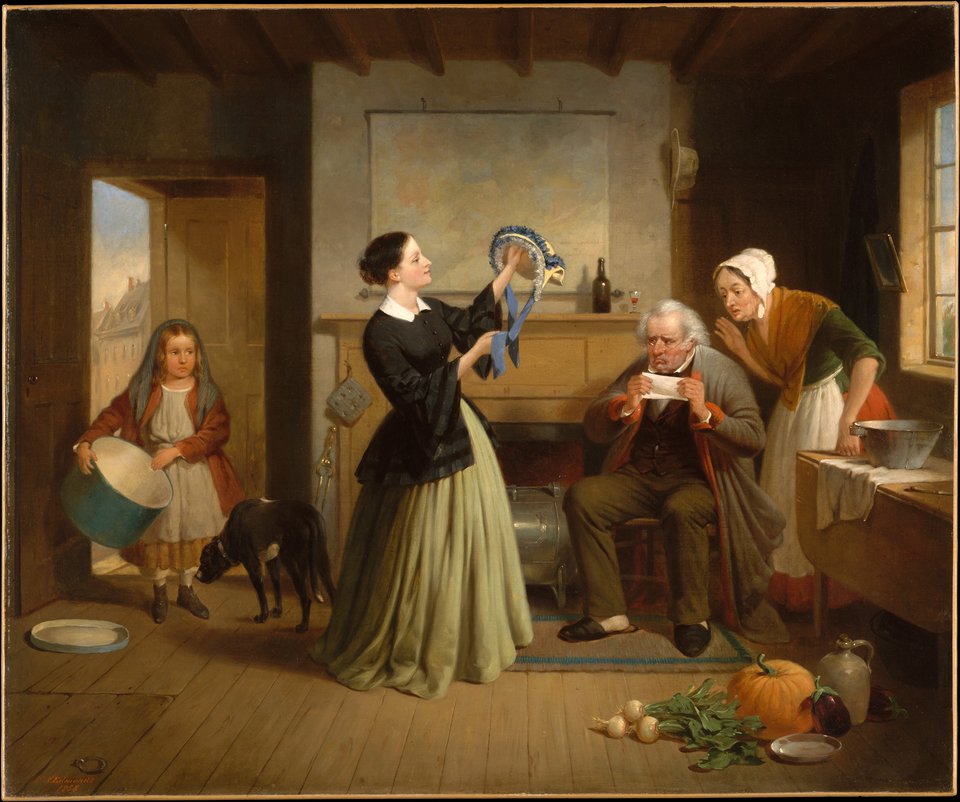
On screens, pumpkin needs dark text: white text on it reaches only about 2.7:1. Real pumpkins in paint are darker and browner. The one in an American painting of 1858, shown below, reads about #A15C17, and the xkcd color survey’s pumpkin is #E17701.
HEX
#FF7518
RGB
rgb(255, 117, 24)
HSL
hsl(24, 100%, 55%)
HSV
24°, 91%, 100%
CMYK
0, 54, 91, 0
OKLCH
oklch(71.6% 0.191 47.1)
Every code converts from the HEX value #FF7518. #FF7518 is the code Wikipedia gives for pumpkin, saying it matches the pumpkin swatch in Maerz and Paul’s A Dictionary of Color (1930, plate 10). The 1955 ISCC-NBS dictionary files that same Maerz and Paul pumpkin as a strong orange, whose center is #ED872D, and Plochere’s pumpkin as a moderate orange, #D99058 (Jaffer’s tables). No standard defines #FF7518; it is a brighter, redder stand-in that color lists repeat. CMYK is a screen-based estimate; print results vary.
Pumpkin on the color map
LighterDarker
The x-axis is hue, from red on the left to yellow on the right. Both dictionary pumpkins sit to the right of the reference at the same lightness, yellower and much softer, and the survey’s pumpkin orange lies just between. The survey’s plain pumpkin is a little darker and yellower. The ISCC-NBS vivid reddish orange falls to the left and lower, and the painted pumpkin far below, a dark, brownish orange well outside the outline. The outline is an approximate range, not a measured one.
Shades and tints
Tintswith white
Shadeswith black
Toneswith gray
Pumpkin sits in the middle. Tints add white, shades add black and tones add gray, in 10% steps out from it. Tap any swatch to copy its code.
Light and dark pumpkin
#FFAC74
Light pumpkinMixed 40% with white. A soft apricot tint.
#ED872D
Dictionary pumpkinThe ISCC-NBS strong orange, where the 1955 dictionary files Maerz and Paul’s pumpkin. Softer and yellower.
Lined up by hue around pumpkin. Hover a color to see how similar it is.The bar under each name shows how similar it is. Similarity comes from the distance between the two colors in OKLab, a model of how we see color.
Pumpkin vs neon orange
Pumpkin#FF7518 · hue 24°
Yellower and a little lighter
Named after a fruit
No standard code
Neon orange#FF5F1F · hue 17°
Redder and hotter
Named after a fluorescent glow
Meant to look like it shines
Meaning
Five species
Carotenes
The tan can
Jack-o’-lanterns
Pumpkin is a color named after a fruit that is not always orange. Its meanings come from the fruit and from Halloween, not from studies of the color: research on color and feeling tests broad words like orange, not pumpkin.
Not one plant, not one color
Well established
Merriam-Webster defines a pumpkin as the fruit of cultivars of five Cucurbita species, typically round and orange but sometimes another color, with pale, fibrous flesh. The University of Illinois Extension lists white pumpkins such as Casper, Lumina and Snowball, and Rouge vif d’Étampes, a deep red-orange pumpkin that was the model for Cinderella’s carriage pumpkin.1, 2
The orange is carotene
Measured
The yellow and orange of pumpkin flesh come from carotenoid pigments. USDA data for raw pumpkin give about 4 mg of alpha-carotene, 3.1 mg of beta-carotene and 1.5 mg of lutein and zeaxanthin per 100 g. In one study of Cucurbita pepo, a single gene raised the carotenoid content of the flesh up to fivefold.3, 4
The flesh deepens in storage
One study
A 2014 study of butternut squash, a winter squash of the same genus, found that the flesh turned from light to dark orange over three months of storage, as carotenoids kept building up for the first two.5
The pumpkin in the can is tan
Extension guidance
The Illinois Extension notes that processing pumpkins, the kind widely used for commercially canned pumpkin, are Cucurbita moschata with tan skin, a long way from the bright orange of the code.2
From turnip to pumpkin
Likely, not certain
Merriam-Webster gives one theory for the jack-o’-lantern: an older practice of hollowing out turnips or other roots, carving grotesque faces in them and lighting them, carried on at All Hallows’ Eve. Immigrants likely brought the custom to America and, finding turnips scarce, used native pumpkins instead. The name itself first meant a man with a lantern, or a night watchman, in 17th-century Britain.6
U.S. Department of Agriculture, FoodData Central, “Pumpkin, raw” (SR Legacy 168448).
Tadmor, Y., Paris, H. S., Meir, A., Schaffer, A. A. & Lewinsohn, E. (2005). Dual role of the pigmentation gene B in affecting carotenoid and vitamin E content in squash (Cucurbita pepo) mesocarp. Journal of Agricultural and Food Chemistry, 53(25), 9759–9763. doi:10.1021/jf0520591.
Zhang, M. K., Zhang, M. P., Mazourek, M., Tadmor, Y. & Li, L. (2014). Regulatory control of carotenoid accumulation in winter squash during storage. Planta, 240(5), 1063–1074. doi:10.1007/s00425-014-2147-6.
The pumpkin is an American plant with a borrowed Greek name, and it took the job of an older European lantern.
About 7,900 years ago
Cucurbita pepo, the species of many pumpkins, is the earliest domesticated plant in Coxcatlan Cave, in Mexico’s Tehuacán Valley.1
1600s
In Britain, a jack-o’-lantern is a man carrying a lantern, or a night watchman.2
1664
The first known use of pumpkin, an alteration of earlier pumpion, which goes back through French and Latin to Greek pepōn, “ripened”.3
1837
Nathaniel Hawthorne’s Twice-Told Tales has the first known use of jack-o’-lantern for a carved, lit lantern, in a line about a gem that would “gleam through the holes”.2, 4
1858
Francis William Edmonds paints The New Bonnet, with a pumpkin on a farmhouse floor.5
1922
The first recorded use of pumpkin as a color name in English, according to Maerz and Paul’s A Dictionary of Color.6
1955
The ISCC-NBS dictionary of color names files Maerz and Paul’s pumpkin as a strong orange and Plochere’s as a moderate orange.7
2005
Researchers show that one gene, B, can raise the carotenoid content of Cucurbita pepo flesh up to fivefold.8
2014
A study of butternut squash finds the flesh darkens from light to dark orange in storage.9
Sources (9)
Smith, B. D. (2005). Reassessing Coxcatlan Cave and the early history of domesticated plants in Mesoamerica. Proceedings of the National Academy of Sciences, 102(27), 9438–9445. doi:10.1073/pnas.0502847102.
Tadmor, Y., Paris, H. S., Meir, A., Schaffer, A. A. & Lewinsohn, E. (2005). Dual role of the pigmentation gene B in affecting carotenoid and vitamin E content in squash (Cucurbita pepo) mesocarp. Journal of Agricultural and Food Chemistry, 53(25), 9759–9763. doi:10.1021/jf0520591.
Zhang, M. K., Zhang, M. P., Mazourek, M., Tadmor, Y. & Li, L. (2014). Regulatory control of carotenoid accumulation in winter squash during storage. Planta, 240(5), 1063–1074. doi:10.1007/s00425-014-2147-6.
PaintingThe New Bonnet by Francis William Edmonds (1858)
In this American farmhouse scene a young woman holds up a new bonnet while an old man studies a slip of paper. A pumpkin sits on the floor in the lower right, beside white root vegetables, an eggplant and a stoneware jug. In the photo its lit side reads about #BD7529 and its body about #A15C17: a deep, brownish orange far from the bright web code.
#BD7529#A15C17#83420C#5B441A
Source: The Met
Source
Sampled from the pumpkin and its stem in The Metropolitan Museum of Art’s photograph (1975.27.1), Open Access, CC0. Colors in a photo shift with the lighting and the varnish, so read the codes as close, not exact.
#F06C00
BrandingSainsbury’s
The British grocer’s orange, #F06C00, the fill of its logo, is a little darker than this page’s code, with almost the same hue.
#F06C00
Source: Sainsbury’s logo file
Source
The orange is the fill in the Sainsbury’s logo file served on the website of its owner, J Sainsbury plc. The logo shown is that file.
Logos belong to their owners and are shown unaltered, only to show where each palette comes from. Palettes are sampled in-house.
Questions
What color is pumpkin?
A vivid reddish orange: #FF7518 (RGB 255, 117, 24). Merriam-Webster defines pumpkin as “a strong orange color”.
Is pumpkin the same as safety orange?
Almost. Safety orange (#FF7900) is a hair yellower, and side by side the two are hard to tell apart. Neon orange (#FF5F1F) is clearly redder.
Are all pumpkins orange?
No. Pumpkins come from five species of Cucurbita and include white kinds such as Casper and Lumina, tan processing pumpkins used for canned pumpkin, and the deep red-orange Rouge vif d’Étampes.
What makes pumpkin flesh orange?
Carotenoids. Raw pumpkin has about 4 mg of alpha-carotene, 3.1 mg of beta-carotene and 1.5 mg of lutein and zeaxanthin per 100 g, according to USDA data.
Why do people carve pumpkins at Halloween?
Faces were carved into hollowed turnips and other roots in an older custom. Immigrants likely brought it to America and, finding turnips scarce, used native pumpkins instead.
Where does the word pumpkin come from?
From earlier pumpion, which goes back through French and Latin to Greek pepōn, “ripened”. Merriam-Webster dates pumpkin to 1664.
What colors go with pumpkin?
Near-black and deep purple for Halloween, navy for a calm contrast, and creams and browns for a pie or harvest look. Use dark text on it: white text is hard to read on pumpkin.