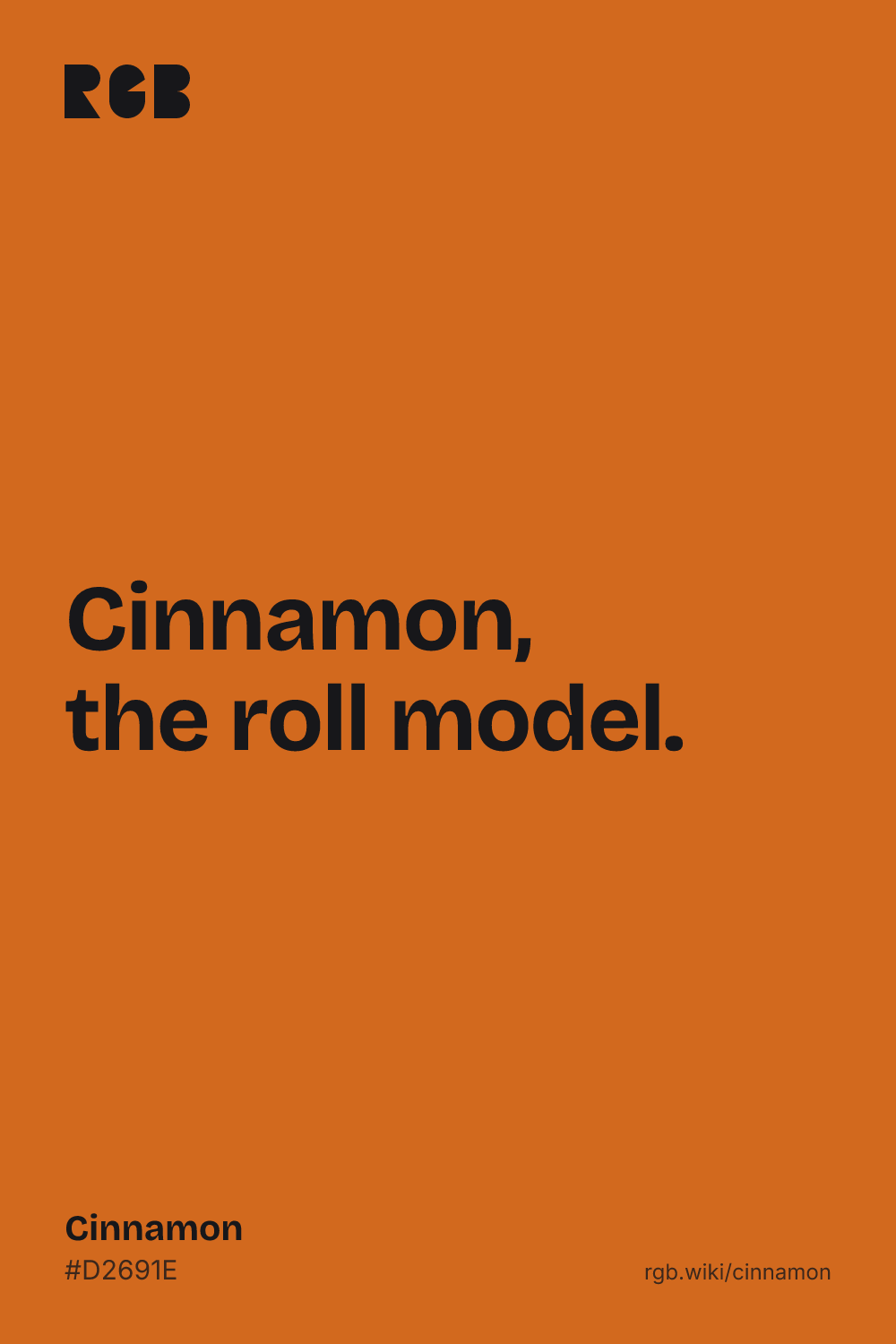
Cinnamon is a warm orange brown. The code used here, #D2691E, has red at 82%, green at 41% and blue at 12%, which gives a bright, toasty orange with a brown edge. It is exactly the CSS color keyword chocolate, so a stylesheet that asks for chocolate paints this shade.
That keyword is why the code has two names. Chocolate joined the X Window System’s color list in 1989, picked by eye on a computer monitor, and from there it passed into SVG and CSS. It is far too orange for real chocolate, so many color lists call it cinnamon instead. For the brown of chocolate itself, see chocolate, #7B3F00.
The real spice is browner and softer. Merriam-Webster calls ground cinnamon tan to dark brown, and the color cinnamon a light yellowish brown. The 1955 ISCC-NBS dictionary files the cinnamon of Maerz and Paul’s A Dictionary of Color (1930) as a light brown or a light yellowish brown, close to camel. In the xkcd color survey, people’s average cinnamon was #AC4F06, darker and redder than the code.
In animals, cinnamon names a light reddish brown coat. Cinnamon cats and cinnamon black bears both owe their color to changes in the same pigment gene. On screen, the code works best as an accent. Black text reads better on it than white, at 5.8 to 1 against 3.6 to 1, and it pairs well with cream, denim blue, sage and deep brown.